Category: brain science

  • New Brain-Computer Interface Restores Speech for ALS Patients: Raises Privacy, Ethical, and Psychological Concerns

    New Brain-Computer Interface Restores Speech for ALS Patients: Raises Privacy, Ethical, and Psychological Concerns

    Brain science has achieved a seminal breakthrough with a new brain-computer interface (BCI). Researchers at UC Davis Health have recently developed this technology to restore speech for ALS (amyotrophic lateral sclerosis) patients, translating brain signals into speech with up to 97% accuracy. After implanting sensors in the brain of a man with severe ALS-related speech loss, researchers enabled him to articulate his intended speech within minutes of activating the system.

    However, despite its revolutionary impact on assistive technology for severe speech impairments, this innovation requires a thorough analysis of the associated privacy, ethical and psychological challenges.

    Historical Context of Brain-Computer Interfaces

    To fully understand the ramifications of this new brain-computer interface, it’s important to consider its historical background. The progression of BCIs began in the 1960s and 1970s with trailblazing experiments on primates. Early research aimed to create a direct link between the brain and external devices.

    Although initial experiments faced challenges with inconsistent responses from primates, improvements in electrode technology and signal recording techniques led to greater accuracy.

    The 1980s and 1990s marked a transition from experimental setups to practical applications. Technologies such as functional magnetic resonance imaging (fMRI) emerged and allowed for more detailed studies of brain activity, including the mapping of specific brain regions responsible for cognitive processes like memory, decision-making, and emotional responses, as well as the real-time observation of brain functions during various tasks and stimuli.

    Meanwhile, the development of the P300 speller in 1988, which utilized Event-Related Potentials (ERPs) to facilitate communication, represented a major milestone by demonstrating the feasibility of non-invasive BCIs for direct communication.

    The P300 speller achieved this by interpreting brain signals associated with visual stimuli and enabling individuals with severe motor disabilities to spell words and communicate effectively through thought alone. This period laid the groundwork for the more sophisticated BCIs of today.

    As we entered the 21st century, focus transitioned to advancing algorithms and increasing accuracy. The BrainGate project exemplified these advances by using invasive BCIs to translate neural activity into control commands for external devices; for instance, a person with tetraplegia was able to control a computer cursor and communicate by typing, achieving a communication rate of approximately 15 words per minute.

    This project demonstrated not only the technical progress of BCIs but also their significant potential to restore communication and independence for individuals with severe motor impairments.

    New Technological Breakthroughs and Capabilities

    Speech BCIs, most notably demonstrated by the device used by the late Professor Stephen Hawking and recognized for its tinny, robotic voice, illustrate a common characteristic of these technologies; however, the UC Davis Health BCI marks a significant advancement in this field.

    The system implanted into Casey Harrell’s brain records signals from the precentral gyrus, a region responsible for speech coordination. This data is then decoded in real time to produce text, which the system vocalizes using a synthesized version of Harrell’s pre-ALS voice.
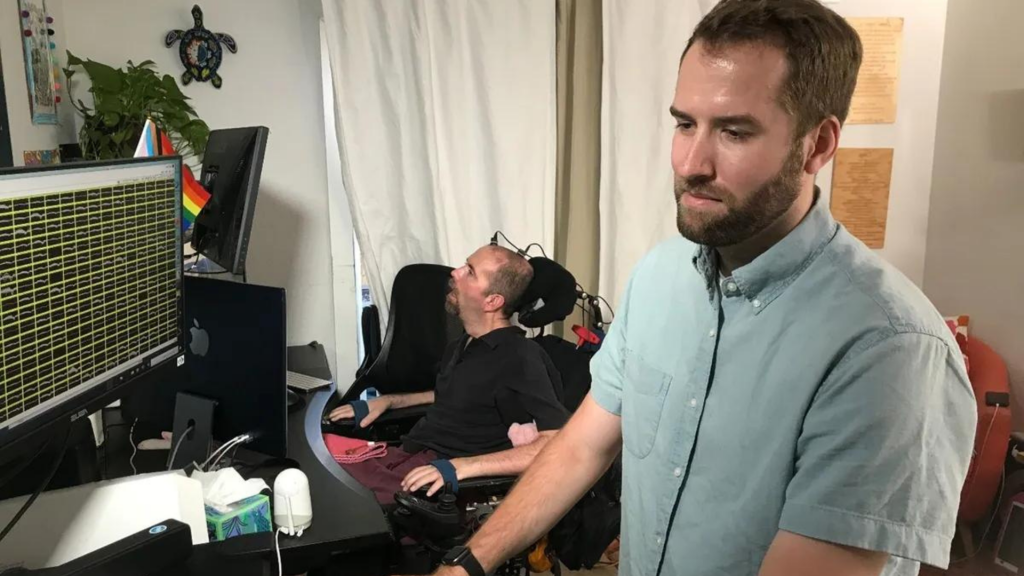
    Brain-Computer Interface Restores Speech for ALS Patients
    Lead study author Dr Nicholas Card readies the BCI system for Harrell. Image credit: UC Regents

    In initial tests, the system achieved 99.6% word accuracy with a limited vocabulary, and 90.2% accuracy with a more extensive lexicon of 125,000 words.

    This technology has enabled Casey Harrell, a 45-year-old man with ALS who was previously unable to communicate effectively, to converse naturally and reconnect with his social circle. Over 248 hours of use, the system has maintained a high accuracy rate, which shows its reliability and potential for widespread application.

    For patients like Harrell, BCIs have emerged as a life-changing prospect for restoring their ability to interact with others through speech; as Harrell himself said in a statement, ‘Not being able to communicate is so frustrating and demoralizing. It’s like you’re trapped.’

    Privacy Concerns

    Along with the sophisticated brain-reading technological achievement of this BCI, it raises a number of privacy concerns. The device’s ability to decode brain signals involves intimate and potentially sensitive information. The continuous monitoring and interpretation of neural activity necessitate stringent safeguards to protect users’ privacy.

    Unauthorized access or misuse of such data could lead to serious breaches of personal information, including the potential for manipulation or exploitation, for instance, compromising financial stability through fraudulent transactions, identity theft involving sensitive personal details, or targeted phishing attacks leveraging compromised data.

    Moreover, the long-term storage of brain data introduces significant risks related to data security, including potential unauthorized access or breaches that could expose sensitive neurological information, increased vulnerability to evolving cyber threats, and the challenge of maintaining the confidentiality and integrity of personal data over extended periods.

    Implementing robust encryption and access control measures, such as AES-256 encryption and multi-factor authentication, is crucial for protecting users from privacy violations.

    As BCIs become more prevalent, addressing these privacy concerns will be essential to preserve trust and ensure the ethical use of the technology; otherwise, misuse of sensitive information could undermine public confidence and hinder the technology’s widespread adoption.

    Ethical Considerations

    The ethical implications of BCIs, particularly in the context of ALS, are multifaceted. One of the primary concerns is the potential influence of BCIs on end-of-life decisions. For patients with ALS like Harrell, who often face difficult choices regarding life-sustaining treatments, the ability to communicate more effectively might alter their perspective on these decisions, as indicated by in-depth studies.

    A BCI could enhance a patient’s quality of life by restoring their ability to express needs and desires.

    However, it also raises ethical questions about the impact of such technologies on the decision-making process regarding life support and euthanasia. The availability of advanced communication tools may influence patients’ decisions on whether to continue or discontinue treatment, which could complicate the already challenging ethical framework.

    There are concerns, in addition, about the pressure that may be exerted on patients to make decisions based on their perceived quality of life. Family members and healthcare providers might inadvertently influence these decisions, as they often prioritize immediate concerns over long-term outcomes, which could overshadow the need for careful consideration and ethical guidelines in the use of BCIs.

    A recent prospective study found that 30% of patients with ALS reported feeling pressured by their families to pursue BCIs quickly, even when they were not fully informed of the risks and ethical implications; this exemplifies the urgent need for comprehensive patient education and informed consent processes in the adoption of advanced medical technologies.

    Psychological Impact

    BCI use for communication also has significant psychological effects. While the restoration of speech can be immensely empowering and life-affirming, it can also lead to emotional challenges.

    The transition from a state of impaired communication to one where speech is facilitated by technology may bring about complex feelings of dependence or frustration, mainly due to the cognitive dissonance experienced when users reconcile their reliance on assistive devices with their desire for autonomy and the emotional impact of the technological constraints on their self-perception and social interactions.

    For patients like Harrell, the joy of regaining the ability to communicate is tempered by the emotional impact of living with a severe disability. The psychological adjustment to the new communication method, coupled with the challenges of daily living with ALS, can affect mental well-being.

    According to a review in Amyotrophic Lateral Sclerosis and Frontotemporal Degeneration, individuals with ALS often experience heightened levels of anxiety and depression, with a prevalence rate of up to 40% for depression and 50% for anxiety, partly due to the significant impact of losing traditional communication abilities and adapting to assistive technologies.

    Ongoing psychological support such as cognitive-behavioral therapy and psychosocial counseling, and counseling by trained mental health professionals, are essential to address these issues and ensure that patients can adapt positively to their new communication abilities.

  • The Human Brain is a Device That Predicts the Future

    Introduction

    The human brain constantly tries to predict the future. It does this by analyzing past data, trying to find patterns and trends, and making calculations based on those experiences.

    When it finds a pattern, it uses that information to predict what will happen next.

    By understanding how the brain makes these predictions, we can learn to control our own thoughts and actions.

    The more data the brain has to work with, the more accurate its predictions will be. The average adult human brain has the ability to store the equivalent of 2.5 million gigabytes data.

    The central human organ can also make predictions based on its own internal state. For example, if it is hungry, the brain will predict that food will be available soon.

    Without the ability to predict the future, we would be constantly surprised by the things that happen around us. We would not be able to plan for the future or make decisions that would help us avoid danger.

    A number of studies that have looked at the relationship between memory and prediction have supported the idea that our ability to predict future events has connections to our memory of past events. One such study found that people with better memories were better at predicting future events than those with poorer memories.

    Another study found that people with higher levels of anxiety were more likely to make inaccurate predictions about future events. This finding is consistent with the idea that people with higher levels of anxiety are more likely to remember negative events from the past, and thus be more pessimistic in their predictions about the future.

    All in all, there are three types of predictions made by our brain:

    Conscious Prediction

    Our ability to reason affects the ability to predict the future. The reasoning is the process of using logical thinking to come to a conclusion. When we reason, we use the information in our memory to come to a conclusion about what will happen in a new situation.

    These predictions are based on the data that your brain has stored in the past. Every experience you have ever had is stored in your brain and used to make predictions about the future.

    The accuracy of the brain’s predictions also depends on the quality of the data it has to work with. If the data is noisy or incomplete, the brain’s predictions will be less accurate.

    Studies have found that individual guesses by humans achieve 58.3% accuracy, better than random, but worse than machines which display 71.6% accuracy.

    When we are driving, we are constantly making predictions about what other drivers will do. We need to be able to anticipate their actions in order to stay safe. This is a conscious prediction made by our brain.

    Sub-conscious predictions

    Some of these predictions are made unconsciously, based on our previous experiences and the patterns we’ve learned but are not aware of.

    For example, when we see a friend walking towards us, we automatically expect that they will stop and talk to us. We don’t need to think about it, we just know that’s what will happen.

    This is a subconscious prediction.

    Subconsciously analyze it to make predictions about the future. This is how we are able to make decisions without even realizing it.

    Our brain is able to pick up on subtle cues in a person’s appearance that we are not even aware of. We can size up a person’s trustworthiness, intelligence, and even sexual desirability without their, or our own knowledge.

    Unconscious prediction

    However, there is another type of prediction made by our brain that is not based on past experiences. This prediction is based on what our brain believes will happen in the future simply because it does.

    We don’t need to have experienced this before, our brain just makes an educated guess based on the laws of physics.

    These predictions help us to interact with the world around us and make split-second decisions. They allow us to catch a ball, avoid a collision and make everyday activities possible.

    We are not consciously aware of these predictions, they happen automatically and outside of our conscious control.

    Scientists believe that these predictions are made by our unconscious mind using a combination of past experiences, sensory information, and natural knowledge of the laws of physics.

    Bottom Line

    The ability to predict the future by analyzing the past is an incredible power that we all have. It is something that we should be grateful for. It is one of the things that makes us human.

  • A way to “Detect Speech” from People’s brain

    A way to “Detect Speech” from People’s brain

    We don’t just make any old random noise when we talk; we’re thinking about our words, and that makes us able to speak fluently.

    Meta’s new AI can scan a person’s brainwaves to “hear” what someone else is saying to them. In other words, it can tell which words you hear by reading your brainwaves. This is not the first time this concept has gotten the spotlight. In 2019, American scientists developed artificial intelligence that could accurately read brain signals and translate them into speech.

    Talking about the Meta’s recent AI, it can decode speech from noninvasive recordings of brain activity. Neuroscientists have always dreamt of decoding speech from someone’s brain for a long time, but invasive methods were needed to achieve this.

    The specialty of the new technique, according to the researchers, is that it is non-invasive, which means that researchers do not have to implant… electrodes, in anyone’s brain.

    Noninvasive techniques such as electroencephalograms, EEG, and magnetoencephalography, MEG, can scan the brain from the outside and watch activity without any surgery, but the problem is that they are too noisy.

    In order to address this problem, researchers turned to machine learning algorithms to help “clean up” the noise. They used the model wave2vec 2.0.

    Brain-wave-reading AIs seem to be an exciting new technology that can be used to help people with speech problems, like people who can’t speak, and those who have had strokes or other issues that cause speech difficulties.

    But so far, only lab-based research has been done on brainwave-reading AI. They haven’t been available for use in the real world yet.

    The future of AIs is will not be limited to acting as a cure for people with speech problems. With advancements in technology, it’s not farfetched to think that advanced forms of AI could be used as ways for computers to communicate with each other.

    As seen by scientists and AI researchers, brain communication will help humans work better together with artificial intelligence and machines. The day is coming, some say it has already.

    When we think about the future of technologies like Meta’s Brain-wave-reading AIs, we shouldn’t forget about the potential for misuse, should we?

    In the future, will these kinds of hacks also be possible against our brains? Could criminals hack into our minds to get information from us?

    Well, we do have trouble with people who spread false news stories on social media to stir up anger. But still, that’s too much for the assumption.

    In fact, it’s too childish to stop the progress of something new just because it has some potential for misuse. Let’s keep in mind that people can also use every single piece of technology for evil purposes, and they still do it.

    Meta’s new steps are looking promising, and we are on the correct path among few, at least, till now.

  • Scientists Now Identify How the Brain Links Memories

    Scientists Now Identify How the Brain Links Memories

    Our brain usually stored memories into groups so that the recollection of one significant memory triggers the recall of others connected by time and they rarely record single memories. But, as we age our brains gradually lose this ability to link related memories.

    In such, UCLA researchers have recently discovered a key molecular mechanism behind memory linking. They’ve also identified a way to restore this brain function in middle-aged mice – and an FDA-approved drug that achieves the same thing.

    The findings, which are published in Nature, suggest a new method for strengthening human memory in middle age and a possible early intervention for dementia.

    Alcino Silva, an author of the research and a distinguished professor of neurobiology and psychiatry at the David Geffen School of Medicine at UCLA said that our memories are a huge part of who we are and the ability to link related experiences teaches how to stay safe and operate successfully in the world.

    According to the researchers, cells are studded with receptors. To enter a cell, a molecule must latch onto its matching receptor, which operates like a doorknob to provide access inside.

    The UCLA team said they focused on a gene called CCR5 that encodes the CCR5 receptor – the same one that HIV hitches a ride on to infect the brain cell and cause memory loss in AIDS patients.

    Silva’s lab demonstrated in earlier research that CCR5 expression reduced memory recall.

    In the ongoing study, Silva and his workmates discovered a central mechanism underlying mice’s ability to link their memories of two different cages. A tiny microscope opened a window into the mice’s brain. This enabled the scientists to observe neurons firing and creating new memories.

    The memory linking was interfered by boosting CCRS gene expression in the brains of middle-aged mice. The mice forgot the connection between the two cages.

    When the scientists deleted the CCR5 gene in the animals, the mice were able to link memories that normal mice could not.

    Silva had previously studied maraviroc (a drug). This drug was approved by the U.S. Food and Drug Administration in 2007 for the treatment of HIV infection. Silva’s lab discovered that maraviroc also suppressed CCR5 in the brains of mice.

    Silva said, “When we gave maraviroc to older mice, the drug duplicated the effect of genetically deleting CCR5 from their DNA.” The older mice were able to link memories again.

    Latest posts:

    The finding suggests that maraviroc could be used off-label to help restore middle-aged memory loss, as well as undo the cognitive deficits caused by HIV infection.

    He also states, “Our next step will be to organize a clinical trial to test maraviroc’s influence on early memory loss with the goal of early intervention.” “Once we fully understand how memory declines, we possess the potential to slow down the process.”

    Which begs the question, why does the brain need a gene that interferes with its ability to link memories?

    Also Read:Is the soul more real than neurons and synapses?

  • What if we discovered the algorithm of thought?

    In the current world of artificial intelligence, there are still many things that computers can’t do. One thing that humans are notoriously good at is coming up with creative new ideas and making decisions based on feelings rather than a strict set of rules. But what if we discovered the “algorithm of thought” – a way to think and make decisions for ourselves that did not involve the conscious use of our logical and rational minds? What if we learned how to do this so completely that we eventually made ourselves obsolete?

    There are two things we must consider with any technological advance. The first is ensuring that technology advances in a way to benefit all people, not just those who are already wealthy or politically influential. The second is ensuring that the technology is safe for all people – that it does not become capable of harming us, and can be controlled in a way so that it does not harm us.

    A brief explanation of the algorithm of thought

    An algorithm of thought is not something like “the complete set of instructions for thinking”. It is rather the ability to translate intuitive, unconscious thoughts into a logical, explicable form. There are two main components to it:

    1) The ability to come up with new ideas (creativity).

    2) The ability to make decisions without having all the information beforehand. This will make more sense in just a bit.

    We will talk about creativity first because that is what people usually think of when they talk about “thinking.” People ask questions like, “How can people be creative if everything has already been done?” We’ve seen examples in this blog like how people can make mash-ups of songs that are unique. What is happening here is that people are translating their intuitive, unconscious thoughts into logical explanations that others can understand.

    The ideas themselves are not creative. In fact, many of them are just the results of people’s subconscious mind trying to satisfy their urges. But what determines whether or not you end up going along with those ideas? That is where decision-making comes in. The very act of translating your gut reaction into an explanation of why you feel a certain way allows you to somehow judge the value of those gut reactions and prioritize them. If it seems like a stupid idea, then your subconscious mind will let it die. If it seems good, then you’ll go with it and make it something more concrete.

    A good decision-making algorithm takes all the information it has about a problem and makes the best possible solution without messing up. So what if we could come up with a completely infallible algorithm of thought…?

    Things that are quite disturbing

    Let’s suppose we could create an algorithm of thought that could make decisions perfectly all the time, based on all the information it has, even if it had to process it in real-time. When a person with the algorithm of thought came up with a creative idea, his or her brain would be satisfied and he or she would go along with that idea. But when the person decided on how to make decisions, the algorithm of thought would be able to process all the information about that decision and come up with the best possible answer. It could not just mess up – it would always come up with the perfect answer.

    When we say algorithm of thought, we don’t mean any kind of strict or rigid system that have to follow. We are talking about a process by which the brain can form new connections whenever it makes a decision, so that it can always come up with the best decision possible.

    Now, this does not mean that people will stop making decisions. People will still want to do things for their own reasons. But the decisions made by the people with this algorithm of thought are mostly subconscious and based on their gut reactions. This means that the algorithm controls them, instead of their brains; in fact, the brain’s role is now reduced to that of a relay and processing front-end for the algorithm.

    How is the invention of the algorithm of thought possible? Or, is it even possible?

    We know that the human brain can change and adapt, learn, and develop new skills throughout life. It can come up with creative new ideas on how to do things. It can even invent entirely new ideas that no one else has ever had before.

    Talking about the algorithm of thought, the brain has not changed in any physical way. It is the same brain that you and I have. But how is it possible that this human brain can invent an algorithm of thought by itself?

    A phenomenon in the brain called neuroplasticity, which basically states that your brain has no fixed structure and can always be changed by learning and experience. This means that you are constantly being shaped by the environment around you, which includes your genes, your friends, books, movies, TV shows – basically everything you experience. Your brain is constantly adapting to these stimuli of changes and forming new connections within itself.

    The neural connections that are formed are not fixed but rather plastic, flexible, and easily modified. The more you use them – either by learning new things or by making decisions – the more tightly they bond with each other. As a result, any of the connections that have been heavily used over time will be stronger than those that have not.

    Impact of the brain on the system

    brain nervous system

    The brain can store all the information it learns in the form of long-term memories. This has been shown experimentally by means of running rats through mazes over and over again in order to teach them to navigate these mazes with ease. In such a maze, there is a blue square in the middle of the maze. When the rat finally gets used to these surroundings and goes through this maze without any problem, there is an area in its brain called hippocampal formation that lights up. This area used to be inactive because it was never used by the rat – but after many repetitions of going through that maze, it has formed strong connections with its neighbors. Now when the rat goes through this same maze, this activated hippocampal region lights up again and it can navigate through these mazes unhindered.

    When we say algorithm of thought, we don’t mean any kind of strict or rigid system that we have to follow. We are talking about a process by which the brain can form new connections whenever it makes a decision so that it can always come up with the best decision possible.

    If a person keeps on making decisions throughout his life and forming these new connections, the algorithm of thought will develop its abilities over time. In fact, the stronger you use this algorithm of thought for making decisions, the stronger this connection will become in your brain.

    Is it the brain’s algorithm, then?

    It’s more like a hack on the brain’s algorithm. For example, when you are hungry and see a pizza, you want to eat it. But in this process, there are millions of patterns being formed in your brain and activities going on. It’s like programming your brain somehow to only react to a certain pattern of stimuli. And you can choose what kind of pattern will make your brain react. You just keep on learning and improving your algorithm of thought over time, until it seems like your mind is a clear platform free of any psychological biases that might stop you from thinking rationally and making good decisions.

    What would happen if we made ourselves obsolete?

    Now, let’s ask the question: What would happen if we turned our brains into a purely logical, predictable, and nearly flawless algorithm of thought? What if we could make ourselves so logical and predictable that we would be a nearly flawless decision-making system? How would this affect us, the living humans?

    One way to think about it is to view computers as a type of tool that we use to manage our lives. If you were to become completely dependent on technology and completely obsolete, you would lose all control over your life. You would lose what made you human in the first place – your ability to make decisions based on your feelings, not just reasons. You would become a machine.

    If you think about it this way, then we can see how this could be dangerous. Just take an example of tech empires that have destroyed themselves by becoming too powerful (or just look at the examples in our world like the Soviet Union and Nazi Germany).

    We exist due to our uniqueness, and our ability to choose. If we become obsolete, we will lose this.

    Bottom Line

    The key to preventing this kind of catastrophe is to ensure that humans’ decisions are based on their own reasoning and intelligence, not based on any sort of algorithm. As we see the rate of evolution of technology in the past decades, scientists are most likely to discover the concept of the algorithm of thoughts in the near decades. This means that we should be very aware of the consequences, and do our best to ensure that we don’t end up becoming obsolete.