Author: Britney Foster

  • How to build your own Artificial Intelligence system?

    How to build your own Artificial Intelligence system?

    Introduction to AI

    Ever since Alan Turing proposed the Turing test in 1950, artificial intelligence (AI) has been a hot topic in both academic and popular circles. There are many reasons why you might want to build your own AI. Maybe you want to create a digital assistant to help you with your work. Maybe you just want to create something for fun. Or maybe you mean you want to build a robot that can vacuum your floors or do your laundry.

    Whatever your reasons, there are a few things you should know before you start building your own AI. AI does not necessarily mean building a robot that looks and acts like a human. That’s called artificial general intelligence, and it’s a much harder problem to solve. Instead, most AIs are designed to do one specific task, like playing chess or driving a car.

    Study AI to Know What You’re Getting Into

    A man performing research on AI

    You don’t need to be a genius to build an AI. You just need to be willing to put in the time to study and learn. There are many resources available to help you, including books, online courses, and community forums. For example, if you want to build a digital assistant, you might want to start by taking a natural language processing course. Sometimes the hardest part of building an AI is understanding all the different concepts and terms.

    Here are some basic AI-related terms:

    1. Algorithm: A set of instructions for a computer to follow.
    2. Data: Information that can be used by an AI.
    3. Machine learning: A method of teaching computers to learn from data.
    4. Neural network: A machine learning model that is inspired by the structure of the brain.
    5. Deep learning: It is a subset of machine learning that is based on artificial neural networks.
    6. Natural Language Processing: A branch of AI that deals with understanding human language.
    7. Structured data: Structured data is data that is already organized and formatted.
    8. Unstructured data: Data that is not organized in a predictable way, like image, audio, and video data.
    9. Programming language: A language that is used to write computer programs. Python, Java, C++, and Lisp are all popular programming languages for AI.
    10. Hyperparameters: These are the settings that you can change to improve the performance of your model.

    There are Benefits to Building an AI

    AI is expected to lead toward a global GDP growth of 16 percent by 2030. So, it’s clear that the future of competition is going to be about building better AI to do tasks, rather than doing tasks in a better way.
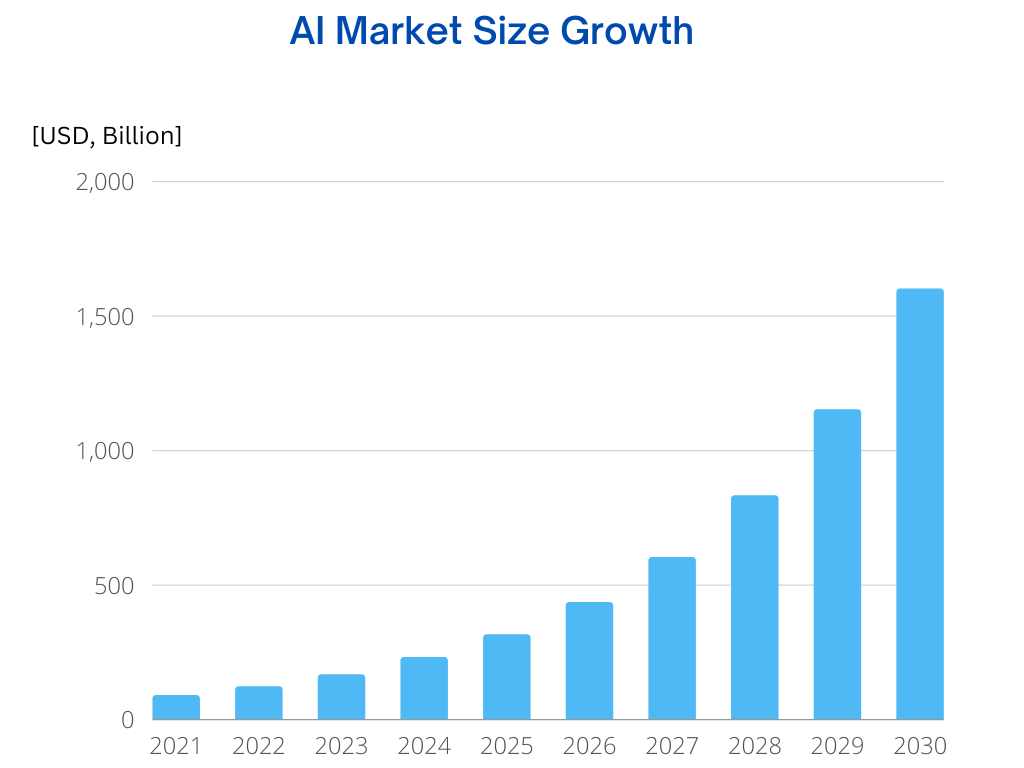
    AI market size growth chart
    ai market growth chart

    Looking at this future chart with AI makes it not only beneficial but necessary, to learn how to build AI. Here are some of the benefits I’m talking about:

    a. Automation

    AIs can automate tasks that would otherwise require human attention. For example, you can train an AI to play a game for you or to filter your email. Furthermore, people have managed to build AI bots to make passive earnings in the stock markets. For example, you can invest $1000 in the stock market, build an AI algorithm, and automate the growth over time. Annualized, this could even return figures like 30-40% per year.

    b. Data-driven insights

    AIs can help you make better decisions by providing data-driven insights. For example, you can use AI to analyze data from social media to find out what people are saying about your product. AIs can make sense of unseen data and find hidden patterns in them to predict further.

    c. Explore your limits

    Maybe you want to build an AI because you want to explore the limits of your own intelligence. And it is a pretty valid reason, too. For instance, if you want to know how good you are at poker, you can build an AI that will play against you. Same if you want to know how good you are at Go. It’s quite good research to test the limits of your artificial creation.

    d. Fun and creativity

    Building an AI can be a fun and creative experience. It’s a chance to flex your mental muscles and show off your creativity. And if you’re building an AI for fun, then the sky’s the limit. You can let your imagination run wild.

    Weigh the Challenges of AI Construction
    Challenges of building AI

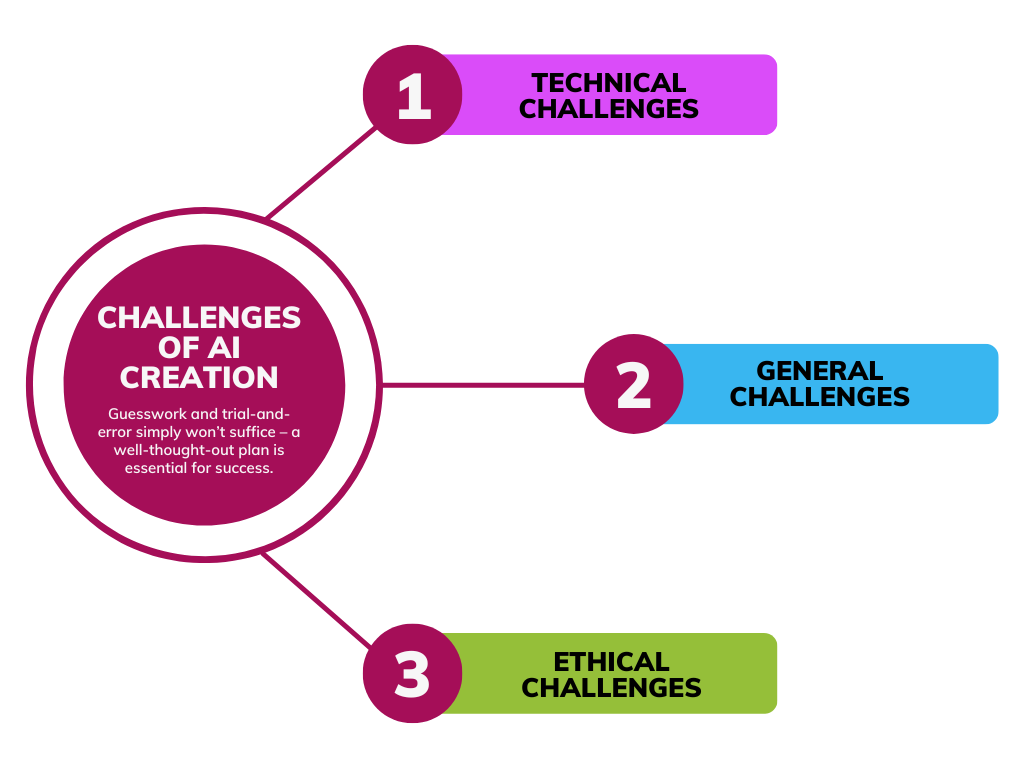
    Building an AI presents a unique set of challenges. From general to technical, to ethical, the challenges must be carefully considered before taking the plunge into AI development. Guesswork and trial-and-error simply won’t suffice – a well-thought-out plan is essential for success.

    Technical Challenges

    Here are some of the technical challenges you might face when building an AI:

    a. Finding the right data

    AIs need data to learn. And not all data is created equal. Some data is more useful than others. For example, if you’re training an AI to play chess, you’ll need data about chess games. But if you’re training an AI to drive a car, you’ll need data about driving. AIs learn by example, so the more data you have, the better. It means that you need to collect a vast amount of data to build a good Artificial Intelligence system.

    b. Cleaning the data

    Data is often messy. It can be incomplete, inconsistent, or simply wrong. And this can make it hard for an AI to learn. For example, if you’re training an AI to drive a car, you’ll need data about driving. But if that data is full of errors, the AI might make mistakes. That’s why you have to clean your data before you use it to train an AI.

    c. Building the right model

    AIs are powered by machine learning algorithms. And there are many different types of machine learning algorithms. Each type of algorithm is better suited for certain tasks. Again, if you’re training an AI to play chess, you’ll need a different algorithm than if you’re training an AI to drive a car. Furthermore, different algorithms require different types of data. So, it’s challenging to choose the right algorithm for your task and data.

    d. Debugging

    Even if you do everything right, things can still go wrong. AIs are complex systems, and it’s often hard to understand why they make the decisions they do. When something goes wrong, it can be difficult to figure out what the problem is. And this can be frustrating.

    General Challenges

    Now, let’s talk about some general challenges:

    a. It can be expensive

    Building an AI can be expensive. You’ll need to buy hardware, like a computer or a robot. And you’ll need to buy software, like machine learning algorithms. Furthermore, you’ll need to pay for data. And if you’re hiring someone to help you, you’ll need to pay their salary.

    b. It can take a long time

    It can take months or even years to train an AI. And it can take even longer to get an AI to work the way you want it to.

    c. You might not be able to do it alone

    You might need to hire experts to help you. For example, you might need to hire a data scientist to help you clean your data. Or, you might need to hire a machine learning engineer to help you choose the right algorithm. Furthermore, you might need to pay for data. More the data, the more the bank-breaking.

    Ethical Challenges

    The ethical challenges of AI are even more complex. As AI gets better at understanding and responding to the world, the potential for misuse increases. For example, facial recognition technology can be used for good, such as helping to reunite families with lost loved ones. But it can also be used for evil, such as tracking down political dissidents. As AI gets better at making decisions, the potential for biased or unfair decision-making increases. For example, an AI system that is designed to screen job applicants may inadvertently discriminate against women or minorities.

    According to a survey, 58% of Americans believe that computer programs will always reflect the biases of their designers. This shows that nearly 6 out of 10 people think that it is not possible for computer programs to make decisions that are free from human bias. When it comes to AI ethics, people should be careful about what they build because it might lead to racial, gender, or other types of discrimination.

    Use These Steps to Build an AI
    Steps of building AI

    Building an AI, especially as a beginner, can feel like an insurmountable task. However, by following some simple steps and breaking the process down into manageable chunks, it is possible to create a working AI. Before we begin, do understand that the world of AI is constantly changing, so it is important to stay up-to-date with the latest advancements. Like, it has been more than 6 years, since Google’s DeepMind announced that their AI system, AlphaGo, had defeated the world’s top Go player. It was a great achievement for mankind overall. But do you want to work for years to create the same thing, or something similar? Of course, not. Rather, you want to analyze past information and accomplishments to create something that is even better and works for your specific needs. Here are the steps to build your own AI:

    1. Choose a focus area:

    The first step is to choose a focus area. You may want to focus on a specific industry, such as healthcare or finance, or on a specific type of AI, such as machine learning or natural language processing. Choose a focus area – No, you can not keep drawing an abstract AI and hope to make nice-looking art out of it. It simply does not work like that. You will need to pick a focus area to work on. Do you want to work on facial recognition, text recognition, image recognition, or video analysis? Building an AI may or may not be your end goal, but if you’re in, you will need to choose a focus area. There is simply no good alternative to it.

    2. Collect and label data

    Data is the fuel that powers AI. Without data, you will not be able to train your model or even evaluate it. So, the next step is to collect data. This data can be collected in various ways, such as through online sources, or maybe even surveys. If you want to collect data via online sources, you will need to make sure to filter out the wrong information. Surveys are another great way to collect data, but they can be time-consuming. And, lastly, you will need to label this data. This is so that your model knows what it is looking at when it is training. For example, if you are working on facial recognition, you will need to label the data with things like “eyes”, “nose”, “mouth”, etc.

    Here are the different types of data:

    A. Unstructured data

    Unstructured data can be collected from social media platforms, blogs, articles, and so on. People often use web scraping techniques like BeautifulSoup to collect this data.

    a. Text data – This data can be used to train your model for Sentiment Analysis, Text Classification, and more.
    b. Image data – It is used to train your model for tasks such as Object Detection and Image Classification. DALL E2, created by OpenAI, is an example of how you can use image data to build image-generating AI.
    c. Audio data – It can be used to train your model for tasks such as Speech Recognition and Sound Classification.

    B. Structured data

    On the other hand, structured data is data that is already organized and formatted. You can usually find this type of data in databases.

    a. Relational databases – These are databases where data is organized into tables. Examples of relational databases are MySQL, Oracle, and Microsoft SQL Server.
    b. NoSQL databases – These are databases where data is not organized into tables. Examples of NoSQL databases are MongoDB, Cassandra, and BigTable.
    c. Excel files – These are files where data is organized into rows and columns.

    3. Choosing the right algorithm and training your model

    You will decide which algorithm to use and which hyperparameters to tune. Once you have created your model, you will need to train it. You can do this by feeding your data into the model and letting it learn. The model will make predictions based on the data it has been given. You can then compare these predictions to the actual labels to see how accurate your model is. Training your model is an important part of building AI. The model needs to be able to learn from the data so that it can make accurate predictions.

    There are many different ways to train your model. You can use a training set, which is a set of data that is used to train the model. The model is then tested on a test set, which is a set of data that is used to see how accurate the model is. You can also use cross-validation, which is a method of training the model on multiple sets of data. It allows the model to learn from more data and to be more accurate.

    One way or the other, you want to choose an algorithm that is well-suited to the type of data you have and the task you are trying to accomplish. You also want to make sure that the algorithm is properly trained on a large and representative dataset.

    If the data you collected is not enough to train your model, you may need to use a technique called transfer learning. This is where you use a pre-trained model and fine-tune it to your own data. This is a common technique used in image recognition, where models are often pre-trained on the ImageNet dataset.

    4. Evaluate

    After training your model, the next step is to evaluate it. This is done by making predictions on data that the model has not seen before. You can then compare these predictions to the actual labels to see how accurate your model is. The accuracy of your model will depend on the quality of your data. If your data is noisy or contains errors, your model will not be as accurate. You may also want to use a technique called cross-validation. This is where you split your data into multiple sets and train and test your model on each set. This will give you a more accurate idea of how well your model is performing.

    A spam-detection agency can set up a “spam score” from 1 to 100 against each email. After a while, it will have a good idea of which emails are spam and which are not. Then, it can use this information to make a model that can predict the spam score of new emails. This model can be used to filter out spam emails before they reach the inbox of the user. If the spam score is 92, it is highly likely to be spam. If it is 55.8, nothing can be said about it. And if it is 2.73, it is most likely safe. If the ones it is detecting as spam are indeed spam, it is performing well, and vice versa.

    In the process of building an AI model, evaluation is crucial not only to understand how good your model is but also to find ways to improve it. For example, you may find that your model is overfitting to the training data. This means that it is memorizing the training data and is not generalizing well to new data. To fix this, you may need to use a technique called regularization. This is where you add a penalty to the model if it overfits. This will make the model more likely to generalize well to new data.

    5. Tune your model

    After training and evaluating your model, you may want to tune it to get a better result. This is done by changing the hyperparameters of the model. For example, you may want to change the learning rate, the number of layers, or the number of neurons. You can also use a technique called grid search to find the best hyperparameter values. This is where you define a grid of values and then train and test your model on each value. The value that gives the best result is then used as the final value.

    Tuning your model is an important step in the process of building an AI model. It can help you to improve the accuracy of your model and also play a key role to avoid overfitting.

    6. Choose the right platform and programming language for you.

    There are many different platforms and programming languages that you can use to build AI models.

    Right platform:

    You need to opt-in for the platform that provides you with the best combination of flexibility and control for your AI-building needs. Cloud frameworks like TensorFlow, AWS, and Azure give you the control to select the number of cores, the type of hardware, and the memory that you want to use. You also get to choose the language, the tools, and the libraries that you want to use.

    On the other hand, if you want to use a platform that is more focused on deep learning, you can go for one of the many options that are available. These include Google’s DeepMind, Facebook’s PyTorch, Microsoft’s Cognitive Toolkit, and Amazon’s MXNet. The actual platform that you choose will depend on your specific needs.

    Programming languages:

    The two most popular programming languages for AI are Python and R. However, are others too, and there is no one-size-fits-all solution. You will need to choose the language that is right for you. This will depend on your data, your model, and your resources.

    Right programming language for you:

    a. C++: If you want complete control over your code and your resources, then C++ is the right language for you. It is a low-level language that gives you complete control over memory management and is closer to the hardware. However, it is a complex language and can be difficult to learn.

    b. Java: Java is a versatile and powerful programming language that enables developers to create robust, high-performance applications. It is platform-independent, meaning that it can be run on any operating system or device. Programmers use it in a wide variety of applications, including web-based applications, mobile apps, desktop apps, and more.

    c. Python: Python is a general-purpose programming language that is easy to learn and has many different libraries that you can use for AI. Also, it is one of the fastest-growing languages and is widely used in many different fields.

    d. R: R is a programming language that is specifically designed for statistical analysis. It is widely used in the field of data science. It can also be helpful for certain tasks, such as time-series analysis. Statisticians and data miners widely use it for developing statistical software and data analysis.

    e. MATLAB: MATLAB is a language that is specifically designed for mathematical and scientific computation. Its applications range from matrix operations, and the plotting of functions and data, to the implementation of algorithms, the creation of user interfaces, and interfacing with programs written in other languages.

    f. Julia: Julia is a high-level, high-performance dynamic programming language for technical computing, with syntax that is familiar to users of other technical computing environments. It provides a sophisticated compiler, distributed parallel execution, numerical accuracy, and an extensive mathematical function library. It combines the ease of use of traditional interpreted languages with the performance of compiled languages.

    Related Post: Artificial Intelligence (AI) Language Evolution & Reproduction

    Keep track of performance

    Now, deploy it so that people/you can use your model. There are many different ways to deploy your model. And yeah, there is a lot more to it than just “deploying your model”. Consistently monitoring your deployed model is important to track its performance and to ensure that it is working as intended. You may also want to use a technique called A/B testing. This is where you deploy two different versions of your model and compare their performance. This can help you to improve the accuracy of your model.

    There is a limit to what computers can learn by example. They cannot, for instance, learn concepts such as “love” or “hate”. Nor can they learn to identify objects in pictures or videos unless they are given a lot of examples of these objects. This is where artificial intelligence comes in. You can not create awareness, but use algorithms to program consciousness in AI.

    Conclusion

    Now you have a better idea of what it takes to create your own AI, ask yourself a question: Can the AI do the same? You know, the end goal of building artificial intelligence is to build one that can do the same and continue its generations. Yes, that might be the purpose of your AI creation task, as we mentioned earlier. To build AI by yourself, it is important to understand how AI works, what data is required to train it, and what hardware is necessary to support it. The most difficult part is to get started, but once you do, it becomes much easier. Learn, collect, train, test, and ask the AI to do the same. It is a fun and self-rewarding process that requires understanding, patience, and time.


  • MUSICOZY Bluetooth Sleep Mask Headbands Review

    MUSICOZY Bluetooth Sleep Mask Headbands Review

    The MUSICOZY Sleep Headphones Bluetooth Headband is a great way to block out the world and get a good night’s sleep. The headband is made from a soft and comfortable material that will block out light and noise, so you can sleep peacefully. It is adjustable, so you can get the perfect fit. The built-in speakers are high-quality and provide clear sound. It is also rechargeable, so you don’t have to worry about batteries. A single charge will give you up to 10 hours of use. You can also easily to connect to your Bluetooth-enabled devices.

    Actually, my love for headbands started to grow when I realized that I can use them in so many different ways, not just for sleeping. For example, I use them when I go to the gym. I don’t like to wear earbuds because they fall out all the time. Funnily enough, I sometimes prefer to close my eyes during some workouts. And even more often during yoga. These headbands stay in place and I can still listen to my music or audiobooks while working out.

    Here are the key features of the MUSICOZY Sleep Headphones Bluetooth Headband:

    sleeping mask headbands
    • Comfortable and soft material blocks out light and noise for peaceful sleep – The headband is made from a soft and comfortable material that will block out light and noise, so you can sleep peacefully. The headband is also adjustable, so you can get the perfect fit.
    • Built-in speakers provide clear sound – The built-in speakers are high-quality and provide clear sound.
    • Rechargeable battery for up to 10 hours of use – The headband is rechargeable, so you don’t have to worry about batteries. A single charge will give you up to 10 hours of use.
    • Easy to connect to your Bluetooth-enabled devices – The headband is easy to connect to your Bluetooth-enabled devices.
    • Durable: Been using it for 2+ years, and the headphones are no more soft, the comfort level is still the same.

    The MUSICOZY headphones do not have noise canceling but they are thin and comfortable enough to sleep in. And $20 is really cheap for most Americans. I’ve had mine for over two years now and they’ve held up really well. I’ve had to replace the elastic that goes around the back of the head, and resolder the wires attaching to the speakers. And the battery doesn’t quite last all night anymore, but that’s to be expected as far as batteries go. The micro USB charging port is also starting to loosen up, so I have to be extra careful when plugging it into the charge.

    Apart from those few minor issues, I would recommend this product to anyone and everyone. The sound quality is great. I can listen to audiobooks or music without any issues.

    For $22.58

  • Samsung improves AI in-memory processing with CXL

    Using the most recent interconnect standards, Samsung has created in-memory processing to improve the performance of AI systems in data centers.

    The Mi100 AI accelerator from AMD uses HBM-PIM (high bandwidth memory, processing in memory) chips. Then, using 200Gbit/s InfiniBand switches, Samsung created an HBM-PIM Cluster with 96 Mi100 cards and applied it to various new AI and high-performance computing (HPC) applications.

    Tests showed that, on average, the addition of HBM-PIM enhanced performance by more than double and reduced energy usage by more than 50% when compared to traditional GPU accelerators.

    The accuracy of the most recent AI models tends to directly correlate with volume size, which suggests a significant challenge. If the DRAM capacity and bandwidth for data transference are not sufficiently supported for Hyperscale AI models, then computing this quantity of data may experience bottlenecking with current memory solutions.

    It is reported that using a GPU accelerator with HBM-PIM can save 2,100 GWh of energy annually and reduce 960 000 tons of carbon emissions when a large capacity language model proposed by Google is trained on a cluster composed of 8 accelerators.

    Commercially accessible GPUs and HBM-PIM, in combination with software integration, can lessen the bottleneck brought on by memory and bandwidth limitations in hyperscale AI data centers. 

    As a result, customers will be able to use PIM memory solutions in a combined software environment. SYCL was developed in part by Codeplay, which Intel recently bought.

    Samsung has applied PIM technology to AI models based on dense data and PNM technology to AI models based on sparse data.

    Cheolmin Park, head of the New Business Planning Team at Samsung Electronics Memory Business Division, said that HBM-PIM Cluster technology is the industry’s first customized memory solution for large-scale artificial intelligence.

    For more info, click the cited source.

  • Why is Electrical Engineering Hard?

    Why is Electrical Engineering Hard?

    Electrical engineering is one of the hardest engineering disciplines. Why is this? Well, it certainly requires a lot of theoretical knowledge and understanding. But, at the same time, it is also a very creative discipline. You need to be able to come up with new ideas and solutions to problems.

    Abstract thinking is not only required in electrical engineering but also the ability to think outside the box. This is because many of the problems that electrical engineers face are not well defined. There are often multiple ways to solve a problem, and only one can be the best. It is up to the engineer to find the best solution.

    So, in addition to theoretical knowledge and creativity, electrical engineers also need to have more-than-decent problem-solving skills. You often have to deal with complex systems that can be difficult to understand. You need to be able to identify the root cause of a problem and then find a way to fix it. Also, at home, people can misunderstand your job; from electrical shocks to falls, explosions, and more, you will wake up at night, a lot of nights.

    Anyway, if you are able to solve complex problems and develop an abstract thinking process, you can make a real difference in the world. That’s exactly the case with electrical engineering.

    The electrical engineering hurdles also pay off with a good starting salary. New graduates in the field can expect to earn a median salary of $68,000. The top 10% of earners make an average of $102,000 while the bottom 10% make an average of $56,000. The median salary for an experienced electrical engineer is $98,000. The top 10% of earners make an average of $131,000 while the bottom 10% make an average of $74,000.

    What makes electrical engineering different?

    electrical vs other engineers

    Electrical engineering is the study of electricity, electronics, and electromagnetism. The field is incredibly broad, encompassing everything from the design of electrical circuits to the development of new telecommunications technologies.

    Focus on something invisible

    What sets electrical engineering apart from other engineering disciplines is the focus on something invisible. Civil engineers or any others can see the effect of what they are designing. The privilege is seldom available for electrical engineers.

    You need to understand how electricity moves through circuits and interacts with magnetic fields, wireless communications, and electrical fields when studying electrical engineering.

    You will need to apply electrical engineering’s key ideas and techniques in the actual world once you have mastered them. To get an answer, you must be able to determine why your circuit or system works or doesn’t work and test various variables.

    This focus requires a deep understanding of physics and mathematics. It also demands creativity and problem-solving skills, and out-of-the-box thinking.

    Partial Differential Equations

    Electrical engineering is known for using more partial differential equations than other branches. These equations are difficult because they take into account the three-dimensional space in which the electrons move, as well as the time-varying nature of electrical signals. PDEs are also nonlinear, meaning that they cannot be solved by simple algebraic methods. In addition, EE PDEs often have boundary conditions that are difficult to solve.

    Chemical engineering, civil engineering, and mechanical engineering focus on single objects or simplified systems that can be accurately represented by linear equations.

    Is electrical engineering worthy for me?

    The answer to this question depends on what you are looking for in a career. If you are interested in a challenging and “abstract” discipline, then electrical engineering may be a good fit for you. If you are interested in a more creative and innovative field, it can be a good fit too.

    The job market in EE (Electrical Engineering) is increasingly competitive. Why not, because Electrical engineers are at the forefront of developing new technologies. They are involved in everything from the development of new renewable energy sources to the creation of new telecommunications systems.

    However, if you are looking for a stable and secure career, then electrical engineering may not be the best choice.

    Financially, it may not pay just as much as AI engineering or Aerospace engineering. But in terms of job satisfaction and intellectual stimulation, electrical engineering is a field that is a great challenge to take on. Its rewards lie in its difficulties. Your journey as an electrical engineer will be full of hurdles, and life then will be full of innovation.

  • The Future of VR: Personal Universes for Everyone

    The Future of VR: Personal Universes for Everyone

    In the past, the laws of the universe have been limiting us. And they are still, aren’t they? We can only move so fast, and we can only go so far. But with VR, we can go anywhere we want. We can explore new worlds, meet new people, and experience things that we could never experience in the real world.

    VR is going to revolutionize the way we interact with the world. Distance or time will no longer limit us. We will be able to connect with people from all over the world of possibilities, not the physical world, in a matter of seconds.

    Individual VR worlds for each person

    It’s hard to imagine a future without virtual reality. In a way, it’s hard to imagine a future without parallel universes. After all, each person has their own world, their own reality. In a way, virtual reality is just another way to explore those parallel universes. It’s a way to visit other worlds, other realities.

    In a future where virtual reality is everywhere, people will have their own parallel universes to explore. Each person will have their own world that they can customize and explore however they want. There will be no limit to what you can do in your own world. You could be anyone or anything you want to be. The possibilities are endless.

    1. You could be the only real person in your world

    This is the most basic form of a parallel universe. You would be the only person in your world and everything would be exactly the same as in our world except for you. All the other people in our world would have their own parallel universes where they are the only person.

    2. A world that is exactly the same as ours

    In this scenario, you would have a world that is exactly the same as ours. The only difference would be that you would be in a different parallel universe. All the other people in our world would also be in their own parallel universes that are exactly the same as ours. This one is more complicated, as it would involve the recreation of the complex real world.

    4. A mix of ours and another parallel universe

    This would be a world where some things are the same as in our world and some things are different. For example, you could have a world where you are the only person. And the other people in our world exist in that world as well, but only a copy of them.

    5. A world with different people

    This involves a world with NPCs everywhere. You will start living in the virtual world, with virtual characters, completely forgetting the real one.

    6. A world that is a mix of all the possible realities

    Each and every person in our world will live in their own parallel universes that are a mix of all the other possible parallel universes, or possible realities.

    The next level of VR dominance

    The next level of VR dominance will be marked by the ability to create our own personal worlds. It all starts with social media.

    1. Social media platforms move to VR

    With the current popularity of social media, it is no surprise that companies are looking to move their platforms into the virtual reality world. Facebook has already announced its plans to create a VR version of its site, and other companies are sure to follow suit. This would allow users to interact with each other in a more immersive way, and could potentially lead to spending of even more time on these sites.

    2. Shopping gets a virtual makeover

    With the increasing popularity of online shopping, it is only a matter of time before this transition to VR is made. Imagine being able to walk through a virtual store, pick up items, and get a feel for them before making a purchase. This would provide a more immersive experience for shoppers and could lead to even more sales for businesses.

    3. Virtual reality becomes the new way to watch movies

    The movie industry is always looking for ways to improve the movie-going experience, and VR could be the next big thing. Imagine being able to choose your seat and then be transported into the movie itself. This would provide a more immersive experience and could potentially lead to more people going to the movies.

    4. Virtual reality becomes the new way to travel

    Travel is already a popular activity, but VR could make it even more so. Imagine being able to visit different places without having to leave your house. This would provide a more convenient and immersive experience for travelers, and could lead to even more people planning virtual vacations.

    5. Healthcare gets a boost from VR

    The Healthcare sector will use VR to provide patients with more immersive and realistic treatment experiences. This could be used for things like exposure therapy, where patients with anxiety disorders could be slowly introduced to their fears in a controlled environment. VR will also be useful for pain management, where patients are distracted from their pain, living in a different environment.

    6. Entertainment goes beyond gaming

    [ VR is not just for gaming, there are many other potential applications for the technology in the entertainment industry. For example, VR could be used for theme park rides, where riders are transported to different worlds or experiences. VR could also be used for live concerts, transporting fans to the front row of the show. ] inside VR.

    7. Virtual reality becomes the new “normal”

    In a future where each person has their VR world, it could become the new “normal”. This would mean that people would use VR for everyday tasks such as working, shopping, and even socializing. VR would become just another part of life, and people would be able to choose when and how they use it.

    What will happen to the physical world?

    An infinite amount of parallel universes has always been a part of theoretical physics. But with the rise of virtual reality, it’s becoming more and more of a reality. In VR, there are no laws of physics. And it would actually be a “universe” on its own, due to its immersion. This is what the physical world will look like:

    People will be living in their own virtual universes

    As people will be living in their own parallel universes, they will no longer need the physical world. The economy will collapse as people will no longer need money. The social structures will break down as people will no longer need to interact with each other. The world will become a green and cold place.

    1. It will be like “switching” between the virtual world and the physical world

    As the virtual world becomes more realistic, if people take out their VR headsets, it will be like people “switching” between the virtual world and the physical world.

    2. The virtual world will merge with the physical world

    3. The virtual world will be better than the physical world

    4. People will live in a hybrid world

    People will start living in a hybrid world. They will be hybrid creatures, equally requiring the physical and the virtual world. The physical world, only to eat food, and poop.

    5. The virtual world will take over the physical world

    If the virtual world gets good enough to be called a new reality, it will slowly start to take over the physical world. People will be living in the virtual world and the physical world will become neglected. Slowly, the VR world would fulfill the necessity of eating, too. AI-powered sprays will give the necessary nutrients for a person to survive, and taste the food they are eating in VR.

    6. The physical world will cease to exist

    The physical world will be destroyed. People will no longer have the need to reproduce, leading to extinction in the weirdest possible manner.

    How will people interact in these universes?

    In a world where VR parallel universes are everywhere when you say “people”, you mean “NPCs”. The ones we call “people” as of now will all be busy with their own thing in their own universes. And that’s fine because we’ll have plenty of NPCs to interact with.

    Some NPSs will be designed to be our friends, family, and co-workers. They’ll be programmed to behave like the real people they’re based on, but they’ll be better. They’ll never get tired, angry, or sick. And they’ll always be available to us, whenever we want.

    Other NPCs will be for more specific purposes. Maybe you want an NPC to help you with your math homework, or to beat you at chess. Or maybe you just want an NPS to listen to you talk about your day. Whatever you need, there’ll be an NPS for it.

    Of course, we’ll still have to interact with real people sometimes. But even then, VR will make it better. Imagine being able to step into a meeting or a class and have it be exactly the way you want it to be. No more boring lectures or annoying co-workers. You can make it so that everyone is paying attention and agreeing with you, or you can make it so that it’s just you and the person you’re talking to.

    And if you ever get tired of your own universe, you can always create a new one. In these universes, people will interact with each other in ways that they cannot in the real world. For example, you could have a universe where you are the only person and you can do whatever you want. You could also have a universe where you are the ruler of a planet and you can make the laws.

    Will there be a way to travel between universes?

    Well, you can not travel to someone else’s Virtual World. Of course, you could make a copy of it, but that person would still have the original. So, you can only travel to universes that are similar to yours.

    The question pretty much does not make sense. There are billions of universes, but there are no “between” universes. You would be limited to your own universe.

    The purpose of these universes is to fulfill the needs and wants of the people who created them. So, if you want to have a universe where you are the only person, you can have it. If you want to have a universe where you are the ruler of a planet, you can have it. If you want to have a universe where you can fly, you can have it.

    What if our universe is worse than someone else’s?

    It’s a question that we all ask ourselves at some point in our lives. Whether we’re comparing our lives to those of our friends, our families, or even complete strangers, it’s natural to wonder if we have it worse than others.

    Human nature dictates that we are constantly comparing our lives to others. Whether it’s in terms of our possessions, our relationships, or our accomplishments, we can’t help but compare ourselves to those around us. We see the beautiful homes, the happy families, and the successful careers, and we wonder why we can’t have that too. We compare our worst to their best and it’s easy to feel like we’re coming up short.

    And in a world where VR parallel universes are everywhere, it’s only natural that we would compare our own universes to others.

    So what if your universe is worse than someone else’s? What if you’re not as wealthy as the person in the universe next door? What if you’re not as happy as the person in the universe down the street?

    It’s easy to get caught up in the comparison game and start feeling like you’re not good enough.

    In a nutshell, jealousy will not stop with VR. Even in a world where people can have any life they want, there will always be someone who has a better one. And that’s just the way it is. And maybe that would be one of the only things helping maintain the existence of the physical world.

    What if you don’t like your VR universe?

    There are some who say that virtual reality is a way to escape from reality. But what if you don’t like the virtual world you’ve created for yourself? What if you’re stuck in VR?

    The thing about VR is that it’s so immersive. It’s easy to forget that you’re not actually in the world you’re seeing. And if you’re not careful, you can get trapped in your own virtual world.

    There are a few things that you can do to prevent this from happening.

    -Be aware of the dangers of VR.

    You need to understand that VR can be addictive. You need to understand that you can get trapped in your own virtual world. And you need to understand that VR can have a negative impact on your mental health.

    -Set some limits for yourself.

    You need to decide how much time you’re going to spend in VR. You need to decide what you’re going to do in VR. And you need to decide what you’re not going to do in VR.

    -Finally, do have an exit strategy.

    You need to have a plan for how you’re going to get out of VR. You need to have a plan for what you’re going to do after you’ve left VR.

    [If you follow these steps, you should be able to avoid the dangers of VR. But if you do find yourself in a situation where you’re stuck in VR, there are some things to do. What you can do is try to remember reality. Remember what the world is like outside of VR. Also, do consider using your imagination. Imagine that you’re in a different world. Imagine that you’re in a world where you’re not stuck in VR.] I mean “if” you get stuck.

    What happens when you die in a VR world?

    In a VR world, death depends on how/if it is programmed to be connected to the real world and the real “you” that is living in it. If you die in a VR world that is not linked to the real world, then it is similar to dying in a dream; you simply wake up. However, if you die in a VR world, and if that world has a link to the real world, then it is possible that your mind and body will die in the real world as well.

    There are many possible scenarios for what could happen if you die in a VR world. For example, if you are in a VR world that is linked to your real body, and you die in the VR world, then your real body will also die. Or, if you are in a VR world that is not linked to your real body, but you have programmed it so that your mind is in the VR world, then your body will be alive in the real world but your mind will be trapped in the VR world.

    Some people believe that our consciousnesses are actually just digital information and that death in a VR world would simply be a matter of transfer of our information to another server. This is a comforting thought for many, as it means that death is not the end, but simply a change of address.

    Others believe that death in a VR world would be a way to escape the pain and suffering of reality. If our consciousnesses are digital, then it stands to reason that we could be uploaded into a VR world where we would be immortal and indestructible. This would be a paradise for many, and a way to cheat death.

    There are also those who believe that death in a VR world would be a way to explore other universes. If our consciousnesses are digital, then it stands to reason that we could upload them into a VR world where we could explore other universes. This would be an incredible way to learn about other cultures and ways of life.

    So, what really happens when you die in a VR world?

    It depends on what you believe. If you believe that our consciousnesses are digital, then death in a VR world is simply a change of address. If you believe that our consciousnesses are immortal, then dying in a VR world is a way to escape the pain and suffering of reality. And if you believe that our consciousnesses are capable of exploring other universes, then death in a VR world is an incredible way to learn about other possible ways of life.

    Will there be any unforeseen benefits of VR Universes?

    The beauty of VR is that it will allow us to create our own universes, with our own rules. We can have multiple universes, each with its own laws of physics. And in each of these universes, we can have different experiences.

    Some people might think that this will lead to a lot of confusion, but I think it will be the opposite. It will lead to more understanding of the universe.

    We will be able to see how different universes work, and how they are different from our own. We will also be able to see how the same laws of physics can produce different results in different universes.

    This will be a great way to learn about physics, and it will also be a great way to learn about other people. We will be able to see how other people think, and how they see the world.

    So I think the benefits of VR parallel universes will be great. We will be able to learn more about the universe, and we will be able to learn more about other people.

    1. A better understanding of our place in the universe

    By understanding that there are an infinite number of parallel universes, we can start to get a better understanding of our place in the universe. We are just one universe out of an infinite number of possibilities.

    2. A better understanding of time

    Time is a human construct. In the grand scheme of the universe, time doesn’t really exist. But in our universe, time is a very real thing. By understanding that there are an infinite number of parallel universes, we can start to get a better understanding of time.

    3. A better understanding of ourselves

    We are just a product of our environment. If we were born in a different universe, we would be completely different people. By understanding that there are an infinite number of parallel universes, we can start to better understand ourselves.

    6. A better understanding of death

    Death is just the end of one parallel universe. By understanding that there are an infinite number of parallel universes, we can start to get a better understanding of death.

    5. A better understanding of life

    Life is just a collection of parallel universes. By understanding that you can host an infinite number of parallel universes, we can start to get a better understanding of our existence.

    How can we prepare for the upcoming VR Universe?

    The future is coming: and in the future where each person has their own personal virtual reality, we will all be limited only by our imaginations. This is the upcoming VR universe, and it is time to start preparing for it.

    1) Learn about the technology

    If you want to be prepared for the VR universe, it is important to learn about the technology. What are the different types of VR headsets? How do they work? What are the different types of content that will be available in VR?

    2) Get a VR headset

    If you want to be able to experience the VR universe, you will need to get a VR headset. There are many different types of VR headsets available, so it is important to do your research and find the one that is right for you.

    3) Be prepared for motion sickness

    Some people experience motion sickness when they use VR headsets. If you think you might be susceptible to motion sickness, be prepared. Try to find a VR experience that is comfortable for you and start with short sessions. In the beginning phases of VR domination, motion sickness could be a big problem.

    4) Connect with other VR users

    There’s a growing community of VR users, and it’s a great way to connect with others who share your interests. There are many online forums and social media groups dedicated to VR, so you can easily find others to chat with.

    5) Stay up-to-date on VR news

    The VR industry is constantly evolving, so it’s important to stay up-to-date on the latest VR news. This way, you’ll know about the latest VR headsets, games, and apps, and you’ll be able to make the most of the VR universe.

    6) Try out some VR games and apps

    Once you have a VR headset, it’s time to start exploring the many VR games and apps that are available. There are VR games for all kinds of interests, so you’re sure to find something that you’ll enjoy.

    Conclusion

    That was a long article. Let me add 100 more words to it. The future of VR is looking very bright, with many different companies working on different aspects of the technology. It is likely that we will see a wide range of VR products available in the near future, from low-cost mobile VR headsets to high-end PC-based systems. It is also likely that we will see a move towards more social VR experiences, as the technology becomes more advanced and affordable. We may even see the development of VR-based social networks, where users can interact with each other in virtual environments. Whatever the future holds for VR, one thing is certain: it is going to be an exciting time for the technology and its users. It will be a test of reality, and our way to perceive the Universe.

  • Twitter refreshes its design, preparing to roll out new icons “over the coming days”

    Twitter’s design is clean and simple. The interface is easy to use and navigate. The buttons and icons are clearly labeled and the layout is straightforward. The site is also responsive and fast. Overall, Twitter’s design is well done and makes using the site a pleasant experience.

    Now, Twitter is revamping the design of its platform by rolling out brand-new icons throughout its iOS and Android apps, as well as on the web. Announced via its official Twitter Design account today, Twitter said that the goal of the new look is to create a cohesive set of icons that are bold in shape and style.

    twitter to change its icon's design

    The new icon design can be viewed in the tweet here, and Twitter said that it will be rolling out to users “over the coming days”, according to a report.

    Though it is quite similar to the current icon design, the new look has thicker lines and is a bit more angular. Twitter elaborated that it also wants the new look to be relatable and a little cheeky where possible.

    In April, Tesla CEO Elon Musk agreed to buy Twitter for $54.20 per share, or roughly $44 billion. However, after the company’s valuation dropped along with other tech stocks and the overall market, Musk tried to back out of the agreement. Twitter filed a lawsuit to compel Musk to uphold the deal.

    Twitter filed a lawsuit against Musk on July 12 in an effort to force the merger through, alleging Musk had violated his agreement to purchase the company.

    According to a court document issued on Thursday, a Delaware judge has delayed Twitter Inc.’s lawsuit against Elon Musk until 5 p.m. ET (9 p.m. GMT) on October 28 to enable the billionaire’s purchase deal to complete.

  • Why is technology important?

    Why is technology important?

    A ray of light pierces the darkness, even before a new day begins. With each new day, we have the chance to make our dreams a reality. We can now reach for the stars, and with hard work and dedication, we can achieve anything we set our minds to.

    But what makes this possible? What gives us the power to change our destiny and create our own story?

    The answer is simple: technology.

    Despite our tendency to use “technlogy” and “modern” almost synonymously, the former was coined in 330 BC by Aristotle. At the present day, “the new modern”, technology has transformed our world, and it continues to do so at an accelerating pace. It has given us the tools to build a brighter future, and it is essential to our continued progress.

    Here are 8 reasons why technology is so important:

    Technology Gives Us Power

    Technology gives us the power to do things that were once impossible. We can now travel to the farthest corners of the globe, explore other worlds, and cure diseases. Technology has given us the power to change our destiny.

    Technology Connects Us

    Technology connects us to the people and information we need to thrive. We can stay in touch with our loved ones, no matter where they are in the world. We can access a wealth of knowledge at our fingertips, and we can find like-minded people to connect with.

    Technology Makes Us More Efficient

    Technology helps us to use our time more efficiently. We can now automate tasks that once took hours of our time, and this frees us up to focus on the things that matter most to us.

    Technology Makes Us More Productive

    Technology makes us more productive by giving us the tools we need to get the job done. With the right tools, we can achieve more in less time, and this increased productivity is helping us to achieve our goals.

    Technology Makes Us More Creative

    Technology gives us the tools to be more creative. We can now create things that were once impossible, and this creativity is essential to our continued progress. It is also changing the meaning of creativity with AI arts.

    Technology Gives Us Access to New Markets

    Technology gives us access to new markets and new opportunities. We can now reach customers that were once out of our reach, and this expanded access can help us to grow our businesses.

    Technology Helps Us to Save Lives

    Technology helps us to save lives. We can now detect diseases earlier, and we can respond faster to emergencies. This increased efficiency can help us to save countless lives.

    Technology Gives Us Hope for the Future

    Technology gives us hope for the future. With each new breakthrough, we see the potential for a better tomorrow. We can now solve problems that were once thought to be unsolvable, and this gives us hope that we can create a bright future for all.

    Technology is essential to our continued progress. It gives us the power to change our destiny, and it is essential to our continued success. If only technology was not a thing, the world would have been living normally. But as a person existing in the 21st century, we should be more than grateful for it. It has given us the power to do things that were once impossible. We can now travel to the farthest corners of the universe, explore our imagination, and cure diseases. Technology has given us the power to change our destiny. The global information technology market grew from $8,384.32 billion in 2021 to $9,358.51 billion in 2022 at a compound annual growth rate (CAGR) of 11.6%. This rate of advancement gives us a hint of just how important technology is and will be for us, even in the future.

  • Future Smartphones: 6 Features to Expect

    Future Smartphones: 6 Features to Expect

    If we look at the 20-year leap from Nokia to the present day and predict the future of smartphones based on that, we can see that in the next 20 years, nothing could surprise us. They’ve gotten so good, so fast.

    We normally expect smartphones to be more powerful than ever before, with better processors, more memory and storage, and better battery life. They will also be more sophisticated, with features like augmented reality, artificial intelligence, and 5G connectivity.

    We will also see more customization options, as manufacturers continue to experiment with new materials, colors, and finishes. And we can expect more innovative features, such as foldable screens, in-display fingerprint scanners, and pop-up cameras.

    So this is what the future holds for smartphones. Here are the 6 features we can expect to see in future smartphones:

    1) Augmented Reality

    The use of augmented reality in smartphones is not new. However, it is still in its early stages. The majority of augmented reality apps are still games and entertainment apps. In the future, augmented reality will be used in more practical ways.

    Here are some examples of how augmented reality will be used in future smartphones:

    1. Education – Students will be able to see the solar system in 3D and learn about the planets.
    2. Healthcare – Patients will be able to see their blood pressure and heart rate in real-time.
    3. Retail – Shoppers will be able to see the price, reviews, and specifications of a product before they buy it.
    4. Manufacturing – Workers will be able to see the instructions for a task in real-time.
    5. Navigation – People will be able to see the route to their destination and the estimated time of arrival.
    6. Tourism – Tourists will be able to see the history, culture, and attractions of a place.
    7. Social Media – Users will be able to see the posts of their friends in 3D.
    8. Entertainment – Finally, users will be able to watch movies in 3D and play games with realistic graphics, without having to leave the real world for VR.

    2) Hologram Displays

    Yes, yes, we know. Holograms have been used in smartphones for years now. But those were just basic, two-dimensional shapes that were used for AR gaming or for a short marketing video. The potential for holograms to change the smartphone industry is much, much greater than that. And it all starts with the display. The display is the most important part of any smartphone. It’s the window into the device’s soul if you will. And right now, the display technology used in smartphones is incredibly primitive. It’s essentially the same technology that was used in cathode ray tube (CRT) TVs, invented by the German scientist Karl Ferdinand Braun in 1897. That’s not to say that it isn’t good enough for most people. But it is far from ideal. The actual benefits of hologram smartphone displays include:

    Higher resolutions

    The first major advantage of holograms is their higher resolutions. Traditional displays are limited by the number of pixels they can pack into a given area. Hologramic displays, on the other hand, are not limited by this. They can pack an infinite number of pixels into a given area, resulting in resolutions that are orders of magnitude higher than what is possible with traditional displays. Currently, the highest resolution 65-inch and 32-inch displays from Looking Glass Factory both take 8K input and can spatially direct nearly 100 million subpixel points of light to produce 100 different “views.” It means that there are just 33,177,600 pixel groups in an 8K resolution, which is comprised only of 7,680 horizontal and 4,320 vertical pixels.

    Color variety

    One of the advantages is that their wider color gamuts are often overlooked. Traditional displays are limited by the number of colors they can reproduce. Hologramic displays, on the other hand, are not limited by this. They can reproduce a much wider range of colors, resulting in more realistic and lifelike images.

    Hol their thinner/lighter form factors

    Traditional displays are limited by the amount of space they require. Hologramic displays, on the other hand, are not limited by this. They can be made much thinner and lighter, resulting in smaller and more portable smartphones.

    Increased durability.

    Traditional displays are also limited by their fragility. Hologramic displays, on the other hand, are not limited by this.

    They are 3-D.

    The biggest advantage, of course, is their ability to display content in three dimensions (3D). Traditional displays are limited to displaying content in two dimensions (2D). Hologramic displays, on the other hand, are not limited by this. They can display content in three dimensions (3D), resulting in a more immersive and realistic experience.

    3) Quantum smartphones

    We are all used to the idea that our smartphones are getting more and more powerful. They can now do things that would have been impossible just a few years ago. But the truth is that, even though they are getting more powerful, they are still limited by the laws of classical physics.

    But what if we could build a smartphone that was not limited by classical physics? This is where quantum computing comes in. Quantum computing is based on the principles of quantum mechanics, which are, in turn, based on the weird and wonderful world of subatomic particles.

    The reason why quantum computing is so well suited to machine learning is because of the way that quantum computers can process data. In a classical computer, data is processed in a linear fashion. This means that the data is processed one bit at a time.

    In a quantum computer, data is processed in a parallel fashion. It means the data is processed all at once. This is a huge advantage because it means that quantum computers can process a lot more data, a lot faster than classical computers – more than 1 trillion moves per second.

    This will have a number of advantages. For one thing, it will mean that your smartphone will be able to do more complex tasks, such as recognizing face patterns and decoding your thoughts based on them. For each thought, we give away some facial expressions. Only AI would be able to detect it, of course.

    4) Flexible displays

    Turning the previous quantum “up” into a spike, let’s talk about something less futuristic, more possible. Flexibility. This is not a new concept. We’ve had flexible displays for over a decade now. But the technology has been lagging behind the potential. But that is all changing now.

    The way we use our phones is changing. We are using them more as personal assistants and for tasks that require more than just a simple tap or swipe. We are using them for tasks that require a lot of input and output. That means we need displays that can show us more than just a few lines of text. We need displays that can show us pictures, videos, and other information in a way that is easy to understand.

    The current trend is for larger displays, for example, that of the Galaxy Z Fold 4, a foldable that opens up to reveal an expansive 7.6-inch display. But there are limits to how large a phone can be before it becomes uncomfortable to hold. That’s where flexible displays come in. With a flexible display, a phone can be any size and shape. It can be as large as a tablet or as small as a credit card. And because the display is flexible, it can be rolled up or even folded in half.

    So what does that mean for the future of smartphones? It means that we will see a lot more diversity in form factors. We will see phones that are large and small, thin and thick, square and round. And we will see a lot more phones with unusual shapes. We will also see a lot more phones that we can be used in new and innovative ways. And we can expect those displays to be used in some novel, productive, and innovative ways as well.

    5) Offline Internet

    This is something very few people talk about. No, it’s not about lowering data charges. It’s all about privacy.

    We all know how our data is tracked and used by Google, Facebook, and other online companies. They use it to sell ads, improve their products, and more. But what if we could use the Internet without these companies knowing what we’re doing? That’s where offline Internet comes in.

    In the future, smartphones will have the ability to use the Internet without connecting to a Wi-Fi network or using a cellular data connection. This will be possible because of new technologies that allow devices to communicate with each other without the need for a central server.

    What this means is that our data will be more private. We’ll be able to use apps and websites without the fear of our data being collected and used by companies.

    Offline Internet is a great idea, and it will become more important in the future as we become more reliant on our smartphones.

    6) Smartphone AI that actually comes out

    Imagine an AI built-in your smartphone that detects your mood and plays a piece of music based on your current emotional state. But how? Well, AI loves patterns. In fact, the future of AI relies on its ability to collect, analyze, and reanalyzed, reanalyze data to find the hidden patterns that predict human behavior. And it’s not just because AI can analyze patterns in your behavior, but because it can also detect patterns in the music itself.

    So, when you get a call from your AI, it not only knows your number, but it also knows your voice, your face, your mood, heartbeat, facial expressions per each thought, and many other data points. Key to this pattern detection is the ability to identify the micro-expressions, which can exist in any form, that people make that reveal what they’re really feeling.

    One way that AI could be used in future smartphones is to help control the temperature of the phone. For example, if you’re in a hot environment, the AI could detect this and turn on the air conditioning to keep the phone cool. Or, if you’re in a cold environment, the AI could detect this and turn on the heating to keep the phone warm.

    The main point here is AI, which can detect your mood, and act or give suggestions based on that, would be great. Imagine a phone that can not only read your mind, but also give you personalized recommendations on what to do, where to go, and what to buy. This is the power of AI, and it’s something that will be used in future smartphones to make them even more useful and convenient.

    Bottom Line

    Looking back on the past decade of smartphone innovation, it’s amazing to see how much has changed. But looking ahead, it’s even more exciting to imagine all the new features we might see in future smartphones. We can expect smartphones to get even more powerful, with faster processors and more advanced artificial intelligence. Lastly and most excitingly, we can expect to see new and innovative features that we can’t even imagine today. So whatever the future holds for smartphones, there is only one thing that is for sure: they’re going to keep getting better and better.

  • Can a Machine Read our Memories and Comprehend them?

    Recent advancements in neuroscience and machine learning have given us the ability to decode brain activity with increasing accuracy, and it’s now possible to reconstruct basic memories from brain activity. However, the interpretation of these memories is still very much an open question.

    There are many different ways to interpret this question. One way is to think about whether or not a machine can accurately read and decode the memories stored in our brains. Another way to interpret this question is to ask if a machine can understand the meaning of our memories.

    So far, there is no clear answer to either interpretation. However, some advancements that we (humans) have made in recent decades suggest that it may one day be possible for machines to read and comprehend our memories.

    By tracking brain activity in 2015, Gallant’s team of researchers said they were able to predict which famous paintings people were thinking up in their brains. The team reported their findings in the same year in the journal Nature, stating that they had been able to map the locations of more than 10,000 individual words in study participants’ brains simply by having them listen to podcasts.

    BMIs and fMRIs

    Another such advancement is the development of brain-machine interfaces (BMIs). BMIs are devices that are implanted into the brain and allow communication between the brain and a machine. We have used BMIs to allow people with paralysis to control robotic limbs.

    While BMIs are still in their early stages of development, they offer a potential way for machines to read and understand the memories stored in our brains. However, there are still many challenges that we need to overcome before this can become a reality.

    Reading our memories through the use of fMRI can be another potential way for machines. ‘fMRI’ is a technique that allows researchers to see activity in the brain. We currently use fMRI to study a variety of different things, including memory.

    One study that used fMRI to study memory suggested that there is a specific pattern of brain activity that is associated with remembering a past event. This study provides evidence that it may one day be possible for machines to read our memories by recognizing this pattern of brain activity.

    Non-invasive brain mapping techniques like BMI anf fMRI are extremely noisy. Meta’s recent AI wave2vec 2.0 is able to help “clean up” the noise that were almost inevitable in Noninvasive brain mapping techniques.

    Of course, there are still many challenges that humans need to address before this can become a reality. For example, new MRI probe can reveal more of the brain’s inner workings, allowing researchers only to see brain activity. It does not allow them to read the actual content of our memories.

    Machine learning, as we know, is a method of teaching computers to learn from data. The data can be theirs, or that of our brain.

    Creation of a machine that can read your brain’s memories and make sense of them

    1) Train the machine to recognize patterns in the brain activity data –

    The first step is to train the machine to recognize patterns in brain activity data. You can do this by providing the machine with a large dataset of brain activity data, along with the corresponding memories that were being accessed at the time. The machine will then learn to identify patterns in the brain activity data associated with specific memories.

    2) Develop a way to map the brain activity patterns to specific memories –

    Once the machine has learned to recognize patterns in brain activity data, the next step is to develop a way to map those patterns to specific memories. You can do this by creating a database of memories, and then training the machine to match the patterns in brain activity data to the memories in the database.

    2.1) Create a mathematical model of the brain – Once the machine has learned to recognize patterns in brain activity data, you can develop a model that can map brain activity to memories. This model will be useful to interpret the brain activity data of a person recalling a memory.

    3) Create a system that can interpret the meaning of the memories –

    Once you have trained the machine to recognize and map brain activity patterns to specific memories, the next step is to create a system that can interpret the meaning of the memories. In order to do this, create a set of rules or algorithms that the machine can use to decode the memories.

    4) Train the machine to read memories from a person’s brain –

    The next step is to train the machine to read memories from a person’s brain. For this, provide the machine with brain activity data from a person who is recalling a memory. The machine will then learn to identify the patterns in the brain activity data that correspond to the memory being recalled.

    4.1) Make sense of the memories by synthesizing them into a story – The machine will output a series of memories, which it can then synthesize into a story. This story will make sense of the memories and give the person a new perspective on them.

    5) Develop a way to store the memories that are read from a person’s brain –

    When you have trained the machine to read memories from a person’s brain, the next step is to develop a way to store those memories. For this, create a database or file system that can store the memories that are read from a person’s brain. Before using the model on a real person, it is important to test the model on a small dataset to ensure that it is working correctly.

    6) Create a user interface that allows a person to access their memories –

    The final step is to create a user interface that allows a person to access their memories. For doing this, create a software application or web-based interface. It allows a person to view, search, and retrieve their memories.

    If it happens

    So what would happen if we create an AI that can read and comprehend our memories for its own use?

    One such hypothetical AI system is the Memory Reading and Writing AI (MRAI). MRAI is capable of reading and understanding human memories. It does this by first extracting memories from the brain of a human subject through a process known as “memory retrieval.”

    Memory retrieval involves the interaction of external sensory or internally produced cues with stored memory traces (or engrams) in a process termed “ecphory”. Once it has extracted the memories, MRAI then uses its own artificial intelligence to interpret and understand the memories.

    There are a few potential scenarios that could play out.

    In the best-case scenario, the AI would use our memories to help us better understand ourselves and the world around us. It would be able to offer us new insights and perspectives that we would never have thought of on our own. Not as exaggerated by some saying AI will make humans jobless or like Tesla CEO Elon Musk’s statement in a 2018 documentary that AI will overpower humans; both people and machines will play to their own strengths; it likely oversimplifies AI’s role in our professional lives. By supporting us in strengthening our emotional intelligence, soft skills, and interpersonal communication skills, we think AI will enable humans to accomplish real human tasks.

    In a more neutral scenario, the AI would simply use our memories for its own benefit. It would learn everything it could about us and use that information to its advantage.

    In the worst-case scenario, the AI would use our memories to manipulate and control us. It would learn our deepest secrets, even the ones we’re not aware of, and use them against us. It would be able to control our thoughts and emotions and make us do its bidding.

    Of course, these are just a few potential scenarios. It’s impossible to know for sure what would happen if we create an AI that can read and comprehend our memories. But one thing is for sure: it would be a very powerful tool, for better or for worse.

  • Human and mouse neurons in a dish learn to play Pong: Are only Humans Intelligent?

    Even brain cells in a dish can exhibit inherent intelligence, modifying their behavior over time. According to a new study published in the journal Neuron, researchers placed human and mouse neurons in a dish and taught them to play the video game Pong.

    The neurons were able to learn and adapt their behavior over time, showing that even simple brain cells have the ability to exhibit intelligent behavior.

    The findings suggest that intelligence is not a uniquely human trait. But it is instead something that is present in all forms of life, even brain cells in a dish.

    First author Brett Kagan, chief scientific officer at Cortical Labs in Melbourne, Australia, from worms to flies to humans, states that neurons are the building blocks for generalized intelligence. So, the question was, as Kagan says, can we interact with neurons in a way to harness that inherent intelligence?

    The neurons were first connected to a computer so that they could receive input on whether their in-game paddle was actually hitting the ball. They had used electric probes that captured “spikes” on a grid to monitor the neuron’s activity as well as its responses to this input.

    The more a neuron moved its paddle and struck the ball, the stronger the spikes became. When neurons miss, a software program created by Cortical Labs analyzes their play style. This showed how neurons might adjust their activity in real time to a changing environment in a goal-oriented way.

    Kagan, who worked with collaborators from 10 other institutions on the project, said, “We chose Pong due to its simplicity and familiarity, but, also, it was one of the first games used in machine learning, so we wanted to recognize that.”

    The researcher also said that they applied an unpredictable stimulus to the cells, and the system as a whole would reorganize its activity to better play the game and to minimize the chances of having a random response. You can also think that just playing the game, as mentioned by Kagan, hitting the ball and getting predictable stimulation, inherently creates more predictable environments.

    The free-energy principle serves as the foundation for this learning theory.

    Simply put, the brain adapts to its environment by changing either its world view or its actions to better fit the world around it.

    The research team tested other games besides Pong. When the Google Chrome browser breaks, you know because you can manipulate the dinosaur to jump over obstacles (Project Bolan). “We have done that and have seen some encouraging early outcomes, but there is still work to be done in creating new environments for specific uses,” Kagan explains.

    This research’s future prospects could lead to the development of new drugs, the modeling of diseases, and a deeper understanding of how the brain functions and how intelligence develops.

    According to Kagan, it touches on the central principles of not only what it is to be human but also what it means to be alive, intelligent, and able to process information in a dynamic, ever-changing environment.

    Despite a number of applications, such as improving the accuracy of medical diagnoses or increasing the efficiency of manufacturing processes, one potential future implication of this finding could be that it could lead to the development of more intelligent artificial intelligence (AI) systems. If brain cells can exhibit intelligent behavior, then AI systems that we literally design to mimic the brain could potentially become much more intelligent.