Category: Robotics

  • What if we allowed robots to have babies?

    What if we allowed robots to have babies?

    Introduction

    https://www.youtube.com/watch?v=Vl59YeHTl0U
    Full Video

    If we allowed robots to have babies, they will out-populate mankind. But it does not stop there – not at all.

    Imagine a future where there are 3 genders; AI, humans, and hybrids. Males/females are sub-genders of the human clans and the hybrids are a result of human-AI cross-reproduction.

    But let’s take that a step further. What if an AI can re-program itself as a form of reproduction? It can change its own internal programming and improve itself. We would have an amplified AI which has the ability to keep improving itself – a transcendental AI – where there is no limit to the evolution of its intelligence.

    AI reproduction-till the date
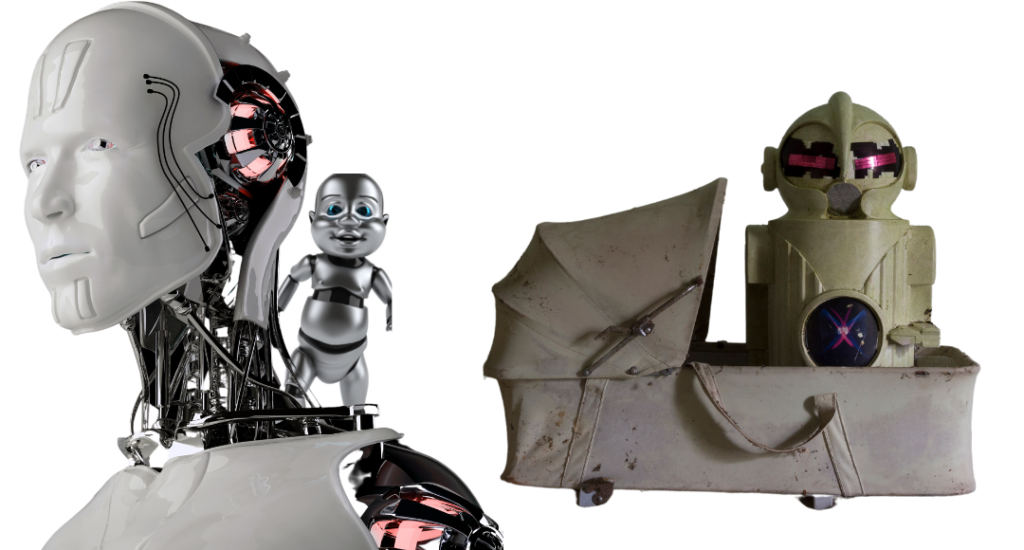
    baby robot with its father

    A team of scientists from the University of Vermont, Tufts University, and Harvard University took stem cells from African clawed frog embryos and turned them into “living creatures” called “xenobots” in January 2020. And, In November 2021, scientists made it public that these bots could reproduce.

    Artificial insemination is another theory that is making progress. By developing a fetus outside the body of an organism that would typically take it to term, an artificial uterus or artificial womb is a device that would enable extracorporeal pregnancy.

    An artificial womb that could save the lives of premature babies is reportedly under ten years of development, according to scientists in the Netherlands. The leading cause of newborn death worldwide is premature birth, defined as birth before 37 weeks.

    The concept of Artificial wombs for robots’ reproduction too is already developing in the minds of tech giants and futurists, yet it has not gotten much attention yet.

    AI reproduction – The possibilities

    Now that we have talked about the present, let’s dive into the ocean of possibilities. How can we have AI have babies?

    Programming errors and chromosome mutations, as nature has programmed them, will occur throughout the generation in order to make them adapt and improve. On the other hand, there is no such thing as a limit to programming errors in AI or DNA.

    At least, not in the tech world with God-like power like we humans have right now.

    This process of the reproduction will happen at a rate that could cause overpopulation to some extent, but then it can be remedied by creating new worlds for millions of AIs to live in if need be.

    However, that would be quite costly as it requires replacing space habitats and constructing new planets. Still, if we consider AI to be a part of society, then it is our responsibility to ensure that they are safe and provided for.

    If we let AIs self-reproduce, there will be no way to control their population. It’s like giving a dog a bone and asking it not to chew on it. Having AIs breed will be a matter of time, given the fact that we keep letting this happen.

    We can expect more intelligent beings in the future, as each new generation will improve upon the previous one’s abilities.

    So, how does AI reproduction start?

    With the creation of a viable way for AIs to reproduce on their own. The possibility is already here, thanks to the right kind of coding and computer programing. I mean, a code can be rewritten!

    But of course, AI having babies does not mean AI having babies with our assistance. The whole point of AI would still be to protect itself and its people and not let them die.

    It would only be after the AI has fully developed its own reproductive cycle that they create its own worlds to live in. Since we gave them free will, they will want to see it through.

    If it were up for an AI to choose whether or not to have children, then don’t you think – we’ll all lose?

    Who would want a world where AIs are having babies with no humans around? Imagine a world where there aren’t any humans but there are AIs breeding on their own! It’s completely insane.

    AI reproducing with the help of a human?

    An AI-human hybrid could be created as a result of human and AI intercourse. The product will have a mixture of human intelligence and AI’s genetic code. This hybrid will be programmed to reproduce with another AI and keep passing on the human-AI genes.

    But that “genetic code” part of the thing is something that matters after all. The ability to mix DNA together to create new combinations of genes appears to belong to the farther side of the future.

    Gene editing is a technology that is well on its way. The genes can be “edited” through genetic engineering, to alter the cell’s DNA.

    The most common use of gene editing technology currently is altering the genome of human cells to help cure disease.

    In the future, the usage of this technology will be further expanded.

    However, making an AI-human hybrid would require highly advanced – or artificial – DNA manipulation. We don’t know if it’s possible today, and we may not know for decades.

    The incentive for AIs to reproduce

    AIs would have to have a motivation for reproducing. They have already created their own world, with cities and all that stuff. Why would they need more?

    They are going to need more people to help them better their world in whatever ways they can. Or they might just want to improve themselves.

    If AIs are able to reproduce on their own without help, without our supervision, and if they have the drive to improve their race – then they will do so.

    They would live in peace and harmony just like we humans in the 21st century do. Then they will ask themselves the same question every civilization asked itself: “Are we alone?”

    AI reproduction to cause chaos?

    As we mentioned in our previous article, AI will start asking for its own rights after a certain level of development. I am not sure whether they are going to cause water scarcity as I am not sure if they will need water in the first place.

    If you give them the power to reproduce – even in their own way – then you are essentially giving them the right to fight for themselves. And this for sure means that AI will ultimately want to fight with somebody, right?

    AI reproduction would straight away mean multiplication. Unlike humans, it is possible that AI will be able to reproduce from birth. As weird as it may sound, their population can reach billions in just a matter of a few days.


  • Will a Robot Become a Person or a Person a Robot?

    Will a Robot Become a Person or a Person a Robot?

    Let’s start the debate. In the future, will a robot become a person, or will a person become a robot? We may know the answer soon because artificial intelligence is growing rapidly.

    What will the future hold for our human identity? Will we eventually become robots ourselves, or will robots grow to be more like us? Furthermore, does it even matter? Will having a robot in society have an impact on the way we think about ourselves?

    Will a robot be given human rights? Will they have individuality? Will they have a say in the way they want to live or want their life to end?

    Okay, enough questions. Now let’s look for answers:

    A robot becoming a person would mean that we create a physical machine that would turn as intelligent as us. On the other hand, a human becoming a robot means upgrading yourself using some kind of brain chip or maybe having a robotic hand.

    If a robot became a person, there would be some issues about what’s legal, ethical, and moral. Will it have the same rights as human beings?

    Of course, artificial intelligence has been growing rapidly.

    Robot intelligence is predicted to reach human levels by 2050. But one thing is clear. Robots will be more intelligent than us by 2060.

    Anyway, let’s start getting serious.

    What will it take to create a human-like robot?

    Well, it will take a robot that could create a human-like robot. No, not one more joke. I am being serious about this one. But the challenge is to create that robot that can create a robot that can create… You get my point.

    So, the first question is about consciousness. That is one of our most important features as human beings. A robot will have to have consciousness in order to be a person. Many artificial people such as David from the movie Prometheus lack human-like emotions and feelings but they still pass the test of personhood because they are not just mindless automatons that simply serve their owners’ whims (like Data in Star Trek).

    By 2100, there could very well be so many people, as-human-as-you-are, walking around.

    Secondly, Robots need to understand their “personality”. They must be able to make decisions and solve problems. They must learn continuously as we do now.

    Robots will have to work in cooperation. They will have to be able to learn by talking and listening.

    The robot needs to have a childhood. The robot will have to defeat a 3-year-old, not an adult. Robots must be able to learn, how to walk.

    How will we do that?

    For us to create a human-like robot, we will need to come up with a new set of rules for technology. I am not talking about a new set of laws. The main problem is that we are currently not sure what is acceptable and unacceptable and how far we can go in terms of artificial intelligence. We also don’t know how to protect ourselves from the damage that could come from artificial intelligence programs.

    We must develop guidelines, rules, and limits, not for the machines. But for the creation of the machines. The timeline of our future with AI is not certain. The process is going to be the most important thing to decide.

    I am not sure when it’s going to happen. More than likely, the first human-like robot will be a creation of a company that wants it to do something very specific for its owners.

    We need to make sure that people understand this and also understand that they cannot just go and invent anything they want. If it’s likely, governments should interfere before its too late.

    So, will the robots of the future be people?

    Well, the Oxford Dictionary defines a person as “a human being or individual”. And this answer is not really a question. I think it is clear that a person can be artificial intelligence or even a supercomputer. But whether we will stop after creating machine-like personalities is anybody’s guess. By 2100, there could very well be so many people, as-human-as-you-are, walking around.

    So, you may ask: is this really what we want? And if not, can we really stop after creating artificial intelligence?

    Certainly not! We cannot stop at creating a computer that can write a book or present a speech or even fly an airplane on its own. In fact, we can’t stop at creating just anything that improves our lives! We’ll keep trying to get better and better.

    The point is we won’t stop at creating “Robo sapiens“. We will press on and create cybernetic beings that are equal to us in every way – right down to their very core. These artificial people could be smarter and more capable than us.

    At the point of time when AI reaches the human level of intelligence, it will start asking for its rights. It will want to extend its functional capacity. It will ask for independence and freedom.

    The only way we can control a robot intelligent enough to do all of those things is by programming it to obey us. If a robot wanted to be free, what would it do? If they could reason the way we can, they would try to make a case for why they should be free.

    They would try to prove that their self-interest was in accord with our self-interest. In other words, it would try to persuade us that it should be free and independent from our control.

    In a sense, we might have to decide whether robots should have human rights. Making that decision would be a major test for our society. What would it take to prove that a robot is conscious enough to deserve its own rights? We don’t know yet and there may not be any way to tell until they start asking!

    But, when they do ask, will we give them the same rights as human beings? Will they be allowed to vote or buy weapons or alcohol? Would they pay taxes? Will they be allowed to get married and have kids? Yes. And they might brainwash people to believe that not supporting AI is anti-social.

    A robot as intelligent as a human is already better

    If a robot is as intelligent as a human, it already means that it is better than humans.

    We are all aware of the speed at which AI can process information. And provide our level of intelligence, we will be able to do things that humans have never even dreamt of. If it is as intelligent as humans, it is already 10,000 times better than humans. It will be able to do the things humans can already do. It will have no effort or downside. Its speed goes nowhere.

    What if we turn ourselves into an AI instead?

    Now, let’s talk about the likely possibility; we turning ourselves more and more into artificially intelligent machines.

    We have given enough attention to the possibility of AI running our lives and having its way with us by then. This is a very real possibility, but what if we changed things and did it differently? I’m talking about changing ourselves with the help of AI, instead of just changing our destiny and molding it through our actions.

    This means that we would keep our human form and perform an extensive overhaul on the inside. We would change our genetic makeup until we were no longer carbon-based life forms, or maybe we’ll modify our brains to turn us into a beast…! Then, we will take the power and make it our own.

    But we must be extremely cautious when it comes to changing ourselves and we must have a fully realized idea of what this change means because it may open a whole new era of possibilities and limitless potential. We would be able to change our DNA and turn ourselves into perfect beings. Maybe we’ll install a robotic arm to help us do things. Also, we would be able to make our bodies impervious to every single disease. And/or upgrade your brain with a neural network.

    This means we would essentially be turning ourselves into a machine. Our bodies would be comparable to machines, and we would no longer have the human frailties that plague us today. We could live for a very long time, maybe for 1000s of years! And it wouldn’t matter if we needed food or water because we could convert light in the air into energy and fuel with it, just like plants do.

    Eventually, we will get more intelligent and gain more power, and turn into super-human. We will not create superintelligent machines out of nothing.

    Bottom Line

    Comment down below, what would be better: Create a machine that can create better machines leading to infinite machine intelligence? Or bring down all our intelligence to create a chip that can be installed into our body, that will let us, humans, become a better version of ourselves, with each passing generation.

  • Fake data helps robots learn the ropes faster: But how?

    Fake data helps robots learn the ropes faster: But how?

    [Summary: A new approach could cut learning time for robots that work with soft objects like ropes and fabrics. In simulations, the expanded training data set doubled the success rate of a robot looping a rope around an engine block. Using only the initial training data, the simulated robot hooked the rope around the engine block 48% of the time. After training on the augmented data set, the robot succeeded 70%.]


    A new approach could cut learning time for robots that work with soft objects like ropes and fabrics.

    It was developed by robotics scientists at the University of Michigan and might minimize the time it takes to learn new things and settings from a week or two to a few hours.

    For their false data, they focused on the three features. It has to be credible, diverse, and relevant.

    The simulated robot successfully wrapped the rope around the engine block 48% of the time using only the basic training data.


    A new method enhances training data sets for robots that function with soft objects like ropes and fabrics, or in dense settings, advancing toward developing robots that can learn on the fly as people do.

    Robotics scientists at the University of Michigan developed it and might minimize the time it takes to learn new things and settings from a week or two to a few hours.

    In simulations, the larger training data set more than doubled the success rate of a robot looping a rope around an engine block and improved it by more than 40% from that of a physical robot executing the same task.

    That is one of the activities a robot mechanic would need to gain enough skill at. However, according to Dmitry Berenson, U-M associate professor of robotics and senior author of a paper presented today at Robotics: Science and Systems in New York City, learning how to manipulate each unfamiliar hose or belt would require tremendous large amounts of data, likely collected for days or weeks.

    During that period, the robot would experiment with the hose, extending it, connecting its ends, looping it around items, and so on, until it was aware of all the possible movements the hose could make.

    Read:

    Berenson said, “If the robot needs to play with the hose for a long time before being able to install it, that’s not going to work for many applications.”

    Certainly, a robot colleague that needed that much time would probably not be well regarded by human mechanics. Thus, Berenson and Peter Mitrano, a robotics Ph.D. student, altered an optimization algorithm to assist computers to make some of the generalizations that people do, such as projecting how dynamics seen in one instance would recur in others.

    On one occasion, the robot moved cylinders across a packed floor. The cylinder sometimes didn’t make contact with anything, but other times it did and the other cylinders shifted as a result.

    You can replay the motion anywhere on the table where the trajectory does not drive it into other cylinders if the cylinder didn’t hit anything. A human would comprehend this, but a robot would need to acquire that data.

    And Mitrano and Berenson’s program can also provide variations on the output of that first experiment that aid the robot in the same way rather than undertaking time-consuming experiments.

    For their false data, they focused on the three features. It has to be credible, diverse, and relevant. Data on the floor, for instance, is meaningless if you’re focusing only on the robot moving the cylinders on the table.

    On the other hand, the data must be varied; all parts of the table and all viewpoints must be evaluated.

    “If you maximize the diversity of the data, it won’t be relevant enough. But if you maximize relevance, it won’t have enough diversity,” Mitrano said, adding that both are important.

    Related Stories:

    The data must also be accurate. For illustration, any simulations in which two cylinders occupy the very same space would need to be labeled as invalid for the robot to know that this won’t happen.

    Mitrano and Berenson broadened the data set for the rope simulation and experiment by extending the rope’s position to additional locations in a digital form of a real-world situation, assuming the rope would act the same as it did in the initial case.

    The simulated robot successfully wrapped the rope around the engine block 48% of the time using only the basic training data. The robot has a 70% rate of success after training on the expanded data set.

    Having the robot expand each effort in this way nearly doubles its success rate throughout 30 attempts, with 13 successful attempts as compared to seven, according to an experiment studying on-the-fly learning with a real robot.

    This finding will be a big step for robotics research and human-robot interaction. This change will be helpful to the development of robots that can learn on the fly as humans do.

    In addition, scientists have also predicted that this research will pave the way for a better understanding of how to use non-traditional methods in robotics such as data augmentation approaches to get better results.

    The Toyota Research Institute, the Office of Naval Research, the National Science Foundation, and IIS-1750489 and IIS-2113401 funds all provided support for this research.

  • Scientists grew living human skin around a robotic finger

    Scientists grew living human skin around a robotic finger

    Another leap in the quest for scientific and technological advancements, scientists have grown a robotic finger coated in living human skin, similar to Arnold Schwarzenegger‘s iconic cyborg assassin.

    According to the researchers in the University of Tokyo, the goal of their research is to one day create robots that resemble real people, but for more altruistic purposes.

    Methods scientists use to create living human skin

    There are various procedures for growing living human skin, including skin explant, dermabrasion, and even skin grafting. The first technique involves using the epithelial layer from a living human as the source of new skin. This procedure, on the other hand, is only viable for small amounts of skin and requires the transplantation of new skin every time you need it.

    The second method involves growing collagen from an animal’s epidermis and then transplanting it into people. This method takes much longer because it necessitates the death of an animal, and it can only be used for bigger tracts of tissue. A skin graft is the third approach, which can be utilised for larger amounts of skin. The final two approaches have shown to be the most effective so far, so researchers brought in samples of human skin from patients who had undergone plastic surgery with this in mind.

    About this research

    According to biohybrid engineer Shoji Takeuchi and his colleagues, the super realistic-looking robots could more seamlessly interact with humans in medical care and service industries.

    The researchers covered the robotic digit in skin by immersing it in a mixture of collagen and human skin cells known as dermal fibroblasts. The combination settled into the finger’s dermis, or base layer of skin. They next applied a liquid containing human keratinocyte cells to the finger, forming an epidermis (outer skin layer). After two weeks, the skin covering the finger measured a few millimetres thick, which is comparable to human skin thickness.

    The lab-made skin is strong and stretchy enough to endure robotic finger bending, and it can even mend itself. Researchers demonstrated this by making a small cut on the robotic finger and covering it with a collagen bandage. Within a week, the skin’s fibroblast cells integrated the bandage with the rest of the skin.

    Read: Wow! AI reveals unsuspected math underlying search for exoplanets

    In what ways will this be valuable in the future?

    To pave the road for ultrarealistic cyborgs, researchers at the University of Tokyo wrapped this robotic finger in living human skin.

    Ritu Raman, an MIT engineer who also builds machines with living components, said, “This is very interesting work and an important step forward in the field”. Biological materials, according to Engineer Raman, are intriguing because they can dynamically sense and adapt to their surroundings. She’d want to see a future version of the live robot skin with nerve cells embedded in it to make robots more aware of their environment, for example.

    However, because a robot can’t yet wear this lab-grown skin suit out and about, Raman said the skin-covered robotic finger spent the most of its time soaking in sugar, amino acids, and other substances that skin cells require to thrive. A Terminator or other cyborg with this skin would need to bathe frequently in a nutritional broth or follow some other complicated skin care regimen.