Mars now draws a lot of interest from people on Earth, but Venus has recently been gaining more attention as a result of plans by NASA, the European Space Agency (ESA), and the New Zealand spaceflight company Rocket Lab to send missions there in the upcoming years.
In addition to this, NASA is considering sailing a robotic “aerobot” balloon in the Venusian winds to study the hostile planet.
NASA’s Jet Propulsion Laboratory (JPL) finally completed two test flights of an aerobot prototype over Nevada’s Black Rock desert as part of a study for a potential mission, successfully showing controlled altitude flights.
It is challenging to send a spaceship to Venus because of the planet’s strong heat, high pressure, and corrosive chemicals, which would render it worthless in a matter of hours. But a location where an aerobot could move safely is a few dozen miles above the hostile region.
“One concept envisions pairing a balloon with a Venus orbiter, the two working in tandem to study Earth’s sister planet,” JPL explains on its website. While the orbiter would remain far above the atmosphere, taking science measurements and serving as a communication relay, an aerial robotic balloon, or aerobot, about 40 feet (12 meters) in diameter, would travel into it, JPL continues.
JPL’s Venus Aerobot Prototype Aces Test Flights Over Nevada
The prototype balloon has an outer balloon made of helium that can expand and contract and an inside reservoir that is rigid and filled with helium. By changing the buoyancy levels and allowing helium to travel between the inner and outer sections, helium vents allow researchers to adjust the aerobot’s altitude.
Two flights were conducted to test a prototype balloon that was approximately one-third the size of the one that would travel to Venus in order to test the design. These flights were conducted by scientists and engineers from JPL and the Near Space Corporation, a commercial provider of high-altitude near-space platforms.
According to JPL, the balloon went 4,000 feet (1 km) to an area of Earth’s atmosphere with a density similar to what the aerobot would experience at a height of around 180,000 feet (55 km) above Venus.
JPL reported that the balloon traveled 4,000 feet (1 km) to a location in Earth’s atmosphere that is comparable to the density the aerobot would face at roughly 180,000 feet (55 km) above Venus.
The aerobot could float high above Venus for weeks or even months, according to the results of the Nevada tests. During this time, it could, among other things, monitor the atmosphere for venusquake-induced acoustic waves and analyze the chemical makeup of the planet’s clouds. All of the data collected would then be transmitted back to Earth via the accompanying orbiter.
JPL robotics technologist Jacob Izraelevitz said that they are extremely happy with the performance of the prototype. “It was launched, demonstrated controlled-altitude maneuvers, and was recovered in good condition after both flights,” added Izraelevitz.
Izraelevitz also said that they’ve recorded a mountain of data from these flights and are looking forward to using it to improve our simulation models before exploring our sister planet.
Since the Soviet Union used a similar design to study Venus in 1985 as part of its twin Vega 1 and 2 missions, balloons have been considered a practical means of doing so. Before their instrument batteries ran out, the two helium-filled balloons flew in the Venusian winds for just over 46 hours. JPL further stated that their short time in the Venusian atmosphere provided a tantalizing hint of the science that could be achieved by a larger, longer-duration balloon platform floating within the planet’s atmosphere.
The James Webb Space Telescope began releasing a new wave of cosmic images on Tuesday, beginning a new era of space exploration.
NASA administrator Bill Nelson said every image is a new discovery, adding, “Each will give humanity a view of the universe that we’ve never seen before”.
On Monday, Webb revealed the clearest image to date of the early universe, going back 13.1 billion years.
The most powerful space telescope ever built, the James Webb Telescope is designed to look farther into the cosmos than ever before. And, the telescope has now started to carry out its responsibility successfully.
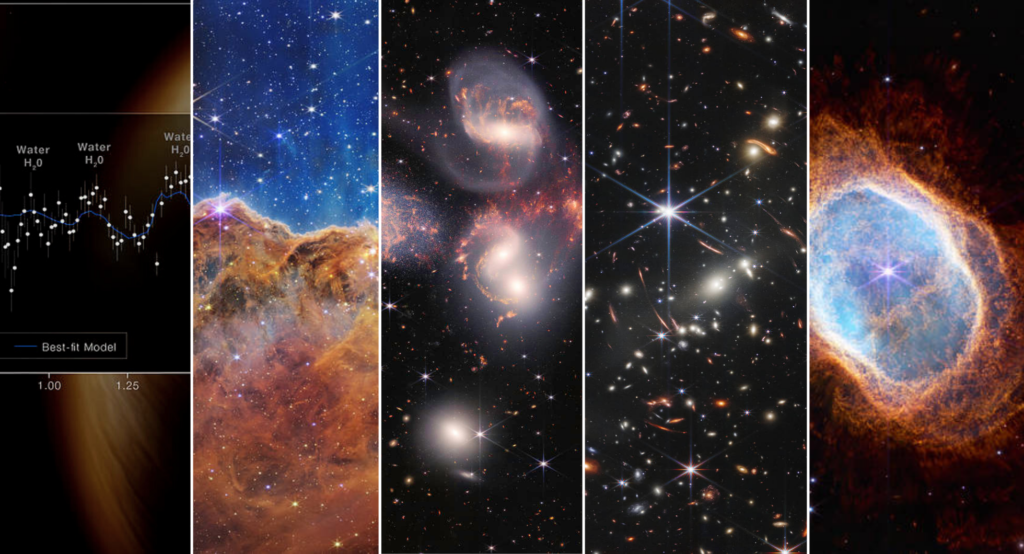
First, five images were released on Tuesday
Image credit: NASA/ESA/CSA/STSCI
In one of the five images released on Tuesday, we see water vapor in the atmosphere of a faraway gas planet. The spectroscopy – an analysis of light that reveals detailed information – was of planet WASP-96 b. The exoplanet was discovered in 2014. Nearly 1,150 light-years from Earth, WASP-96 b is about half the mass of Jupiter and zips around its star in just 3.4 days.
Constructed from almost 1,000 separate image files, another image shows Stephan’s Quintet, a visual grouping of five galaxies, as observed from the Webb Telescope.
The Webb telescope also revealed never-before-seen details of Stephan’s Quintet, in which four in five galaxies experience repeated close encounters, which provide insights into how early galaxies formed at the start of the universe.
Likewise, the Webb image of Carina Nebula, a stellar nursery, famous for its towering pillars that include “Mystic Mountain,” a three-light-year-tall cosmic pinnacle captured in an iconic image by Hubble, also bewildered beholders with its grand star-forming beauty.
The image has presented an unprecedented detail of the “mountains” and “valleys” of a star-forming region called NGC 3324 in the Carina Nebula, dubbed the “Cosmic Cliffs,” 7,600 light years away.
In the beginning, the White House on Monday released a stunning shot that was overflowing with thousands of galaxies and features some of the faintest objects observed.
The image, known as Webb’s First Deep Field, shows the galaxy cluster SMACS 0723, which acts as a gravitational lens, bending light from more distant galaxies behind it towards the observatory, in a cosmic magnification effect.
The Webb Space Telescope has also revealed details of the Southern Ring planetary nebula that were previously hidden from astronomers. Planetary nebulae are shells of gas and dust ejected from dying stars.
How these images are set to change the course of understanding about the universe and the galaxies across the universe:
Astronomers expect a torrent of knowledge from the James Webb telescope, which has infrared frequencies that are not visible to the human eye but are extremely rich in information about the building blocks of the universe.
Johns-Krull said in an interview that the telescope will also be a particularly powerful source to look at planets around other stars.
According to Johns-Krull, the telescope also opens many possibilities for finding a planet that supports life, and knowledge about how galaxies are formed.
NASA had earlier said that with Webb’s observations, researchers would be able to tell us about the makeup and composition of individual galaxies in the early universe for the first time.
The James Webb Telescope, which is orbiting the Sun at a distance of a million miles (1.6 million kilometers) from Earth, in a region of space called the second Lagrange point, was launched in December 2021 from French Guiana on an Ariane 5 rocket.
The total project cost is estimated at $10 billion, making it one of the most expensive scientific platforms ever built, comparable to the Large Hadron Collider at CERN.
Made up of 18 gold-coated mirror segments, Webb’s primary mirror is over 21 feet (6.5 meters) wide.
How James Webb telescope images are changing the understanding of the universe
Images captured by the James Webb Telescope are expected to change our understanding of the universe – and it has now started with the first five high-resolution images in ‘microscopic'(in the universal scale) details.
It reveals the earliest galaxies, the birth of stars, and even water vapor in the atmosphere of a faraway gassy planet.
With the first five images released on Tuesday, the James Webb telescope has already started to change our understanding of the universe and also help us in finding relationships between early universes and planets and star formation.
James Webb telescope images will change the human understanding of the universe in the following ways:
Astronomers say we have begun seeing the universe in wavelengths we have never seen before.
Observing things like star and planet formation and when galaxies first formed, can tell us a lot about how galaxies formed.
Another major purpose of the James Webb telescope is to provide a detailed picture of the early universe.
By observing these universes, astronomers will be able to examine how galaxies formed and how they evolved.
The James Webb Telescope will have a powerful infrared vision. This vision will also be able to study planets that are orbiting other stars.
Astronomers look at the James Webb Telescope’s image as a “new camera”. This telescope has a large mirror, so it can see things much more clearly than other telescopes.
The James Webb telescope will reveal hundreds of mysteries of the universe, including the search for extraterrestrials.
The image that was released on Tuesday shows the Pioneer galaxies, the galaxies that formed in the first few hundred million years after the Big Bang.
The James Webb Telescope has finally opened a new window to the universe and with its success, let’s hope that our future generations would be able to mine Gems, traveling far and wide in the universe.
Researchers claim that a proposed future instrument called “GRADAR” might use gravitational wave reflections to map the invisible universe in an article accepted to Physical Review Letters.
These signals could help astronomers locate dark matter or faint, unusual stars and uncover information about their interiors.
The very fabric of space and time is being shaken by gravity waves, which were first identified in 2015. Gravitational waves are used by astronomers to observe dramatic occurrences like the merger of two black holes, which is extremely challenging to observe with simply light. However, physicists are also aware of the illogical capacity of gravitational waves to change direction.
Using Einstein’s theory as a guide, they calculated the strength of the signal that would come from waves dispersing within a star itself.
This would make it possible for researchers to look for large space objects that would otherwise be impossible to locate, such as dark matter clumps or lone neutron stars on the far side of the observable universe.
This discovery could also be used to map the universe in greater detail and trace the innards of stars.
The latter gravitational wave signals, often called “gravitational glints,” had always been thought to be too faint to be seen. But due to Einstein and his theory of gravity, Cleveland, Ohio’s Case Western Reserve University physicists Craig Copi and Glenn Starkman made a breakthrough.
Can the gravitational wave “radar” be a foundation for futuristic cosmic technology?
Not intelligent yet, but gravitational wave “radar” could be developed into an intelligent system. In order to do so, physicists will have to develop a system that can detect small signals from astronomical objects distant from Earth. The signal coming from a small object, such as a neutron star, would be only about one trillionth the intensity of sunlight. To get enough information to observe detailed patterns, the signal needs to be more than 100 trillion times stronger.
The Universe is made up of billions of atoms and galaxies. Dark matter, or invisible matter, makes up 68% of the Universe, but we can’t see it. It could be a kind of repulsive gravity that drives galaxies apart, or something unknown.
And the Universe has also been expanding since its very creation. Quantum mechanics explains about a “hundred percent” of what happens on Earth, the Universe, and even bigger scale. In such, we need help from Artificial Intelligence(AI) to explore the universe further.
For the purpose, scientists could develop the gravitational wave “radar” (GRADAR) as an AI. “GRADAR AIs” could be created with the help of Machine Learning(ML) techniques that are still maturing.
The intelligent GRADAR would be like an intelligent calculator that collects data from a space probe (observing station). It will process, organize and transfer data to an intelligence that can make decisions and send it to ground controllers.
Future use of the finding
If scientists find dark matter, it would be a huge help to astrophysicists who are trying to understand how the Universe began. Dark matter was first hypothesized in the 1930s by two physicists named Fritz Zwicky and Jan Oort.
In addition to this, Gravitational wave “radar” could be developed into an artificial intelligence. GRADAR AIs could be created with the help of Machine Learning(ML) techniques that are still maturing. It would be like an intelligent calculator that collects data from a space probe.
Copi said, “It’s a very hard calculation”. But in the end, we’ve dealt with a lot of situations like this previously. Consider the Large Hadron Collider or even the entire gravitational wave detection narrative. Once upon a time, it was likewise believed to be an improbable scenario.
It will be a significant step toward a more thorough knowledge of the Universe if this research is validated and confirmed. We can hopefully increase our understanding of the invisible Universe by further research and experiments.
Now, detection of gravitational waves in the invisible universe has almost become possible. Scientists hope that GRADAR AIs or further futuristic cosmic technology would be developed in future. This artificial intelligence would be like a space probe or telescope. And, it would collect data from the universe and send it to an imaginary world!
Our AI could be used for all kinds of purposes, including these studies that run on data gathered from space probes such as the Voyager and Cassini missions, among others.
After being trained on real astronomical observations, artificial intelligence (AI) algorithms now outperform astronomers in sifting through massive amounts of data to find new exploding stars, identify new types of galaxies, and detect the mergers of massive stars, accelerating the rate of discovery in the world’s oldest science.
Astronomers say AI can reveal something deeper like unsuspected connections hidden in the complex mathematics arising from general particular, how that theory is applied to finding new planets around other stars.
What is an AI algorithm?
An AI algorithm is a set of mathematical instructions based upon some pattern or problem; andthat the person creating the algorithm wants to solve. To do this, it uses known data sets (e.g., many different training sets) to solve similar problems by searching for patterns in the data. When given a new problem, it searches through its training data sets; and it utilizes whatever solution it finds to compare its new unknown results.
It then uses this comparison to alter its approach in an attempt to improve its solution for all future comparisons that use similar approaches. In practice, this means it will adjust itself based on the historical performance of the approach; it also makes future comparisons more accurate than past ones.
New finding: AI reveals unsuspected math underlying search for exoplanets
In revealing unsuspected math underlying the search for exoplanets, AI can offer insights into observations of massive stars and their remnants, including black holes and neutron stars. Moreover, AI can be used to develop more efficient ways of discovering new exoplanets; and possibly, we can use it for discovering life outside our solar system.
In a paper published this week in the journal Nature Astronomy, the researchers have described how an AI algorithm developed to more quickly detect exoplanets when such planetary systems pass in front of a background star and briefly brighten it. It’s a process called gravitational microlensing. It revealed that the decades-old theories now used to explain these observations are woefully incomplete.
Albert Einstein himself 1936 used his new theory of general relativity to show how the light from a distant star can be bent by the gravity of a foreground star, not only brightening it as seen from Earth but often splitting it into several points of light or distorting it into a ring, now called an Einstein ring. Researchers say this is similar to the way a hand lens can focus and intensify light from the sun.
Major degeneracies and their unification
Degeneracies are the collective phenomenon arising from the massive stars in the center of the image. They cause light rays to split into many images that are seen as a ring.
An event related to gravitational microlensing was observed in 1987. At that time, two massive stars collided and caused their respective Einstein rings to merge into a single distorted ring. These events are called ‘symbiotic’ gravitational microlensing events. It’s because researchers say, they unite (or “symbolize”) several degenerate objects into a single one.
These degeneracies have no theory underlying them, so explaining them was thought impossible until now. AI has revealed hidden structures in this complex math.And that may show how it works for both general relativity and quantum mechanics.
When the foreground object is a star with a planet, the brightening over time — the light curve — is more complicated. What’s more, there are often multiple planetary orbits that can explain a given light curve equally well — so-called degeneracies. That’s where humans simplified the math and missed the bigger picture.
But the AI algorithm pointed to a mathematical way to unify the two major kinds of degeneracy in interpreting what telescopes detect during microlensing, showing that the two “theories” are really special cases of a broader theory that the researchers admit is likely still incomplete.
Now, professional astronomers say that a machine learning inference algorithm, which was previously developed, led us to discover something new and fundamental about the equations that govern the general relativistic effect of light- bending by two massive bodies.
Authors of the paper claim that this is kind of a milestone in AI and machine learning. They say Keming’s machine learning algorithm uncovered that degeneracy that had been missed by experts in the field toiling with data for decades. And this was suggestive of how research is going to go in the future when it is aided by machine learning, which is exciting.
Discovery of exoplanets to date and future plans
To date, more than 5,000 exoplanets, or extrasolar planets, have been discovered around stars in the Milky Way. However, few of them have been seen through a telescope and they are too dim. Most of them have been detected because they create a Doppler wobble in the motions of their host stars. Or because they slightly dim the light from the host star when they cross in front of it; transits that were the focus of NASA’s Kepler mission. And only a few more than 100 have been discovered by a third technique, microlensing.
NASA’s Nancy Grace Roman Space Telescope is scheduled to launch by 2027. It has the main goal to discover thousands more exoplanets via microlensing. NASA states that the technique has an advantage over the Doppler and transit techniques. It’s in that it can detect lower-mass planets, including those the size of Earth, that is far from their stars, at a distance equivalent to that of Jupiter or Saturn in our solar system.
Astronomers’ previous attempts to develop an AI algorithm
The team of Bloom, Zhang, and their colleagues set out two years ago to develop an AI algorithm to analyze microlensing data faster to determine the stellar and planetary masses of these planetary systems and the distances the planets are orbiting from their stars. They say that such an algorithm would speed the analysis of the likely hundreds of thousands of events the Roman telescope will detect to find the 1% or fewer that are caused by exoplanetary systems.
But one problem astronomers encounter is that the observed signal can be ambiguous. When a lone foreground star passes in front of a background star, the brightness of the background stars rises smoothly to a peak. And then it drops symmetrically to its original brightness. It’s easy to understand mathematically and observationally.
But if the foreground star has a planet, the planet creates a separate brightness peak within the peak caused by the star. While trying to reconstruct the orbital configuration of the exoplanet that produced the signal, general relativity often allows two or more so-called degenerate solutions; all of which can explain the observations.
View of astronomers on the issue
Scott Gaudi, the co-author of the paper, a professor of astronomy at The Ohio State University and one of the pioneers of using gravitational microlensing to discover exoplanets, said that astronomers have generally dealt with these degeneracies in simplistic and artificially distinct ways to date. If the distant starlight passes close to the star, we could interpret the observations either as a wide or a close orbit for the planet — ambiguity astronomers can often resolve with other data.
According to Gaudi, the second type of degeneracy occurs when the background starlight passes close to the planet. In this case, the two different solutions for the planetary orbit are generally only slightly different.
The researchers said that these two simplifications of two-body gravitational microlensing are usually sufficient to determine the true masses and orbital distances.
What’s in the new paper based on general relativity?
Zhang and Gaudi have submitted a new paper that rigorously describes the new mathematics based on general relativity. And it explores the theory in microlensing situations where more than one exoplanet orbits a star.
The new theory technically interprets microlensing observations with more ambiguity. It’s because there are more degenerate solutions to describe the observations. However, the theory also clearly demonstrates that observing the same microlensing event from two perspectives; it’s from Earth and the orbit of the Roman Space Telescope, for example. It will make it easier to settle on the correct orbits and masses. Gaudi also clarified that that is what astronomers currently have planned to do.
Likewise, Bloom said that the AI suggested a way to look at the lens equation in a new light and uncover something really deep about its mathematics of it.
So, for now, AI researchers, astronomers, and cosmologists are confident that machine learning is useful in understanding microlensing. They say that the new method has led to the discovery of a new mathematical property of general relativity. It could be useful for finding exoplanets with NASA’s Roman Space Telescope.
The team also says they may use their method to solve other issues in astrophysics. They have already found an interesting application in a separate field of stellar physics. There, researchers are trying to determine the average temperature and density of stars more accurately than they can now. These quantities are important for understanding how stars evolve over cosmic time and how they explode as supernovas.