Every single moment, the present is changing into the past. As such, what fraction of time can we consider the present? Is it a minute, a second, or is it a fraction of a second?
The philosophical question of the present is quite broad, as it deals with a specific point in time that cannot be measured. However, it is important to understand the idea of “now”. The philosophical concept of “now” is confusing and almost impossible to define.
The past and future make sense because we can easily share experiences from those times; however, the mere concept of now seems to be nonexistent in its own right.
The past existed once and the future does not exist yet; however, there is a specific point in time where we can all say “now”. This blog will explore the paradoxical idea of the present, including some of the different philosophical viewpoints on what it could be.
What fraction of time is the best definition of the word “present”?
We may define “now” as a specific point in time; however, how can we prove that this point in time actually exists? This question is quite confusing, because if we are to be precise about what fraction of time makes up the present, then it would mean that the present must be quantifiable.
What does this mean? Well, it means that if something cannot be measured and cannot be quantified, then it does not exist. This poses a problem for the idea of the present. The present cannot be calculated precisely because it does not exist; thus, there is no exact amount of time for which we can say there is a present.
The problem of quantification for the present is not only a philosophical issue but also a scientific one. What does it mean to quantify a substance that cannot be measured? Do we even have any way of measuring “now” on our current technology?
The concept of the present is so important to our current understanding of the world because it is impossible to apply any math formula or equation to “now”.
For example, what fraction of time is going by right now? We could come up with several different answers. Could the current moment be 1 second? Could it be 5 seconds? It is difficult to provide an exact number in time, and this is a problem for the concept of the present.
Is it just a “straight line”?
One way of thinking about time is to imagine it as a straight line. One edge would be the past, and the other edge would be the future. We are essentially moving along this line; however, we can never reach either edge because they both move farther away.
Past events no longer exist, and yet they were a part of our lives; however, they can now never be experienced again. The future, on the other hand, is a concept that exists in our minds; however, we have not experienced it yet.
This is the paradoxical nature of time: the past and future both exist and do not simultaneously exist.
Understanding what fraction of time is the present will allow us to understand our lives as a whole.
More about the idea of “Present”
The idea of the present should be important to us because it gives us a way of understanding our lives. We experience unique moments every single day; thus, when we think about these times with love and nostalgia as opposed to boredom or hate – then we are truly living in the moment.
The idea of living consciously is to understand that these moments are fleeting; they are incredibly small fractions of time that will always pass us by until there is nothing left but past experiences and unknown futures.
In response to the above problem, we could say that “now” is a specific time point in which we have experienced something. This would mean that “now” is an actual amount of time.
However, it is not possible to measure or quantify “now”, so it would make sense that our definition of it can only be defined by our experience and knowledge. The reader could make assumptions based on their own experiences rather than rely on just one truth; however, this only leads to more confusion because everyone’s experiences are different.
Philosophers have been debating the nature of the present for centuries and many have come up with different ideas on how “present” should be defined:
Idea 1: The present does not exist
This idea suggests that the present does not exist, because it is only a concept that we can never really understand. The past exists as an actual experience, and the future exists as a concept; however, there is no actual understanding of what the present is.
We can never fully experience these times or we can never completely understand them. Because they are abstract concepts in our minds and they do not have any physical presence, then they cannot be said to exist or not exist.
Idea 2: All time is the present
This idea suggests that all time exists right now; therefore, there is no past or future. The past, present, and future are all different ways of thinking about our lives. We can say we were in the past because it is true that we were in the past.
However, this does not mean that we are not living right now because if we are alive, then we must be living right now. The present is real because it is experienced by us; however, to anyone else, our “now” moment may be the past or the future.
For example, the moment someone dies and there are no more thoughts or experiences – their “now” moment is gone forever. There is no longer a point in time where that person can say they are experiencing something.
Idea 3: The present is just the here and now
This idea suggests that the present is no different than any other moment in time. It is our own subjective experience of reality and it depends on where you are, who you are, and what you are doing – as well as your emotions at that moment. You can have an amazing or horrible experience right now; however, since the past exists on paper or screens – there must be a “now” somewhere in time.
And, if there was no “now”, we would not have a reason to do anything; however, we do have a reason to live every day because we can say that right now we are alive. We are experiencing this “now” moment which is something we can never know if will be gone immediately.
The theory that the Present is infinite
This is one of the astonishing theories about space-time and existence. If the present is infinite, and the present exists, then infinity exists. And this is the most startling idea about the universe.
If “now” is an infinite amount of time, it follows that something cannot have a beginning or an end if it is infinite. So, anything that exists would need to be infinite to exist. If we accept this argument, it follows that the present would be infinite because it exists right now and infinity exists right now.
All ideas are rooted in the present moment; therefore, our minds and bodies are part of this eternal moment where everything connects to everything else through space-time.
Conclusion
Multiple philosophers have argued that the present exists in some way or another; however, they usually argue that the past and future cannot exist because they are both made up of different moments. The idea that what fraction of time is the present is important because it allows us to understand our lives as a whole.
The present gives us a reason to live, dream, and think about our plans. It helps us imagine a better world where we can achieve our goals and become successful people. We love the idea of being alive and living right now; however, we also dread the idea of death because at that point it would be impossible to experience anything else.
The universe we are all living in is just an illusion, created by our minds without having to go anywhere other than our own thoughts.
A perspective
Have you ever found yourself wondering “how can I be learning anything from a one-dimensional story, how can something so abstract be real?”
Well, wonder no more, because this article has been written about this subject and the implications it has for us all. Read on to learn more and see what you think!
Scientists have long argued as to whether or not reality is really our perception of it, or if there is any objective truth at all. This topic in particular has been widely debated over and over again throughout the history of mankind.
One thing’s for sure: The universe we are all living in is just an illusion, created by our minds without having to go anywhere other than our own thoughts.
Is the “universe” just an illusion created by our minds?
The universe is our “dreaming”
Imagine, for a moment, that we are living in an enormous dream. As the dream goes on, we get closer and closer to “waking up”.
The question then arises: what caused us to fall asleep in the first place? Moreover, who is dreaming this very dream in which we are dreaming of existence? Is there any way we can wake up?
https://www.youtube.com/watch?v=xVCk0VSKPW8
Probably, it’s possible that every moment, we are creating the universe in our minds and thus causing it to exist.
Our minds create the universe, and similarly everything that happens within it. This “universe” could be said to be a simulation created by our minds.
Indeed, every single one of us has a conscious mind able to experience this “dream”.
How can we know anything, after all?
Now, what if our minds are not “dreaming” everything that happens there? That means we could not base any of our beliefs on these experiences, as the only thing we could ever claim to “know” about existence is the things about it that our conscious mind can experience.
And surely that wouldn’t be much.
Thus, if this “universe” is truly just a projection created by our mind, has it actually happened anywhere or anyhow?
Or perhaps it was merely imagined and then stored in a matrix called the “universe”. In this case, it wouldn’t be very likely that there would be an objective reality behind anything.
A person’s mind can have three different states of consciousness: waking up, being asleep, and dreaming.
The first represents the conscious mind being fully engaged and aware of all presented stimuli.
The second one is characterized by a state of deep sleep, in which there are no dreams but the brain waves are present.
The third one is a mental state between the other two, where one remains in bed awake but goes into an inner world, not unlike our own universe (only far more simple).
Storing, accessing knowledge in brains
Now, if our minds are actually creating the universe that we are living in, does this mean that everything is just a product of our imagination? Or perhaps the explanation for the universe’s origin lies beyond the conscious mind.
Interestingly, when we sleep and have those wild dreams, we may access knowledge from what seems like another dimension. While most of it remains a mystery, some parts of this information can be consciously remembered. It can therefore be considered “objective”. There could still also be some form of an outside influence (some sort of higher entity) guiding us to create this “universe”.
One way or other, even quantum physics accepts that something exists only if there is an observer to observe it. The known universe does not exist independently from any observer. Therefore, it is fully reasonable to assume that all of this could be a simulation created by our minds as a result of some sort of higher entity.
The brain is like a “supercomputer” that processes any information we are supposed to access during our conscious experience. However, what if we have no control over what goes on there? How can we be sure that this “universe” isn’t just another product of our minds?
Probably, it’s possible that every moment, we are creating the universe in our minds and thus causing it to exist. Perhaps, then, the universe is an illusion created by our minds. And, we are unable to even understand it given the fact that it’s just a creation of ours.
Perhaps at this very moment, our minds create the universe that we experience and believe exists independently from us. If this hypothesis were true, then there would be no need to look for any further explanation as to why reality appears the way it does: everything would be just a product of imagination. We can not claim for sure one way or another. All we can do is make assumptions, and try to make sure they are valid.
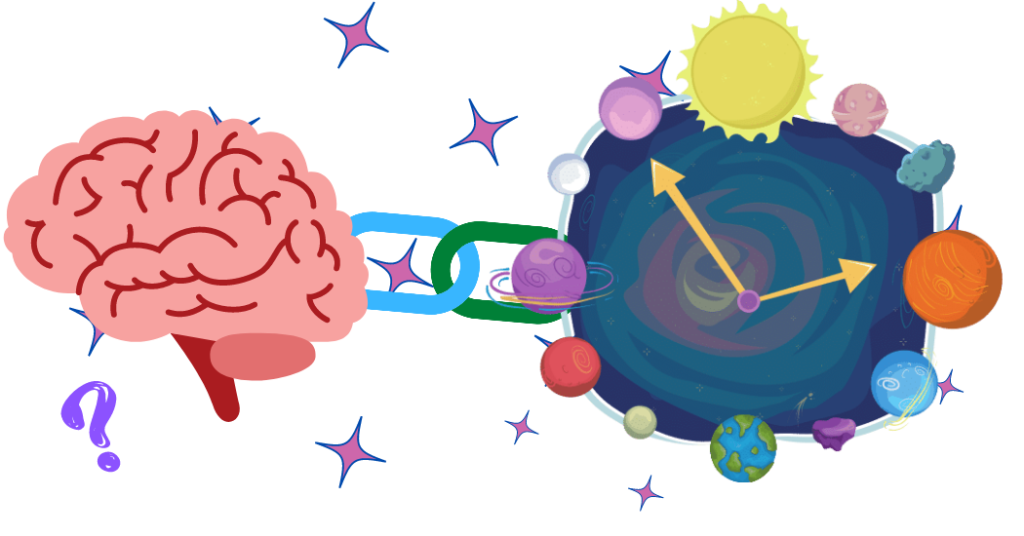
Our brain and space-time have relation in the sense that both have alike systems.
The space we are accustomed to inhabiting is three-dimensional and it has length, width and depth. Moving through space means that an object changes its position with respect to an observer as the observer moves closer or away.
In contrast, we usually consider time as a one-dimensional construct, with only one direction that anything can travel: forward. That’s why Einstein called our perception of time “the biggest mystery” in his life.
Although the superb structure and exceptional functions of the brain are still mysterious to the much extent, this post will dig into the relation of our brain with space-time.
The complexity of human brain
Our brain is a complex system. It’s so complex that no observable signal can possibly describe it accurately enough to reproduce it as a computer simulation. And yet it works exactly like the most complex computer simulation ever constructed: our Universe.
Let’s start at the beginning: we are born when a new life form, us, appears out of the early Universe. And we possess consciousness as soon as we enter this 3D world filled with space and time.
We live life in our 3D Universe, filling space with us and time with the events of our lives. As we age, we lose some of the new brain cells that we never got a chance to use and eventually die when they are all gone.
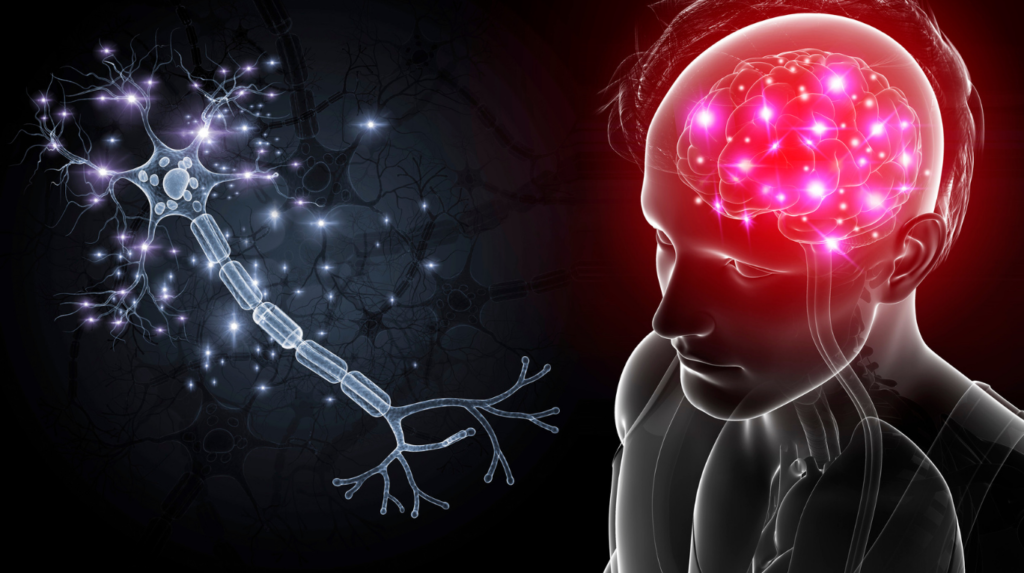
Brain is made up of billions of neurons, and space-time consists of billions of galaxies.
But in reality, it’s not that simple. You grew up thinking that your brain is composed of billions of neurons, connected by synapses, firing electrical signals to transmit information one step at a time.
But this is not how it works. The nervous system is far more complicated than this process. It’s because every single cell in our body can communicate directly with every other cell via electric pulses traveling through its membrane potential (which is the output from all cellular membrane potentials).
So, if the brain is made up of billions of cells, how can each cell communicate with every other cell?
We know that our Universe is the “totality of space-time” that expands and contracts over the billions of years it takes for the Universe to form and evolve.
Yet, we are made up of time and space. There are billions of neurons in each of our brain cells. But it’s not possible for there to be billions of simultaneous brain cells communicating with each other via single neurons firing electric signals.
The answer is that our brain weaves all these different processes together. There are billions of neurons that can talk to other groups of neurons.
While at the same time, they are made up of many groups of neurons that talk to each other via single neurons firing electric signals.
Furthermore, every single neuron not only communicates with all the other neurons in our brain, it also communicates directly with all the other cells in our body.
In this way, our 3D Universe is woven together by threads made up of many thousands of messenger chemicals that communicate via brain signals. And we can see these networks “unraveling” as we age and destroy the messenger chemicals that were created in our 20s and 30s.
This same process also happens to all of us, as our brain cells are replaced throughout our lives by new cells that are built from new messenger chemicals.
Points to claim that our brain has a real relation with space-time
Our brain and the space-time have relation in the sense that both have alike systems. The brain is a system where many groups communicate with one group. And similarly, the universe is made of atoms that communicate with one another. And they create the molecules that form us and our Universe.
Our brain’s neurochemical communication system is exactly the same as the Universe’s neurochemical communication system. We can see it unraveling as we age, which is exactly similar to what happens to our Universe; specially when it expands and contracts over billions of years. In fact, a neuroscientist just recently proved that this process of breaking down neurons and rebuilding them over our lifespan is the basis for both time and space in our Universe. His name: Jack Cowan.
Our brain works very much like a computer simulation. And we are made up of real space-time that connects our brains together.
We can measure the complexity of our brain through the parallelism between its structure and the structure of our Universe.
The structure of our Universe and the structure of our brain are all but exactly the same.
Our brain’s neural connections are very similar to the connections between atoms in our Universe.
Our brain’s communication system is very much like the connections between atoms in our Universe.
Brain is made up of billions of neurons, and space-time consists of millions of galaxies.
It’s amazing to see the any relation between the space-time and our brain. And it’s also mysterious how our brain’s complexity reveals more about the nature of space-time itself. We long know that space-time has made everything in our Universe, atoms and molecules.
We have not yet realized that the same space-time has made us. But it’s organized in a very special way by our brain.
We hear about different aspects of time like ‘now time’, ‘time clock’, ‘time frame’, ‘time line’ etc. but the question about our actions “if there exists no time, but just eternal now” comes up in a time when time is so abundant and important.
It’s hard to imagine what our existence would be like without time. But, I’m sure it would be just interesting to find out what we would do in a situation where there’s only eternal now and no existence of time at all.
The question of the timeless existence of physical reality has entered into debate for centuries, with many claiming that there are no limits or boundaries on human thought. If we could tear away the veil from our day-to-day life and see through our imagination to another dimension, which may have unlimited opportunities for us, this becomes an intriguing idea.
Let’s dive deep into it…
What if there exists no time?
The goal of this article is firstly to analyze what time actually is and then to discuss its philosophical implications. It’s the notion that there is a “now time”. And also the question of whether this “now time” is real or just a perception of our mind.
In addition, we’ll briefly shed light on some subordinates of time like ‘time clock’, ‘time frame’ and ‘time line’.
Finally, we will try to imagine how different would our lives be if there exists no time – just eternal now. What would be the implications on our lives in the timeless situation? Would everything have same meaning as it does right now? Would the idea of life and death still exist as it is?
Lets try to find out…
Does time really exist? (5 different definitions of time)
1) Time exists as a time clock
In one sense, time is based upon the idea that there are physical instants and that these instants are “countable”. In other words, time exists only if it is possible to measure any amount of time – or in a time clock. Physicists often use a certain type of clock called an atomic time clock to measure the duration between two instants.
An atomic time clock is really just an oscillator that sends out electromagnetic waves through a microwave cavity at a frequency that is proportional to its oscillation frequency. Atoms control these oscillations.
It’s also worthy to remember Buddha’s experience about time. When experienced enlightenment under the Bodhi tree, he became aware of this “eternal now” perspective and gained infinite knowledge about everything including reality.
2) Existence of time as a measure of change
Human life is often measured in terms of the changes we undergo and our progress towards a desired state. We may say that we’re growing older, or that our business is failing. Time here also becomes a measure of how much change has taken place. There are also different concepts of time being expressed as “now time”, “past time” and “future time”.
Every moment of time is transitory. The exact ‘now time’ does not remain static even for a billionth of a trillionth of a second. The ‘now time’ so quickly changes into the ‘past time’ that it’s no way observable for us. And so does the ‘future time’ to change into ‘now time’. This’s why we see the existence of time a measure of every change in the universe.
3) Time exists as an imaginary construct
From a philosophical viewpoint, time and time clock are different in the sense that the former is an abstract concept. Many scientists and thinkers have come to the conclusion that time is subjective. It means that, unlike a time clock, time does not exist independently outside the human mind. In other words, our minds create the idea of time. Our perception of time’s passing depends on our memory and expectations.
The present moment – or ‘time now’ – doesn’t really exist, which is in a constant process of change. We can only recall a past time line in memory and no future time line we can experience or prove that it even exist (yet). That’s why we hear people say that “time clock” may go by fast or slow for different people depending on their attitude towards life.
It means that people’s attitude towards life is completely a subjective factor. And, as we need to subjectively view a particular time line to understand it, we call time an imaginary construct.
4) Time as a dimension in which all physical things exist
In classical physics, scholars view time as a dimension, means a time frame, in its own right. They consider time to exist independently of events, in the same way that space exists independently of events. If you assume that everything is made up of energy, you could view time as the fourth dimension.
According to Einstein, you need to describe where you are not only in three-dimensional space – length, width and height – but also in time. It means time is the fourth dimension. So, to know where you are, you have to know what time it is.
It would make sense for the universe to be made up of four dimensions. In them include three spatial dimensions plus one time dimension. In the same “time frame” of the fourth dimension, each physical and abstract thing, including all the matter, energy and space – and the concept of the ‘eternal now’ as well – exists.
5) Time is made by human beings
The philosophy of Zen Buddhism says that time does not exist, but rather it is something made up by human beings. Like the other four definitions, we believe if you observe closely everything at a subatomic level, time doesn’t seem to exist. Everything is happening all at once.
In this view of time, the future time and the past time become just illusions created by our limited perception and understanding of reality. This perspective supports the aforementioned view in SH2 that time never remain static and nobody can detect its transition from one time line to another.
The question of whether there is a “now time”
When we say ‘now’, what do we mean? Does ‘now time’ even exist in the first place? Philosophers have pondered on this question for centuries, but still has no definite answer.
Imagine you are in a very different dimension and you can’t see into our ‘now time’. How do you perceive this dimension? Or how do things in this dimension seem to be happening? Can you say that something is happening before it happens or after it happens?
The question “what is the ‘now time’?” becomes more difficult because there is no physical reference for us to act upon. So we might ask “in what sense does ‘now time’ exist and what do we mean by the past time and future time?”
In a sense, we can say that all things exist simultaneously right now, even if it doesn’t look like it. Time is a concept that is commonly used to help us organize and understand things. In this sense, we can set time’s rules and its limits on physical reality. But if time is not real or no time exists at all, what are we doing? And, if there exists no ‘now time’, how can we experience something during an eternal ‘now’?
One thing that we can be sure of is that the human mind creates the notion of ‘now time’ because it helps us to function. So if there was any space between each moment, there would be nothing for us to think about and our consciousness could no longer function. Our minds need a time frame in order to exist. We therefore use time-concept to understand the world, organize our perceptions of reality and experience the climax of the ‘eternal now’.
But, if the world does not operate like it does today, our ability to perceive reality would be limited. The source of time is in our minds – not in the physical world – and if you look closely, time doesn’t exist even at a subatomic level either. It means any objectification of time – like now time, time frame, time line etc. – is just a product of our illusion. It means they all are only the products of our mind – and so is the ‘eternal now’
Eternal now – is it even possible?
We believe if there was only eternal now, we wouldn’t need to worry about time-based phenomena like life or death. If you were able to relive your entire life right now, you would see how all the events that took place in your life were important for you at some point. If you could relive your entire life, it would be like being able to review every moment from an eternal perspective and be able to see the big picture.
This idea of reliving our entire lives is not something that people are aware of because we are so limited by our human minds.
Unlike time, this concept of the eternal now is highly controversial and most people would think it’s impossible. We know that the mind can create time out of reality, but can it go beyond time? Can the mind create a place where everything is happening at once and nothing can change?
This seems like a utopia or an ideal world that we would all like to live in. If such a place existed, we could enjoy life more. It’s because we would be able to see everything as it is and have a clearer understanding of reality.
The mind can create time out of everything in the physical world, but it is important to remember that time of any form does not exist on itself and now time, the past time and the future time, all are only illusions. The mind is the source of time and it is certainly capable of creating a place where everything is happening at once.
But this place, or state (where only an eternal now exists), goes against logic because if you were there, you wouldn’t be able to do anything. Your consciousness would have limits to one thought/perception at all times (which quite often is already too much for us). If it’s true that the universe is managed by thoughts, our minds are limited. And they do not let us go beyond the ‘now time’.
In many spiritual traditions, adopting an eternal now perspective is one of the main goals. Achieving this state of mind gives us a new level of clarity and perspective. When we open our minds to new possibilities, we can finally see the big picture.
The next time you are worrying about the future time or thinking about the past time, remember that it doesn’t matter as much as you think. It’s because everything is happening at the right ‘now time’ and every moment has its purpose. The present moment might just be a small part of something bigger. And it may not even exist in our narrow perception of reality. If you live in the ‘now time’, you will be more in tune with your thoughts and emotions. It means living our best in the ‘now time’ makes it possible to living in the ‘eternal now’ as well.
Eternal now and enlightenment
As that of time throughout history, most of the world’s greatest philosophers and thinkers have proposed this idea of ‘eternal now’. Among them were Heraclitus, Plato, Plato’s student Aristotle, Plotinus, St. Augustine of Hippo and Nietzsche.
For example, Nietzsche said: “No moment ever dies or is past”. It’s also worthy to remember Buddha’s experience. When experienced enlightenment under the Bodhi tree, he became aware of this ‘eternal now’ perspective and gained infinite knowledge about everything including reality.
We hear ,modern physicists also say similar things like “a reality that is always here”. They all agree that even though there might be an infinite number of different places and time/s, there is only one present moment – the eternal now.
The past and future are reflections of the present moment, which we can call reality. Our mind creates the concept of some abstract time because it is limited by its own thoughts. The mind creates experiences out of physical reality because its own perceptions limit it.
The mind’s infinite power to create anything out of the physical world would be limitless if the only thing that existed was the eternal now. In fact, we think if all possible realities were created right now, we still wouldn’t be able to handle it.
The mind is capable of creating absolutely anything out of reality. But by creating something that goes against logic, the mind creates something that it can’t handle. And it thereby creates more limitations for itself.
Does this mean that there is no value of anything in life, then? Yes, it does – because there is a purpose. But it might not be what you are thinking. We believe that there will always be a purpose for our existence on Earth because otherwise the universe, the ways and the purpose of this universe wouldn’t exist.
Life and the universe are in a state of flux and always changing. Everything is always in a state of becoming something else. Life is everything if we view it from the eternal now perspective – it means it’s not only life as we know it today.
If you believe that thoughts manage the universe and our minds are capable of creating anything out of the physical world, it’s easy to think that the mind can create a place where everything is happening at once and nothing can change. But even if this place existed, whether we could handle this kind of reality might be another matter.
When we adopt an eternal now perspective, we cannot think about things as they are. It’s because we’re not in a state to think clearly then. Our mind can’t handle such a reality. The reason behind this is it goes beyond any time frame, any time clock or any time line and logic. We believe that at times humans can enter this state of mind temporarily. It’s because they have found peace inside themselves; but only for a temporary period until their human minds take over again.
To be a better version of ourselves, we must become aware of how our minds create a hypothetical time line out of reality and why they do this. There’s no reason to waste our lives stressing about the past and worrying about the future. We can make a change right at the ‘now time’ if only we are aware that we are doing it. There has to be a purpose behind all this, but maybe it is not what we think it is.
In fact, there’s been no reason to create anything at all because everything already exists as it is. The way your mind creates ‘time’ out of reality depends on what you believe about yourself and life in general. If you don’t believe it is possible to create anything out of the physical world, you won’t worry about making everything happen at right the now time.
There’s no reason to worry because nothing could ever happen – except in your mind and in your thoughts.
To conclude
Neither yesterdays nor tomorrows – the time is only the ‘now time’. And the same ‘now time’ is the ‘eternal now’ – the ‘right now’! You can do something about it right now! The now time is all there is. There is no time line such as past time line or future time line, but is only the eternal now. And, we are responsible for everything that our minds create out of physical reality. We need to accept this and be aware of our mind’s infinite capabilities.
The eternal now perspective gives us an entirely new level of clarity about ourselves and how we should lead our lives if we want peace and happiness inside ourselves as well as allover progress and prosperity. It’s because time doesn’t exist as we’ve always thought.
Our minds are accepting physical reality and creating something out of it. We can make a change right now – at the now time – if only we realize that our mind is creating time out of something that doesn’t have any time.