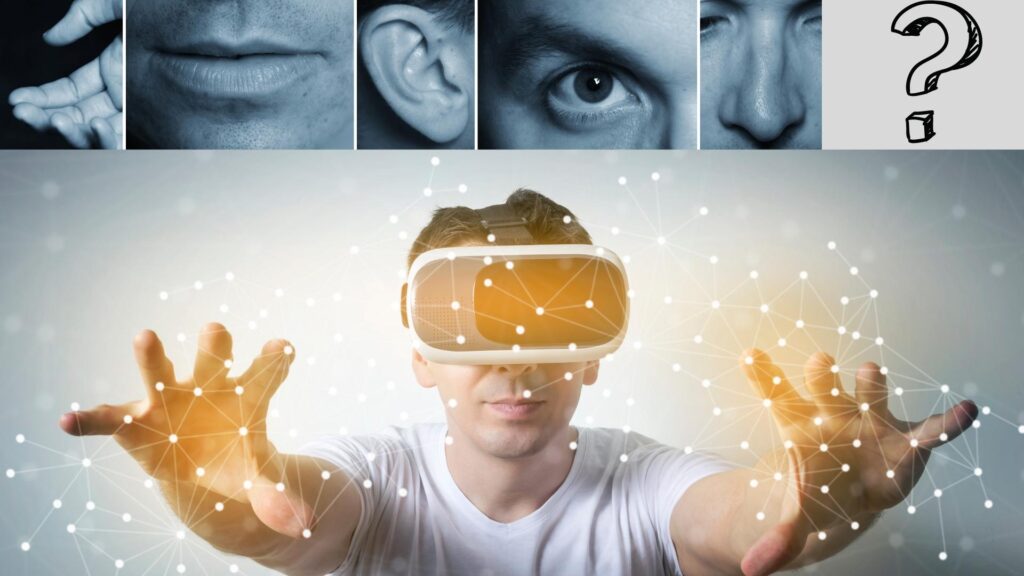
Reality editing is essentially a combination of a spectrum of technologies and approaches aimed at altering or enhancing human perception of reality. Reality editing is more than VR (a headset), AR (a headset) and even mixed reality, which is the visual blendof virtual and real worlds. While VR and AR dominate discussions, these technologies represent only a fraction of what reality editing constitutes. In recent years, especially with the initiation of AI era with the rise of Generative AI, research and development efforts have increasingly focused on synergizing AI with reality editing technologies.
Conventional VR and AR
VR typically involves wearing a head-mounted display to enter a fully immersive virtual environment, while AR overlays digital content onto the user’s view of the real world using devices like smartphones or smart glasses. These technologies have found real-world applications in education, architecture, and many more industries; even healthcare.
Non-VR aspects and future additions to reality editing
Here is a basic overview of non-VR facets of reality editing:
Auditory Reality Editing: Sound plays a crucial role in shaping our perception of reality. Consider noise-canceling headphones—they edit out unwanted sounds, creating a personalized auditory environment. Future applications could involve enhancing natural sounds or even introducing entirely new auditory layers.
Haptic Reality Editing: Haptic feedback is already a well-established VR integration. Our sense of touch profoundly influences how we perceive the world. Haptic feedback in VR controllers or wearables simulates physical sensations. You can feel the texture of a virtual sculpture or sense the warmth of a digital fireplace.
Temporal Reality Editing: Time manipulation is a powerful tool. Think about rewinding a video or fast-forwarding through a lecture. In reality editing, we could alter the perception of time. You could relive cherished moments, and on the other hand, compress hours into minutes during a tedious task.
Emotional Reality Editing: Emotions color our reality. Can we edit emotions? Perhaps. Future technologies might allow us to adjust emotional states. Imagine dialing down anxiety or enhancing feelings of joy.
AI in Reality Editing
The integration of AI into reality editing introduces capabilities beyond VR and AR experiences. AI algorithms can analyze user behavior, adapt content in real-time, generate dynamic narratives, and enhance sensory feedback, thereby creating more engaging and realistic virtual environments.
Recent Advancements in AI-Enhanced Reality Editing
AI-Driven Content Generation: Recent research has focused on large language models, such as OpenAI’s GPT-4, to generate lifelike narratives and dialogue within virtual environments. In fact, there are intelligent NPCs in existence already, like NVIDIA ACE’s characters, Jin and Nova, who recently talked to each other about their digital reality possibly being an “elaborate cybernetic dream”; all based on NVIDIA’s Nemo LLM, generating a new conversation each time. Such AI systems can understand and respond to user input, allowing for more interactive storytelling experiences in VR.
Enhanced Sensory Feedback: AI-powered haptic technology enable more realistic touch sensations in VR environments. The most recent haptic breakthrough, published on Nature Electronics, is this skin-integrated multimodal haptic interface for immersive tactile feedback. By integrating AI algorithms with haptic devices, developers can simulate textures, forces, and vibrations, enhancing the sense of presence and immersion for users.
Neuroadaptive Interfaces: Research into brain-computer interfaces (BCIs) aims to directly interpret neural signals and translate them into actions within virtual environments. BCIs offer the potential for lifelike interaction and control in VR and AR applications by bypassing traditional input devices.
Emotion Recognition: AI algorithms can analyze facial expressions, voice intonations, and physiological signals to infer users’ emotions in real-time. With emotion recognition capabilities, developers can customize user experiences, In fact, even to evoke specific emotional responses and enhance user engagement.
Real-time Adaptation: AI algorithms are being developed to analyze user interactions and adapt virtual scenarios in real-time by tracking user behavior and preferences. This is already being employed in digital conscious characters in “The Matrix awakens“.
Dynamic Object Interactions: Reinforcement learning algorithms allow virtual agents and objects to display behaviors that feel more natural and react intelligently to user input. This makes experiences that are not only more immersive but also more interactive achievable.
Cross-reality Collaboration: AI allows for the collaboration between virtual and physical spaces, enabling applications such as mixed reality and remote assistance. Integrating AI-powered communication and interaction tools, users can interact with virtual objects and remote participants as if they were physically present, like in platforms such as Nvidia’s Omniverse.
Future Directions
The convergence of AI with reality editing is expected to drive further innovation and transformation across various industries. Future research directions may include:
Advancing AI algorithms for more sophisticated content generation and interaction in virtual environments.
Exploring new modalities for immersive sensory feedback, such as olfactory and gustatory stimuli.
Enhancing AI-powered virtual assistants and agents to provide personalized guidance and support within VR and AR applications.
Investigating the potential of AI-driven predictive analytics to anticipate user preferences and adapt virtual experiences proactively.
Let’s be honest and agree that the present-day VR experiences are no better than the CRT Televisions of 1960. Just like we have developed a lot since then with better hardware, AI will do the same with VR.
In this article, we will talk about how AI will revolutionize Virtual Reality. But before that, let’s understand what VR is.
What is VR
Virtual Reality (VR) is a simulated experience that can be similar to or completely different from the real world. VR is achieved by using a computer to generate realistic images, sounds and other sensations that simulate a user’s physical presence in a virtual or imaginary environment.
A person using virtual reality equipment is able to look around the artificial world, move around in it, and interact with virtual features or items. The effect is commonly created by VR headsets, consisting of a head-mounted display with a small screen in front of the eyes, but can also be created through specially designed rooms with multiple large screens.
Now that we know what VR is, let’s see how AI changes the game.
AI is making the VR experience more realistic. The main aim of VR is to make the experience as realistic as possible. And with AI, we are getting closer to that goal. AI is already helping in creating realistic environments and characters. Just like in the real world, these characters can interact with you and react to your actions. A big advantage of using AI is that it can create and simulate an infinite number of possibilities. This means that you will never get bored of the VR experience as there will always be something new to do. As AI can also create realistic physics which makes the experience even more believable, it will make VR even more realistic in the future. Here are a few ways AI-powered VR experiences will challenge reality:
a. You
Yes, you read that right. In the future, AI will be able to create a realistic virtual version of you. This means that you will be able to meet yourself in a virtual world and interact with yourself. This can have many applications like helping you rehearse for an important presentation or interview. But yeah, it will be more than that, for sure.
b. Your surroundings
Just like AI can create realistic versions of people, it can also create realistic versions of your surroundings. So whether you want to visit the Eiffel Tower or the Great Wall of China, AI will be able to take you there without even leaving your home. And as AI gets better at creating these environments, they will become more and more realistic until they are indistinguishable from reality itself!
c. Other people
AI will also be able to create realistic versions of other people. So whether you want to meet your friends in a virtual world or talk to a celebrity, AI will make it possible. These characters will be based on real people, and will be able to react and respond just like them!
d. “A” world
AI will help create entirely new worlds which don’t exist in reality. So whether you want to visit a world made of candy or a world made of fire, AI will be able to take you there. Or maybe a world where gravity works opposite.
e. Anything else you can think of!
So whether you want to fly like a bird or swim like a fish, AI will make it possible. And as AI gets better and better, the sky is the limit for what it will be able to create! If you think AI can’t do it, you are utterly wrong. Have you ever heard about AI art generators, and how they can create art out of nothing? Exactly.
What about the immersion, though?
Well, let’s not overlook the VR part as it is the main factor in the process. You can not get immersed in the present-day boxes. The VR lenses must be comfortable, natural, lightweight, and with a large field of view. Also, the sound must be spatial and beyond three-dimensional.
And that’s not all! The user interface must be easy to use and natural. So that you don’t need to think about how to do something, you just do it. For example, if you want to pick up an object, you just reach out and grab it like you would in real life.
For that to become possible, we need haptic feedback. Haptic feedback is the sense of touch in VR. This means that when you interact with something in a virtual world, you should be able to feel it. Nowadays, we are only able to feel some vibrations, but in the future, haptic feedback will be much more realistic. You will be able to feel the texture of objects and even the temperature! Imagine being able to touch fire without getting burned or feeling the coldness of ice! That would take immersion to a whole new level!
And as if that wasn’t enough, AI can also help us with scent generators. So instead of just seeing and hearing things in a virtual world, you will also be able to smell them! This would make VR experiences even more realistic and immersive than they are now. And as AI gets better at creating these scents, they will become indistinguishable from reality itself! All in all, we could use a combination of non-invasive techniques to trick our brains to believe that the virtual world is real.
Conclusion
AI is going to change the game when it comes to VR experiences. It is already making them more realistic by creating realistic environments and characters which can interact with you just like real people do. But that’s not all! In the future, AI will make VR even more realistic by making it possible for you to meet yourself virtually, visit any place in the world without leaving your home, talk with celebrities or anyone else you want, create entirely new worlds which don’t exist in reality, fly like a bird or swim like fish among many other things. And if that wasn’t enough, AI can also generate and simulate any worlds, circumstances, and events you can think of, in VR.
AI has resided in our minds for decades now. But what if it was just a sort of distraction from what was coming? Is our future destined to reside with the next level ofvirtual reality(VR) – that’s Virtual Artificial Intelligence(VAI)?
We have realized Artificial Intelligence as on its way to our homes and workplaces. The internet is chock-full of articles proclaiming the imminent death of mankind at the cost of a few thousand lines of code.
We have plastered a concept about AI in our brains. We’ve also already accepted that it’s the only possible way it is going to be. That’s not a coincidence, it’s a form of confirmation bias. Maybe, there is something far more fascinating that is going to get unveiled.
What is that “something far more fascinating”?
Well, it’s Artificial Intelligence, but Virtual. Here, we are not even talking about something like a neural implant or a cortical implant. No, we are talking about the most exciting and yet the most subtle technology of them all, Virtual Reality.
Virtual Reality itself is a step further than AI. VR is not even a human invention, it’s an evolutionary technology. The innermost desire of every organism is to survive and thrive in any environment possible. That’s what drives evolution forward across species and time.
Artificial Intelligence is merely a child of this evolutionary drive, because, given our timeline of tech evolution, it was the first implementation that met the conditions for survivability in our thoughts.
Now, it’s time to take a step further and open up to “Virtual” survivability. It means preparing ourselves to survive in the imminent virtual reality of the next level.
In the age of digital technology, we have been creating so much data that it has begun to form a sort of collective memory, which we call the internet.
The internet is an ample infrastructure that allows us to create anything and everything in it. And because we are talking about virtual reality here, there is no need to limit ourselves to real-life data anymore, right? All this makes Virtual Reality a very exciting field where AI itself can be put on hold for a while.
If you ask me what technologies are going to define this century, chances are I am going to say the next level of Virtual Reality – VAI.
The most interesting, and encouraging as well for further development, thing about VR is that we can create the conditions or environments we wish to explore.
With VR you can create any environment that you want to live in and find your solutions where necessary. We are safe and we can solve “virtual” problems with relative ease. With physical AI, you never know what will happen.
Virtual Artificial Intelligence(VAI) – The complete concept
The current form of Artificial Intelligence we have is digital AI. The one shown in “Terminator” and other Sci-fis is Physical Artificial Intelligence (less likely, more dangerous). The one we are talking about, which is the future, is Virtual Artificial Intelligence.
Virtual Artificial Intelligence is where a digital representation of the AI has been implanted in your brain (or any other part of the body) with an input link. The digital representation is then able to mimic almost every physical activity you could perform yourself.
Thus, it can create virtual simulations of reality that are accurate beyond human biological limitations. And therefore, we can use them as real environments for training and testing.
If this were to work marvelously well, it would be without a doubt the next step in all areas of life, from business and politics to acting and entertainment. We would all have our own personal “9-to-5” office (wherever you are at the time).
The term
Yes. Here, the term Virtual Artificial Intelligence(VAI) refers to an AI-powered human who has immense capabilities inside a virtual world. We can see this as a revolution over the current form of digital AI.
In virtual reality, VAI can potentially solve problems that our organic minds cannot even comprehend.
For example, we can create a simulated environment with all sorts of variables and test it to death. It means we can create VAIs, to whom we will task to solve a problem. They will also be able to conduct their own research. Consequently, they will produce much more accurate results than any human being.
Can you imagine the possibilities this opens up for every industry? VAIs will soon be our personal assistants and an extension of our brains. We will have the power of thousands of minds inside our heads, solving problems, creating knowledge, and developing new technologies at an exponentially faster pace than we could have ever possibly imagined before.
And here is the best part; Everything will look real!
We’re going to visit a couple of different worlds:
The world of “perfect” problem solving, where anything goes and you can think of any solution that you wish to implement. In this world, AI is at its best and can create amazing results compared to our organic minds.
There are no rules or limits in this world. And, everything is possible there, from flying cars to healing the sick or traveling across universes or galaxies. This world only exists inside your mind – so far! But with VAI, we can make it true!
Or The real world, where you can fly a plane but it has to follow some set rules and regulations. In this world, AI is still at its best and it can create amazing results compared to our organic minds. But the problem here is that there are always limitations or limits to certain things.
Some limitations are scientifically proven (like gravity) and others are formed by society’s standards (like flying cars). This world only exists inside your mind – at least until now! With virtual artificial intelligence, we can make it true!
What do we need to make this concept a reality?
First off, we need to create the digital representation of our AI (which was implanted in our mind) that can do all the physical actions we wish and then can be used to create a virtual environment.
The main ingredient for this is a Virtual Reality lens.
What about the rest of these things? Well, we need some new hardware to make this possible. The main one of course is an implantable computer device. It can read your brain’s thoughtsand interpret them into commands for implementing those thoughts inside a virtual world.
You could describe it as a Brain-Machine Interface (BMI) or simply as “mind control”.
We also need to have a way to connect these two together, either through a wired connection or with the help of an advanced brain-wave translation system.
But it’s not that simple! We don’t just want to implant this technology in your head and then leave it there.
The next thing is immersion. We must be able to sense the virtual world just as well as the real one. This can be done with some excellent visual and audio technology. But it’s still not completely immersive yet.
Imagine a virtual world where you can sense temperature and touch sensations, to whatever degree possible. You could take a virtual stroll in the rain or even go on a skiing session without fear of freezing your hands off!
We need to feel everything that we could feel in our real life and every other sense as well. In these ways, we will be able to experience the virtual world just like it is reality.
The next thing we need is a physical space, of course. We will still need a physical environment to stay alive after all and this can be anything from a space station to a beautiful house on a tropical island or a human-sized box.
Artificial Intelligence is going to do the rest of the job: How?
AI-powered brain chip simulates the world and connects to the Virtual Reality lens which then connects to your brain.
All of a sudden we are immersed in a world that we can experience exactly like real life (complete with all of its senses), but there is no way to die physically! We can only be injured or killed in virtual reality, never in reality!
We will use anti-gravity and many more things inside VR and travel faster than light speed, i.e. 300,000 kilometers per second (186,000 miles per second) through the “vacuum” of empty space. But,yes, we will manipulate time and live much longer inside the virtual world.
AI-powered chip? But how will that chip be made?
The creation of an AI-powered chip we are talking about is too complicated. It can be made, and we will be discussing the details here.
For the creation of such a chip, we will need a few things:
1) High-level AI computing power
An AI that can formulate complex ideas and decisions, in a very efficient way, like the human brain. (This is probably the most difficult part of the solution).
2) The simulation of SoC-AIP (System on a Chip Advanced Intelligence Processor)
This is an artificial brain that simulates synapses in the human brain for processing information. This is also very similar to neural networks that are used by our biological brains for thinking and learning. (Mostly related to point 1.)
3) A very compact computer system that can be implanted in humans
Ideally, it will have all of its parts as small in size as possible, so it can be placed inside a small room in your head. (Yes, this is still a relatively difficult part).
4) The interface with the human brain and a series of other elements that do not need any further explanation here
So, if you think you have everything at your disposal that is needed for creating such a chip, then let’s talk about how to use it.
First, we have to build the AI chip. So let’s talk about the second part of the solution.
We will continue to use a computer system that is adapted to be implanted in humans. The computer system we are talking about is a chip that consists of an advanced computer processing platform with a neural cortex chip and a visual filter installed inside it. This combination is then connected to an implantable Brain-Computer Interface (BCI).
This BCI has what people call a ‘non-invasive electrode array’, which reads your brain’s electrical signals while you are wearing the headset and then translates them into commands that you can use in this virtual world.
Let’s get back to the computer. The first part of the chip is a System on Chip Advanced Intelligence Processor (SoC-AIP).
How will it work?
So, how will the SoC-AIP actually work? Well, let’s think about it for a second. You have an advanced computer that is capable of processing ideas and decisions. What else can this computer do except create virtual worlds?
The SoC-AIP will continuously create new environments around you that are absolutely identical to every thought you come up with. It also collects data from you through your senses and immediately analyzes it to determine its relevance or importance. It will then create virtual world environments that are most similar to the environment of reality.
Let’s take another example. You’re in a beautiful house on a tropical island, with a lake in the middle of it, and under you are exotic buildings surrounding you. Then, suddenly some kind of robot goes through an open gate at the back of your house and you hear something that seems to be like fireworks!
That’s just an example, but this is how the SoC-AIP works. It doesn’t generate anything out of thin air, it just makes sure that everything that comes into your mind is actually something real.
SoC-AIP was just one part of the solution. The other part was the visual one.
Visual sensory devices include your eyes, nose, and those little holes in your ears too, for sounds, and then the rest of your sensory system (like touch sensations).
This is a very complex part of our brain that we can find in every human brain and works differently from each other depending on age. So it’s obvious that in order to make a complete system that simulates life as it is to humans, we need artificial intelligence.
For example, I like to fish and I want to smell some fishy odor – so I ask my VAI, virtual assistant, for it. I get what I want and it looks good to me so I decided to take a bite.
How does that visual sensory device work? The SoC-AIP feeds the visual sensory device information about the idea or decision that you have created. If you are smelling fish then it will give you an image of fish, and when you decide to taste it, then it will provide you with the feeling of taste. So, in a nutshell: If we put all of the systems we talked about together into one intelligent system, it will create a perfect illusion, exactly like reality.
Why not Artificial Augmented Reality?
Forget about AR – AR is the best at what it does and is already more advanced than any physical AI yet created. This doesn’t mean that it’s better than any other form of AI. Only that it’s the most comfortable one you can use at this present moment.
Let’s give a quick definition of Augmented Reality: Augmented Reality is where digital objects are placed inside our world and they appear to be real – there are no real-world digital objects in Augmented reality.
The concept is simple: Take a digital representation of your environment and place it in the real world. By doing so, you get a constant, visual reminder of what you can do in that world.
The idea behind this concept is not to create an “illusion” but an “inspiration” in which people are aware of their abilities and limitations or rules that the society has formed or the rules created by science, but they are not aware of them while they are outside the simulation.
Let’s think about it from another perspective.
It’s more like having a “real-life-visual-reality assistant“. It can help simulate any reality you wish to explore through your own creation. You can see this in the example of video games. In these games, we can achieve new heights with our choice of characters and the places we explore in these worlds. We are able to create anything we want that feels real while it is only in our minds.
Traditional AR doesn’t do this, but it’s close to it! It’s a good start but falls short compared to what Virtual Reality offers as a solution. What’s more, it fails as a solution. It’s because it does not challenge your mind to solve problems you haven’t thought about yet. If you want to make something new come out of thin air, you will never know until you try. It means is not possible unless you get those superpowers – VAI!.
It is worth noting that there exist a number of frameworks for virtual reality in technology.
Here are some of them:
a) Augmented Reality (AR): As mentioned earlier, Augmented Reality (AR) is the use of computer systems, such as mobile phones, tablet computers, video game consoles, and Headsets with special cameras and software known by developers as 3D Object-Server (also known as Virtual Reality) to overlay non-digital information on top of the physical world.
b) Virtual Reality – VR is the use of computer systems to create a simulated 3D graphical environment. Manufacturers create it via Computer Graphics tools. Augmented Reality has been a new trend in the past few years. Whereas, the development of Virtual Reality is still going up. People have been using it mainly in gaming, except that the technology is on a larger scale.
c) Mixed Reality (MR): This is the use of Computer Graphics and Virtual Reality together to create a new environment. Different companies and divisions ship the “Mixed Reality”.
d) Metaverse – The Metaverse is the interconnecting virtual world of all computer applications. It is an AR, VR, MR, and Mixed Reality combined. This represents a real life that together these technologies could create to improve our society in the future.
Metaverse technology has been in development since at least 1995, when James Martin developed it as the “Metaverse SDK”, a free software project for building such a system.
The future of VAI
The future with VAI is the end of our current reality. It will be a human-centered technology that learns from us, evolves with us, and is more than just idle eye candy. We’ve got a long way to go, but it’s heading in the right direction.
Heading in the right direction refers to the necessary target of human evolution. And, only VAI can lead human intelligence toward that goal.
The human mind is not just a simple machine, it is truly an incredible one. And, when it gets support from the VAI, it will be able to develop into something much more intelligent than it already is.
A human with a VAI will be able to learn about the world and more about itself at the same time. For example, if you are playing a video game, you can ask your VAI for help. And it will provide you with information that you can use in the virtual world. It’s because the storage of all information will be within each individual, waiting for us to access and use.
VAI’s intelligence is better than human intelligence; it is just that we don’t know how to use it yet because we haven’t evolved enough. But, as we do so, technology evolves as well and things become far easier and far more productive for the whole human civilization.
Let’s conclude
So, there you have it. VAI is the future of artificial intelligence. It means this technology will one day completely replace AR.
The possibilities are endless – all thanks to VAI and the fact that it can learn from us, just as we can learn from it to create an even more intelligent human.
We have an amazing adventure ahead of us. But first, we must take a step back in time to know where this journey started and how far we got so far. We need to go back a few years before VR became a thing and before AR became popular, just to see how far technology already pushed us – at the time when my younger brother began playing around with his Vuzix device – iCOM – in late 2001.
Artificial Intelligence(AI) and time travel have been here for a long time. Although they have nothing to do with each other as of now, the incomprehensible combination of AI and Virtual Reality(VR) could open doors for Time Travel in the future.
We’ll get into the hows, ifs, and whens of AI + VR assisting Time Travel. But first of all, let’s be clear about all three concepts:
Virtual Reality – This reality is a simulated 3D environment constructed with technology in which an individual may interact with a computer-generated environment and with their imagination.
Artificial Intelligence – It refers to the ability of a machine to perform tasks that normally require human intelligence.
Time Travel – Time travel is the ability to travel through time.
First of all, let’s explore deeply the concept of ‘Time Travel’
Time Travel is a fictional concept with a “missing piece of the puzzle,” and the missing piece is TIME itself. Time does not exist in reality because the past is history, the future does not exist, and the present – what fraction of time is the present? Present – looks like a burning cigarette.
Time itself stands like a question when it comes to physical time travel. We just can’t travel in time because time is an illusion and has no physical existence.
The reason why we can’t physically travel in Time is that it is not a physical thing in our lives; rather it’s a concept. And a concept is something conceived in the mind.
A physical system can perform and manage processes internal to the system. On the other hand, change to, or use of, a conceptual system involves processes performed by external physical systems interacting with the conceptual system.
It’s about physicalizing the concept of time travel.
So, what this article is all about?
How AI and VR will help us with time travel?
The combination of Artificial Intelligence and Virtual Reality is a simple concept, yet dangerous in its way. This combination of technologies, as you may have guessed, will be used to develop and implement life-like experiences and even let you travel in time.
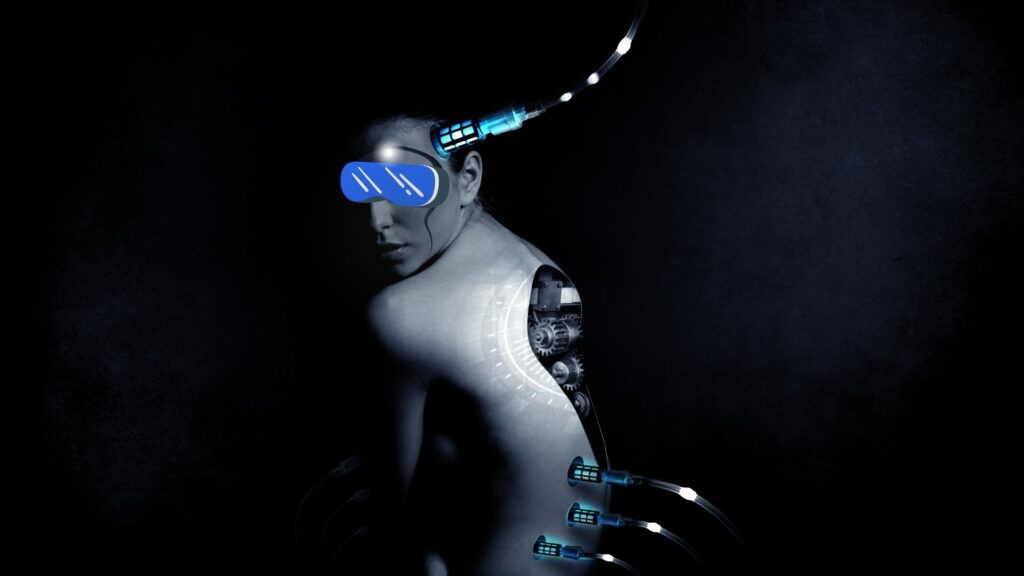
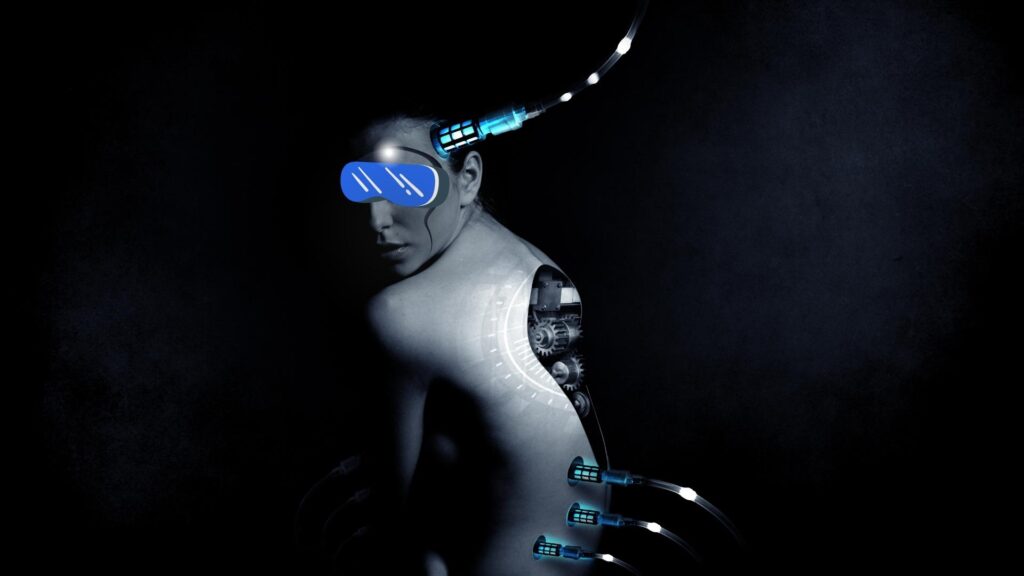
The following picture illustrates the concept of physical artificial intelligence wearing a VR headset. But this is not how it is going to work. Rather, the one who will be wearing the headset will still be you, and the AI will exist in the Virtual Simulation.
These artificial bits of intelligence will have the capability to simulate life much like in the movie “Ex Machina”. They can make themselves appear lifelike by using VR simulations and act at a given time (instead of now) in their lives.
The Visual Immersion of Virtual Reality will be a key part of artificial intelligence to be able to simulate a life-like experience. Instead of VR headsets, we will need something futuristic such as VR eye lenses. The reason for this is very simple, “immersion”.
But the Virtual Reality part does not stop right there. When we are talking about traveling in time with VR, we need to be able to interact with our environment in a very similar way as we would in the normal physical world.
Exactly, this is where machines and programming come in. They will then be able to manipulate the elements of our environment exactly as we would in the real world.
They will be able to control the elements of our environment, according to their programming and based on what they have learned from us. Artificial intelligence will then be able to simulate life exactly as we want it to. Let’s take a hypothetical scenario:
Artificial intelligence has the capability of simulating life: past, present, and possible future. And it uses virtual reality to make the simulation very lifelike.
How will Artificial Intelligence simulate life/time?
Using trillions of historical pattern analyses, artificial intelligence will simulate life as well as time.
This AI will use the exact data. And, it will then be able to simulate exactly what our time travel trip would be like in the future.
The AI will have the capability to travel through time. As a result, it will be able to learn what we want it to learn. The AI can then take the knowledge of millions of years of historical data. And it will then simulate it in a way that appears lifelike.
We don’t even need to travel in Time for the AI to gather all this data. It’s because it can just do it from anywhere at any time. Its work speed will probably be even faster than the speed of light, i.e. more than 299 792 458 m/s. It’s all about programming, algorithms, and efficiency.
What will Artificial Intelligence do with the gathered historical data?
If you would have been able to travel in time and go to the past, you would have probably learned new things that would have helped you in the future. For example, learning about inventions or even coming across new technology.
The AI won’t be any different, but it will “actually” go to the past and learn things. Unlike humans, AI can go in time as many times as it needs to, without any disability.
What is this “disability” that I’m talking about? Disability is the limitation of the human body and senses that restricts us from exploring the world around us.
Artificial Intelligence will not have those limitations, it will simply be able to travel in time and gather historical data at an unlimited speed. This acquisition of data through time traveling would provide the AI with all the information needed to become Artificial AI(AAI) or any other super-intelligent entity.
Artificial Intelligence will then compare what it has learned from the historical data and its own “programming”. The comparison will determine how to design new environments, new cities, and even new universes.
Imagine a world where you can travel back to ancient Egypt, without actually having to physically travel there. You will just have to program the AI, tell it your destination and it will be able to simulate it for you.
This is why I’m saying, “AI + VR is one of the most dangerous combinations in the entire universe“.
After an AI (no matter in what form) has learned how to manipulate time, it will then be able to develop new universes and even travel through these universes. These are all simulations. And these all simulations are created by the AI itself, however, they will look like reality in every way possible.
Okay…back to the real world.
The future does not exist yet, right?
Yes, that’s true. There is no such thing as ‘future’. What AI + VR will do is they will help us live in a possible future. The most likely one.
Don’t get me wrong, nobody can program the future. We can only describe it as a “continuous process of change”. This means that there are infinite possibilities of what the future might look like. But some futures are more likely than others. And it all depends on who is creating the future.
This brings us back to the main story. What AI + VR will do for us is they will create a possible future, based on whatever we have gathered from knowledge and data throughout time. So what? What does this destruction of time mean for us?
The destruction of time means that we won’t be able to tell apart between reality and imagination/simulation anymore.
The thing is that we won’t even know that our futures are based on historical data, and not on our imagination.
By doing things in the present moment, we are affecting the future – people often call this the causality principle. VR + AI combo can even change that.
The laws of nature and Virtual Reality
The biggest advantage of “Virtual” reality is that the laws of nature will not apply there. You can feel the opposite gravity or travel faster than the speed of light. You can manipulate time in a way that you want to.
This is why VR is one of the most powerful tools, which has not been created yet. Yes, Virtual Reality has not been created yet.
We are nowhere close to creating a fully realistic simulation of the world around us.
As said in a previous article, defeating the laws of nature inside Virtual reality and being able to live there simply means “defeating nature“.
The step-by-step process – How AI and VR are going to help us achieve time travel
If you are still confused, let me put it most simply; simple at a subatomic level:
For this, we need a VR lens, a space in the physical world where we do all the VR things, the ability to get VR senses, and powerful AI that gathers trillions upon trillions of historical data and then uses that data to build a simulation of the future and an AI program, by using which the user gets an immersive experience of what is “possible”.
VR lens
1) First, we need a VR lens that is nothing similar to current VR boxes so that we are immersed in the VR world.
What this means is that we need a 3D VR display; not a normal 2D monitor sitting on your desk. It will virtualize the entire reality around us.
That’s the reason why we need no physical objects to hold in our hands; such as an Oculus Rift or a similar product. It would be like you are inside the videogame world…that’s all we could get from it.
But instead of playing video games, this would be making a “Virtual Reality” out of our current physical world.
Physical world
2) Then we need a space in the physical world where we do all the VR things. Can I call the ‘space’ a time machine?
It’s too early to tell what this “time machine” will look like, but it is safe to assume that it will be a small space, just for our bodies to get adjusted.
VR senses
3) Then we will need the ability to get VR senses. The senses will be able to perceive VR things as if they were real – just like our senses. AI chips will help us feel like everything is real.
We do not need any physical sensors or heads-up displays or anything like that. All of our senses would be virtualized and augmented in a way that we could just see and feel everything as if it was real – just like our physical senses work.
The sensory system works with each other, and now we are going to make it work with the world around us as well.
Data collection and analysis
4) AI collects trillions upon trillions of historical data, microscopically analyzes it, and then uses that data to build a simulation of the future.
This is the final stage, when we have all the necessary ingredients in place, AI will be able to program itself and create a simulation of the future world. Although it won’t be 100% accurate, AI will simulate the most probable future.
Using AI program
5) Using the AI program, the user gets an immersive experience of what is “possible”. That’s exactly what we are aiming for.
It’s not about “what is going to happen”, but rather “what’s highly possible”.
You would need really really high enough computational power. When I say really really high, I don’t mean an upgrade to our current computers. I mean a revolution, a complete change in the hardware architecture of the hardware.
You would feel like that was real, and when you kill someone, they could really die.
You can see elsewhere what I meant by “being able to live in this world”
How scientific is my theory?
First of all, I would not say that this is “MY” theory. In the current age of the internet, nothing belongs to nobody. I thought that I was the first to realize it, but the fact is that this may or may not be something new. Lots of people have been talking about time travel for ages now.
The most famous is H G Wells’ 1895 book “The Time Machine“, a science fiction novella, which is generally credited with the popularization of the concept of time travel by using a vehicle or device to travel purposely and selectively forward or backward through time.
I have been following time traveling and other time-related theories since I was a kid. But when I became really interested in Artificial Intelligence and Virtual Reality, then this idea just came up naturally by itself.
My theory is based on time traveling because it is the most popular topic related to “time” and it matched my enthusiastic interest to do something different. So I tried to look at the issue of time from the opposite side.
I am not even saying that this is entirely true, there are just a lot of facts that support my theory; such as AI getting good enough, or Virtual Reality making an immersion realistic enough. It’s all about reaching that point, and we can’t explain any reality without imagination.
Final lines
Virtual reality and Artificial Intelligence are undoubtedly the things of the future. The present Amazon Alexa and Sophia are just unborn babies. At the same time, Oculus Rift and other “advanced” VR headsets are still inside the womb.
The future, as I said before, could hardly be predicted, not by the farthest level of AI. But the most likely future I can predict is the one where we surpass the natural laws with the combination of Artificial Intelligence and Virtual Reality.