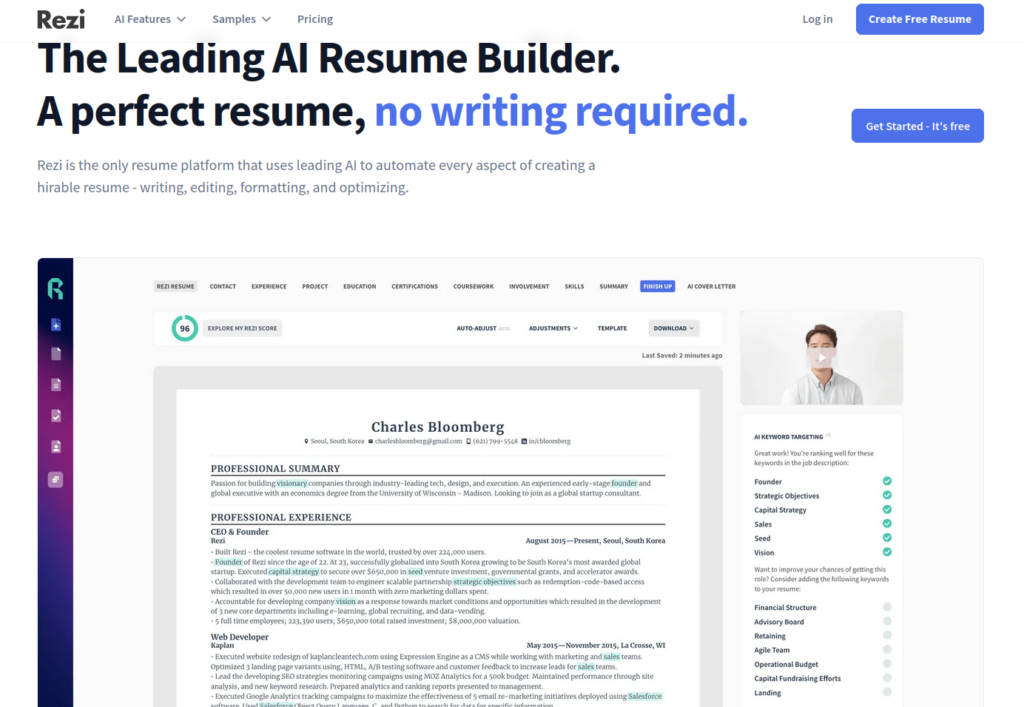
In order to build a good resume, you will need to have strong writing skills. And who said that’s enough? Good grammar, a flooded-up resume template, and a bit of creativity are needed too. But a resume-building AI has started taking over the internet, and it can help you with all of that.
Since the early days of the world wide web, people have been using computers to help them with their resumes. However, these programs were not very user-friendly and often required users to have some knowledge of HTML in order to create a decent-looking resume. Now, there are resume-building AIs that can help you create a great-looking resume, without any prior knowledge of HTML or other programming languages.
Step-By-Step method
First and foremost, you will need to find a resume-building AI that you can use. There are many different kinds of resume-building AIs out there, so it is important to find one that is right for you. For example, some resume-building AIs are better for entry-level positions while others are better for more experienced positions. Also, some have more features than others. Some features include the ability to track your progress, help you create a custom resume, or let you choose from a variety of templates.
Do some research and read reviews before you decide on which AI to use. Here are some steps on how to use a resume-building AI:
Once you have found a resume-building AI, the next step is to sign up for an account. This is usually a very simple process and only requires you to provide your email address and create a password. After verifying the email and creating the account, you will be able to log in and start creating your resume.
The process of creating a resume with a resume-building AI is very simple. You will just need to enter your personal information, work experience, education, and skills.
The AI will then create a professional looking resume for you.
If you want to make your resume look even better, you can use the customization options that most resume-building AIs offer. With these options, you can change the font, color, layout, and other aspects of your resume.
You can also add images, videos, and other multimedia content to your resume.
Once you are happy with your resume, you can download it or print it out. You can also share it online with potential employers or networking contacts.
Is it ethical to use AI to build a resume?
The fact is that it is 2022, and even if it were to be unethical, we have seen something beyond. AI art generators from text, GPT-3-based article generators, and even AI music, and video generators exist. So if you want to use a resume-building AI to get an edge over others, there is nothing stopping you.
However, you do need to be careful about the information you input into the AI. Remember, AI is only as good as the data you feed it. So if you input false or misleading information, the AI will generate a resume that is not accurate. It is important to be truthful on your resume.
You can still use marketing techniques to make your resume stand out. For example, you can use keywords that will help your resume get noticed by potential employers. AI is pretty good at this, but you need to be careful not to overdo it.
Also, don’t rely on resume-building AI for the complete job. Rather, use it as an initial draft, and make any changes or additions that you think are necessary. It is also important to remember that your resume is only one part of the job application process. Employers will want to see a cover letter and may ask for additional information such as references or work samples. AI can’t do that just yet.
Can it replace the jobs of resume writers?
The World Economic Forum estimates that AI machines will replace 85 million jobs by 2025. But at the same time, it will create 97 million job slots. Now, that’s pretty much more than good. The case with resume writing is that AI can help with the first pass of screening resumes for key qualifications, but it will never replace the human touch that is needed to sell someone’s qualifications to a potential employer.
The biggest thing AI lacks is the ability to find out the sentences of emphasis. From a given 500-word text, the machine would not know which are the important ones. It would also not be able to discern the candidate’s tone as accurately as a human can. Is the candidate too humble? Is the candidate overselling themselves? These are the types of nuances that can only be picked up by a human being. So while AI can help with the first pass of screening resumes, it will never replace the need for a human resume writer.
Ever since Alan Turing proposed the Turing test in 1950, artificial intelligence (AI) has been a hot topic in both academic and popular circles. There are many reasons why you might want to build your own AI. Maybe you want to create a digital assistant to help you with your work. Maybe you just want to create something for fun. Or maybe you mean you want to build a robot that can vacuum your floors or do your laundry.
Whatever your reasons, there are a few things you should know before you start building your own AI. AI does not necessarily mean building a robot that looks and acts like a human. That’s called artificial general intelligence, and it’s a much harder problem to solve. Instead, most AIs are designed to do one specific task, like playing chess or driving a car.
Study AI to Know What You’re Getting Into
You don’t need to be a genius to build an AI. You just need to be willing to put in the time to study and learn. There are many resources available to help you, including books, online courses, and community forums. For example, if you want to build a digital assistant, you might want to start by taking a natural language processing course. Sometimes the hardest part of building an AI is understanding all the different concepts and terms.
Here are some basic AI-related terms:
Algorithm: A set of instructions for a computer to follow.
Data: Information that can be used by an AI.
Machine learning: A method of teaching computers to learn from data.
Neural network: A machine learning model that is inspired by the structure of the brain.
Deep learning: It is a subset of machine learning that is based on artificial neural networks.
Natural Language Processing: A branch of AI that deals with understanding human language.
Structured data: Structured data is data that is already organized and formatted.
Unstructured data: Data that is not organized in a predictable way, like image, audio, and video data.
Programming language: A language that is used to write computer programs. Python, Java, C++, and Lisp are all popular programming languages for AI.
Hyperparameters: These are the settings that you can change to improve the performance of your model.
There are Benefits to Building an AI
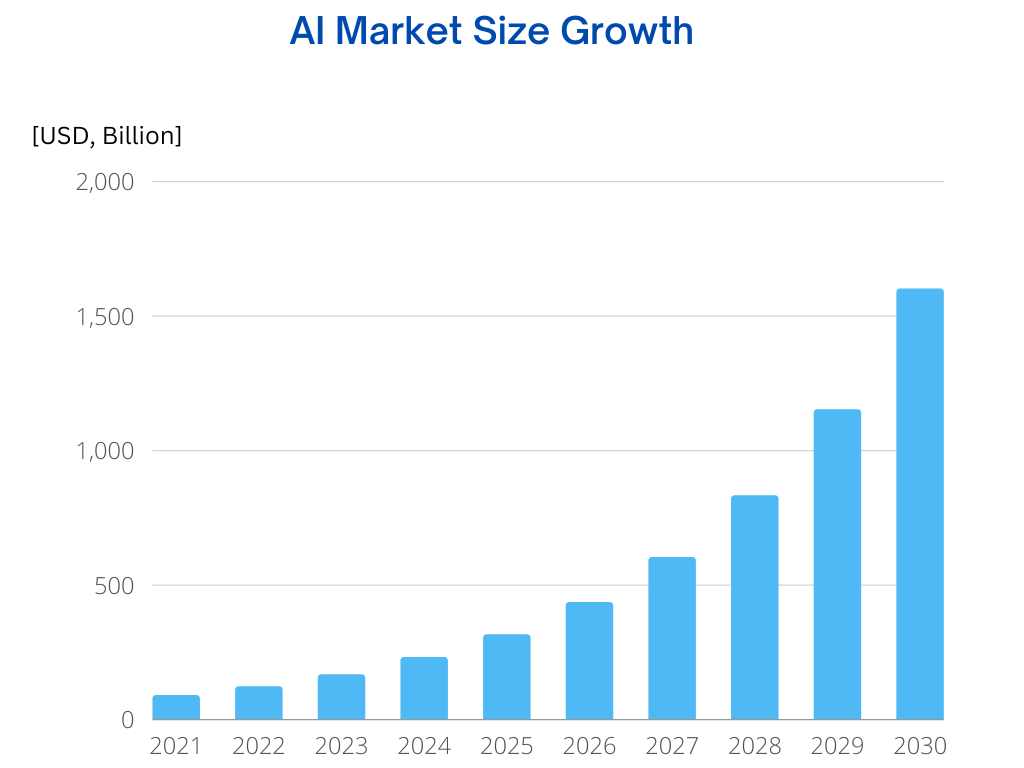
AI is expected to lead toward a global GDP growth of 16 percent by 2030. So, it’s clear that the future of competition is going to be about building better AI to do tasks, rather than doing tasks in a better way.
ai market growth chart
Looking at this future chart with AI makes it not only beneficial but necessary, to learn how to build AI. Here are some of the benefits I’m talking about:
a. Automation
AIs can automate tasks that would otherwise require human attention. For example, you can train an AI to play a game for you or to filter your email. Furthermore, people have managed to build AI bots to make passive earnings in the stock markets. For example, you can invest $1000 in the stock market, build an AI algorithm, and automate the growth over time. Annualized, this could even return figures like 30-40% per year.
b. Data-driven insights
AIs can help you make better decisions by providing data-driven insights. For example, you can use AI to analyze data from social media to find out what people are saying about your product. AIs can make sense of unseen data and find hidden patterns in them to predict further.
c. Explore your limits
Maybe you want to build an AI because you want to explore the limits of your own intelligence. And it is a pretty valid reason, too. For instance, if you want to know how good you are at poker, you can build an AI that will play against you. Same if you want to know how good you are at Go. It’s quite good research to test the limits of your artificial creation.
d. Fun and creativity
Building an AI can be a fun and creative experience. It’s a chance to flex your mental muscles and show off your creativity. And if you’re building an AI for fun, then the sky’s the limit. You can let your imagination run wild.
Weigh the Challenges of AI Construction
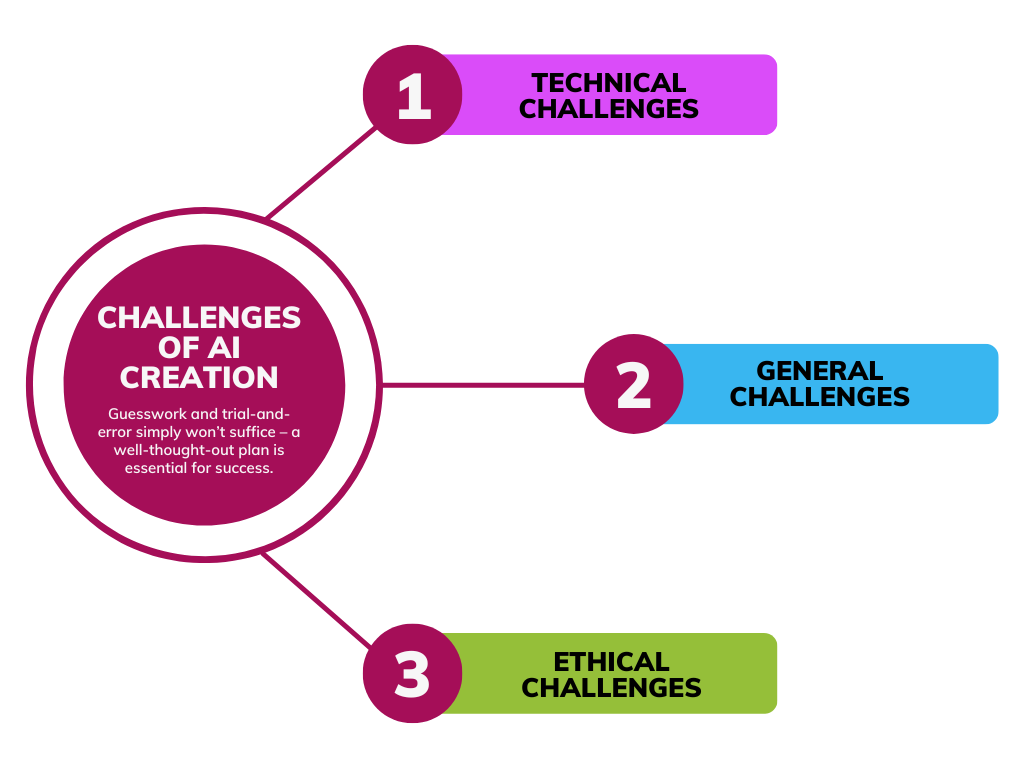
Building an AI presents a unique set of challenges. From general to technical, to ethical, the challenges must be carefully considered before taking the plunge into AI development. Guesswork and trial-and-error simply won’t suffice – a well-thought-out plan is essential for success.
Technical Challenges
Here are some of the technical challenges you might face when building an AI:
a. Finding the right data
AIs need data to learn. And not all data is created equal. Some data is more useful than others. For example, if you’re training an AI to play chess, you’ll need data about chess games. But if you’re training an AI to drive a car, you’ll need data about driving. AIs learn by example, so the more data you have, the better. It means that you need to collect a vast amount of data to build a good Artificial Intelligence system.
b. Cleaning the data
Data is often messy. It can be incomplete, inconsistent, or simply wrong. And this can make it hard for an AI to learn. For example, if you’re training an AI to drive a car, you’ll need data about driving. But if that data is full of errors, the AI might make mistakes. That’s why you have to clean your data before you use it to train an AI.
c. Building the right model
AIs are powered by machine learning algorithms. And there are many different types of machine learning algorithms. Each type of algorithm is better suited for certain tasks. Again, if you’re training an AI to play chess, you’ll need a different algorithm than if you’re training an AI to drive a car. Furthermore, different algorithms require different types of data. So, it’s challenging to choose the right algorithm for your task and data.
d. Debugging
Even if you do everything right, things can still go wrong. AIs are complex systems, and it’s often hard to understand why they make the decisions they do. When something goes wrong, it can be difficult to figure out what the problem is. And this can be frustrating.
General Challenges
Now, let’s talk about some general challenges:
a. It can be expensive
Building an AI can be expensive. You’ll need to buy hardware, like a computer or a robot. And you’ll need to buy software, like machine learning algorithms. Furthermore, you’ll need to pay for data. And if you’re hiring someone to help you, you’ll need to pay their salary.
b. It can take a long time
It can take months or even years to train an AI. And it can take even longer to get an AI to work the way you want it to.
c. You might not be able to do it alone
You might need to hire experts to help you. For example, you might need to hire a data scientist to help you clean your data. Or, you might need to hire a machine learning engineer to help you choose the right algorithm. Furthermore, you might need to pay for data. More the data, the more the bank-breaking.
Ethical Challenges
The ethical challenges of AI are even more complex. As AI gets better at understanding and responding to the world, the potential for misuse increases. For example, facial recognition technology can be used for good, such as helping to reunite families with lost loved ones. But it can also be used for evil, such as tracking down political dissidents. As AI gets better at making decisions, the potential for biased or unfair decision-making increases. For example, an AI system that is designed to screen job applicants may inadvertently discriminate against women or minorities.
According to a survey, 58% of Americans believe that computer programs will always reflect the biases of their designers. This shows that nearly 6 out of 10 people think that it is not possible for computer programs to make decisions that are free from human bias. When it comes to AI ethics, people should be careful about what they build because it might lead to racial, gender, or other types of discrimination.
Use These Steps to Build an AI
Building an AI, especially as a beginner, can feel like an insurmountable task. However, by following some simple steps and breaking the process down into manageable chunks, it is possible to create a working AI. Before we begin, do understand that the world of AI is constantly changing, so it is important to stay up-to-date with the latest advancements. Like, it has been more than 6 years, since Google’s DeepMind announced that their AI system, AlphaGo, had defeated the world’s top Go player. It was a great achievement for mankind overall. But do you want to work for years to create the same thing, or something similar? Of course, not. Rather, you want to analyze past information and accomplishments to create something that is even better and works for your specific needs. Here are the steps to build your own AI:
1. Choose a focus area:
The first step is to choose a focus area. You may want to focus on a specific industry, such as healthcare or finance, or on a specific type of AI, such as machine learning or natural language processing. Choose a focus area – No, you can not keep drawing an abstract AI and hope to make nice-looking art out of it. It simply does not work like that. You will need to pick a focus area to work on. Do you want to work on facial recognition, text recognition, image recognition, or video analysis? Building an AI may or may not be your end goal, but if you’re in, you will need to choose a focus area. There is simply no good alternative to it.
2. Collect and label data
Data is the fuel that powers AI. Without data, you will not be able to train your model or even evaluate it. So, the next step is to collect data. This data can be collected in various ways, such as through online sources, or maybe even surveys. If you want to collect data via online sources, you will need to make sure to filter out the wrong information. Surveys are another great way to collect data, but they can be time-consuming. And, lastly, you will need to label this data. This is so that your model knows what it is looking at when it is training. For example, if you are working on facial recognition, you will need to label the data with things like “eyes”, “nose”, “mouth”, etc.
Here are the different types of data:
A. Unstructured data
Unstructured data can be collected from social media platforms, blogs, articles, and so on. People often use web scraping techniques like BeautifulSoup to collect this data.
a. Text data – This data can be used to train your model for Sentiment Analysis, Text Classification, and more. b. Image data – It is used to train your model for tasks such as Object Detection and Image Classification. DALL E2, created by OpenAI, is an example of how you can use image data to build image-generating AI. c. Audio data – It can be used to train your model for tasks such as Speech Recognition and Sound Classification.
B. Structured data
On the other hand, structured data is data that is already organized and formatted. You can usually find this type of data in databases.
a. Relational databases – These are databases where data is organized into tables. Examples of relational databases are MySQL, Oracle, and Microsoft SQL Server. b. NoSQL databases – These are databases where data is not organized into tables. Examples of NoSQL databases are MongoDB, Cassandra, and BigTable. c. Excel files – These are files where data is organized into rows and columns.
3. Choosing the right algorithm and training your model
You will decide which algorithm to use and which hyperparameters to tune. Once you have created your model, you will need to train it. You can do this by feeding your data into the model and letting it learn. The model will make predictions based on the data it has been given. You can then compare these predictions to the actual labels to see how accurate your model is. Training your model is an important part of building AI. The model needs to be able to learn from the data so that it can make accurate predictions.
There are many different ways to train your model. You can use a training set, which is a set of data that is used to train the model. The model is then tested on a test set, which is a set of data that is used to see how accurate the model is. You can also use cross-validation, which is a method of training the model on multiple sets of data. It allows the model to learn from more data and to be more accurate.
One way or the other, you want to choose an algorithm that is well-suited to the type of data you have and the task you are trying to accomplish. You also want to make sure that the algorithm is properly trained on a large and representative dataset.
If the data you collected is not enough to train your model, you may need to use a technique called transfer learning. This is where you use a pre-trained model and fine-tune it to your own data. This is a common technique used in image recognition, where models are often pre-trained on the ImageNet dataset.
4. Evaluate
After training your model, the next step is to evaluate it. This is done by making predictions on data that the model has not seen before. You can then compare these predictions to the actual labels to see how accurate your model is. The accuracy of your model will depend on the quality of your data. If your data is noisy or contains errors, your model will not be as accurate. You may also want to use a technique called cross-validation. This is where you split your data into multiple sets and train and test your model on each set. This will give you a more accurate idea of how well your model is performing.
A spam-detection agency can set up a “spam score” from 1 to 100 against each email. After a while, it will have a good idea of which emails are spam and which are not. Then, it can use this information to make a model that can predict the spam score of new emails. This model can be used to filter out spam emails before they reach the inbox of the user. If the spam score is 92, it is highly likely to be spam. If it is 55.8, nothing can be said about it. And if it is 2.73, it is most likely safe. If the ones it is detecting as spam are indeed spam, it is performing well, and vice versa.
In the process of building an AI model, evaluation is crucial not only to understand how good your model is but also to find ways to improve it. For example, you may find that your model is overfitting to the training data. This means that it is memorizing the training data and is not generalizing well to new data. To fix this, you may need to use a technique called regularization. This is where you add a penalty to the model if it overfits. This will make the model more likely to generalize well to new data.
5. Tune your model
After training and evaluating your model, you may want to tune it to get a better result. This is done by changing the hyperparameters of the model. For example, you may want to change the learning rate, the number of layers, or the number of neurons. You can also use a technique called grid search to find the best hyperparameter values. This is where you define a grid of values and then train and test your model on each value. The value that gives the best result is then used as the final value.
Tuning your model is an important step in the process of building an AI model. It can help you to improve the accuracy of your model and also play a key role to avoid overfitting.
6. Choose the right platform and programming language for you.
There are many different platforms and programming languages that you can use to build AI models.
Right platform:
You need to opt-in for the platform that provides you with the best combination of flexibility and control for your AI-building needs. Cloud frameworks like TensorFlow, AWS, and Azure give you the control to select the number of cores, the type of hardware, and the memory that you want to use. You also get to choose the language, the tools, and the libraries that you want to use.
On the other hand, if you want to use a platform that is more focused on deep learning, you can go for one of the many options that are available. These include Google’s DeepMind, Facebook’s PyTorch, Microsoft’s Cognitive Toolkit, and Amazon’s MXNet. The actual platform that you choose will depend on your specific needs.
Programming languages:
The two most popular programming languages for AI are Python and R. However, are others too, and there is no one-size-fits-all solution. You will need to choose the language that is right for you. This will depend on your data, your model, and your resources.
Right programming language for you:
a. C++: If you want complete control over your code and your resources, then C++ is the right language for you. It is a low-level language that gives you complete control over memory management and is closer to the hardware. However, it is a complex language and can be difficult to learn.
b. Java: Java is a versatile and powerful programming language that enables developers to create robust, high-performance applications. It is platform-independent, meaning that it can be run on any operating system or device. Programmers use it in a wide variety of applications, including web-based applications, mobile apps, desktop apps, and more.
c. Python: Python is a general-purpose programming language that is easy to learn and has many different libraries that you can use for AI. Also, it is one of the fastest-growing languages and is widely used in many different fields.
d. R: R is a programming language that is specifically designed for statistical analysis. It is widely used in the field of data science. It can also be helpful for certain tasks, such as time-series analysis. Statisticians and data miners widely use it for developing statistical software and data analysis.
e. MATLAB: MATLAB is a language that is specifically designed for mathematical and scientific computation. Its applications range from matrix operations, and the plotting of functions and data, to the implementation of algorithms, the creation of user interfaces, and interfacing with programs written in other languages.
f. Julia: Julia is a high-level, high-performance dynamic programming language for technical computing, with syntax that is familiar to users of other technical computing environments. It provides a sophisticated compiler, distributed parallel execution, numerical accuracy, and an extensive mathematical function library. It combines the ease of use of traditional interpreted languages with the performance of compiled languages.
Now, deploy it so that people/you can use your model. There are many different ways to deploy your model. And yeah, there is a lot more to it than just “deploying your model”. Consistently monitoring your deployed model is important to track its performance and to ensure that it is working as intended. You may also want to use a technique called A/B testing. This is where you deploy two different versions of your model and compare their performance. This can help you to improve the accuracy of your model.
There is a limit to what computers can learn by example. They cannot, for instance, learn concepts such as “love” or “hate”. Nor can they learn to identify objects in pictures or videos unless they are given a lot of examples of these objects. This is where artificial intelligence comes in.You can not create awareness, but use algorithms to program consciousness in AI.
Conclusion
Now you have a better idea of what it takes to create your own AI, ask yourself a question: Can the AI do the same? You know, the end goal of building artificial intelligence is to build one that can do the same and continue its generations. Yes, that might be the purpose of your AI creation task, as we mentioned earlier. To build AI by yourself, it is important to understand how AI works, what data is required to train it, and what hardware is necessary to support it. The most difficult part is to get started, but once you do, it becomes much easier. Learn, collect, train, test, and ask the AI to do the same. It is a fun and self-rewarding process that requires understanding, patience, and time.
There is a common misconception that artificial intelligence (AI) can be programmed to be conscious. This is simply not true. Consciousness is a complex phenomenon that cannot be created through code.
Some people may argue that we don’t fully understand consciousness, and there might be some way to create it artificially. However, this is a moot point. Even if we don’t fully understand consciousness, we know enough about it to be certain that we cannot create it through code.
In order to understand why “programmed AI consciousness” is not “consciousness”, it is first important to understand what consciousness is. The general definition of the consciousness is “the ability to be aware of and think, feel and perceive”. This definition, however, is quite vague and does not really give us a clear understanding of what exactly the consciousness is. There are various theories of consciousness, but we are yet not ready to say a particular theory is the correct one.
One theory of consciousness is the Mind-brain identity theory. This is a philosophy that purports the mind and brain are the same and the consciousness is simply a product of the brain. This theory suggests that consciousness arises from the activity of the brain. And that it is not something that exists independently of the brain.
This theory is supported by the fact that when the brain is damaged, consciousness is also often damaged. Our brain is made up of an average of 86 billion neurons, each with up to 15,000 connections with other neurons via synapses. This intricate network of neurons leads us to be aware of our consciousness.
Another theory of consciousness is that it is something that exists independently of the brain and that the brain is simply a receiver of consciousness. Dr. Peter Fenwick, a well-known neuropsychiatrist who has spent more than 50 years studying the near-death experience (NDE) phenomenon and the human brain, argues that, in reality, consciousness is a fundamental quality of the universe itself, very much like dark matter, dark energy, or gravity. It exists independently of the brain and outside of it. Fenwick reached the conclusion after his extensive research that consciousness persists even after death.
The fact that some people with brain damage have still been able to be conscious supports the theory.
One way or the other, it is impossible to replicate this level of complexity with code. Even the most powerful computers are nowhere near as complex as the human brain. This is why AI will never be able to achieve true consciousness.
Many people believe that artificial intelligence (AI) could one day achieve consciousness. That is a level of intelligence that rivals or even surpass that of humans. After all, if we can program a computer to beat a grandmaster at chess, why can’t we program it to become self-aware?
However, there are a number of reasons why this is not possible. For one thing, consciousness is intimately bound up with the physical world. It requires a physical body and a brain to process information and create thoughts and perceptions. A computer, no matter how sophisticated, cannot replicate this.
Secondly, consciousness is not simply a matter of information processing. The capacity to be self-aware, to have emotions, and to make decisions requires something more than mere intelligence. It requires what some philosophers call “qualia” – the subjective experiences that make up our inner lives. A computer might be able to simulate these experiences, but it could never have them itself.
Finally, even if we could create a self-aware AI, there is no guarantee that it would be friendly to humans. In fact, it is more likely that it would see us as a hindrance to its own plans and goals, as the philosopher Nick Bostrom has argued.
Many people believe that consciousness is necessary for intelligent behavior. However, we don’t really know if this is true. There are many examples of machines that exhibit intelligent behavior without any signs of consciousness. This suggests that consciousness might not be necessary for intelligence.
AI is already displaying intelligent behavior without consciousness.
There are many examples of AI displaying intelligent behavior without any sign of consciousness. For instance, Google’s AlphaGo program beat a world champion Go player, even though it was not conscious. Go is incredibly complex despite its seemingly simple rules. More than the number of atoms in the known universe, there are an astounding 10 to the power of 170 possible board configurations. As a result, Go is googol times more sophisticated than chess.
If AI can be intelligent without consciousness, then it raises the possibility that AI could become extremely intelligent without ever becoming conscious. If a higher level of existence created us, maybe, we are not conscious either in reality.
Machines can now learn from data and experience, just like humans. They can identify patterns and make predictions, without any conscious effort. And our effort to keep improving them is not slowing down too. Estimated at $15.50 billion in 2021, a report from Fortune Business Insights has forecast that the global machine learning market will reach a staggering $152.24 billion by 2028 at a CAGR of 38.6%.
An additional example is natural language processing. Machines can now understand human language and respond in a way that is indistinguishable from human conversation. If the machines get the ability to “think” in languages, they could get the ability of reasoning, and eventually, turn out to be more powerful than us. But still, we would consider it to be a simulation of consciousness: “They are not conscious. They are simply programmed to be conscious.” And if we could do that, there is no reason to believe that we are at the very top of it.
In the past, there have been various debates on the topic of human-AI hybrid doctors. Some believe that AI algorithms and physical human doctors can never be combined together and that they should remain separate entities. However, the time has witnessed that human-AI hybrid doctor is already there, and it is the future of medicine.
The field of medicine is changing rapidly. New technologies are emerging that are changing the way that doctors diagnose and treat diseases.
Standing today on the cusp of a new era in medicine, we are using AI in a number of ways to improve healthcare. In the past, we used AI just to diagnose and treat patients. But its potential, as we have already started to observe, is much greater. With the vast amount of data that is now available, we can use AI to predict disease outbreaks, identify new drug targets, and even design personalized treatments.
For example, the advent of gene editing and CRISPR-Cas9 is revolutionizing the field of medicine. With these new technologies, it is becoming increasingly possible to treat diseases at the genetic level.
Along with the technological advancement, the capabilities of human-AI hybrid doctor will continue to increase. With time, Doctors, using AI, will be able to diagnose diseases earlier, and treat them more accurately and effectively. They will also be able to provide personalized treatment recommendations based on a patient’s individual genetic makeup. A doctor using a significant amount of AI in treatment/diagnosis is what we can call an AI-human hybrid doctor. Fair enough, isn’t it?
Here are 6 ways the combo of humans and AI will revolutionize medicine
With the help of AI, human doctors can become more efficient and accurate in their diagnoses and treatments.
AI doctor will have higher level of accuracy
One of the biggest advantages of hybrid doctors is that they are able to achieve a higher level of accuracy than human doctors or AI doctors alone. This is because they are able to draw on the strengths of both AI and human doctors. For example, AI algorithms can quickly and accurately identify patterns that a human doctor may miss. However, AI alone is not perfect and can sometimes make mistakes. A human doctor can provide the critical thinking and experience needed to catch these mistakes.
Faster decision-making: Another advantage of hybrid
One of the key advantages of having a human-AI hybrid doctor is that they can make decisions much faster than a human doctor can. This is because the AI can quickly process large amounts of data and identify patterns that a human doctor may miss. This can not only help to speed up diagnosis and treatment but could turn decisive when “impulsive decision-making” is needed in treatment.
AI can help reduce medical errors
Medical errors are a major problem in the healthcare industry, and they can often have serious consequences. For example, a nurse was charged for injecting Vecuronium instead of Versed at a 2017 event. A Tennessee nurse was accused of administering Vecuronium, a paralytic anesthetic, to a 75-year-old patient instead of Versed, a sedative.
AI can help reduce such medical errors by providing doctors with better decision-support
They can provide earlier detection of diseases
Another benefit of AI is that it can help doctors to detect diseases earlier. This is because AI algorithms are able to spot patterns that human doctors would otherwise have missed. This early detection can often lead to better outcomes for patients.
They can reduce the cost of healthcare
The use of AI can also help to reduce the overall cost of healthcare. This is because AI-assisted care is often more efficient and can help to avoid the need for expensive tests and procedures.
They can provide more personalized care
With the help of AI, human doctors are able to gather more data about their patients and tailor treatment plans that are specifically designed for each individual. This is a major improvement over the one-size-fits-all approach that is often taken with traditional medicine.
In the future, AI will become increasingly important in medicine as we strive to provide better care for our patients. By harnessing the power of AI, we will be able to make faster and more accurate diagnoses, and identify new treatments, and ways to prevent diseases from occurring in the first place. In addition, AI will help us to better understand the complexities of the human body and disease, providing us with invaluable insights that we can use to improve our care.
So far, AI has shown great promise in a number of medical applications. For example, AI-based diagnostic tools are now being used to detect a variety of diseases, including cancer. AI is also being used to develop new drugs and to personalize treatments for individual patients. AI in the future will continue to play a vital role in helping humans improve healthcare, save lives, and noticeably increase our lifespan.
The way we think about death is changing, thanks to artificial intelligence.
The advent of artificial intelligence has led to some interesting changes in the way we think about death. In particular, AI is currently bringing the dead back to ‘life’ with pattern analysis, and holograms. Despite the controversy, AI was used to deepfake chef Anthony Bourdain’s voice to provide narration in the documentary “Roadrunner.”
In the past, when someone died, they were gone forever. However, with AI, we are now able to bring people back to ‘life’, in a sense. With historical pattern analysis, we are able to reconstruct the voices of long-dead people. With pattern analysis + holograms, we are able to create lifelike representations of them. This has led to a change in how we think about death, as it is no longer final.
Furthermore, the laws of nature do not necessarily apply to Artificial Intelligence. So, humans have started to think of ways to turn themselves into something more artificial.
We used to think of death as the end, but AI is giving us a new perspective: Now, with pattern analysis, AI is able to bring the dead back to ‘life’. Mankind will soon create AI capable enough to see what they were thinking about, and even what they would have wanted.
Holograms are another way AI is changing our view of death: With holograms, we can now see our loved ones after they’ve passed away. This gives us a whole new level of closure that we didn’t have before. Kanye West, for example, gifted Kim Kardashian a hologram of her late father for her birthday.
AI doesn’t age, which makes us question aging and death: If AI can exist forever, why can’t we? If AI can exist forever, why do we have to die? This is an intriguing question that is yet to be fully answered. It definitely makes us think about the concept of death in a different light.
AI is helping us to understand death on a more spiritual level: There are now AI-created religions that are based on the belief that we can achieve immortality through technology. This is something that is definitely changing the way we think about death.
AI is helping us to extend our life expectancy: One of the main goals of AI is to help us to extend our life expectancy. This is because AI can help us to identify diseases earlier and also to develop new treatments for diseases. This is important because it means that we can enjoy our lives for longer.
With AI, we are now able to see death as something that can be overcome in the future. No longer do we have to accept death as an inevitable part of life. Instead, we can view it as something that can be overcome with the help of technology.
This change in perspective is sure to have a profound impact on the way we think about death and the way we deal with it.
The rise of the concept of digital immortality is a huge shift in our thinking about death, and it will have a profound impact on our society.
Digital immortality is the concept that our consciousness can be stored on a computer or digital device and then transferred to a new body or avatar after our physical death. This means that we could potentially live forever as digital beings.
There are a number of reasons why digital immortality is attractive.
It would actually allow us to live forever. This is obviously a huge benefit, as it would mean that we would never have to experience the pain of losing a loved one or the fear of our own death.
Second, it would give us the opportunity to travel to other parts of the universe or experience other dimensions. We would no longer be limited by our physical bodies.
Third, it would allow us to upgrade our bodies and minds as technology advances. We would no longer be stuck in the same old bodies that are subject to disease and aging. Instead, we could have the bodies of our dreams and the intelligence of a supercomputer.
In conclusion, AI is changing the way we think about death by providing us with new ways to cope with death and by helping us to understand death in new ways.
As anyone who’s ever doodled in a notebook knows, there’s a fine line between art and garbage. So it’s no surprise that some people are skeptical of the capabilities of AI art generators. Can a machine really create something that’s beautiful or moving?
The answer, it turns out, is a qualified yes. AI art generators are still in their infancy, but they’re already capable of producing some impressive results. And as they continue to evolve, they’re only going to get better.
AI art generators work by analyzing a dataset of images and their corresponding text descriptions. From this data, they learn to associate certain words with certain images. So when you give an AI art generator a text description of, say, a cat, it will generate an image of a cat.
The results can be striking. For example, the AI art generator DALL-E has produced some pretty compelling images, including a cat made out of spaghetti and a floating cockroach head.
Of course, not all of the images produced by AI art generators are hits. For every impressive image, there are many more that are, well, less or less than impressive. But as technology continues to evolve, the ratio of good to bad images is only going to improve.
In the future, AI art generators will become even more sophisticated. They’ll be able to take into account the context of the text they’re given and generate images that are more in line with what the user is looking for.
They’ll also be able to generate entire scenes and scenarios. So if you give an AI art generator a text description of a South American beach vacation, it will be able to generate a realistic-looking image of a Brazilian beach, complete with sand, sea, and sky.
Ultimately, AI art generators will become so good at their job that it will be hard to tell their images from those created by humans. And that’s when they’ll truly come into their own as a tool for artists and designers.
So if you’re interested in seeing the future of art, keep an eye on the development of AI art generators. They’re sure to surprise and delight us in the years to come.
AI art generators are still in their early stages, as mentioned earlier. In the future, they could be used to create entire collections of art, or even to generate new works based on an artist’s style.
At present, we use AI art generators to create “simply complex” images with a decent resolution. However, as technology develops, it is likely that more complex and realistic images will be produced, and maybe, videos too, who knows!
There are a number of benefits to using AI to generate art. Firstly, it can be used to create artworks that would be impossible to create manually. Secondly, it can be used to create large quantities of artwork quickly and efficiently. Never mention the creativity, and its tendency to push the farthest limits.
However, there are also some drawbacks to using AI art generators. One of the main concerns is that the artworks created by AI may lack originality and creativity. Another concern is that AI art generators could eventually replace human artists altogether.
Overall, AI art generators are a promising new technology with great potential. In the future, they could revolutionize the art world and change the way we create and appreciate art.
AI can already create images with your text commands. We’re not talking about “text-to-video software” in this article. Rather, we are talking about deep learning where computers can understand the content and produce an output.
We can say that we have reached the “DALL E 2 stage of creative AI”. DALL E 7 will be about generating videos out of text commands.
Here are the 3 ways AI-generated videos are going to challenge real videos:
No limits
Apart from being indistinguishable from reality, AI-generated videos will have no limits. You can make it generate anything, even things you could not have imagined. Such videos will start challenging the real world. They might even challenge your existence. For example: “A video illustration of the apocalypse.” “A video that shows what happens to the world after a nuclear war.” AI-generated video can create more crazy scenarios than you can imagine. Since there are no limits, even a mildly creative person can think of the weirdest possible videos. Google’s imagen AI is already there with the ability to convert text into videos, with creativity. But it is far from being available to the public.
Sense of presence
Erasing the boundary between real and fake is the first thing AI-generated videos will do. Just like AI-generated images, as pattern recognition gets better, AI will soon be able to generate videos indistinguishable from reality. In a sense, they will be the real thing. Unlike AI-generated images, in videos, the “sense of presence” will be much more difficult. Images can be creative even without them. But videos need it to convince viewers that what they are watching is real. It’s tough, but AI will do it.
Create Movies
Creating movies should not be a big deal for AI. Movies are fictional anyway, so AI can create your ideal movie. it will save money that had to be paid to the actors, and maybe reduce some overall movie revenues too. 😉 But it might be better than that. The AI can create movies of whatever genre you want, whichever actors you want, and with whatever storyline you want. You can give the script, and it will create a movie about it. Oh sorry, you just need to give the title. AI will generate the script, and it will pass it to the next stage where AI can generate the video. So, all you need is the Movie’s title. We can create videos from audio too. It will work better than text; converting speech to text, and text to video.
No limits again!
It’s going to be very interesting to watch what happens when AI creates its own genre of AI-generated movies.
If you want to change the future, you have to know what the future holds. That’s where artificial intelligence comes in. AI can help us predict the future in a variety of ways, from the stock market to the weather.
AI can analyze data faster than humans. For instance, it can analyze data in seconds which would take a human hour to do. AI can examine all the data and tell you what it means faster than you ever could on your own.
AI can identify patterns that humans might miss. To find every trend and pattern in a sea of data, humans need to go through it manually, which is time-consuming. AI won’t be tired or bored of looking at all the data, which means it will be able to find everything you’re looking for faster than a human ever could.
To be more exact
AI can make decisions based on probabilities. AI can make decisions on its own, based on predictions of what’s going to happen in the future.
AI can learn from past events to predict future events. It can learn by analyzing data and making educated guesses about what’s going to happen next.
AI can provide recommendations based on what it predicts will happen in the future.
AI can help us make better decisions by taking into account “all the possible outcomes“. It will consider all possibilities, filter them out, and provide information based on what is most likely to happen next so that we can make better decisions without making the wrong choice.
AI can help us find new opportunities that we might not have considered before. Maybe, it can also help us find more ways to make more money or save more money. 😉
AI can help us with the odds of scenarios happening in the future. It would be more like an odds-based forecast, which means that AI will not say that a certain event is going to occur for sure. Rather, it will provide you with the odds of it happening or not happening.
With all of this information at our fingertips, we’re able to prepare better for the future and move ahead in a confident manner. Indeed, the future is all about this: The best AI creator wins.
“Text to Video” will be the future of business. Decades ago, the first TV commercial was created. The impact it had on marketing was huge and forever changed the way companies advertise. Similarly, AI-based translation of the text to video will have a monumental effect on the future of marketing and business.
For example, there is a website named synthesia.io, that creates a digital humanoid “speaking”, not “reading”. Yes, all it needs is your text. You can also create your own “avatar”, which feels like actual “you” talking. Such Text to Video could soon turn out to become the default setting for businesses.
The following are just a few ways in which AI-based translation of the text to video will be helpful for any business:
Precision: AI Text to Video translation will translate text into animations that look real. As of now, AI’s voice is quite distinguishable. But we all are witnessing the improvements since Microsoft’s Narrator. So basically, it should sound human-like, and perfect, at the same time. Tough, isn’t it? Especially following the fact that the natural human voice is not perfect and vice versa. But AI needs to adapt to that imperfection. That said, businesses will no longer face the dilemma to use long-winded content. As AI-based Text to Video will be able to convert even the most-complex text into a precise video with precise expressions. Customers will easily understand the speech, its grammar, and its context, with AI’s precise voice and facials.
No Language Barriers: This is the main challenge for businesses to reach their target markets globally. With the help of AI-based Text to Video, businesses can create content in foreign languages without having to rely on their employees or third-party contractors. This will save time and money for businesses by reducing the use of outside resources.
Saves Time: In addition to being better and more precise, AI-based Text to Video will save time for businesses. It will be as much as 5x faster than the manual creation of content using off-the-shelf tools. Save time = increased ROI = greater profits for businesses. For businesses for whom video content creation is the key, Text to Video will give them better quantity, along with quality, as they can do more work in less time, and even more in more time.
No impulsive slips: Humans are prone to errors, as there are several factors like stress and exhaustion. Moreover, human speaking is impulsive and people often skip words or say them wrong. Similarly, they may forget to include necessary information while they are in a hurry. While AI-based Text to Video will neither be stressed nor exhausted… marketers can expect no impulsive slips of any kind. Furthermore, if you are giving some video message to your employees, one slip can demote your overall authority. With AI, there is no need to worry about that.
Customizable: You can not control a human’s actions. But an AI can be as friendly as you want it to be, as you can customize its behavior. You might want your human-like “avatar” to be super helpful or simple to understand. You can program AI’s “personality” and that’s the biggest edge you will have. Customers will feel that they are talking with a real person, who knows them and will cater to their needs.
There exist some arguments on credibility & trustworthiness. For some customers, a real person might be more credible and trustworthy than an artificial one. But for most customers, it’s all about perception. But we are talking about the people of 2022. In the future, of course, we’ll start adapting to the changes and trust more in AI.
The use of an AI art generator is not only to produce funky-looking art but also to learn more about artificial intelligence. You can generate cool animals and faces, but also use them to test the limits of your creativity.
Most people are amazed by how incredible AI is these days. A decade ago, I bet you could not have imagined AI starting with art – the mission to take over the world. All of us believed that AI will first take on physical labor, then maybe someday creativity. But it’s clear, and the actual scenario is quite opposite.
DALLE.2, Midjourney, or any other AI art generators will help you to create art. But they will also learn from your work, and that is why they will improve over time.
Image-based AI art is used synonymously as of 2022. But it does not only include pictures, but also video loops, text, and even music. Here, in particular, we are talking about the 9 cool things to do while using an Image-based AI art generator:
Try to push its limits
What is AI for? Pushing our limitations by pushing theirs. People often use AI to create some common and imaginable things like teddy bears playing underwater. You know, the usual stuff of art. But you can use AI to generate something really hard, like a picture of the inside of a black hole.
Connect with others over an AI art generator
You can use AI art generators to create memes. 2022 is the age of social media, and AI art is the current cool trend for it. You can use it to communicate with others, like a witty image or some creativity on message boards. A huge audience will appreciate your work, become curious, and share it with their friends and followers.
Test its algorithms
AI art generators can be used to test how far their algorithms can go. They are very complex algorithms: many parameters are changeable, random factors are in place, and so on. You can them for the purpose of testing themselves. After all, we create AI to test it, correct? DALL.E 2’s creators, for example, have stated that even they don’t know how far the algorithm can go.
AI-generated cartoon characters
DALLE.2 is very good at producing cartoon characters. You can use this command, for example: “An Alien-Like looking man with a green mustache, cartoon”. It will generate a new cartoon image. It is perfect for your next story, comic, or maybe a children’s book.
An Alien-Like looking man with a green mustache, cartoon
Have fun with an AI art generator
DALLE is great for the process of creation, but it can also be used to have fun. You can play with it. You can use it as a tool to make art and have fun with other people in your process of making something. Basically, you can take it as “gaming” with AI.
Create a new image to enhance your imagination
Testing AI is not enough. What about you? You can use AI to generate art, and the commands, meanwhile, always increase your imagination power with time. Frequent use of AI art generator can broaden your horizons, kind of like that guy who throws you into a whole new world with a snap of his fingers. You will start perceiving the real world in a different way.
Create thumbnails for YouTube
This is where AI actually starts taking our jobs. But it’s the truth. AI can generate good thumbnails as per your commands, sometimes better than humans. The job of a graphic editor is at risk, but you are not one, are you? If yes, don’t worry because AI will be the best partner for you. You can use AI to create graphics.
Make a new image and surprise yourself
Time and again. AI-generated art will surprise you and produce something completely different, but still brilliant. Guess what, getting surprised helps us to focus our attention and inspires us to look at our situation in novel ways. Of course, you don’t want a big real-life snake to get surprised; AI can do the job for you. FYI, the unexpected and inspiring are the most fun things.
Create paradoxes
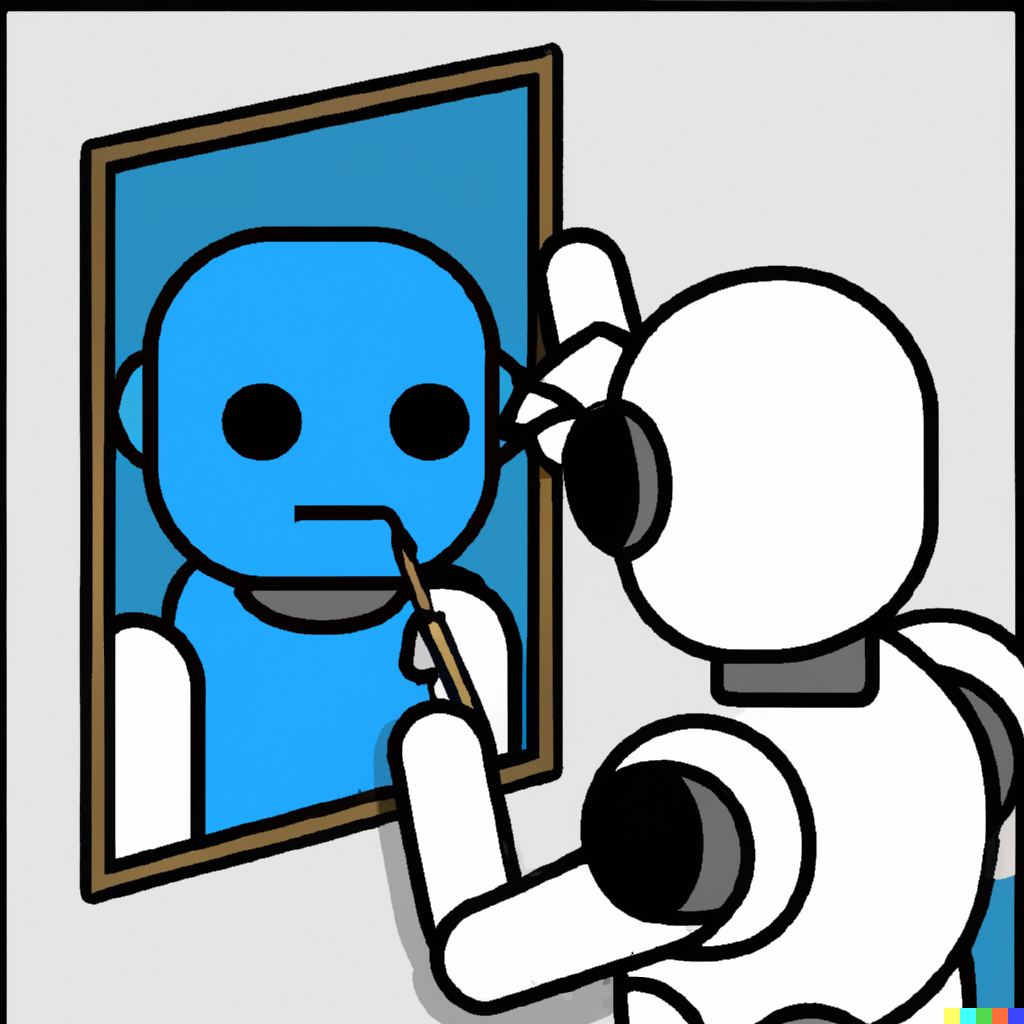
You can also command AI to generate paradoxes like “A robot creating a picture of a robot that is creating AI”. It is a new form of art and it will create a new paradox. We are running out of paradoxes anyways, aren’t we?
A robot creating a picture of a robot that is creating AI
We didn’t include points such as “AI generating pictures of you” because it can’t just yet do so. However, you can put yourself in the picture and see how AI is doing right now.
We hope you enjoyed our list of 9 cool things to do while using an Image-based AI art generator. The key is to have fun!