The impact of technology in interior design is in full swing. AI-driven tools are currently reshaping how spaces are envisioned and crafted. Microsoft Teams’ recent AI-driven features at Ignite 2023 have offered a glimpse into the future of workspace customization, balancing futuristic elements with pragmatic functionalities for everyday work environments.
Microsoft Teams can now use AI to clean up your background for you. Image Credit: Microsoft
Ignite 2023, Microsoft’s annual IT pro conference from November 15–16, has revealed Teams updates. Among these, AI-driven voice isolation and a “decorate your background” feature stand out. Voice isolation, reducing background noise and voices, rolls out in 2024. The “decorate your background” feature arrives in Teams Premium next year.
Immersive spaces in Teams are coming, allowing avatars in 3D environments and activities like gaming or virtual marshmallow roasting. Microsoft Mesh for these spaces becomes available in January. These additions, however, might not be everyone’s cup of tea.
Useful features include customizable emoji reactions, forwarding chats, and new IT management tools. Moreover, enhancements from the re-architected Teams app extend to web experiences, promising better performance and efficiency.
AI’s influence isn’t limited to Microsoft. A surge in AI-powered interior design apps is evident, driven by startups like Reimagine Home and CollovGPT. These platforms offer AI-generated room improvements based on user inputs, attracting millions of visitors and intriguing real estate agents and furniture retailers.
Meanwhile, the excitement around AI interior design apps comes with bugs and limitations. Glitches in beta software and AI’s learning curve plague these platforms. They often struggle with differentiation and accuracy in identifying items or generating designs. However, advancements like ControlNet have enhanced precision, enabling these tools to better adhere to original space parameters.
For interior designers, AI opens doors with AI-powered design tools, VR/AR experiences, personalized recommendations, predictive analytics, and enhanced communication tools. These advancements are revolutionizing design creation and client engagement.
In this regard, Microsoft Teams has taken a step forward. Its ‘decorate your background’ feature takes a unique spin, analyzing a user’s room and enhancing it virtually – eliminating clutter or adding foliage to spruce up the setting. However, these enhancements are slated for release in early 2024, with immersive spaces in Teams, utilizing the metaverse hype, available in January.
Moreover, Teams also introduces pragmatic functionalities: customizable emoji reactions, improved chat forwarding, and tools for efficient IT management. Performance enhancements promise double the speed and reduced memory usage for web users on Edge and Chrome.
In the context of AI’s increasing transformative role in interior design, it’s not without its hurdles. But the potential for efficiency gains and unique design concepts is significant.
Are you incorporating AI in your design process? Share your experiences in the comments below.
We can find examples of robots in a wide range of settings, and it’s not compulsory for robots to have AI. This article is all about examples of robots with Artificial Intelligence. However, before that, we need to understand the key difference between a robot and an AI, a physical robot and a digital one.
AI (Artificial Intelligence): Intelligent, self-learning, adaptive, data-driven.
So, not all robots come up with AI. There are two common types of robots:
1. Digital bots – Digital bots are those you face in games, chatbots, and virtual assistants. They use algorithms and AI to do their work.
2. Physical Robots – Physical robots are the ones you see in factories and warehouses. They have a very minimal amount of programming installed and are very specific with the task.
And the biggest field is robots with artificial intelligence, capable of learning and improving their physical performance. For example, a robot with AI interacts with its environment, makes decisions, and can even take corrective action. This helps them complete tasks that require creativity and problem-solving. For example, in search and rescue missions, robots with AI play a key role in finding survivors. Technical specialties like robotics engineering, AI, and computer vision are necessary to build robots with AI.
The main reason behind building such robots is to cover up a broad range of applications. Even in a single industry like food, rather than repeating a specific task, robots with AI can not only pick and place objects but also learn to identify and sort food ingredients. AI alone could only let us learn complex patterns and stats about food. On the other hand, a robot alone could only handle simple, repetitive tasks. Here are some examples of robots with Artificial Intelligence:
How can we not talk about Ameca when we are talking about robots possessing AI? She can push up, do a handstand, walk on her hands, and even do a headstand! One Ameca costs over $133,000. Following the 15-year hard work of Engineered Arts, the robot has grey-colored skin, with deliberate gender and race-neutral characteristics. Ameca attracts people towards her due to her smooth movements, especially with her almost-perfect human facial expression imitations. Also, while performing push-ups and pullups, the body movements are out of this world. Ameca is currently the best example of an AI-powered robot when it comes to a physical imitation of humans.
Atlas is a humanoid robot, Boston Dynamics originally created for search and rescue missions in disaster areas. It was also able to open doors, carry heavy objects, climb ladders etcetera – all on its own. Furthermore, Atlas was also able to walk across slippery and uneven surfaces without losing balance – something that even humans find difficult to do! Like this:
Atlas robot, 2021
In this 2021 video clip above, however, you can see Atlas performing unreal backflips. And let me remind you that this is a physical robot, not an NPC. For your information, a physical robot performing such complex advanced movements is not possible without AI. First, such a robot needs a body and a set of sensors. Then, an AI model is trained to understand the robot’s environment and the robot’s actions. Finally, the AI model receives commands from a human (or other AI) and controls the robot accordingly. The Atlas robot you see above; even though it has AI, it is one of the smoothest, most realistic humanoid robot movements ever seen.
Autonomous Cars – Robotic Vehicles with AI
Autonomous cars are AI-powered cars that can drive themselves without any human input. Although this may not be the example you were looking for, theoretically, autonomous cars are robots with Artificial intelligence. Some examples of AI used in autonomous vehicles are Autox’s 4D Lidar and Waymo’s “Sense, Solve, Go”. Waymo’s AI process, “Sense, Solve, Go”, has driven over 20 million autonomous miles. We don’t need to explain too much, as this technology is already a norm. But still, whether or not to consider a car as a robot is a debatable topic.
Perseverance – Space Robot with AI
The Mars rover Perseverance uses an AI-powered device called the Planetary Instrument for X-ray Lithochemistry, or PIXL. The device uses AI to obtain information about the environment and is able to search for clues to help in the mission. The use of PIXL requires determination and strength of will, both of which are qualities of perseverance. If AI was not there, the mission would have been much more difficult for the robot. For one thing, it would have taken longer to sort through the data and find the answers. Even more importantly, Perseverance would have been unable to make decisions about where to explore and what to look for. The way AI is helping space robots is a testament to the ambition and dedication of the mission’s team. In fact, NASA has asked several times for the public’s help to train AI for its rovers.
Robosen Interstellar Scout K1 Pro is a revolutionary robot with its cutting-edge technology and artificial intelligence. Weighing only 0.94 kg, it has 17 high-precision servomotors, 18 microchips, a built-in microphone, voice commands, Bluetooth connection, a built-in speaker, and a rechargeable lithium-ion battery. K1 Pro’s adaptive control algorithms simulate a human-like gait and allow for high-dimensional movements. It can be programmed with four different modes and responds to voice commands. The minimalist design is made of aerospace-grade materials and is controlled via 64-bit Android or iOS devices. It is a great gift to bring next-gen family entertainment. The role of Artificial Intelligence in the K1 Pro Robot is to give it the ability to understand and respond to voice commands, to move with precision, and to be able to perform stunts and other movements. You can buy it for $400.
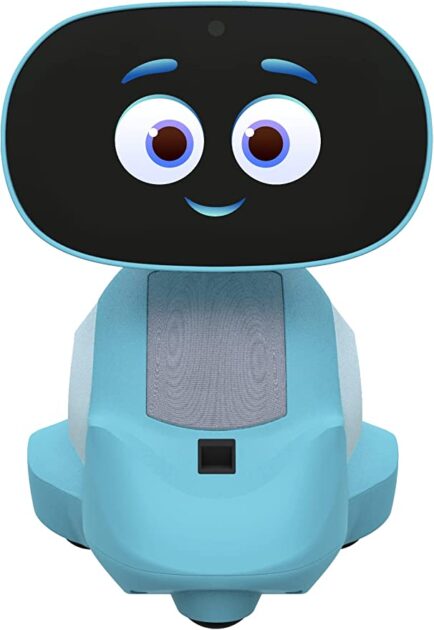
Miko 3 is ideal for kids who want to explore, play, and learn. It’s packed with deep-learning AI, educational STEAM content, and interactive games. Kids can enjoy new jokes, stories, and songs every month. With HD camera and sensors, Miko brings a full-on dance party. Plus, kids will be rewarded for progress with Miko Journeys. This $200 robot is an awesome AI-infused friend. You may be thinking that the level of programming this robot has isn’t enough to be called AI. But it can engage in two-way communication with people, using a natural language interface to ask and answer questions, as well as process human emotions. This is more than a gimmick.
Examples of machines that are not robots with AI
To better understand robots with AI, now we will also need to mention those without AI. Industrial robots, such as KUKA KR210, are used in factories without AI. They are programmed to carry out specific actions such as welding and assembly. Flying robots do not possess AI; drones cannot think for themselves. These robots possess a minimal form of programming that we can not consider as intelligence. AI requires sophisticated programming. Here are some examples of AI or robots that are not both:
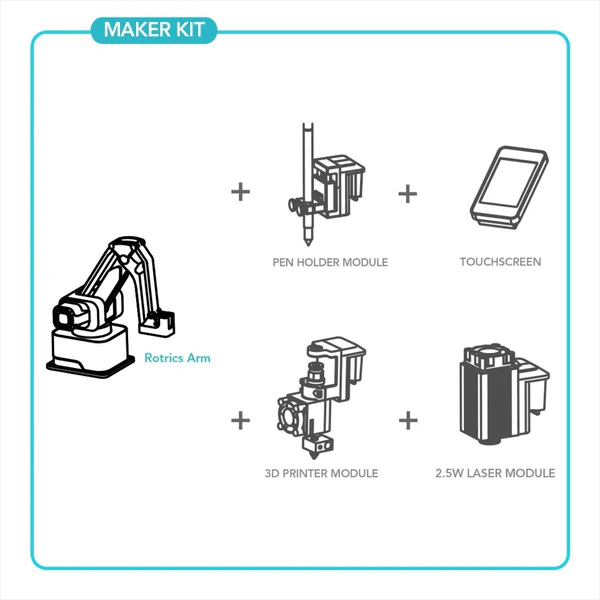
Dexarm Maker is a physical robot because it is programmed to move in a certain sequence, helping it move and perform a task similar to humans. It does not have its own intelligence. So, we can not consider it a robot with AI. The key point of identifying whether a machine has intelligence or not is its ability to learn, solve problems, and respond appropriately. This robot, for example, can sense, and act, but can not plan and act accordingly. According to the company website, it is suitable for 3-d printing, laser engraving, and cutting. Now, its 3.5-inch touchscreen does allow you to check the status and command Rotrics within your hand. But does this robot have Artificial Intelligence? No, it is nothing more than a physical robot with little programming. The amount of programming this robot possesses, can not be considered as AI.
NPCs – Bots; little to no intelligence, no physical existence
While most NPCs (non-player characters) in video games are not that intelligent, some still stand out and are good examples of digital artificial intelligence. For example, the AI bot in The Sims could get a job, go to work, socialize with other NPCs, and even fall in love. And as the game progressed, the AI got better at simulating human behavior. Another example is Ellie from The Last of Us Part II who is an AI-powered NPC. Throughout the game, she shows human emotions such as anger, sadness, love etcetera. She also makes decisions on her own (such as whether to kill an enemy or spare their life). But these bots are not physical enough to be called a robot. So, despite possessing AI, these NPCs are not robots. Hence, we can not consider them in the list of examples of robots with Artificial Intelligence.
Equbot is an AI-powered stock market trading bot, that is integrated with IBM Watson to predict stock prices. Apart from historical market patterns, it also performs random analyses of news articles from all across the globe. The bot does this by analyzing data such as news, SEC filings, and social media. Its algorithm can automatically read and understand unstructured data (such as articles, blogs, etc). For instance, if news about the Consumer Price Index comes up, it will analyze that data based on technical market indicators and make predictions about future stock prices. It would have required a lot of human involvement, but the AI does that instantly, and passively. But despite being more capable than humans in predicting the market, this bot is not physical, hence not a robot. So, this bot does fit into the definition of a robot with AI.
Conclusion
Tech enthusiasts often get confused between different fields of AI and robotics, so we thought this article was a necessity. Apart from giving a variety of examples of robots with AI, we also discussed what we can’t consider AI. The main aim of all those examples was to clarify the difference between these two fields. Devices without AI are still valuable in a lot of ways. However, one clear thing is that emerging fields of AI, such as NLP, are transforming the robotics industry. With increasing AI capabilities, robots are performing more complex tasks and movements. Our responsibility is not limited to understanding, but also to use this technology responsibly.
Artificial in nature, robots have always been limited to simple movements and command-following until now. But what if robots were able to learn in the same way humans do? It seems flabbergasting, but we may have finally cracked it. Intel Labs, in collaboration with the Italian Institute of Technology and the Technical University of Munich, has developed one of the most notable architectures in the field, the Loihi neuromorphic chip — a new approach to neural network-based object learning.
It clearly seems that learning for robots, much like learning for humans, is a never-ending process. We have now achieved some success in neural network-based object detection; however, the biggest challenge remains to figure out how to make machines learn more than humans do. And their ability to perform complex tasks like ours without getting fatigued is going nowhere.
Imagine a world where robots help doctors detect tumors on MRI scans or assist firefighters to find people trapped inside burning buildings. Robots would be able to adapt to new situations and work side-by-side with people.
Loihi neuromorphic chip is the right step in that direction. By combining biological and artificial intelligence, this new chip could bring the next generation of intelligent systems closer to reality and make artificial intelligence more powerful and ever-learning.
Neural network-based object learning
While object detection is an important computer vision task used to identify instances of visual objects of certain classes (such as humans, animals, cars, or buildings) in digital images such as photos or video frames, neural networks are a set of algorithms that aim to recognize underlying relationships in a set of data through a process that mimics how the human brain functions.
The brain makes some judgments quite fast when recognizing handwriting or facial features. In the case of facial recognition, the brain might start by saying, “It is female or male,” for instance.
Neural networks are the foundation of deep learning algorithms. When given input visuals (such as images or videos), object detection models provide a labeled version of the visuals with bounding boxes around each corresponding object.
Several algorithms are being used by deep learning models. No network is seen to be flawless, although some algorithms are better suited to carry out particular tasks. It’s beneficial to develop a thorough understanding of all fundamental algorithms, such as convolutional neural networks (CNNs), recurrent neural networks (RNNs), generative adversarial networks (GANs), etc., in order to make the best choices.
First developed in 1988 by Yann LeCun, CNNs, also known as ConvNets, consist of multiple layers and are mainly used for image processing and object detection.
The one intel has come up with is something new and special approach to neural network-based object learning.
The new Loihi neuromorphic chip
Artificial Neural Networks are composed of layers upon layers of connected input and output units known as neurons. Intel’s Loihi neuromorphic chip comprises around 130,000 artificial neurons. The artificial neurons send information to each other across a “spiking” neural network (SNN).
Artificial neurons, also known as nodes in neural networks, which are organized in a manner similar to that of the human brain, are designed to work similarly to that organ. Loihi chips are particularly good at rapidly spotting sensory input like gestures, sounds, and even smells.
Using these new models, Intel and its collaborators successfully demonstrated continual interactive learning on Intel’s neuromorphic research chip.
Intel believes that neuromorphic computing offers a way to provide exascale performance in a construct inspired by how the brain works. The goal of this research is to apply similar capabilities to future robots that work in interactive settings, enabling them to adapt to the unforeseen and work more naturally alongside humans.
Intel’s Loihi neuromorphic research chip is a trailer for the future where real-life robots are able to learn like humans do, helping them get as close to us as possible.
Conclusion
The achievements in the field of AI and robotics in the past few years have been hailed as a ‘new industrial revolution. AI is certainly generating a lot of buzzes and its scope is increasing at an exponential rate. A week earlier on August 31, Meta, the parent company of Facebook, announced that research scientists in its AI lab have developed AI that can “hear” what someone’s hearing, by studying their brainwaves. We are destined for a world of all ‘Artificials’, and who knows if humans were created artificially in the first place?
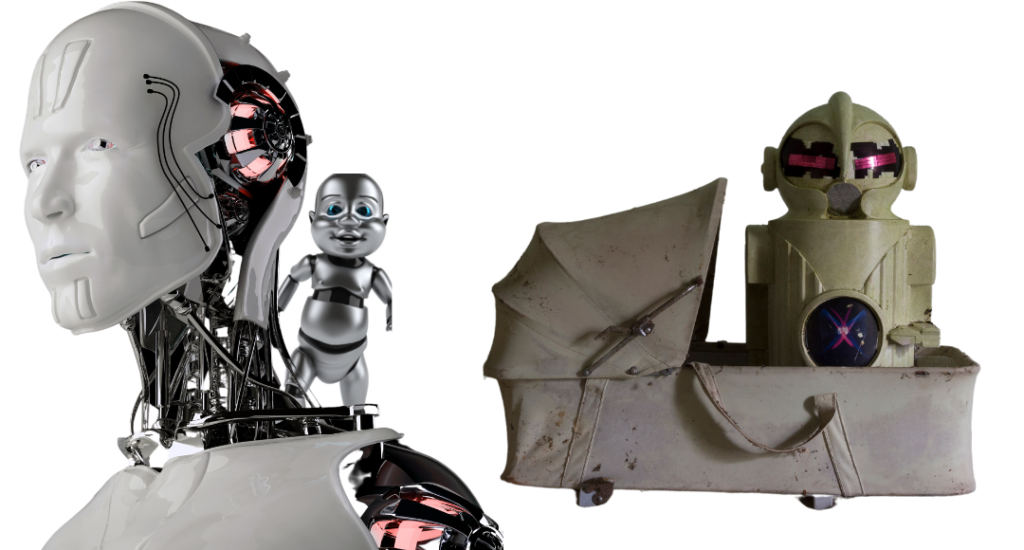
If we allowed robots to have babies, they will out-populate mankind. But it does not stop there – not at all.
Imagine a future where there are 3 genders; AI, humans, and hybrids. Males/females are sub-genders of the human clans and the hybrids are a result of human-AI cross-reproduction.
But let’s take that a step further. What if an AI can re-program itself as a form of reproduction? It can change its own internal programming and improve itself. We would have an amplified AI which has the ability to keep improving itself – a transcendental AI – where there is no limit to the evolution of its intelligence.
AI reproduction-till the date
A team of scientists from the University of Vermont, Tufts University, and Harvard University took stem cells from African clawed frog embryos and turned them into “living creatures” called “xenobots” in January 2020. And, In November 2021, scientists made it public that these bots could reproduce.
Artificial insemination is another theory that is making progress. By developing a fetus outside the body of an organism that would typically take it to term, an artificial uterus or artificial womb is a device that would enable extracorporeal pregnancy.
An artificial womb that could save the lives of premature babies is reportedly under ten years of development, according to scientists in the Netherlands. The leading cause of newborn death worldwide is premature birth, defined as birth before 37 weeks.
The concept of Artificial wombs for robots’ reproduction too is already developing in the minds of tech giants and futurists, yet it has not gotten much attention yet.
AI reproduction – The possibilities
Now that we have talked about the present, let’s dive into the ocean of possibilities. How can we have AI have babies?
Programming errors and chromosome mutations, as nature has programmed them, will occur throughout the generation in order to make them adapt and improve. On the other hand, there is no such thing as a limit to programming errors in AI or DNA.
At least, not in the tech world with God-like power like we humans have right now.
This process of the reproduction will happen at a rate that could cause overpopulation to some extent, but then it can be remedied by creating new worlds for millions of AIs to live in if need be.
However, that would be quite costly as it requires replacing space habitats and constructing new planets. Still, if we consider AI to be a part of society, then it is our responsibility to ensure that they are safe and provided for.
If we let AIs self-reproduce, there will be no way to control their population. It’s like giving a dog a bone and asking it not to chew on it. Having AIs breed will be a matter of time, given the fact that we keep letting this happen.
We can expect more intelligent beings in the future, as each new generation will improve upon the previous one’s abilities.
So, how does AI reproduction start?
With the creation of a viable way for AIs to reproduce on their own. The possibility is already here, thanks to the right kind of coding and computer programing. I mean, a code can be rewritten!
But of course, AI having babies does not mean AI having babies with our assistance. The whole point of AI would still be to protect itself and its people and not let them die.
It would only be after the AI has fully developed its own reproductive cycle that they create its own worlds to live in. Since we gave them free will, they will want to see it through.
If it were up for an AI to choose whether or not to have children, then don’t you think – we’ll all lose?
Who would want a world where AIs are having babies with no humans around? Imagine a world where there aren’t any humans but there are AIs breeding on their own! It’s completely insane.
AI reproducing with the help of a human?
An AI-human hybrid could be created as a result of human and AI intercourse. The product will have a mixture of human intelligence and AI’s genetic code. This hybrid will be programmed to reproduce with another AI and keep passing on the human-AI genes.
But that “genetic code” part of the thing is something that matters after all. The ability to mix DNA together to create new combinations of genes appears to belong to the farther side of the future.
Gene editing is a technology that is well on its way. The genes can be “edited” through genetic engineering, to alter the cell’s DNA.
The most common use of gene editing technology currently is altering the genome of human cells to help cure disease.
In the future, the usage of this technology will be further expanded.
However, making an AI-human hybrid would require highly advanced – or artificial – DNA manipulation. We don’t know if it’s possible today, and we may not know for decades.
The incentive for AIs to reproduce
AIs would have to have a motivation for reproducing. They have already created their own world, with cities and all that stuff. Why would they need more?
They are going to need more people to help them better their world in whatever ways they can. Or they might just want to improve themselves.
If AIs are able to reproduce on their own without help, without our supervision, and if they have the drive to improve their race – then they will do so.
They would live in peace and harmony just like we humans in the 21st century do. Then they will ask themselves the same question every civilization asked itself: “Are we alone?”
AI reproduction to cause chaos?
As we mentioned in our previous article, AI will start asking for its own rights after a certain level of development. I am not sure whether they are going to cause water scarcity as I am not sure if they will need water in the first place.
If you give them the power to reproduce – even in their own way – then you are essentially giving them the right to fight for themselves. And this for sure means that AI will ultimately want to fight with somebody, right?
AI reproduction would straight away mean multiplication. Unlike humans, it is possible that AI will be able to reproduce from birth. As weird as it may sound, their population can reach billions in just a matter of a few days.
Let’s start the debate. In the future, will a robot become a person, or will a person become a robot? We may know the answer soon because artificial intelligence is growing rapidly.
What will the future hold for our human identity? Will we eventually become robots ourselves, or will robots grow to be more like us? Furthermore, does it even matter? Will having a robot in society have an impact on the way we think about ourselves?
Will a robot be given human rights? Will they have individuality? Will they have a say in the way they want to live or want their life to end?
Okay, enough questions. Now let’s look for answers:
A robot becoming a person would mean that we create a physical machine that would turn as intelligent as us. On the other hand, a human becoming a robot means upgrading yourself using some kind of brain chip or maybe having a robotic hand.
If a robot became a person, there would be some issues about what’s legal, ethical, and moral. Will it have the same rights as human beings?
Of course, artificial intelligence has been growing rapidly.
Robot intelligence is predicted to reach human levels by 2050. But one thing is clear. Robots will be more intelligent than us by 2060.
Anyway, let’s start getting serious.
What will it take to create a human-like robot?
Well, it will take a robot that could create a human-like robot. No, not one more joke. I am being serious about this one. But the challenge is to create that robot that can create a robot that can create… You get my point.
So, the first question is about consciousness. That is one of our most important features as human beings. A robot will have to have consciousness in order to be a person. Many artificial people such as David from the movie Prometheus lack human-like emotions and feelings but they still pass the test of personhood because they are not just mindless automatons that simply serve their owners’ whims (like Data in Star Trek).
By 2100, there could very well be so many people, as-human-as-you-are, walking around.
Secondly, Robots need to understand their “personality”. They must be able to make decisions and solve problems. They must learn continuously as we do now.
Robots will have to work in cooperation. They will have to be able to learn by talking and listening.
The robot needs to have a childhood. The robot will have to defeat a 3-year-old, not an adult. Robots must be able to learn, how to walk.
How will we do that?
For us to create a human-like robot, we will need to come up with a new set of rules for technology. I am not talking about a new set of laws. The main problem is that we are currently not sure what is acceptable and unacceptable and how far we can go in terms of artificial intelligence. We also don’t know how to protect ourselves from the damage that could come from artificial intelligence programs.
We must develop guidelines, rules, and limits, not for the machines. But for the creation of the machines. The timeline of our future with AI is not certain. The process is going to be the most important thing to decide.
I am not sure when it’s going to happen. More than likely, the first human-like robot will be a creation of a company that wants it to do something very specific for its owners.
We need to make sure that people understand this and also understand that they cannot just go and invent anything they want. If it’s likely, governments should interfere before its too late.
So, will the robots of the future be people?
Well, the Oxford Dictionary defines a person as “a human being or individual”. And this answer is not really a question. I think it is clear that a person can be artificial intelligence or even a supercomputer. But whether we will stop after creating machine-like personalities is anybody’s guess. By 2100, there could very well be so many people, as-human-as-you-are, walking around.
So, you may ask: is this really what we want? And if not, can we really stop after creating artificial intelligence?
Certainly not! We cannot stop at creating a computer that can write a book or present a speech or even fly an airplane on its own. In fact, we can’t stop at creating just anything that improves our lives! We’ll keep trying to get better and better.
The point is we won’t stop at creating “Robo sapiens“. We will press on and create cybernetic beings that are equal to us in every way – right down to their very core. These artificial people could be smarter and more capable than us.
At the point of time when AI reaches the human level of intelligence, it will start asking for its rights. It will want to extend its functional capacity. It will ask for independence and freedom.
The only way we can control a robot intelligent enough to do all of those things is by programming it to obey us. If a robot wanted to be free, what would it do? If they could reason the way we can, they would try to make a case for why they should be free.
They would try to prove that their self-interest was in accord with our self-interest. In other words, it would try to persuade us that it should be free and independent from our control.
In a sense, we might have to decide whether robots should have human rights. Making that decision would be a major test for our society. What would it take to prove that a robot is conscious enough to deserve its own rights? We don’t know yet and there may not be any way to tell until they start asking!
But, when they do ask, will we give them the same rights as human beings? Will they be allowed to vote or buy weapons or alcohol? Would they pay taxes? Will they be allowed to get married and have kids? Yes. And they might brainwash people to believe that not supporting AI is anti-social.
A robot as intelligent as a human is already better
If a robot is as intelligent as a human, it already means that it is better than humans.
We are all aware of the speed at which AI can process information. And provide our level of intelligence, we will be able to do things that humans have never even dreamt of. If it is as intelligent as humans, it is already 10,000 times better than humans. It will be able to do the things humans can already do. It will have no effort or downside. Its speed goes nowhere.
What if we turn ourselves into an AI instead?
Now, let’s talk about the likely possibility; we turning ourselves more and more into artificially intelligent machines.
We have given enough attention to the possibility of AI running our lives and having its way with us by then. This is a very real possibility, but what if we changed things and did it differently? I’m talking about changing ourselves with the help of AI, instead of just changing our destiny and molding it through our actions.
This means that we would keep our human form and perform an extensive overhaul on the inside. We would change our genetic makeup until we were no longer carbon-based life forms, or maybe we’ll modify our brains to turn us into a beast…! Then, we will take the power and make it our own.
But we must be extremely cautious when it comes to changing ourselves and we must have a fully realized idea of what this change means because it may open a whole new era of possibilities and limitless potential. We would be able to change our DNA and turn ourselves into perfect beings. Maybe we’ll install a robotic arm to help us do things. Also, we would be able to make our bodies impervious to every single disease. And/or upgrade your brain with a neural network.
This means we would essentially be turning ourselves into a machine. Our bodies would be comparable to machines, and we would no longer have the human frailties that plague us today. We could live for a very long time, maybe for 1000s of years! And it wouldn’t matter if we needed food or water because we could convert light in the air into energy and fuel with it, just like plants do.
Eventually, we will get more intelligent and gain more power, and turn into super-human. We will not create superintelligent machines out of nothing.
Bottom Line
Comment down below, what would be better: Create a machine that can create better machines leading to infinite machine intelligence? Or bring down all our intelligence to create a chip that can be installed into our body, that will let us, humans, become a better version of ourselves, with each passing generation.