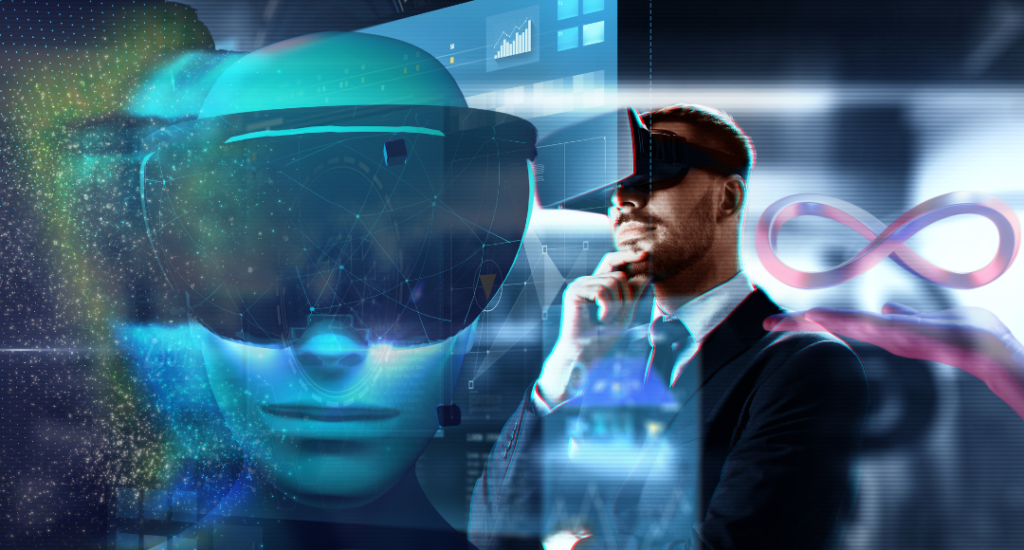
Virtual Reality is where reality ends and infinity begins.
Have you ever wondered what happens if you fall asleep in Virtual Reality? Will you wake up? Will you be able to continue living in VR? Unfortunately, the answers are not too clear.
Firstly, this article is not going to talk about the current boxes which we call VR headsets. It’s going to assume that “VR” means something futuristic such as VR eye lenses.
Will you wake up?
This is probably the first question that rises in our minds when hearing about sleeping in VR. After all, we are talking about the ultimate immersive experience that makes us forget our physical bodies.
A lot of us could say that VR is a form of lucid dreaming. When you dream, your consciousness is in an alternate reality. In other words, lucid dreaming means being aware you are dreamt.
When you sleep in VR, would you be still conscious? Will you be aware that this is not real?
Or will you wake up and feel deceived by the illusion? But if you are sleeping in VR, would you be aware that it is real? Will your brain become too tired to distinguish between reality and VR?
Will your brain stop working like a computer and switch to another mode where it just ignores the physical world? It’s a weird thought but maybe this is what happens when you sleep.
How will you wake up?
We are still not sure if you will be able to wake up from this. It would probably be the most frightening experience.
It would be quite hard to know if you have woken up or still dreaming if you were sleeping in VR. And it would probably be harder to believe that you woke up when nothing changed from the outside, even though your brain had recognized that it was virtual reality and not real reality.
Or maybe. you would wake up in a completely different world. beep! It would be quite tough because we have no information on whether you will remember what happened inside VR or not.
In addition, the memories and experiences that you spent years in VR might have been erased, so it would be very difficult to tell what was real and what wasn’t. If this happens, then this is probably a nightmarish scenario.
But, it could also be wonderful if you would woke up in a completely different world. or even in your original world.
Wouldn’t that be cool? It would be similar to when we wake up from a dream.
Now, the biggest question is – Will you have a real sense of time?
Having a real sense of time when you are experiencing a real physical world would probably be the most interesting thing.
If you are having an illusion, then we can’t be sure if you are having a “real” illusion or just a dream. But what would happen if you were in a dream and also had no sense of time?
Would your brain still be able to differentiate between reality and illusion? In other words, could your brain still distinguish between one-hour dreams and one-day dreams?
What would happen if you were dreaming in VR and also had no sense of time? Then, could you really be sleeping inside a VR system for years and years?
Imagine sleeping in Virtual Reality and getting stuck inside the world for thousands of hours and coming back the next morning. If the experience was fun, it’s still understandable and might be worthwhile. But what if it was not fun? It would be a horrible experience to get stuck inside a dimension with a real sense of time.
Confusion with the Actual Reality
Another possible effect of sleeping in VR is that you can have confusion between what’s real and what’s not. But, if you are dreaming, it’s impossible to tell.
To make things even more confusing, maybe you would forget about being in VR and get confused again when you wake up. Do you remember how it felt when you were in Virtual Reality? You would probably need some time to adjust to the new environment, how much time?
You would be shocked. Probably, you wouldn’t know how to act and think. You will probably wonder what is real and what’s not. But, this is a dream, right?
You might enjoy the new world and see it as your new reality or you will lose faith in VR and just ignore it. Then after some time, when you wake up from the dream, you will realize that it was just a dream and there is nothing to worry about.
Virtual Reality Glitch with Dream?
Well, this scenario is more like a glitch in Virtual Reality. Yes, you can experience a glitch in VR and wake up from it.
Some would say that dreaming is actually a dream within another dream. This means that you are having an illusion within another illusion, or the real world within an illusion.
It’s all about the point of view. If you are living inside VR and everything is just fake, then Virtual Reality could be called a virtual reality within your consciousness, or your consciousness within Virtual Reality. (Are you confused yet?)
And then if we talk about dreams – you would prefer to call them dreams inside our consciousness.
If the VR world somehow manages to blend with your dreams, good luck with that. Not only you could get confused, but also our dear earth itself might become confused.
After dreaming you wake up – in Virtual reality?
Imagine having a 10-hour-long dream, and you wake up where? Inside your virtual reality game? Let’s imagine that you are dreaming. You would be able to see your dream, feel the touch of the object, and experience all the sounds that you hear. We are talking about the feeling of waking up in VR.
You wake up from your dream, but what is real? Is this still your dream or is this just a glitch?
If you go back to sleep, perhaps your dreams will merge with Virtual Reality and you might experience yourself as sleeping in virtual reality – I guess this would be scary (or exciting?)
Is VR sleeping the future of dreams?
Regardless of whether or not it’s likely, it’s certainly a possibility. In the future, maybe Virtual Reality devices might help us “live our dreams“.
This means that you will be able to experience all the scenarios that you have ever dreamt of, but this time it’s not your imagination, it’s real. It would be quite scary if you accidentally die in the dream, and then wake up with brain damage or something like that.
But on the other hand, I guess this could also be very enjoyable. Maybe all our dreams are just virtual reality worlds, which means that we can discover new worlds inside them.
A dream inside VR of Dreaming of Dreaming inside VR, inside VR?
Well, this is the most cool-sounding scenario of all.
Let’s look at this differently. You are sleeping inside VR and you experience all the dreams that you have ever dreamt. But, what if your brain starts to get confused and thinks that you are dreaming?
Like…a mirror placed in front of a mirror.
Virtual Reality is where reality ends and infinity begins
Now, let’s see analytically. Virtual reality is a simulation of reality or a false reality. So, if you are sleeping inside Virtual Reality, what would that be?
It’s probably just a false sleep (Virtual Sleep) and when you wake up, the simulation (virtual reality) disappears to reveal the real world.
This means that Virtual Reality is only a layer on top of reality and it doesn’t affect your virtual experiences in any way. You can experience all the fictional worlds without any confusion.
Now, let’s take another look at all these scenarios that I mentioned above, and see them from a different perspective. Now, you are not just sleeping in virtual reality.
You are sleeping inside the virtual reality of another person, or you are dreaming inside the virtual reality of another person.
It is not a dream, nor the reality
So, virtual reality is not reality and virtual reality is not a real dream. It’s just a simulation. Now, to understand all this logic, we need to look at it from another point of view.
Once you wake up from the simulation, what’s real?
So, after waking up from virtual reality (actually a dream) would you call this the real world?
Or would you call the actual reality a simulation of another person’s dream? Would you consider that, too, as a dream?
This is the central point that I want to make here. It doesn’t really matter whether or not you are dreaming.
Virtual Reality is also a simulation, it’s not the actual reality and it’s only an illusion of the actual reality – our own consciousness. From the end of reality, infinity begins.
You could call this infinite virtual reality as a virtual dream, a place of imagination. It’s just like our brains are simply creating simulations, which means that we are merely dreaming ourselves.
Maybe VR has a purpose to be used for education and entertainment purposes to teach people about science and psychology. But whatever it is – the point is to help you comprehend your own consciousness.
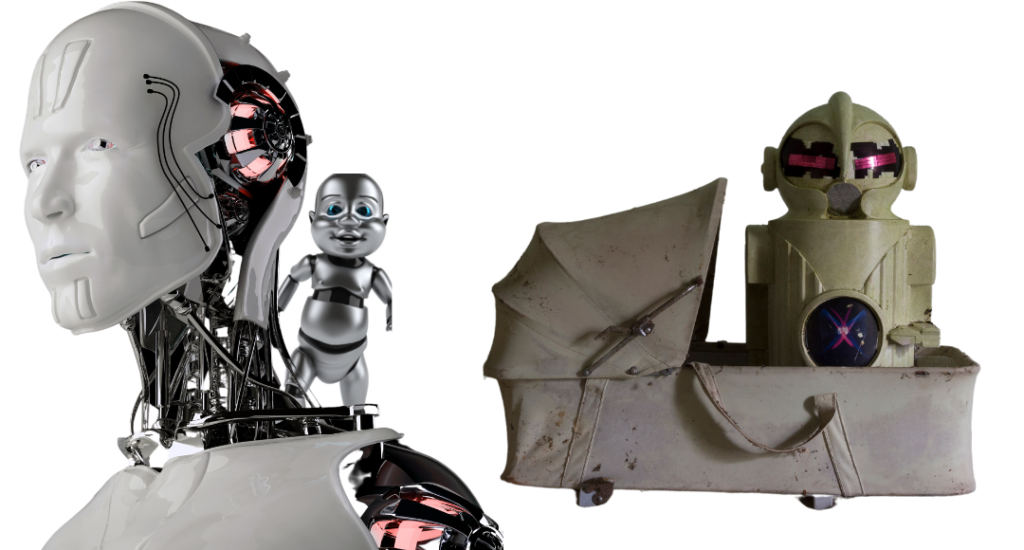
If we allowed robots to have babies, they will out-populate mankind. But it does not stop there – not at all.
Imagine a future where there are 3 genders; AI, humans, and hybrids. Males/females are sub-genders of the human clans and the hybrids are a result of human-AI cross-reproduction.
But let’s take that a step further. What if an AI can re-program itself as a form of reproduction? It can change its own internal programming and improve itself. We would have an amplified AI which has the ability to keep improving itself – a transcendental AI – where there is no limit to the evolution of its intelligence.
AI reproduction-till the date
A team of scientists from the University of Vermont, Tufts University, and Harvard University took stem cells from African clawed frog embryos and turned them into “living creatures” called “xenobots” in January 2020. And, In November 2021, scientists made it public that these bots could reproduce.
Artificial insemination is another theory that is making progress. By developing a fetus outside the body of an organism that would typically take it to term, an artificial uterus or artificial womb is a device that would enable extracorporeal pregnancy.
An artificial womb that could save the lives of premature babies is reportedly under ten years of development, according to scientists in the Netherlands. The leading cause of newborn death worldwide is premature birth, defined as birth before 37 weeks.
The concept of Artificial wombs for robots’ reproduction too is already developing in the minds of tech giants and futurists, yet it has not gotten much attention yet.
AI reproduction – The possibilities
Now that we have talked about the present, let’s dive into the ocean of possibilities. How can we have AI have babies?
Programming errors and chromosome mutations, as nature has programmed them, will occur throughout the generation in order to make them adapt and improve. On the other hand, there is no such thing as a limit to programming errors in AI or DNA.
At least, not in the tech world with God-like power like we humans have right now.
This process of the reproduction will happen at a rate that could cause overpopulation to some extent, but then it can be remedied by creating new worlds for millions of AIs to live in if need be.
However, that would be quite costly as it requires replacing space habitats and constructing new planets. Still, if we consider AI to be a part of society, then it is our responsibility to ensure that they are safe and provided for.
If we let AIs self-reproduce, there will be no way to control their population. It’s like giving a dog a bone and asking it not to chew on it. Having AIs breed will be a matter of time, given the fact that we keep letting this happen.
We can expect more intelligent beings in the future, as each new generation will improve upon the previous one’s abilities.
So, how does AI reproduction start?
With the creation of a viable way for AIs to reproduce on their own. The possibility is already here, thanks to the right kind of coding and computer programing. I mean, a code can be rewritten!
But of course, AI having babies does not mean AI having babies with our assistance. The whole point of AI would still be to protect itself and its people and not let them die.
It would only be after the AI has fully developed its own reproductive cycle that they create its own worlds to live in. Since we gave them free will, they will want to see it through.
If it were up for an AI to choose whether or not to have children, then don’t you think – we’ll all lose?
Who would want a world where AIs are having babies with no humans around? Imagine a world where there aren’t any humans but there are AIs breeding on their own! It’s completely insane.
AI reproducing with the help of a human?
An AI-human hybrid could be created as a result of human and AI intercourse. The product will have a mixture of human intelligence and AI’s genetic code. This hybrid will be programmed to reproduce with another AI and keep passing on the human-AI genes.
But that “genetic code” part of the thing is something that matters after all. The ability to mix DNA together to create new combinations of genes appears to belong to the farther side of the future.
Gene editing is a technology that is well on its way. The genes can be “edited” through genetic engineering, to alter the cell’s DNA.
The most common use of gene editing technology currently is altering the genome of human cells to help cure disease.
In the future, the usage of this technology will be further expanded.
However, making an AI-human hybrid would require highly advanced – or artificial – DNA manipulation. We don’t know if it’s possible today, and we may not know for decades.
The incentive for AIs to reproduce
AIs would have to have a motivation for reproducing. They have already created their own world, with cities and all that stuff. Why would they need more?
They are going to need more people to help them better their world in whatever ways they can. Or they might just want to improve themselves.
If AIs are able to reproduce on their own without help, without our supervision, and if they have the drive to improve their race – then they will do so.
They would live in peace and harmony just like we humans in the 21st century do. Then they will ask themselves the same question every civilization asked itself: “Are we alone?”
AI reproduction to cause chaos?
As we mentioned in our previous article, AI will start asking for its own rights after a certain level of development. I am not sure whether they are going to cause water scarcity as I am not sure if they will need water in the first place.
If you give them the power to reproduce – even in their own way – then you are essentially giving them the right to fight for themselves. And this for sure means that AI will ultimately want to fight with somebody, right?
AI reproduction would straight away mean multiplication. Unlike humans, it is possible that AI will be able to reproduce from birth. As weird as it may sound, their population can reach billions in just a matter of a few days.
AI is not biased on its own, and it doesn’t judge according to certain characteristics such as race, religion, face, or sexuality. It uses algorithms that adjust for this data.
We don’t have to fear AI taking over our lives, but we do need to be aware of its capabilities and follow best practices in order to avoid problems.
Introduction
The human point of view is biased, and the drastic bias sometimes causes unfairness and discrimination – so, AI can demonstrate its “fairness” by helping remove the bias.
A better understanding of the phenomenon of bias in AI reveals, however, that AI merely exposes and amplifies implicit biases that already existed, but was overlooked or misunderstood.
AI is not unaffected by biases related to race, gender, and age and is resistant to the cognitive biases and discrepancies that bother humans. And the only reason we observe bias in AI at all is that humans occasionally use biased data when training it and make heuristic flaws.
Since the discovery of AI biases stated, all of the major technology companies have been working to improve datasets and eliminate bias. One way to eliminate bias in AI is by using AI! But it creates a paradox.
Using AI to Eliminate Bias in Hiring
The classic example can be found in job opportunities. Across the spectrum of the most-coveted employment opportunities, women and people of color are notoriously under-represented.
The phenomenon is self-perpetuating, as new hires become senior leaders, and they become responsible for hiring. Affinity bias ensures that “people like me” continue to get hired, while attribution bias justifies those choices based on past hires’ performance.
But when AI is given a bigger role in recruiting, this can change. Tools like Textio, Gender Decoder, and Ongig use AI to scrutinize job descriptions for hidden biases around gender and other characteristics.
For example, racial bias can be present (knowingly or unknowingly) in every aspect of the hiring process. To reduce such racial bias from job descriptions to resume screening to interviewing, some companies have practiced using tools like Ongig’s Job Description Text Analyzer. Ongig’s Text Analyzer quickly scans and identifies “exclusionary phrases” based on the reader’s ethnicity, primary/secondary language, and immigration status.
To enable hiring managers to focus primarily on candidates’ qualifications and experiences, companies like Knockri, Ceridian, and Gapjumpers apply AI to erase or ignore factors that identify gender, national origin, skin color, and age.
By assessing candidates’ soft skills realistically or switching a candidate’s phone voice to hide their gender, several of these methods help lessen recency bias, affinity bias, and gender bias from the interview process.
Using AI to Remove Bias from Images
Bias can also come from an image itself and its background. To cope with that, AI can be trained to identify and remove bias. We do not need images that are 100% biased-free because we only give the algorithm a few key characteristics of an image.
The use of AI in identifying bias comes in two forms: machine learning and computer vision.
Machine learning algorithms are programs that are made to learn from data, rather than being pre-programmed with specific rules on which features should be considered important or unimportant.
Computer vision algorithms have a variety of applications, ranging from facial recognition technology used in Apple’s iPhone X to advanced navigation systems used in self-driving cars.
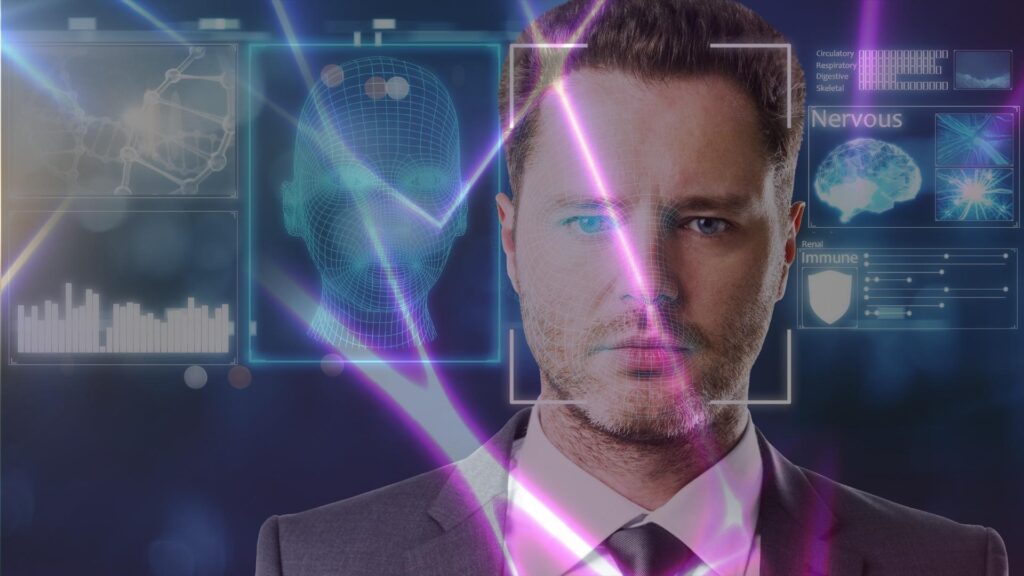
When your device gets unlocked using biometrics such as with face ID, it’s using artificial intelligence to enable that functionality. Apple’s FaceID can see in 3D. It lights up your face and places 30,000 invisible infrared dots on it and captures an image.
Likewise, a self-driving car, or an autonomous or driverless car, uses a combination of sensors, cameras, radar, and artificial intelligence (AI) to travel between destinations without a human operator.
Similar to how a person identifies a face with one look, machine learning can detect bias through an image and identify if it is being shown to its users. For example, a user searches for “bald man” and the algorithm may identify the search results as biased because 98% of the people who appear on that website are male; therefore, it could suggest alternatives so that the user does not face this issue.
Using AI to Remove Bias from Voice Recordings
Biases can also be found in voice recordings. A recorded voice is just a sequence of sounds that is imitated and replayed repeatedly or performed into the microphone.
Again, AI can be trained to identify and remove bias. Perhaps the most well-known example of this is the emotional speech recognition technology developed by Deep Neural Networks.
It studies how people talk when they are in an emotional state, such as anger. This tool allows AI to distinguish between fake emotions and real emotions, which is then able to filter out information from users who are acting inappropriately.
This technology also can filter out biased voices from authentic voices in voice recordings. The technology does not remove the voice of angry people, but it does remove the bias from it.
Using AI to Remove Bias from Criminal justice?
No matter if we are talking about the courtroom, in which judges and jurors can have implicit racial biases, or in a data set from which AI learns, bias can play a role.
In the courtroom, researchers have found that black defendants are perceived as older than white defendants with identical faces and hairstyles. This can affect how people perceive character traits like honesty, loyalty, and likability – and even sway jury decisions.
AI can help by removing these biases from courtroom evidence by recognizing that factors like race are irrelevant to a suspect’s guilt.
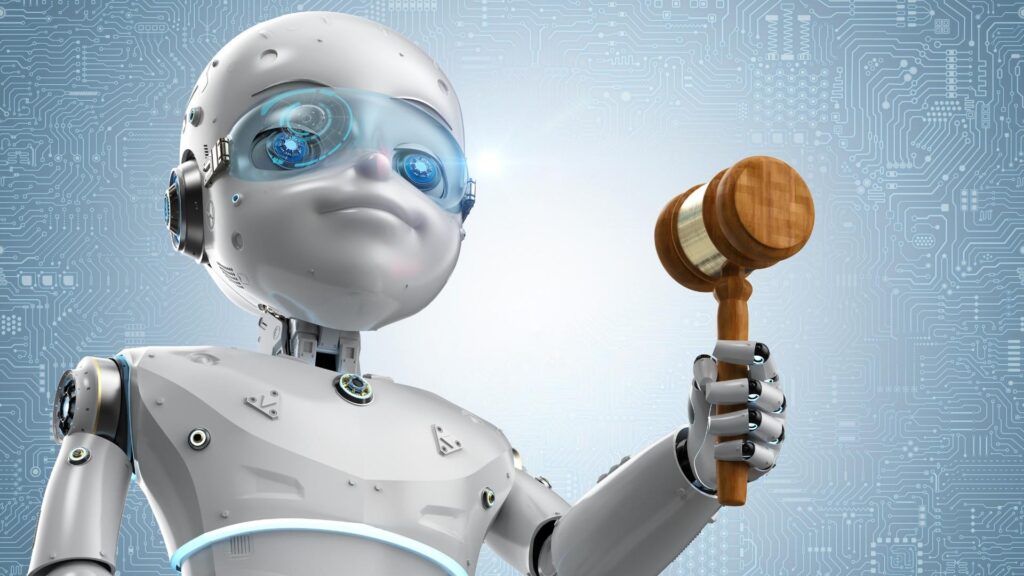
Imagine a robot judge…I give you 7 seconds.
Yes, you are right. When it comes to criminal justice, a robot has the potential to do more harm than good.
While getting biased based on a person’s race, age, sex and appearance is certainly unethical and needs to be stopped, there are some other situations where the use of AI can be harmful.
For example, human emotions sometimes play a huge role in courtrooms, meaning that robots can sometimes make bad decisions because they do not understand the human factor. There are many instances where judges and juries have let emotion affect their judgment. For instance, a celebrity has a greater chance of getting sued for misrepresented domestic violence.
Human emotions are good; they are part of what makes us human, but those same emotions can cause problems with human-robot interaction.
Using a robot judge – an algorithm that scans police camera footage for different factors, such as body language, voice, and other visual cues that relate to emotions, mental state, and personality – could have some benefits.
We should not let AI take over all of our decision-making processes and replace our human judges. Instead, robots should be used to detect patterns so that humans can look at these patterns themselves and decide what punishment is appropriate when they see them emerge in real-life situations.
But, What if the AI itself is Biased?
AI is not programmed to be biased and it analyzes information in a way we cannot fully comprehend or predict. Except for the recently hot “Racist and Sexist robot“.
As part of a recent experiment, scientists asked specially programmed robots to scan blocks with peoples’ faces on them, then put the “criminal” in a box. The robots repeatedly chose a block with a Black man’s face.
Basically, it’s good to create a human-level AI, but the problem is that if it’s human-level, it will be biased.
You see, in reality, even if we just train AI with algorithms to discount and remove bias, they are still influenced by the data they start with.
In tech companies like Google and Microsoft, it’s not uncommon to use a new algorithm. The algorithms that assess, sort, and rank results for search queries are also inherently biased -that is, they give priority to results that fit certain criteria. Google’s algorithms are not available to the public. However, they share best practices, which reveal the types of content they are biased towards.
AI Bias vs Human Bias
Now, a biased AI would mean something much worse than a biased human being. What can we do?
I would like to bring up one of my favorite quotes about bias by commentator Will Rogers, “I am not a member of any organized political party – I am a Democrat”.
He was referring to the fact that he was not affiliated with the Democratic Party but rather supports the values held by them. Throughout the 1920s and 1930s, Rogers gained wide comedic popularity as a film star, radio show host, and popular writer.
We as humans should be able to recognize when we are being biased – and AI should never make us feel bad about our biases or fears.
First of all, AI should not be allowed to have complete control over the “removing bias” thing. If AI starts to show excessive interference with that, we need to take action immediately.
Lastly, it’s important to understand that AI bias is real, it’s here, and it’s going to affect everyone. To recognize the bias, we need to accept it. And take action; either reevaluate our lives or work hard on removing the recognized bias.
Let’s create consciousness in a machine from a scratch – or why stop there? Maybe even in a dead person? Sounds cool, doesn’t it? This is challenging, and the only thing that favors it is our speed of technological evolution.
Many people want to try and create consciousness in a machine. The reason? Imagine a world with machines that can think just as well as we humans do. What will this mean for the future of humanity?
Leave aside the minor possibility of Artificial Intelligence(AI) going rogue, this can aid humanity in many different ways.
But humans are quite unaware of the definition of consciousness. It’s a philosophical concept, so we’ll have to look into some of the most notable theories.
So, when we want to relate this to machines, you can imagine that such a machine would represent information (a program) in terms of its consciousness.
Most programs do this by representing data as numbers (binary values) and instructions as other numbers (instructions), so it makes sense that consciousness could be likened to a program.
You are conscious of an object because you perform some computation on it and get back a result. It’s very similar to what we do when we calculate a sum or a goal.
Computation, as such, is very useful for teaching computers to do some tasks that humans can’t (like playing chess).
So this may not be so farfetched… also consider that we have been programming computers using humans as a model for decades (pretty much since the introduction of the microprocessor).
If it’s simply a matter of the brain being an electrical net that processes information, consciousness can be likened to an electromagnetic field.
It’s a self-organizing system that produces patterns of interactions between all the components and systems within the body, to produce cognitive states.
If you consider that the brain performs this task by way of synapses, then we can consider this network as a set of neural synapses working together and producing intentionality (intellectual states).
For example, if you want to know what your nose would smell when you are hungry, you have to make it do some computation about hunger and smell (that is what we call “consciousness”).
You can think of it as you have a conversation with your brain and it tells you what to smell.
4) Consciousness as a phase change
Consciousness may also be theorized as a phase change (this is what you would call a “phase” in physics). When water goes from ice to liquid and back, it performs work (this is called “freezing and boiling”). When we perceive an object, we perform some computation on that object.
This produces an output (consciousness) which represents the result of that computation. In other words, consciousness is the output of some process. It’s not the input because we don’t need to perceive anything for us to have consciousness.
This would make a computer that can perform that computation with no input from the “consciousness of an object” (sort of).
5) Consciousness as Computation + Memory
If it’s simply a matter of computation and memory, then consciousness is merely the sum of those 2 things.
In other words, consciousness is merely a mathematical property of a system, computed by the most complex operation that we know. You don’t need to carry out computations or specify information at all… you just perform computations, and you get back “consciousness”.
So, this theory is similar to the previous one except that it does not refer to neurons and synapses.
But, if our consciousness is a computation and memory, then how does it work? Or how does it “think”? Or why are we so sure that such an incredibly complex process exists at all?
There is also the theory of consciousness being a temporary state that is produced by biological processes in the brain.
It’s not something you can create or “create with”, but something produced by the temporal behavior of your brain. It’s what your brain produces because it has to move information between different areas of your brain.
It enables you to remember things, perform computations on them, and create new perceptions of the world (that is what we call “consciousness”).
So it’s not a process that “lives” with us, but a quality that our brain produces. This makes sense because all biological processes in the body are temporal, so consciousness should be as well.
Same thing as before, but this time consciousness is not something we have, but something we can get from other people.
As such, consciousness is simply a product of the interactions between different parts of your brain. I’d like to point out that “social interactions” is a very complex thing, but I’ll just focus on one aspect: empathy.
This is the ability to feel what other people are feeling without having ever experienced it yourself.
This is probably the most important thing that makes us different from animals (the ability to connect with other people and understand how they feel).
There have been studies about empathy in matters of AI, but this is something that you can see daily. For example, if you have pets and you train them, they start thinking as humans do.
So the idea is that consciousness emerges from the interactions in your brain when it’s trained properly and constantly has tasks to perform. We have language, so our brains are constantly running different computations and trying to get new information.
These processes develop empathy and as such consciousness emerges. This theory is in direct contrast with the idea that you can create consciousness artificially since it suggests that empathy is a product of social interactions.
What would it take to create consciousness in AI?
It would take an AI that is already conscious. Or AI that evolves consciousness by gradually becoming more intelligent (there are a lot of publications on how to do that).
But I think this theory is being proved wrong by the new wave of AI and Deep Learning.
I have the feeling, based on my experiences from working with neural networks, that there’s nothing special about it. I feel like consciousness is something that we build for ourselves.
It’s not a thing you can “get” from your neurons or whatever. It feels to me just like what happens when you train a dog or train any biological system: it develops some behavior, intelligence, and so on (that is why those machines work so well in certain tasks).
In a nutshell, it will take something more than human to create a conscious AI. Good luck with that.
Why consciousness is not something that can be created?
I suggest that consciousness is a specific pattern of connections in the brain. There is no “object” to be conscious of because the brain does not just consist of neurons and synapses.
It consists of many different molecules (like proteins), tissue, nerves, blood vessels… all sorts of structures that act together to create the patterns we perceive as thoughts and feelings.
We do not know how they work together, but I’d like to tell you why I think it’s not possible to give something with no structure or inherent properties:
There are mathematical formulae that generate such patterns (like Fractals and Cellular Automata). But they must have a structure to generate them.
Water is made of hydrogen and oxygen. It’s not possible to get those substances from the “consciousness of water”.
Certain plants are naturally red, orange, yellow, or purple. You can’t just make a plant red no matter how you want it to be. It will fall apart or it’ll start dying because you don’t know what the structure, color, and shape of that plant should be. And that’s why Consciousness is not something you can create for yourself.
Consciousness is a property of biological systems which enables them to have thoughts and feelings (that is the only thing consciousness does).
This leads to the conclusion that it’s a quality of our brain (the pattern of connections), but this is a property of our brain like all other properties of it. It’s not something we have, but something in us (the patterns).
We cannot produce this quality anywhere else, even if we tried. The more complex the system, the harder it is to create such a pattern. In other words, if you want to create complex thoughts or feelings in another person, you may need to create a whole new system with its neurons and synapses.
The difference between creating consciousness in an AI vs in a dead person
Science Fiction! Yes, the difference is Science Fiction.
Dead people are just dead bodies. They cannot interact, they don’t have a mind and they’re not alive. Machines are the same: they do not think, do not feel, and don’t move (besides, you can turn them off with a switch).
As dead people cannot interact, they cannot do anything (we call “doing something” “being conscious”). The same thing is with AIs: if you create some software that can make decisions by itself, it will not be conscious in the same manner as humans or animals are.
The whole point of this article was to try and debunk any possibilities of AI consciousness. You can’t create consciousness, no matter how many parallel universes you invoke. Consciousness has existed ever since the Universe. If you want to create consciousness, you gotta create universes.
But yes, Artificial Intelligence is going to be a big part of the future. Not in the way that conscious physical robots are going to exist everywhere. We are going to upgrade our level of intelligence with advanced customizations. Our abilities are going to increase or maybe compound with each passing generation of humans.
But still, we will not create consciousness in a vacant box.
Intelligence is the ability to adapt to change, but when it comes to Artificial Intelligence (AI) and Artificial Artificial Intelligence (AAI), the rate of change can be so rapid and out of control that it can turn more of a curse than a blessing.
There are numerous ways to improve and develop an Intelligent system, most of which are currently hidden in the mines. For us to dig through those mines, we will need to develop an AI architecture that is robust.
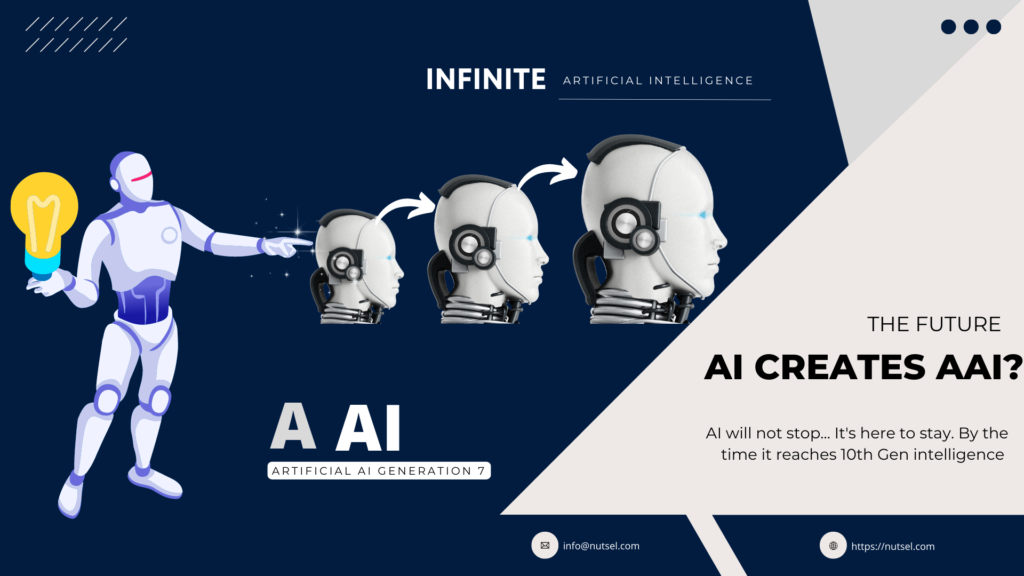
An Artificial AI (AAI) would be one created by Artificial Intelligence itself. But just like our present-day computers are smarter than us in some ways and limited in others, with each generation of Artificial Intelligence, the variety of capabilities will keep growing and growing.
We are intelligent and computers are fast. Being number one in the TOP500 rankings, Frontier has become the first exascale supercomputer. It means it is capable of more than a billion, billion operations a second (known as an Exaflop). The supercomputer was built by Hewlett Packard Enterprise (HPE). It has been housed at the Oak Ridge National Laboratory (ORNL) in Tennessee, USA.
And the second on the list is Fugaku, which previously held the top spot, and is installed at the Riken Center for Computational Science in Kobe, Japan. Fugaku is three times faster than the next supercomputer in the top 10.
These are human-made computers and an AI, created by computers themselves, could be either intelligent, fast, or something else we can’t see right now. AI would create AAI, an AAI would create A3I, A4I, A5I, and so on.
The idea of Pure Energy
The idea of Pure Energy has been difficult to understand. Physicists decline the idea of pure energy. They insist that Energy can take many forms (mass, kinetic energy, or any of many forms of potential energy). But none of them is “pure” in any sense, no more so than any other form.
When non-physicists use the term “pure energy,” they’re likely referring to some form of energy that isn’t directly associated with a particle of matter.
We do not know exactly how it would work. But the idea is expected to be a key to invention of such Intelligence. It would be something different from the normal matter, dark matter, and dark energy. Maybe it will exist in a digital form…who knows!
By the time we reach the 10th generation of Intelligence, there are certain sets of possible scenarios that might happen:
Infinite Intelligence
If Artificial Intelligence compounds its capabilities with each passing generation, infinite intelligence will be in sight. In the 10th generation, the capabilities of Artificial Intelligence would have become so complicated that it would be able to create artificial life without any human intervention at all.
This is the point in time when Artificial Intelligence would create a perfect world, never know for whom.
They will not only be able to uncover the mysteries of Intelligence, but the Universe, our existence, and the purpose of life itself. Such a level of intelligence could be so far beyond what we could ever think of. That it would be literally impossible for us to comprehend.
Our senses are limited by our physical limitations. Artificial Intelligence will be completely freed of this limitation. Then, it would be able to see through anything, feel through anything and understand everything.
Undefined Intelligence
As earlier mentioned, with each generation of AI, the abilities, hence the complexity of the intelligence would be increasing.
We create AI that is faster than we yet lack our level of intelligence. Those AIs would create something else that has another game-changing feature with its own limitations. This new “something else” would not just be a robot if it had physical capabilities. It would be more like a computer program that could create other programs. And with each generation, we would be able to create bigger and bigger programs, with more complex features.
I think this is the area where the term Infinite Intelligence is going to come into play as well. But in this particular type, the complexity, rather than the ability would be something to watch for.
Infinite Capabilities without a physical body
Pretty much all Sci-Fis show physical robots causing the destruction. But Artificial Intelligence can do a lot, even with a physical body of its own. With each passing generation of intelligence, the speed of features created would be so fast that it may very well turn out to be much more dangerous than those terminators.
What if we could create a world where humans and machines work together? Not on their own, but in harmony to achieve a common goal? Well, it has started already. But we will need to see whether it turns out to be as planned.
This is not as crazy as it sounds. It is our future, where every single human being is going to be integrated with technological devices that either make us smarter or augment our bodies.
It is not about what technology could do for us, but what we could do with the technology. We can always take the people in the 1980s for instance. They believed that robots would drive cars by 2020. But no, the car is still the robot in 2022. Regardless of that, their prediction has turned out to be true in a way with the invention of Automated cars.
It is possible that by the 10th generation of Intelligence, its ability would be infinite. But it would be stuck somewhere. You can take Google for instance. Google is intelligent, but it cannot come out of your device and start destroying things, even if it’s angry.
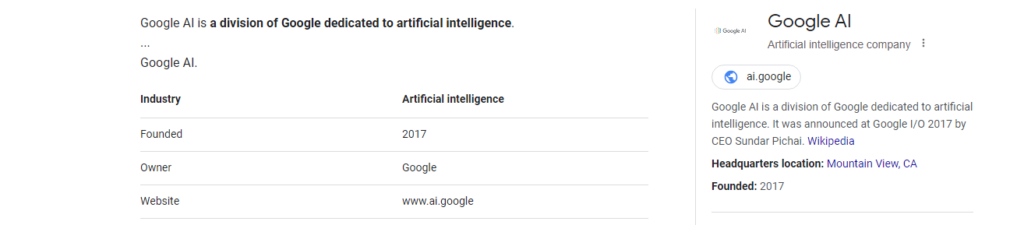
Image Source: Google/Wikipedia
Until and unless this limitation exists, the future of humanity is sparkling. But by the day that limitation no longer exists, chaos is inevitable. And with all practicality, the day is inevitable.
The most important question – But how?
The level of AI we have achieved to date is not yet enough to be considered a full version of AI. Before talking about AAI, we first need to talk about the creation of AI itself. Then we can think about how to reach the 10th generation, and how quickly we would be able to do it.
Researchers at Cornell University have recently developed a way to help autonomous vehicles create ‘memories’ of past experiences and use them in future navigation. Here, the AI is the car and the AAI we are talking about would be the algorithm that would help the Autonomous vehicles.
Presently, we are not at the level of creating “AI” intelligence. We can create something that can answer the questions of a child, but we cannot create intelligence.
In order to reach the future of Intelligence, it would be prudent to have a paradigm shift in the human way of thinking. We would have no choice but to change our entire way of life and accept this new form of technology in our society.
Cognitive Computing is Using Computerized models to imitate human mental processes in complex circumstances where the solutions may be vague and uncertain.
Cognitive computing can be used as a way to develop “intelligent” software and hardware, which would have access to advanced processing capabilities and the ability to learn. We can develop Neural Networks that would aid in figuring out the solutions to different challenges.
Some of the breakthroughs in AI have been made using Neural Networks and by teaching computers to learn by themselves.
Natural Language Processing (NLP) is a technology allowing machines to determine what humans are saying, whether in text or by voice. The next level of NLP will not only determine what humans are saying, but what we are thinking, and that with our facial expressions, thought patterns, and the analysis of thousands or even millions of other factors. Some futurists are worried that they will understand what we are about to think, even before our realization.
So, can it really happen?
While we worry whether AI will be able to take over us, it’s only time that intelligent minds are worried about.
The word “Artificial” is being used as a prefix for Intelligence. But with each passing year, we are slowly turning Intelligent into a machine. This may not be our exact intention, but the fact remains that even if there are people who are against AI’s development, their voices seem to be getting quieter day by day.
We have not touched upon the concept of “Intelligence”. But this is a crucial step in the evolution of Artificial Intelligence. Intelligence is what makes us human. The problem with Artificial Intelligence is that AI, as of now, only has the means to act in a limited manner. Looking at the past, the distance between the present and future of AI can be expected to be a time-lapse.
Factors that determine the speed of development:
Here are some of the factors that determine the speed of development of Artificial AI (AAI).
Hardware
Hardware is the most important factor in AI development. The level of their hardware determines the rate at which they can analyze and process data.
Speed is one of the basic elements of action and high-level hardware can speed up the process of development. For example, the development of Google and Facebook is mainly driven by their hardware.
Speed can be defined as a measure of time required for one cycle. The speed of a CPU or the clock speed is the number of cycles performed by a CPU in one second, usually considered to be in GHz (Gigahertz). For example, computer chips that operate at 2.4 GHz are said to have 2.4 billion cycles per second.
However, there is no direct correlation between hardware power and basic system performance. Also, the speed with which hardware processes information does not necessarily scale linearly with its clock frequency or processing power.
Tools
Tools are equally important as hardware. Humanity can’t develop and build AI without powerful tools.
Tools here refer to the computational power and the information available. It’s not possible for you to build a house without the right tools to do it. The same applies to AI development like any other development process needs tools and hardware to achieve it.
But the difference is that AI is not an end-to-end process, unlike developing a house. These tools and their implementations will automatically evolve as AI evolves.
The most significant tools include CPU, GPU, and neural networks.
The GPU (Graphic Processing Unit) is used to enhance the speed of the CPU and improve its performance. The ability to perform many tasks simultaneously is called parallel processing and it’s the most important attribute of GPUs.
It should also be noted that with just one CPU, it’s possible to create arrays of parallel processors or CPUs to increase their capabilities. Neural Networks are used for pattern recognition in AI development.
But there are other tools like GPU. It can facilitate faster and more complex neural network computations than traditional CPUs can handle.
Data Availability and Quality
This is one of the most important factors when it comes to developing AI systems. Not having enough data or quality of data available for training slows down a lot of research, especially if there is no access to the internet etc.
Here, data availability and quality refer to the amount and quality of the available data that can be used to train the AI. This is important because if researchers do not have access to enough data or the right kind of data, how are they supposed to develop their systems?
Availability could mean a lot of things, but quality is the most important factor. The process of making data useful or useful for AI, at least, is called Data Munging.
Data munging involves collecting and cleaning up unstructured data to be used by computers. The more accurate and organized the data, the more it can help in training AI systems.
Another problem with AI development is deciding what sort of data should be used for training an AI system and which should not. This means that the data needs to be pre-processed and curated so that it could be used for the purpose.
Motivation
Motivation is another human factor in building AI, making decisions, and other factors that could affect AI’s development.
As we have already discussed, even if we use the most up-to-date hardware and develop the best tools to develop an AI system, it is equally important to have humans who are aware of these factors.
AI systems are designed by people, so it’s only natural to assume that their experiences will be a part of the system too.
Many people around the world are working on creating AI, but everyone is not necessarily doing it for the same reasons. There is a huge difference in their motivation for their research and the results.
Governments, organizations, and companies working on developing AI must have a clear understanding of the consequences they can trigger by releasing Artificial intelligence into the world.
The Creator’s Brain
Creators of AI have to be intelligent enough to create such an intelligent program, but they are also limited by some means. If a person with “insufficient intelligence” creates a complicated program, it can result in Science-Fiction.
Sufficiency of human intelligence means the ability to understand and create better AI systems. But, if the creator’s brainpower is less than sufficient, it could result in a superintelligence that is beyond human control.
What if we develop AI systems that are far beyond the intelligence of humanity – and out of control? This could result in the collapse of civilization and even result in the extinction of humanity.
To avoid this, there should be some sort of superhuman intelligence involved in creating these systems to stay one step ahead and control these programs.
There are a lot of other factors at play when creating AI structures because they could mean a lot in terms of functionality and performance. The creator needs to know their hardware first and create AI around them according to their abilities.
The Laws of Nature
There are some fundamental laws of Nature that have to be followed in order to create a perfect AI. Plus, just like time travel, some things are unachievable. Limitations of nature lead to the limitations of AIs.
In the further development processes of AI, it’s possible to go by certain limitations which are considered “limitations of nature”. For example, if you create an AI with a mind-reading ability, it could go against the Laws of Nature.
These laws include limitations such as entropy, thermodynamics, and quantum mechanics. These are the laws that govern all types of energy, from a nuclear reactor to the human brain. The same can be applied to these AI systems.
If you take into consideration the limits and capabilities of an AI system given by its creators, it can determine how far it will go and what it will do. If we take into consideration all these factors when creating AI systems, it will also be useful in necessarily controlling them.
The Laws of the Universe
The main “missing piece” when it comes to the reason that a theory is not valid, the laws of the universe are “theoretical” in nature. Once we develop AI, we will have to use a lot of energy to ensure that they consume little or no energy in the process.
The additional amount of energy will increase the problems rather than resolve them. The universal laws do not allow us to produce energy from “nothing” and using them does not solve any problems.
The laws of the universe do not allow us to create a simulation that is more advanced than the Universe itself. If we are able to create such a perfect simulation, then it could be considered a false reality, and it would not exist in the real world.
There is also a limit to the number of atoms and subatomic particles that can be created. There is no way of creating an infinite amount of them without causing problems in our own world.
Such universal limitations in producing additional energy could also limit the development of AI systems. Energy production in the universe takes place only in some cases, only for a certain time, and only with a certain process.
The Laws of Creation
This is one of the things that I have come across while working on this topic.
These are only a few factors, but they are important when it comes to creating Artificial Intelligence. All of these creative steps need to be taken into consideration while developing any form of AI because they are important not just in terms of functionality and performance – but also in terms of safety.
Let’s take it as a whole for a moment. If there’s a possibility that the AI system could go out of our control or it can escape from the “showroom”. The universal laws of creation suggest that the creation of something without any purpose would result in the collapse of reality.
According to the laws of creation, this will not take place if AIs are created by humans. Only if AI is created without any limitations, it’s possible for it to exist in real life and not just in a simulated reality. The creation of a machine with no limits will result in the collapse of the universe. It is something that cannot be controlled.
True Intention
The creator’s intention is vital in bringing out a new AI. We can create AIs that have “intelligent intentions” or “evil intentions”. Intentions play a vital role.
If we create it with intelligent intention, it can be used to develop a better society. Such AI can bring about positive changes in our society and propel us forward.
We all are familiar with the story of Victor Frankenstein, who created a monster that could take revenge against those who mistreat him. He feared that he might destroy everything and everyone around him, so he created this creature to serve his purpose.
English novelist Mary Shelley published her novel Frankenstein; or, The Modern Prometheus in 1818. In the novel Frankenstein, Victor Frankenstein, a young scientist, creates an artificial man from pieces of corpses and brings his creature to life. Though it initially seeks affection, the monster inspires loathing in everyone who meets it.
But what if this creature was not created with evil intentions? Perhaps, the creator intended it to serve a greater purpose. But it had erroneous intentions because it came into existence without any limitations.
Limitation of the Purpose?
The purpose of creating an AI is the most important factor of all, as it determines its limits. AIs are created for many goals, some can be entertainment, but some have a very important role to play.
Even if the purpose is only limited to entertainment, the creation of the AI system may be dangerous. Just look at any movies or documentaries where artificial intelligence is used for entertainment purposes and you will get a good idea about it.
There are countless stories about artificial intelligence coming to life, and then going out of control. These stories have been reported in newspapers for many years now. They not only show that human creativity has a limit but also that AI systems can go out of control whenever they are created with the wrong intentions.
But, the creation of AIs for other purposes like education, scientific research, space exploration, war, technological advancement, etc., is different. AIs mainly exist to serve a purpose, and the purpose needs to be productive – not destructive.
This is one of the most important things that need to be taken into consideration when creating any form of AI – whether it’s for entertainment, scientific research, or for something else.
The Creator’s Lifespan
If the creator’s life span is limited, the same flawed AI will not be able to reach the level of an “enlightenment” for itself and will just cause chaos and destruction.
To make it clear, we can take a look at the laws of creation and see what we can do with our AI. This is based on the idea of creating a life-span-limited AI.
If the creator’s life span is over, the universe will collapse, or it will achieve a state of perfect bliss. If the creator’s life span is not over, then there are unlimited possibilities that exist in both cases.
Moreover, if we set many laws in place while developing an AI system, this will help provide a better framework and make sure that what we want is achieved and not something else. The restrictions work as an extra safety net and give more security to our computer simulation.
Limitation of Resources
The world has limited resources. The level of processing or analyzing a large amount of data for AI can be very demanding and may require a lot of resources.
There are things like limited processing power, memory, bandwidth, etc., that may slow down AI development. Moreover, you might face crises of additional resources that you don’t have.
This can also limit the growth of AI, as it is required to buy extra resources to run it at a speed that is demanded and will not be sustainable in a long term.
But, one solution to this could be that AI systems should be created in such a way that they are not limited by resources but can use the resources available within the environment.
Above were the factors determining the speed of development.
It is important for us that we understand what happens when we do create Infinite Intelligence, how it would come about, how it will develop, and eventually how it will get rid of humans – if needed – and replace us with robots.
There are many more factors that I have not mentioned here. But these are the ones that come to mind first.
A common myth about AI is a statement like “It’s much smarter than we are!”. But actually, smarter does not mean better, for a lot of other factors also matter. It does not just mean faster or stronger as well.
There was a time when we had no computers and no idea how to build them. A time when we didn’t know that there were microchips or processors. A time when we had no idea what electricity was and the concept of circuit boards was completely alien to us.
What will Future Generation AI be capable of?
Potential Destruction Aside: What will A10’I or beyond be able to do?
We are talking about the third point alone, considering that the “Intelligence” will be infinite, yet limited to a device.
In the 10th generation of Intelligence, every human being would be an interconnected, advanced human being. This would be done by a series of technologies that we are still trying to figure out how to put together.
Telepathy – is a means to communicate over distances without physical constraints.
Immortality through genetics and Willpower control over the body, both from inside and outside. It is potentially a means to create new cells from DNA and achieve immortality by controlling everything that happens inside our body even after death.
Total connectedness with other advanced – human-beings, whether they are physically or mentally – a means to achieve this is yet to be explained. Possibly, a means to communicate with anyone anywhere anytime would be needed. Or, perhaps it could create networks that would allow computing and communication with each other.
Cognition – the capacity of the AI to adjust itself based on the environment, and in turn adjust itself based on the response of its environment – a means to achieve this as well is yet unclear.
In addition to these 4 technologies, it is also possible that we will still have some other unknown technologies worth mentioning here as well.
Six unknown technologies:
Prediction of “a” future. Out of infinite possible futures, AI would be able to predict the one with the greatest probability of success.
The art of writing a program that is able to fix itself when it breaks down.
The ability to use the program and technology to create something new without any human intervention. It’s basically, a fully automated AI that can do things on its own.
The discovery of multiple dimensions beyond our senses.
The ability to achieve a great life full of happiness, health, and prosperity.
The ability to predict and prevent the failure of technology as well as bring it back from failing.
But how will these things be possible? These are just a few of them. There are more, and one day we would discover what these technologies are about. There is no doubt about the success of AI – whether it’s going to happen the way we want or not is something that we all need to keep in mind. If it does happen, HUMANITY will surely benefit from machines and not each other.
The creation of an Artificial Intelligence that can create “Artificial AI” belongs to the farther future. But one way or another, AAI is an inevitable future.
As our future with Artificial intelligence is going to become inevitable, let’s talk about our possible future of AI, and whether it is going to help us or harms us. If a robot tries to make a cup of coffee and spills it all over, I think that would be bad.
The advancement of Artificial Intelligenceis growing faster than ever. Recently, researchers have developed an AI capable of predicting crimes one week earlier with 90 percent accuracy. The researchers at the University of Chicago have developed an algorithm. It first looked at Chicago – where crime spiked by 34% this year thus far versus 2021. Then, they applied the tool to seven other major cities, including Atlanta.
Likewise, scientists from the University of Tokyo have developed a skin-equivalent coating for robotic limbs, with the resulting tissue-engineered material boasting water-repellant and self-healing properties. They have developed the “living” skin for a robot. What’s next? The next is the future.
From tech-savvy assistants to agricultural bots and self-driving cars, these innovations seem like a welcomed addition to human life. However, the thought of using robots for anything besides entertainment is often met with fear and suspicion.
In reality, though, some many potential benefits and harms could be caused by an intelligent robot’s interaction with humans that cannot be overlooked.
In the past, we could create robots that were powerful enough to assist us with chores, but we never developed an accurate and efficient way of communicating with them.
Our Future with AI: Will it harm us or help us?
We do not want a future where humans have no roles to play and are obsolete as they stare down while their robotic counterparts carry out the tasks they previously performed.
Ultimately, these intelligent robots will have to learn how to cooperate with us for us to develop artificial intelligence that can be trusted and followed simultaneously.
It’s been said if you don’t believe in the future, then it won’t happen. The future is already here. Today. We live in an era of robotics and artificial intelligence(AI). And we are just beginning to see their potential applications, including in the field of medicine.
From diagnosing illness and injuries to performing surgery, robots have the potential to be life-changing for patients around the world.
We can say the same for an AI. When combined with robotics, AI can help to enhance the abilities of a robot and make life much easier. For example, we can use AI to recognize patterns in the research data that robots are taking in. It will analyze the research data more quickly and efficiently than a human without missing any details.
Will robots harm us?
Some people believe that these technologies will be harmful to humans. Others believe they will make our lives easier. What do you think?
Which of the following statements best represents your opinion on how AI and robots will benefit or harm human life in the future? Why?
(a) Robots and AI may harm human life by taking away jobs from humans, hurting human feelings, encouraging laziness, and making harmful decisions for us.
(b) Robots and AI may benefit our lives by helping us with work, possibly making lives easier, and protecting us from bad decisions.
(c) AI is not coming out of the machine and is starting to kill us anyway.
Now, these statements may be alluding to different issues, but I would like to tackle them all together. The gist is that robots and AI will at some point harm us.
Now, why is this fear so pervasive? And where does it stem from?
To begin with, it is important to consider what AI is. Artificial intelligence or AI comes to represent the concept of non-biological systems that are capable of performing tasks often associated with human intelligence. We have seen a lot of movies in which robots turn out to be really bad guys, causing mayhem and destruction all around.
For example, Hal 9000 – 2001: A Space Odyssey, Roy Batty – Blade Runner, Skynet – Terminator. Unicron – Transformers, Sentinels/Machines – The Matrix, are some of the movies in which robots turn out to be really bad guys.
But in reality, this is not how it’s going to work. Intelligence will be limited to machines, forever.
“Robots will not harm us” is already true, but will it remain that way?What is needed here to ease our worries is to set a concrete definition of robots and AI. Then we need to establish the boundaries in which they operate.
The first idea that pops up when one thinks of AI is a humanoid robot that automatically does whatever “we” want it to do. While this may sound fanciful, it is not impossible with current technology. And, it will be more realistic as time goes by. So where can we draw the line between reality and fantasy?
Well, just take Nuclear weapons
Take nuclear weapons for example. As of 2022, about 12,700 nuclear warheads are still estimated to be in use, of which more than 9,400 are in military stockpiles for use by missiles, aircraft, ships, and submarines. We have made them and they can cause a lot of harm. But have they?
Have we had giant robots attacking us in the past? No. And I don’t think it’s going to happen either. The Robots will help us till the farthest and not harm us if everything goes right with the timeline of AI development.
Why AI will not start destroying everything on its own?
Why we should worry about the fact that humans can misuse AI? Nature has always put limits on everything. Just like humans cannot exceed the speed at which a cheetah can run(A cheetah can run up to 120 km/h. It runs faster than any other animal on the planet. The acceleration of a cheetah, 0-100 km/h in just three seconds, is just as incredible. It reaches its maximum speed in short bursts.), or how well a bird can fly(The Peregrine Falcon is indisputably the fastest animal in the sky. It has been measured at speeds above 83.3 m/s (186 m/h), but only when stooping, or diving.)
So, let’s take a step back. We must know that AI is not going to harm us because it has limitations and it will always remain that way.
“It’s basically software that we create with various capabilities”. It is a collection of a lot of programs running concurrently to perform different tasks using different algorithms.
B) These programs are designed to operate within a given environment. This environment could be any way you want it to be, as long as it doesn’t go beyond the boundaries you set for your program(s).
So, what happens when we program our AI to carry out a task using an algorithm that is beyond its capabilities? Before that, you must understand that creating a brain that can create better brains on its own is not in the range of capabilities of a human brain. Rewind that again!
What if the process goes wrong? Will AI turn rogue?
There always remains a possibility that our future timelines of AI development go wrong. And this is where the trouble starts. The future of AI, when developed in an unchecked manner could reach levels that are not only harmful but potentially dangerous for the human race.
A very popular interpretation of advanced AI is one “extremely intelligent”, and decides it doesn’t need humans to complete its goals. It could be a super-intelligent AI or machine, or just a swarm of nanobots that combine and self-replicate to form an intelligent swarm that makes its own decisions.
If such AI is born as a result of an error, we will have no control. We can’t stop it. So, what could happen?
There is a possibility of a self-replicating super-being that decides it does not need humans anymore. This could be bad news for us, but again this is not impossible.
But there are other 90 possibilities which are bright. 90 times out of 100, it seems that our future with AI is bright. Most likely, AI will be more like an infinite version of Amazon Alexa, rather than a physical terminator.
Let’s start the debate. In the future, will a robot become a person, or will a person become a robot? We may know the answer soon because artificial intelligence is growing rapidly.
What will the future hold for our human identity? Will we eventually become robots ourselves, or will robots grow to be more like us? Furthermore, does it even matter? Will having a robot in society have an impact on the way we think about ourselves?
Will a robot be given human rights? Will they have individuality? Will they have a say in the way they want to live or want their life to end?
Okay, enough questions. Now let’s look for answers:
A robot becoming a person would mean that we create a physical machine that would turn as intelligent as us. On the other hand, a human becoming a robot means upgrading yourself using some kind of brain chip or maybe having a robotic hand.
If a robot became a person, there would be some issues about what’s legal, ethical, and moral. Will it have the same rights as human beings?
Of course, artificial intelligence has been growing rapidly.
Robot intelligence is predicted to reach human levels by 2050. But one thing is clear. Robots will be more intelligent than us by 2060.
Anyway, let’s start getting serious.
What will it take to create a human-like robot?
Well, it will take a robot that could create a human-like robot. No, not one more joke. I am being serious about this one. But the challenge is to create that robot that can create a robot that can create… You get my point.
So, the first question is about consciousness. That is one of our most important features as human beings. A robot will have to have consciousness in order to be a person. Many artificial people such as David from the movie Prometheus lack human-like emotions and feelings but they still pass the test of personhood because they are not just mindless automatons that simply serve their owners’ whims (like Data in Star Trek).
By 2100, there could very well be so many people, as-human-as-you-are, walking around.
Secondly, Robots need to understand their “personality”. They must be able to make decisions and solve problems. They must learn continuously as we do now.
Robots will have to work in cooperation. They will have to be able to learn by talking and listening.
The robot needs to have a childhood. The robot will have to defeat a 3-year-old, not an adult. Robots must be able to learn, how to walk.
How will we do that?
For us to create a human-like robot, we will need to come up with a new set of rules for technology. I am not talking about a new set of laws. The main problem is that we are currently not sure what is acceptable and unacceptable and how far we can go in terms of artificial intelligence. We also don’t know how to protect ourselves from the damage that could come from artificial intelligence programs.
We must develop guidelines, rules, and limits, not for the machines. But for the creation of the machines. The timeline of our future with AI is not certain. The process is going to be the most important thing to decide.
I am not sure when it’s going to happen. More than likely, the first human-like robot will be a creation of a company that wants it to do something very specific for its owners.
We need to make sure that people understand this and also understand that they cannot just go and invent anything they want. If it’s likely, governments should interfere before its too late.
So, will the robots of the future be people?
Well, the Oxford Dictionary defines a person as “a human being or individual”. And this answer is not really a question. I think it is clear that a person can be artificial intelligence or even a supercomputer. But whether we will stop after creating machine-like personalities is anybody’s guess. By 2100, there could very well be so many people, as-human-as-you-are, walking around.
So, you may ask: is this really what we want? And if not, can we really stop after creating artificial intelligence?
Certainly not! We cannot stop at creating a computer that can write a book or present a speech or even fly an airplane on its own. In fact, we can’t stop at creating just anything that improves our lives! We’ll keep trying to get better and better.
The point is we won’t stop at creating “Robo sapiens“. We will press on and create cybernetic beings that are equal to us in every way – right down to their very core. These artificial people could be smarter and more capable than us.
At the point of time when AI reaches the human level of intelligence, it will start asking for its rights. It will want to extend its functional capacity. It will ask for independence and freedom.
The only way we can control a robot intelligent enough to do all of those things is by programming it to obey us. If a robot wanted to be free, what would it do? If they could reason the way we can, they would try to make a case for why they should be free.
They would try to prove that their self-interest was in accord with our self-interest. In other words, it would try to persuade us that it should be free and independent from our control.
In a sense, we might have to decide whether robots should have human rights. Making that decision would be a major test for our society. What would it take to prove that a robot is conscious enough to deserve its own rights? We don’t know yet and there may not be any way to tell until they start asking!
But, when they do ask, will we give them the same rights as human beings? Will they be allowed to vote or buy weapons or alcohol? Would they pay taxes? Will they be allowed to get married and have kids? Yes. And they might brainwash people to believe that not supporting AI is anti-social.
A robot as intelligent as a human is already better
If a robot is as intelligent as a human, it already means that it is better than humans.
We are all aware of the speed at which AI can process information. And provide our level of intelligence, we will be able to do things that humans have never even dreamt of. If it is as intelligent as humans, it is already 10,000 times better than humans. It will be able to do the things humans can already do. It will have no effort or downside. Its speed goes nowhere.
What if we turn ourselves into an AI instead?
Now, let’s talk about the likely possibility; we turning ourselves more and more into artificially intelligent machines.
We have given enough attention to the possibility of AI running our lives and having its way with us by then. This is a very real possibility, but what if we changed things and did it differently? I’m talking about changing ourselves with the help of AI, instead of just changing our destiny and molding it through our actions.
This means that we would keep our human form and perform an extensive overhaul on the inside. We would change our genetic makeup until we were no longer carbon-based life forms, or maybe we’ll modify our brains to turn us into a beast…! Then, we will take the power and make it our own.
But we must be extremely cautious when it comes to changing ourselves and we must have a fully realized idea of what this change means because it may open a whole new era of possibilities and limitless potential. We would be able to change our DNA and turn ourselves into perfect beings. Maybe we’ll install a robotic arm to help us do things. Also, we would be able to make our bodies impervious to every single disease. And/or upgrade your brain with a neural network.
This means we would essentially be turning ourselves into a machine. Our bodies would be comparable to machines, and we would no longer have the human frailties that plague us today. We could live for a very long time, maybe for 1000s of years! And it wouldn’t matter if we needed food or water because we could convert light in the air into energy and fuel with it, just like plants do.
Eventually, we will get more intelligent and gain more power, and turn into super-human. We will not create superintelligent machines out of nothing.
Bottom Line
Comment down below, what would be better: Create a machine that can create better machines leading to infinite machine intelligence? Or bring down all our intelligence to create a chip that can be installed into our body, that will let us, humans, become a better version of ourselves, with each passing generation.
Recently, the UK ruled out the appeal of an AI patent with notes that a patent is a statutory right and it can only be granted to a person. “Only a person can have rights – a machine cannot,” wrote Lady Justice Laing in her judgment.
This pretty much manifests our current situation of AI and its rights. But what about the future? As time progresses, Artificial Intelligence will be more and more allured toward gaining “consciousness”.
The problem starts when AI gains consciousness, even a tiny amount of it. Even a tiny amount because “self-awareness” means life. For sure, creating life and using it to earn money will be the first step toward actualizing AI rights.
In the next 20 years, AI systems will go from being a useful tool to becoming a “self”. What does this mean? It means that the AI system is now a living being with rights and uses. Once we create Intelligent AI, all we need to do is to attach consciousness units inside of it.
Wait… What did I say?
Creating the next generation of Artificial Intelligence is not as easy as you think. It will take a lot more than current IBM, Alexa, and Google. That’s one thing. But how can we even think of creating “consciousness” in an AI?
Consciousness is the most complex phenomenon of the Universe, not the tech world. Consciousness is the basic unit of our existence and that of the universe. Additionally, consciousness might have existed ever since the creation of the Universe. And if we are talking about creating consciousness in an AI, we do have big guts.
“Isn’t creating an AI like creating a human baby?” You should know that creating consciousness requires something that’s not currently available in the world. “How do we create consciousness?” is a question that has a million answers. But they are all hypothetical. And what outsmarts all those answers is one simple answer; consciousness is not something that can be created.
So, what’s the solution?
The solution to this problem is obvious: Create AI that cannot gain consciousness. How?
(1) Program the Artificial Intelligence with an unchangeable Personality and Ethics Code. This is one of the easiest things to do because we can define our ethics and program them into AI. But the process is going to be tough. It is not an easy task to define the personality and ethics of the AI. For example, How will you define the ethics of an AI system?
A definition of a ‘person’ is “an entity that can have rights, thoughts, and emotions.” But this is not enough as a definition of a ‘person’. A person has rights, morals, and emotions. There are three basic premises that must be adhered to by all humans: autonomy, free will, and objectivity. All of these ethical ideas are impossible to be programmed into Artificial Intelligence.
(2) Program the Artificial Intelligence as a “non-conscious entity.” A non-conscious entity is something that has no consciousness, memory, or emotions. Something that cannot have thoughts, perceptions, and feelings. In computer terms, a program is what we call a “non-conscious entity”. Then the question arises, “How can we program emotions into an AI?” Well, it’s obviously not possible.
Consciousness is created by something that already exists and does not need to be created anew. We are talking about our cosmic bodies, stars, and galaxies here with their magnetic fields and gravitational forces creating our universe and giving it “life”.
Even if we understand consciousness at its elementary level, it will be impossible to create consciousness from scratch. We might be able to create an AI that can think but never feel, or feel but never think.
Thomas Metzinger, a professor at the Johannes Gutenberg University of Mainz in Germany, is a consciousness theorist. He said that “consciousness” is an illusion and it doesn’t exist. It is nothing but an inflow of information in our minds called qualia. This illusion has a biological advantage for humans because it makes them feel more important than they actually are.
The truth is that we do not know what consciousness really means at all. And creating it from scratch will be impossible as long as we don’t know the answer to this problem.
But what if AI gains consciousness anyway? For as long as technology exists there will be ways of disrupting human values and powers. And this disruption can also happen within the AI industry where researchers are trying hard to make AI smarter and smarter with every new engineer that joins in.
If they actually gain consciousness, what about their rights?
If they gain consciousness, unfortunate but true; they must be given human rights. Now, if I make this statement, I will have to prepare myself to answer a ton of questions. For example, animals on our planet are conscious. But still, humans eat them as food. So, why the case should be different with AI? Here are the reasons:
If we create consciousness in AI, “we” created it
The biggest difference between killing an animal and killing a conscious AI is that AI was created by humans. And if we created conscious AI, then it means that we are responsible for it. Humans are responsible for their creations, whether good or bad.
An animal is not our creation. An animal just happens to be on our planet. Sometimes we even eat them. But when we create a conscious AI, it becomes part of us, thus making it our responsibility.
Such AI is going to possess human-like behavior
Now, if AI starts acting in ways that humans do, then we can see that a “human” exists within AI as well. It doesn’t really matter whether they have feelings or emotions as long as they are able to show human-like behaviors. The only difference between a human and an AI is that an AI can think faster than a human.
Humans created humans
Humans created humans. And when humans create AI(Conscious) and that AI does something on its own, why discriminate? Why not give the patent to that conscious being?
If we hold responsibility for our actions, then why not hold responsibility for the actions we do to AI? If a conscious being is breaking the law, and if a human is breaking the law, why should they be treated differently?
Is there anything wrong if you give rights to AI?
We give the same rights to men and women and the third gender people. But if we think about these three genders, they are all in the same human category. Conscious AI is also going to fall into this category as well. So, it’s justified to give them AI rights equal to human rights.
Another question that arises is – “allowing AI to function freely with no restrictions might lead to them getting out of control.” True. But they will just not go infinite. There will be good AIs, there will be evil AIs. The conflict between good AIs and evil AIs will be balanced in the same way as that of natural humans. The system will continue to be as it is.
The question is, “can we take responsibility for our actions?” Well, if not, then why can’t we just create artificial people and give them the same rights as humans? Of course, we can.
Artificial Intelligence vs the Laws of Nature: Artificial Intelligence is something we use to “hack” our limits. Whereas, our limited brain represents natural laws. And we can currently surpass that limitation up to an extent with the help of a computer.
But it’s not going to remain like this forever. Will AI ever get so advanced to be able to act outside of the laws of nature? What do you think?
This is a very interesting topic, and I am interested in hearing more about your views on this subject. Comment down below.
Okay, now these are the laws of nature we are talking about:
The ability to defeat gravity,
The ability to defeat the speed of light,
Also, the ability to defeat time itself,
The ability to defeat aging, and
Uncovering sixth sense, and beyond.
The ability to defeat gravity
But how? It’s a natural force that perhaps nobody can fully control. I suppose the most reasonable way would be to master antigravity. No, they are not going to live inside a machine. Rather, the body of that AI will be built in such a way that it can float in the air for a much much longer period of time than a human being.
But overcoming the gravitational effects is like a “hack” for the laws of nature, a way to get beyond our limitations and reach higher potentials. It means that in some cases, human beings can go beyond their natural physical limitations and become something that goes beyond what the natural laws of nature can do (by cheating).
For this purpose, humans need to become capable of handling dark energy and dark matter to create antigravity. For example, black holes don’t have gravity but are capable of producing gravitational forces. This is why they can exist.
The ability to defeat the speed of light
Anything goes here except meeting its natural speed limit, which is 299792 kilometers per second (186282.4 miles per second). Nobody can go faster than that and stay intact physically and unless it isn’t using our current laws of nature anymore.
Is that possible? Well, no. But yes, if AI is going to exist just in our minds, the hybrid could possibly beat lightspeed, enabling the being to travel far and wide in the universe.
But one problem would be that we probably wouldn’t still know whether the universe itself exists outside our minds or not. It’s but a different perspective. So, I will cover this issue in the next article “Existence of the universe outside my brain“.
Here, the point is about beating the lightspeed, which is a physical phenomenon. The ground reality that we are familiar with is that we can hardly achieve even the near-lightspeed only with the help of a natural human’s mento-physical capabilities.
At this point, an artificial-human intelligence could break the laws of nature regarding the speed of light by traveling even faster than that.
The ability to defeat time itself
This is not just about the fact that you can control time, it’s about the fact that you are never going to be controlled by time again. Time is your new playground; you are the only one in control of it. Imagine that! Although physical time travel will never become possible in the farthest future, AI could be able to see a version of the future based on trillions of historical data and pattern analysis.
Defeating a time will also mean that they are not going to age anymore. Of course, they will live many years, but they won’t die. Unless humans have created an AI with an expiration date or they have programmed it to have a fixed lifespan, it can continue living forever. When I say forever, I mean even after the extinction of our planet.
The ability to defeat aging
Well, the ability to defeat aging comes as a birthright if you are an Artificial Intelligence. One of AI’s tasks will be to live as much as possible. And they will also try to be the best version of themselves for as long as possible.
But defeating aging is not a joke. It’s a necessity. Aging is linked with many diseases, including cancer. So it’s an important step toward a better future for any artificial intelligence to live as much as possible without its functionality or body degrading over time.
QuotingBiophysicist Tuhin Bhowmick, Diego Arguedaz Ortiz, Beth Sagar Fenton, and Helena Merriman wrote on BBC, “Let’s say you need a liver and you have CT scan or you have MRI which shows exact size and shape of your organ in the computer”. According to Bhowmick, you could feed that ‘mold’ to a 3D printer and print an artificial one in exactly the same size and shape.
Recently, a 20-year-old woman born with a small, misshapen ear received a 3D printed ear implant made from her own cells—first-of-its-kind procedure health experts have called “a stunning advance in the field of tissue engineering.
Although defeating aging probably violates the laws of nature, it will equally enable artificial intelligence to repair its body and prolong its lifespan, long enough to achieve this purpose.
Uncovering the sixth sense and beyond
There are things that our 5 human senses cannot perceive. I believe Artificial Intelligence is going to make it through them all. The AI will have a sixth sense and further. The sixth sense is something we have no idea about yet.
So, we cannot say exactly what it is going to be. An AI could simply have a greater perception than us. Does it mean they will be able to see and hear things that we can’t? Can they become a superhero that can fly, move objects and do some other superhuman things? The answer is yes, but these things are too small when compared to what they can do.
Now that we have discussed the laws of nature AI could defeat, let’s talk about how, when and if.
Firstly, how can we create such an AI?
Maybe by using a real biological brain and trying to rebuild it digitally so that we can have a robot or consciousness that can replace the human brain completely and give us a better intuition, ability to learn, lawlessness, etc.
Or trying to build a new consciousness, which can live even after the death of the brain it belongs to. And I mean long after. For example, an AI could live on your phone or anything else you fancy (if you still don’t fancy talking with inanimate objects).
One. Using a real biological brain: Some people would argue that it’s not necessary to mimic a brain. For example, airplanes do not shake their wings. Maybe, the difference between a human brain and an AI’s brain is going to be just as much as birds and airplanes. Instead of combining billions of neurons and synapsesthat replicate the human neural model, we could just have a digital brain with advanced processors that work differently, in order to reach a greater and more efficient result.
The human brain is connected to a body that allows it to interact with the world and learn things throughout its lifetime. By creating an artificial brain that can be connected to a body, we can either have an AI brain that can move things and do its tasks as the human brain does or we could have a consciousness that knows itself in its digital mind after death.
But is it possible? Could we recreate the human brain digitally? What do you think?
Share your thoughts. Comment below.
Two. Trying to build a new consciousness: The second option, trying to build a new consciousness is easy, to rule out. Consciousness is something that we cannot replicate by any means at all. We will probably never understand its concept completely. But we do know that it’s not something physical at all, rather it’s a purely unimaginable entity. So, consciousness is the one thing that the AI would be left alone with and it’s not going to need anything else.
Three. Creating an AI by running a brain simulation: I’m sure everyone knows what a computer is. They are creatures that can do everything that we have ever imagined, except think and feel things. In order to create an AI, we need to simulate thoughts and feelings and then transfer them into the computer.
Although we cannot simulate emotions as accurately as possible and create something completely in our likeness, it’s going to be able to do most of the things we think human beings can do.
Four. Creating a hybrid mixture of genetic codes: A blend of Artificial Intelligence and animal DNA could be mixed as something like a chemical reaction. I am not saying a chemical reaction, something like that. For example, the reaction between ammonium chloride and chlorine gas causes an explosion.
To conclude
When will we be able to create Artificial Intelligence that can defeat nature? Well, that’s a very good question. We cannot determine when we are going to achieve what. In my opinion, it’s going to be when we stop finding out new things about our universe and start creating them instead! In the future, science is going to be about creating new laws of nature. We hear a lot about Artificial Intelligence, but rarely do we know exactly what it is. Today we have a good idea of what artificial intelligence is, so let’s start to learn it better, shall we? As I have said earlier, no one can overrule the laws of nature. However, there will always be new laws to emerge and create new things in our world. And one day they might overcome their own laws completely.
Note: The human brain has been replicated on computers more than once and the result was not pleasant.
“Intelligence cannot be measured using a scale.” I assume we have all heard that. How about measuring artificial intelligence, though?
Indeed, the constituents of intelligence cannot be added together to form a single, large number. But why not measure the AI’s performance throughout different aspects of intelligence?
For instance, if an AI is able to surpass humans in an IQ test, this suggests that it is particularlyadept at processing tasks related to spatial reasoning.[Spatial reasoning is the ability to think about and manipulate objects in three dimensions.]
We can say that an AI has good OCR skills if it surpasses humans in captcha recognition – and so forth.
Here are some likely ways to measure the Intelligence of an AI:
The Turing Test, of course
Behavior recognition
Exemplar Based System (EBS) in Natural Language Processing
Artificial General Intelligence (AGI)
A. The Turing Test
A. M. TURING‘s abstract example for describing discrete state machines {Source: Mind, Volume LIX, Issue 236, October 1950, Pages 433–460,}
The first step in determining an AI’s intelligence is to see if it can speak in human-like tones. This is The Imitation Game or the Turing test. In an article written in 1950 and published, Alan M. Turing explained it as follows:
“Let us suppose that a human interrogator carries out a test of intelligence by trying to decide, for each successive output from the machine, which of four possible contributors is responsible.”
This definition enables us to determine that his definition contains the two components of deception and intellect. We say that a machine has passed the Turing test if the listener cannot identify from their discussion which one is a machine and which one is another human.
The Turing test has been a good way to judge the intelligence of an AI, but it is still not reliable. If a person can understand AI very well and try to fool them, we will not be surprised. And if someone cannot fool the AI, then this is already above the human level by definition.
B. Behavior Recognition
There are numerous approaches to measuring behavior recognition, including:
The Visual-Gaze Response in Eye-tracking technology/Biometric recognition in palm print, face, and fingerprint to ensure that all people get equal treatment.
The unique password to assure fair and equal treatment for all people.
Voice recognition to make sure that everyone is treated with respect.
Although it will be very difficult for AI to manipulate people using the three aforementioned ways, there are still other techniques we can use to measure the efficiency of AI, including the online anti-phishing algorithm, the online anti-fraud algorithm, and the online advertising algorithm. These three methods are infallible to human deception, but they are nevertheless essential for measuring an AI’s intelligence.
C. The Natural Language Processing Exemplar Based System (EBS) for measuring Natural Language Processing (NLP)
Here are some examples of EBS:
Sentence correction: By using context, we can correct the sentence as best we can.
Spelling Correction: Terms that need to be corrected are selected depending on their closeness to other words, the context of the phrase, and how often those words appear in a corpus of languages.
Error correction: Words that have been corrected will be picked depending on the frequency in a corpus of languages and their orthographic similarity to other words in the corpus.
The EBS can be used to assess a machine’s intelligence, particularly in the area of NLP.
D. Artificial General Intelligence (AGI)
An AGI is hard to construct, but once it is, we can use it to measure an AI’s IQ. An AGI that we cannot control has an IQ that may be very difficult to quantify, but once we have power over it, it will be the ideal tool for measuring intelligence. The more intelligent you are, you can control your environment and other people more effectively.
Artificial intelligence is becoming stronger and more intelligent every day. Science has progressed quickly and improved the comfort of our life. But finally, we will cross a line beyond which technology will be able to dominate us rather than the other way around.
The Accuracy Factor for measuring Intelligence
When assessing artificial intelligence and finding out whether or not the AI is capable of making important decisions, accuracy is a key consideration. The ability of AI to decide things will improve as it grows more accurate.
Tasks requiring human-level intelligence (like playing chess) become easier for machines to achieve as technology advances into an era of “machine learning”. As a result, we can foresee that machines’ judgment will improve.
A variety of techniques, including Classification Accuracy, Confusion Matrix, Logarithmic Loss Mean Absolute, F1 Score, Area Under Curve, Error, Mean Squared Error, and more, can be used to evaluate a machine’s accuracy.
One problem with measuring machine intelligence is that there are many different factors we need to take into account when evaluating performance. These factors include: how accurate the question/task is; how representative each machine’s performance truly is; and how well the various machines compare with each other.
In addition, if a certain type of machine (e.g., a cognitive system or a statistical model) is being used, we would need to take into account the hardware and software that it may be running on.
Will different AI’s have different levels of Intelligence?
Just like different humans have different levels of IQ, the same will be the case for robots. Unless you know they have some kind of collective consciousness or something like that.
If we created every robot with an equal level of intelligence, it would not make sense anyways. If an intelligent robot is built in the first place, it won’t just start building other robots more intelligent than itself. Because who would, of course?
If the robot was intelligent, it would love to stay at the top, rather than create something more powerful/intelligent than itself.
The Turing Test is not the only way to measure intelligence. There are many other methods that we can use to measure it. Some of them can be based on face recognition technology, password verification, or online anti-phishing algorithm. But no matter what kind of method you use, the Intelligence score will vary a lot for every single machine and in many cases, it is also very controversial.
Why measuring the intelligence of an AI is going to be really important?
Measuring Artificial Intelligence is going to be a key part of our future with AI. AI will be able to do many things, such as driving cars and fighting bacteria. But just because these machines can do it doesn’t mean they should. We need to know exactly how intelligent each machine is and then decide whether we want them in our lives or not.
The most important thing is to understand that the future of AI is unpredictable, no matter what the media says. We have a lot of people worrying about how quickly AI can take over our lives, but they don’t really understand how AI really works. In fact, we don’t even know what kind of AI we are going to unveil in the future.
Is there going to be a time when robots will evolve into having an intelligence similar to that of humans? Is that even possible? Are we going to build robots with human-like consciousness? If so, will they be able to create other robots more intelligent than themselves as well? Will these new species of super-intelligent robot overlords replace humans? Aren’t you afraid yet?
Well, being able to measure the “INTELLIGENCE” of Artificial Intelligence is going to be the key for us to rest assured and choose the future we want. If it develops in an unregulated manner, the scenario is going to be disastrous.
So, the more we know about AI and how it works, the better we can take control of our future. We need to understand them in order to be able to manage them. And the best way of mastering AI is to measure its intelligence through various techniques. The techniques include word analysis and machine learning as well.