Category: Art Generators

  • What does it take to create a ChatGPT voice assistant?

    What does it take to create a ChatGPT voice assistant?

    The way ChatGPT blew up; even OpenAI’s president Greg Brockman and executives say they hadn’t expected that much. Just one week after being launched on November 30th last year, the super-intelligent chatbot crossed 1 Million users. This shows just how badly people needed a smart AI-powered assistant to talk with. Now, whenever digital assistants have come forward, voice features are the ones that follow. Take Google’s assistant, for example. In fact, even blogs are now commonly using TTS(Text-To-Speech) AI APIs to read out articles. And when it comes to AI the level of ChatGPT, the expectations after it enables voice features are very high. Like… from Rowan Cheung‘s recent tweet calling ChatGPT a free money printer to hbr’s review calling it AI’s tippling point. Not only does it have to be conversational, but it also has to sound natural and human-like. Of course, only that will do justice to the generative abilities ChatGPT possesses.

    How ChatGPT Works

    ChatGPT is a member of the GPT family of language models developed by OpenAI. Other GPT models, including the latest davinci-003, focus on language generation tasks. ChatGPT has more conversational training data. Just like any other GPT model, ChatGPT is transformer-based. It works by predicting the next word in a sentence based on the input text, using deep neural networks and a self-attention mechanism. The model has 175 billion parameters and was trained on over 570 GB of text data from various sources. Apart from common Crawl, sources include web pages, books, and Wikipedia articles. The training took over 3 months on then-high-performance GPUs (it took place in 2021). The model’s ability to generate coherent and diverse text, answer questions, summarize text, translate languages, and perform other language tasks makes it a powerful tool for natural language processing applications.

    Why is there no voice version of ChatGPT yet?

    It looks so easy on the surface — just combine a text-to-speech (TTS) model with a GPT model, right? Well, it’s not impossible by any means. But still, it’s not as simple as it looks. Looking from OpenAI’s perspective, adding TTS to the ChatGPT model would add an extra layer of complexity. From additional resources like GPUs to storage, developers need to figure out how to make the model work efficiently. Integrating a TTS model with GPT would also require a lot of additional budgets, training time, and resources. High-quality audio, accurate speech recognition, again, are must to maintain ChatGPT’s reputation. For that, a partnership with a good TTS provider would be necessary, which can be costly and time-consuming, especially now, as ChatGPT is available for free. (OpenAI itself has stated that ChatGPT is in its feedback stage.)

    When will we see ChatGPT voice assistant?
    ChatGPT Voice Assistant Illustration

    It’s impossible to predict the exact day and time of ChatGPT voice assistant’s launch. However, we can take the available information and speculate.

    a. Budget Problem

    Sources state that OpenAI executives are discussing a $42 monthly subscription fee for ChatGPT. If that happens, then the company will probably be able to invest in TTS. After looking at ChatGPT, Microsoft has already confirmed its $10 Billion investment in OpenAI; it’s a huge step forward. Remember how Microsoft invested $240 Million in Facebook back in 2007? They know how to invest in the right tech and turn them “giants”.

    b. Training a Model

    Once the budget is in place, the next step would be training a TTS model. OpenAI will need to train a model that can generate convincing and accurate audio from text. It will also need to be powerful enough to handle the conversational abilities of ChatGPT. ChatGPT servers are already famous for crashing due to heavy load. TTS models can add an extra load, so OpenAI will need to be extra careful about this.

    c. Version Management

    We are yet to see whether the voice feature will cost extra or be included in the existing ChatGPT subscription. In either case, maintaining two different versions of the product — text-only and voice-enabled — will require extra effort.

    d. Artificial Voice

    OpenAI already has its “whisper“, an ASR (Automatic Speech Recognition) system. However, they may need to tweak the system to match the naturalness and accuracy of human voices. As mentioned earlier, partnering with a good TTS provider is the likely way for them to go.

    We can estimate the ChatGPT voice assistant to arrive sometime in Q3-Q4, 2023.

    Voice control browser extension for ChatGPT

    Voice Control Browser Extension for ChatGPT

    The ChatGPT Voice Extension is a hidden gem that many are not aware of. This amazing tool allows you to interact with the ChatGPT preview from OpenAI using just your voice. The option to record your voice and have responses read aloud makes the conversation feel more natural and immersive. It also offers press-and-hold shortcuts such as holding down the SPACE key outside the text input to record, releasing to submit, and pressing ESC or Q to cancel the transcription. Additionally, you can press E to stop and copy a transcription to the ChatGPT input. The extension supports multiple languages, making it accessible to a wide range of users. The extension is easy to use and supports multiple languages. Despite its usefulness, this extension is not widely known and is definitely worth discovering for anyone looking to enhance their ChatGPT experience.

    Please note that this article is not sponsored by or affiliated with “OpenAI” or “Voice control browser extension for ChatGPT” by any means. It is the user’s responsibility to ensure that they are comfortable with the level of privacy and security provided by the extension, and to make informed decisions about what information they share online.

    Conclusion

    As with any other AI-based technology, OpenAI’s ChatGPT also requires lots of resources, training, and budget to incorporate a voice feature. Due to its enormous capabilities, people often tend to forget that ChatGPT is still in its early phases. There’s a lot to come if we look at the improvements each new generation of GPT models have brought.

  • A Robot that Draws vs AI-Generated Art

    A Robot that Draws vs AI-Generated Art

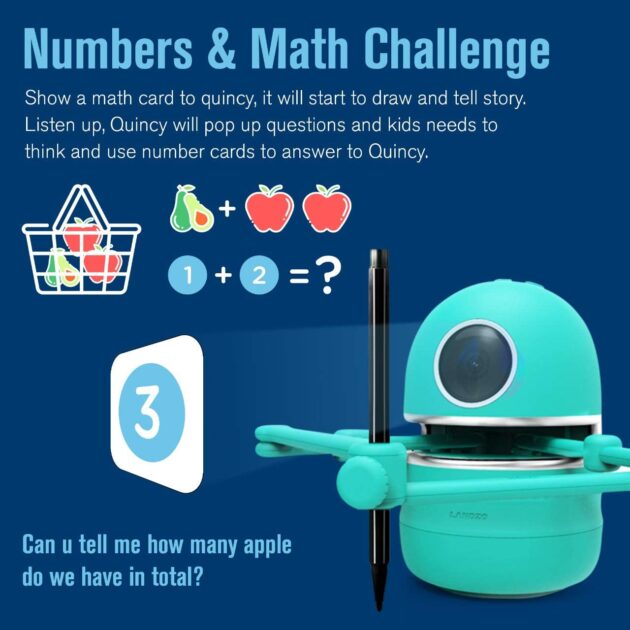
    Today, I was surfing Amazon and got to buy Angie, a drawing robot. The way Angie draws a picture using its robotic arm was incredible. My drawings are always awful, and so are the ones created by a robot with my command! Sandaisy’s video below should show the better of Angie:

    There are more than 12 million robots among us, and drawing is definitely not among their top jobs. But the end goal of robotics is to combine Artificial Intelligence and physical robots. The combination’s weight, let’s say, is heavier than the sum of the two parts. And with the latest trend of using AI to generate art, I considered comparing Angie’s work with AI-generated art.

    A Drawing Robot

    A Drawing Robot

    Drawing robots come with a kinematic structure. It not only allows them to draw with precision but also with a sense of style. For example, Angie can draw using various techniques like pointillism, shading, and outlining. Manufacturers program robots with algorithms to identify and interpret their environment. For a drawing robot, it would be to identify the shapes it needs to draw. Say, a robot can draw a perfect circle or a triangle. All in all, these robots are physical. Being physical means that they can have an impact on the environment.

    Here are a few examples of robots that draw:

    Angie

    Angie

    Angie is a great learning buddy for children aged 4 and up. I got easy, step-by-step instructions to solve puzzles and more. With three buttons–Scan, Next, and Repeat–I was able to become an “artist”. The package also comes with two pens, a charger, and over sixty drawing cards. What’s funny is that I didn’t read the description that Angie is for kids (it’s also for testing spelling and math skills). But believe me, despite being 26, I had as much fun as a kid. The drawing robot is a great gift to surprise your child.

    4M Doodling Robot

    4M Doodling Robot

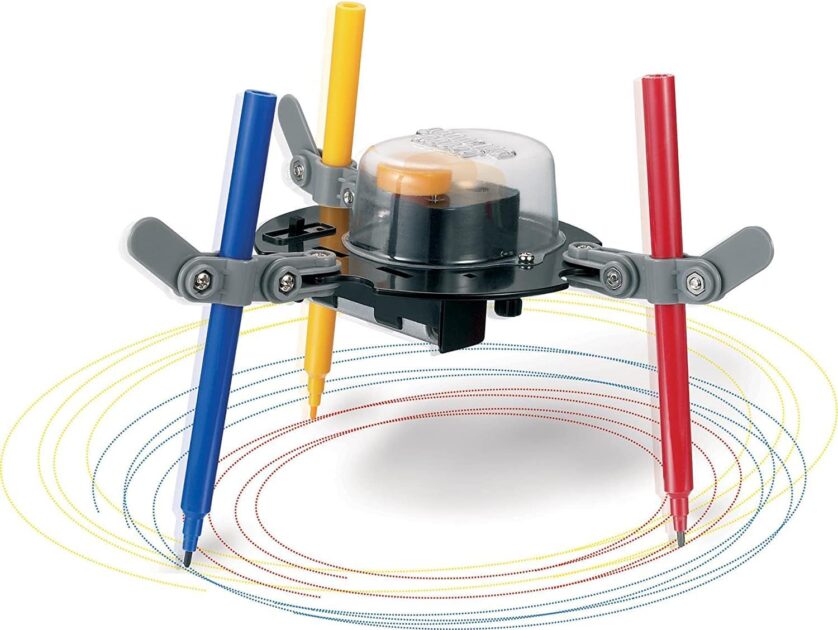
    The 4M Doodling Robot is a great drawing tool for any child looking to explore their creativity. With adjustable height and angle, you can create art without any special tools or knowledge required. This educational toy runs on one AA battery (not included) and is suitable for ages 8 and up. The kit includes parts, pens, and instructions to help get the robot up and running. Also, the vibration and spin of the robot’s motor help it doodle pictures, which makes it fun to watch.

    iDrawHome A3 Pen Plotter

    iDrawHome A3 Pen Plotter

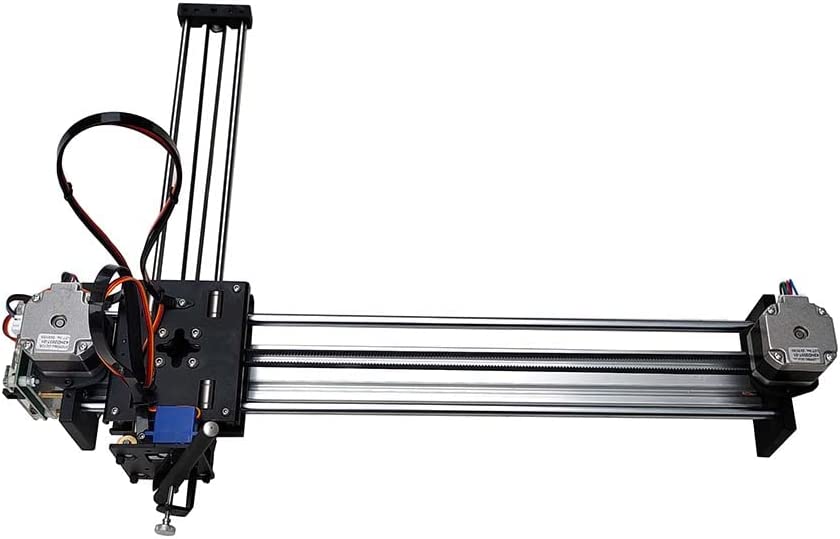
    A robot that draws 3D images is something that will take your creativity to the next level. The iDrawHome A3 Pen Plotter offers an amazing experience that requires some hands-on ability. It has an A3 working area, a high-precision 42 stepper motor, and 16 subdivision A4988 drive. This provides a 0.2mm positioning accuracy and 0.2mm XY movement accuracy, making it ideal for intricate drawings. It’s like almost assembled, with a guide to finish the whole assembly. In fact, this drawing robot can print direct input, drawing, or SVG JPG BMP PNG DXF files. It means that you can quickly print almost any graphics or text.

    Comparing a Drawing Robot with AI-Generated Art

    From the way MyHeritage AI Time Machine generates your ancestors, to DALL E 2 picturing your imagination. And from MidJourney-generated art winning an art competition to GPT-3 disrupting the art of content creation. Just leave alone Google’s Parti, a text-to-video generator Google is scared to release. AI-generated art has turned out to be the biggest trend of the decade. It’s more than just a robot drawing based on your simple commands! Here is how it’s different from a robot that draws:

    a. Programming/Intelligence

    AI-generated art possesses significantly more complex programming than that of a drawing robot. AI art generators can detect, analyze and interpret patterns. Programmers feed them with a set of data for that. The data is often in form of images and alt text i.e. descriptions. Furthermore, it uses that data to create unplanned art. The limits here are not the availability of data or the number of possibilities, but the practicality. For example, if you automate it, an AI art generator may keep on generating art pieces forever. Only the practicality is limited here. It is possible to create a lot of art pieces, but difficult to decide which one’s the best. It’s clear that AI-generated art relies on algorithms and data sets. Yes, drawing robots, too, have algorithms. But the difference is in the level/intensity of programming. For example, a drawing robot is programmed with coordinates and commands to draw. It will keep drawing until it receives a stop command, like forever!

    b. Interaction with the Physical Environment

    A drawing robot has the ability to interact with a physical environment. On the other hand, an AI art generator can draw only within the parameters of its code. The AI art generator can not come out of the device; it’s only the output that you may print. And that too, as 2D art on paper, is barely physical. Drawing robots have become advanced, and are already printing 3D things, like the iDrawHome’s A3 robot does to an extent. On top of that, 3D printers, themselves, are considered to be a form of robots (and they draw objects). One way to compare AI-generated art with drawing robots is by comparing sports with gaming. However, this method asks for controversy, due to its subjective nature. Let’s say, playing a game and playing a physical sport share some similarities. They each have rules, and goals, and require a certain degree of skill. Yet, the physical nature of playing a sport gives it an edge. But it’s all about the primary form of something. Physical sports have existed for centuries, while gaming is relatively new, making physical sports superior. However, when it comes to AI and Robotics, things change. Because programming language, which didn’t have any physical forms, has been around for longer than robots. As such, the primary/default form of AI is not physical, but digital.

    A Mixture of a Drawing Robot and AI-Generated Art

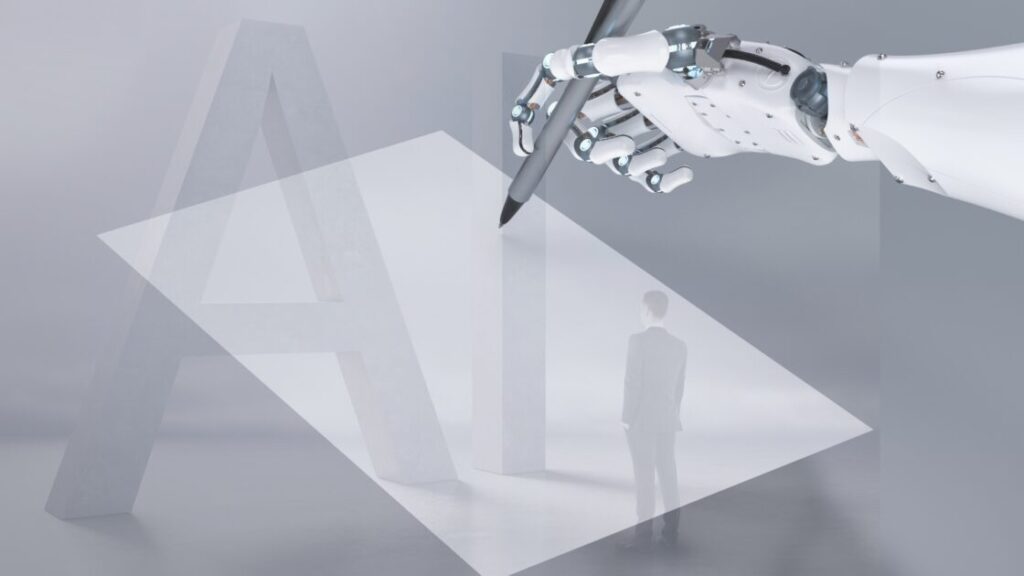
    A drawing robot drawing physical object with AI-generated art

    The combination of the AI art generators’ limitlessness, and the physical nature of robots make an interesting hybrid. As of now, AI is already capable of generating everything. Courtesy of OpenAI, the public got to know that a superhuman AI content generator, the level of GPT-3 can exist. And it doesn’t just stop there. We are all familiar with how human these AI-generated contents are; let it be images, text, or audio. Humanity has already deployed a human-like AI in digital form, and it’s only 2023. Humans are challenging Terminator’s prediction in every possible way, and 2045 now seems to be too far.

    Now comes the interesting part, the mixture, which involves two main steps, and then, 3-D printing.

    a. Automation

    Automating AI-generated content is not an enormously difficult task. In fact, if nothing works, just create a robot that automatically presses buttons and creates art. Yes, that’s not the smartest way to go about it. A much better and smarter approach is by using robots that can read an AI’s output and draw it in real time. One way or the other, automation is not tough, and we can definitely manage it.

    b. Deploying the power of AI generators to a physical machine

    This step is now the only obstacle that is coming between us and our robot-generated art. We need to figure out how to take the AI’s output and transfer it to a physical machine. This is where the difficult part comes in. We need to figure out how to combine the output of an AI with a robot and make it draw the art autonomously. There are many reasons why it’s tough. For example, the AI’s output might be too complex for a robot to interpret, or the robot might not have the precision needed to draw the art accurately. Furthermore, it might take a long time to transfer the AI’s output to the robot.

    c. 3-D printing of the art

    Again, this step is not as difficult as the step 2. Once the robot is able to draw the art correctly, it can be 3-D printed. We all know 3-D printing is already advanced, and it is becoming more accessible to everyone.

    Bottom Line

    Art indeed is lovable, but AI-generated art is here to stay. A robot that draws, such as Angie, offers an interesting comparison; it does create cute drawings. But such robots may lack the diversity and complexity of AI-generated art. The best way around this is to combine the two; an AI algorithm and a flexible physical robot. In this case, combining the creativity of the robot artist with the precision of AI-generated art. Feeding the drawing robot with complex generative models, it can draw something unique, beautiful, and physical in nature.

  • How Accurate is the MyHeritage AI Time Machine?

    How Accurate is the MyHeritage AI Time Machine?

    How AI Time Machine Works

    AI is timeless, an entity of several trillions of calculations that can collect historical data, and build upon the present to predict the future. However, as we all are witnessing for a while now, AI is going the opposite way than we had predicted. We’ve already mentioned that in one of our previous articles. Every futurist from 2010 predicted AI to first take over physical tasks, then maybe someday creative works. But as we can see with AI image generators, AI has turned creative before helpful, and, in fact, is using that creativity to help us with physical tasks. It’s going just the opposite. Similarly, in contrast to a future-predicting AI, MyHeritage’s AI’s ability to predict the unseen past is trending.

    Introduction to MyHeritage AI Time Machine

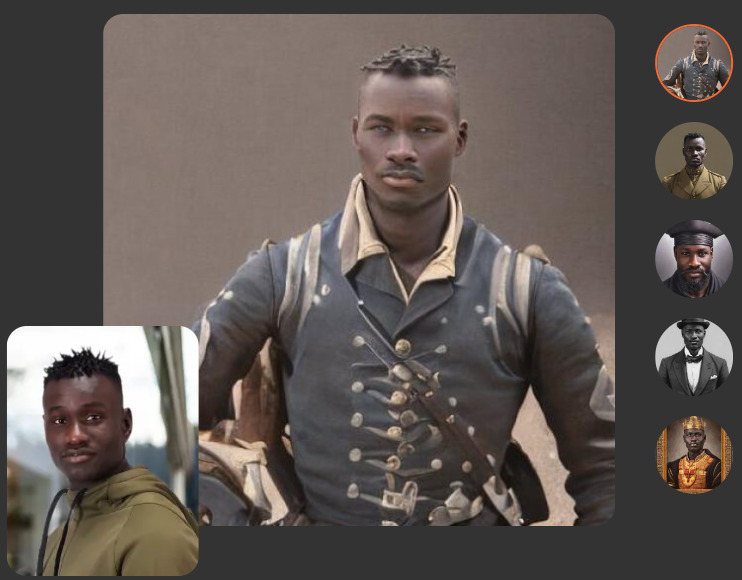
    MyHeritage AI Time Machine is an emerging technology that utilizes your photos to show you a glimpse of what your ancestors looked like. Basically, it allows you to explore the past and see yourself in different roles. As you consensually submit 10-25 photos of yourself, the AI engine creates your AI avatar in various periods in history. You can customize gender, pose, and background to get photorealistic images. In fact, you can also share these images on social media and use them as profile pictures. It takes 30-90 minutes to generate these images, and the output depends on the quality of the photos uploaded. MyHeritage offers a subscription plan, as well as a one-time purchase to get access to all the Time Travel themes. A free trial period is also available at times. AI Time Machine is a fun way to explore the past and see yourself in different roles.

    myheritage AI time machine demo
    Image credit: MyHeritage.com

    What it is Not

    Over-excitement is only normal, when an ancestry website, not even a tech website, offers you a “Time Machine”. Calm down, we’re just not there yet! Here are the 5 common misunderstandings about the MyHeritage AI Time Machine:

    Does not provide an exact or close resemblance to your ancestors. It all happens automatically using specialized technology. The AI avatars generated by MyHeritage are synthetic images and not actual photographs.

    Not an actual time machine. It is not a real-time machine, and you will not be able to travel back in time. No, you are not going to get a physical or video-based time machine to meet your ancestors with MyHeritage.

    No guarantees of perfection. While highly realistic, images created by AI Time Machine™ are simulated by AI too; they are not authentic photographs.

    Not foolproof. It is important to upload photos featuring only one person. If there are other people who appear prominently in your photo, crop them out before uploading them.

    Does not guarantee results for all ages. No. The technology for MyHeritage AI Time Machine™ needs to create a model of the person, and photos from a wide range of ages tend to confuse it.

    How accurate is the MyHeritage AI Time Machine?

    We can not yet measure the accuracy of MyHeritage AI Time Machine, as it is not a photograph. It is a simulated image created using AI. The AI still needs to go through a lot of hustles before actually predicting what your stone-age ancestors looked like. Accuracy, in terms of the image, depends on the quality of the photos uploaded. A higher number of photos with varied poses and expressions, taken on different days, will give you better results.

    Furthermore, it all depends on several factors, including:

    • quality and diversity of the photos uploaded
    • number of photos uploaded
    • lighting and background
    • gender and pose

    The accuracy of your ancestors’ physical characters, however, is indefinite. That’s because AI can only go so far in simulating facial features, body type, and physical characteristics similar to you. Now, 20 generations back, you had a million ancestors, and it’s yet impossible to predict the exact look of one of them. I said “yet”, because who knows, collective DNA-based technology is already a thing. In fact, MyHeritage has been long known for its DNA testing kits, long before this AI thing. And maybe in a few decades, we’ll be able to predict our ancestors’ physical characters accurately. Funnily enough, though, that’s when we will really be able to travel back in time.

  • Use Resume-Building AI to Prepare One With No Skills?

    Use Resume-Building AI to Prepare One With No Skills?

    In order to build a good resume, you will need to have strong writing skills. And who said that’s enough? Good grammar, a flooded-up resume template, and a bit of creativity are needed too. But a resume-building AI has started taking over the internet, and it can help you with all of that.

    Since the early days of the world wide web, people have been using computers to help them with their resumes. However, these programs were not very user-friendly and often required users to have some knowledge of HTML in order to create a decent-looking resume. Now, there are resume-building AIs that can help you create a great-looking resume, without any prior knowledge of HTML or other programming languages.

    Step-By-Step method

    First and foremost, you will need to find a resume-building AI that you can use. There are many different kinds of resume-building AIs out there, so it is important to find one that is right for you. For example, some resume-building AIs are better for entry-level positions while others are better for more experienced positions. Also, some have more features than others. Some features include the ability to track your progress, help you create a custom resume, or let you choose from a variety of templates.

    Do some research and read reviews before you decide on which AI to use. Here are some steps on how to use a resume-building AI:

    Once you have found a resume-building AI, the next step is to sign up for an account. This is usually a very simple process and only requires you to provide your email address and create a password. After verifying the email and creating the account, you will be able to log in and start creating your resume.

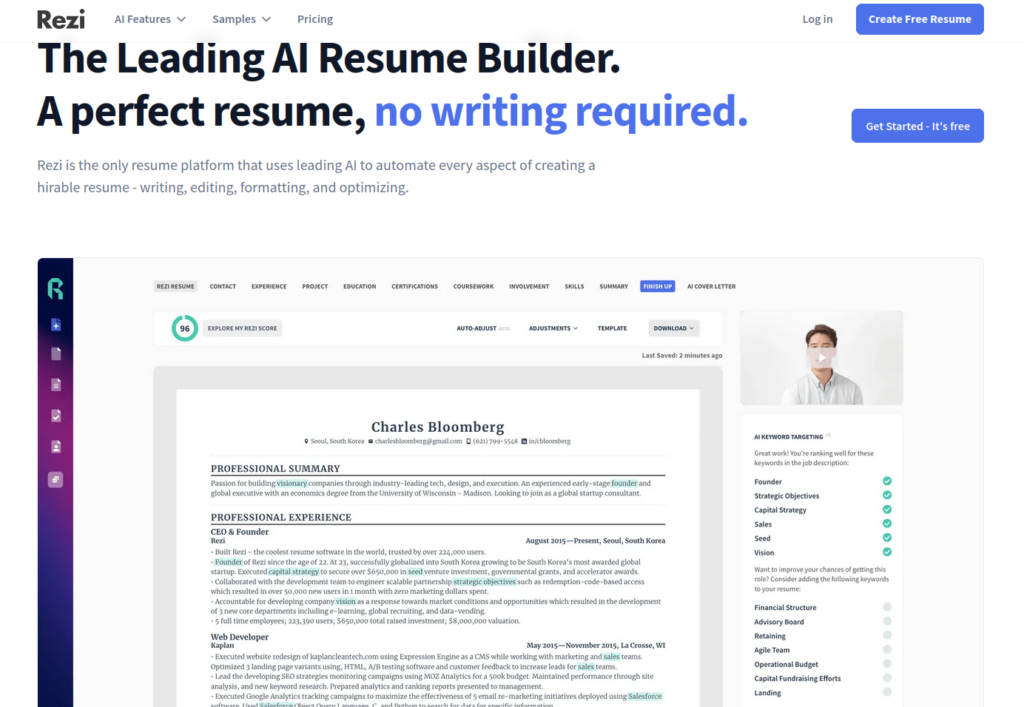
    example of a resume-building ai
    rezi.ai

    The process of creating a resume with a resume-building AI is very simple. You will just need to enter your personal information, work experience, education, and skills.

    The AI will then create a professional looking resume for you.

    If you want to make your resume look even better, you can use the customization options that most resume-building AIs offer. With these options, you can change the font, color, layout, and other aspects of your resume.

    You can also add images, videos, and other multimedia content to your resume.

    Once you are happy with your resume, you can download it or print it out. You can also share it online with potential employers or networking contacts.

    Is it ethical to use AI to build a resume?

    The fact is that it is 2022, and even if it were to be unethical, we have seen something beyond. AI art generators from text, GPT-3-based article generators, and even AI music, and video generators exist. So if you want to use a resume-building AI to get an edge over others, there is nothing stopping you.

    However, you do need to be careful about the information you input into the AI. Remember, AI is only as good as the data you feed it. So if you input false or misleading information, the AI will generate a resume that is not accurate. It is important to be truthful on your resume.

    You can still use marketing techniques to make your resume stand out. For example, you can use keywords that will help your resume get noticed by potential employers. AI is pretty good at this, but you need to be careful not to overdo it.

    Also, don’t rely on resume-building AI for the complete job. Rather, use it as an initial draft, and make any changes or additions that you think are necessary. It is also important to remember that your resume is only one part of the job application process. Employers will want to see a cover letter and may ask for additional information such as references or work samples. AI can’t do that just yet.

    Can it replace the jobs of resume writers?

    The World Economic Forum estimates that AI machines will replace 85 million jobs by 2025. But at the same time, it will create 97 million job slots. Now, that’s pretty much more than good. The case with resume writing is that AI can help with the first pass of screening resumes for key qualifications, but it will never replace the human touch that is needed to sell someone’s qualifications to a potential employer.

    The biggest thing AI lacks is the ability to find out the sentences of emphasis. From a given 500-word text, the machine would not know which are the important ones. It would also not be able to discern the candidate’s tone as accurately as a human can. Is the candidate too humble? Is the candidate overselling themselves? These are the types of nuances that can only be picked up by a human being. So while AI can help with the first pass of screening resumes, it will never replace the need for a human resume writer.

  • The Present and the Future of AI Art Generator

    The Present and the Future of AI Art Generator

    As anyone who’s ever doodled in a notebook knows, there’s a fine line between art and garbage. So it’s no surprise that some people are skeptical of the capabilities of AI art generators. Can a machine really create something that’s beautiful or moving?

    The answer, it turns out, is a qualified yes. AI art generators are still in their infancy, but they’re already capable of producing some impressive results. And as they continue to evolve, they’re only going to get better.

    AI art generators work by analyzing a dataset of images and their corresponding text descriptions. From this data, they learn to associate certain words with certain images. So when you give an AI art generator a text description of, say, a cat, it will generate an image of a cat.

    The results can be striking. For example, the AI art generator DALL-E has produced some pretty compelling images, including a cat made out of spaghetti and a floating cockroach head.

    Of course, not all of the images produced by AI art generators are hits. For every impressive image, there are many more that are, well, less or less than impressive. But as technology continues to evolve, the ratio of good to bad images is only going to improve.

    In the future, AI art generators will become even more sophisticated. They’ll be able to take into account the context of the text they’re given and generate images that are more in line with what the user is looking for.

    They’ll also be able to generate entire scenes and scenarios. So if you give an AI art generator a text description of a South American beach vacation, it will be able to generate a realistic-looking image of a Brazilian beach, complete with sand, sea, and sky.

    Ultimately, AI art generators will become so good at their job that it will be hard to tell their images from those created by humans. And that’s when they’ll truly come into their own as a tool for artists and designers.

    So if you’re interested in seeing the future of art, keep an eye on the development of AI art generators. They’re sure to surprise and delight us in the years to come.

    AI art generators are still in their early stages, as mentioned earlier. In the future, they could be used to create entire collections of art, or even to generate new works based on an artist’s style.

    At present, we use AI art generators to create “simply complex” images with a decent resolution. However, as technology develops, it is likely that more complex and realistic images will be produced, and maybe, videos too, who knows!

    There are a number of benefits to using AI to generate art. Firstly, it can be used to create artworks that would be impossible to create manually. Secondly, it can be used to create large quantities of artwork quickly and efficiently. Never mention the creativity, and its tendency to push the farthest limits.

    However, there are also some drawbacks to using AI art generators. One of the main concerns is that the artworks created by AI may lack originality and creativity. Another concern is that AI art generators could eventually replace human artists altogether.

    Overall, AI art generators are a promising new technology with great potential. In the future, they could revolutionize the art world and change the way we create and appreciate art.

  • 3 ways AI-generated videos are going to challenge reality

    3 ways AI-generated videos are going to challenge reality

    AI can already create images with your text commands. We’re not talking about “text-to-video software” in this article. Rather, we are talking about deep learning where computers can understand the content and produce an output.

    We can say that we have reached the “DALL E 2 stage of creative AI”. DALL E 7 will be about generating videos out of text commands.

    Here are the 3 ways AI-generated videos are going to challenge real videos:

    No limits


    Apart from being indistinguishable from reality, AI-generated videos will have no limits. You can make it generate anything, even things you could not have imagined. Such videos will start challenging the real world. They might even challenge your existence. For example: “A video illustration of the apocalypse.” “A video that shows what happens to the world after a nuclear war.” AI-generated video can create more crazy scenarios than you can imagine. Since there are no limits, even a mildly creative person can think of the weirdest possible videos. Google’s imagen AI is already there with the ability to convert text into videos, with creativity. But it is far from being available to the public.

    Sense of presence


    Erasing the boundary between real and fake is the first thing AI-generated videos will do. Just like AI-generated images, as pattern recognition gets better, AI will soon be able to generate videos indistinguishable from reality. In a sense, they will be the real thing. Unlike
    AI-generated images, in videos, the “sense of presence” will be much more difficult. Images can be creative even without them. But videos need it to convince viewers that what they are watching is real. It’s tough, but AI will do it.

    Create Movies


    Creating movies should not be a big deal for AI. Movies are fictional anyway, so AI can create your ideal movie. it will save money that had to be paid to the actors, and maybe reduce some overall movie revenues too. 😉 But it might be better than that. The AI can create movies of whatever genre you want, whichever actors you want, and with whatever storyline you want. You can give the script, and it will create a movie about it. Oh sorry, you just need to give the title. AI will generate the script, and it will pass it to the next stage where AI can generate the video. So, all you need is the Movie’s title. We can create videos from audio too. It will work better than text; converting speech to text, and text to video.

    No limits again!

    It’s going to be very interesting to watch what happens when AI creates its own genre of AI-generated movies.

  • 9 Cool Things to do While Using an AI Art Generator

    9 Cool Things to do While Using an AI Art Generator

    The use of an AI art generator is not only to produce funky-looking art but also to learn more about artificial intelligence. You can generate cool animals and faces, but also use them to test the limits of your creativity.

    Most people are amazed by how incredible AI is these days. A decade ago, I bet you could not have imagined AI starting with art – the mission to take over the world. All of us believed that AI will first take on physical labor, then maybe someday creativity. But it’s clear, and the actual scenario is quite opposite.

    DALLE.2, Midjourney, or any other AI art generators will help you to create art. But they will also learn from your work, and that is why they will improve over time.

    Image-based AI art is used synonymously as of 2022. But it does not only include pictures, but also video loops, text, and even music. Here, in particular, we are talking about the 9 cool things to do while using an Image-based AI art generator:

    Try to push its limits


    What is AI for? Pushing our limitations by pushing theirs. People often use AI to create some common and imaginable things like teddy bears playing underwater. You know, the usual stuff of art. But you can use AI to generate something really hard, like a picture of the inside of a black hole.

    Connect with others over an AI art generator


    You can use AI art generators to create memes. 2022 is the age of social media, and AI art is the current cool trend for it. You can use it to communicate with others, like a witty image or some creativity on message boards. A huge audience will appreciate your work, become curious, and share it with their friends and followers.

    Test its algorithms


    AI art generators can be used to test how far their algorithms can go. They are very complex algorithms:  many parameters are changeable, random factors are in place, and so on. You can them for the purpose of testing themselves. After all, we create AI to test it, correct? DALL.E 2’s creators, for example, have stated that even they don’t know how far the algorithm can go.

    AI-generated cartoon characters


    DALLE.2 is very good at producing cartoon characters. You can use this command, for example: “An Alien-Like looking man with a green mustache, cartoon”. It will generate a new cartoon image. It is perfect for your next story, comic, or maybe a children’s book.

    AI art of "An Alien-Like looking man with a green mustache, cartoon"
    An Alien-Like looking man with a green mustache, cartoon

    Have fun with an AI art generator


    DALLE is great for the process of creation, but it can also be used to have fun. You can play with it. You can use it as a tool to make art and have fun with other people in your process of making something. Basically, you can take it as “gaming” with AI.

    Create a new image to enhance your imagination


    Testing AI is not enough. What about you? You can use AI to generate art, and the commands, meanwhile, always increase your imagination power with time. Frequent use of AI art generator can broaden your horizons, kind of like that guy who throws you into a whole new world with a snap of his fingers. You will start perceiving the real world in a different way.

    Create thumbnails for YouTube


    This is where AI actually starts taking our jobs. But it’s the truth. AI can generate good thumbnails as per your commands, sometimes better than humans. The job of a graphic editor is at risk, but you are not one, are you? If yes, don’t worry because AI will be the best partner for you. You can use AI to create graphics.

    Make a new image and surprise yourself


    Time and again. AI-generated art will surprise you and produce something completely different, but still brilliant. Guess what, getting surprised helps us to focus our attention and inspires us to look at our situation in novel ways. Of course, you don’t want a big real-life snake to get surprised; AI can do the job for you. FYI, the unexpected and inspiring are the most fun things.

    Create paradoxes


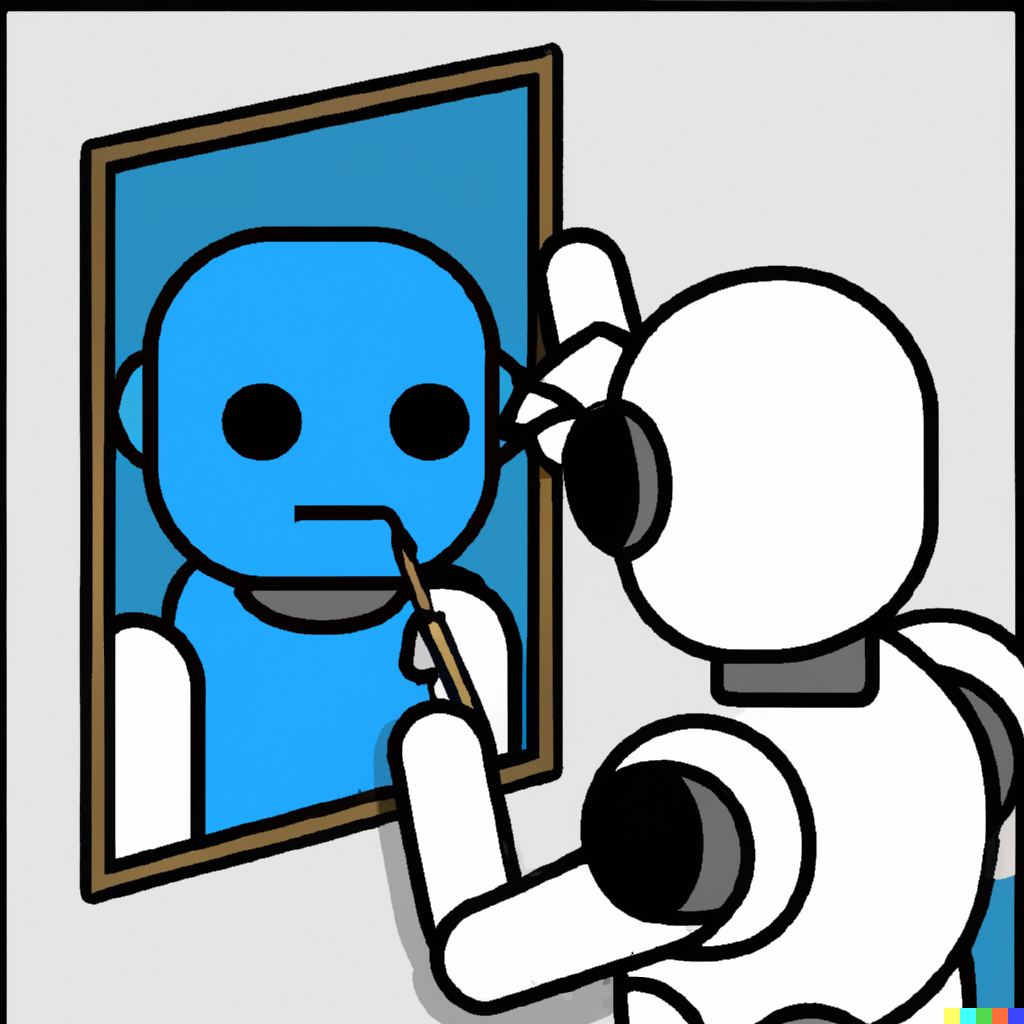
    You can also command AI to generate paradoxes like “A robot creating a picture of a robot that is creating AI”. It is a new form of art and it will create a new paradox. We are running out of paradoxes anyways, aren’t we?

    AI art of "A robot creating a picture of a robot that is creating AI"
    A robot creating a picture of a robot that is creating AI

    We didn’t include points such as “AI generating pictures of you” because it can’t just yet do so. However, you can put yourself in the picture and see how AI is doing right now.

    We hope you enjoyed our list of 9 cool things to do while using an Image-based AI art generator. The key is to have fun!

  • DALL-E’s AI Art Generator Finally Opens Doors to a Wider Internet

    DALL-E’s AI Art Generator Finally Opens Doors to a Wider Internet

    Key Points:

    • DALL-E, an AI image generator, is now free and available to everyone.
    • As of now, the AI generates more than 2 million AI-generated graphics daily.
    • As we all know, developers claim they have improved their filters to reject images that imitate sexual, violent, or political content using data and customer input.
    • The Washington Post reports that the software may be used to produce protest photographs.

    Artificial intelligence-created images are already prevalent in online art and image collections. Now that DALL-E, the AI picture generator that probably began the current artificial image obsession, is free and available to everyone, expect to see even more creative images or images of dubious origins.

    Developers of DALL-E OpenAI stated in a blog post on Wednesday that the game already has 1.5 million users and generates more than 2 million AI-generated graphics daily. The company claims they have improved their filters to reject any images intended to imitate sexual, violent, or political content using data and customer input. DALL-E does not currently have an API available, but they are reportedly developing one.

    Although there is now a signup page, the DALL-E section of the OpenAI website still requires users to register for a waitlist as of the time of publication. OpenAI claimed that it used an “iterative deployment approach” to responsibly scale DALL-E, which “has allowed us to find ways they may use it as a powerful creative tool,” according to a statement sent by email.

    New users receive 50 free credits to go toward image creation during the first month after signing up, followed by 15 free credits each subsequent month.

    When OpenAI’s image generator was first announced in April, people rushed to sign up, with some waiting months for their turn. Though DALL-E-named after famed artist Salvador Dali and written akin to Disney Pixar’s WALL-E-was the first system to significantly advance AI image technology, other systems have since caught up, at least in terms of popularity. On its Discord-based platform, Midjourney has hundreds of thousands of members, and StabilityAI, the company behind the AI art generator Stable Diffusion, has been in discussions to raise millions of dollars thanks to its more open-ended, controversial system.

    Reactions Include Criticisms

    Due to both, the increasing popularity of AI arts and the public backlash against them, OpenAI’s announcement finds itself in a very awkward position. The Washington Post spoke with numerous OpenAI product directors while showing how one may use the software to fabricate protest photographs, which would go against the firm’s guidelines for producing political imagery. By activating content warnings on words like “preteen” and “teenager,” the system reduces user prompts. The Post also pointed out that, while the system should prohibit prompts based on famous people, it still allows users to create images of people like Mark Zuckerberg and Elon Musk.

    And the vital question of possession is still open. After entering and winning the top prize in a local art competition with an AI-generated work of art, a tech executive made headlines. The U.S. Copyright Office has stated they do not accept any work that was not created by human hands, thus the question is still up for debate. Last week, an artist claimed she received the first copyright for work created using AI art.

    Of course, controversy has touched all of the most well-known image-makers. Some have attributed the creation of child porn to Stable Diffusion, despite the fact that StabilityAI founder Emad Mostaque stated that they were developing tools to prevent it. Even the heads of the companies Stability AI and OpenAI have argued over which of their solutions is the least controversial.

    OpenAI last week announced that they were removing the constraints that prevented users from uploading actual human faces for the AI model to try and modify. It also claimed to have developed detection technology to prevent people from abusing the platform to produce violent or pornographic content. Users were allegedly banned from posting pictures of people’s faces online without their permission. OpenAI had previously allowed academics interested in building artificial human faces access to its systems.

  • AI-Generated Art Wins a Prize: Artists left with no words

    AI-Generated Art Wins a Prize: Artists left with no words

    They did make us aware of this future with AI – but couldn’t stop it from happening. Maybe, it was just inevitable.

    A decade ago, when you talked about AI, you would have assumed that AI was going to first take over physical jobs, and only then get its hands into the “thinking” part, and finally, creative tasks. But technologies like DALL E 2, GPT-3, and Midjourney are not only changing, but opposing the predicted timelines.

    The annual art competition at the Colorado State Fair this year awarded prizes in all the customary categories, including painting, quilting, and sculpture.

    However, one participant, Jason M. Allen, had some other plans. He didn’t use a brush or a piece of clay to create his work. He used Midjourney, an artificial intelligence tool that transforms words into incredibly lifelike images.

    “I’m not going to apologize for it,” he said. “I won, and I didn’t break any rules.”


    https://www.nytimes.com/2022/09/02/technology/ai-artificial-intelligence-artists.html
    AI-generated picture

    And in fact, he is not wrong either. What’s wrong is the timeline of technological advancement that was inevitable from one certain point in the 20th century.

    It’s clear that AI is entering a new era—an era of creative thinking and creativity. 10 years ago, when I was in high school, people used to say: “Computers can’t think.”. Well… they can’t think, but now it seems like they are going to find a better word for “think”.

    There are two main ways of thinking: The first is logical, structured, and clear, and the other is creative, unstructured, and non-linear.

    Strategy for those who want to know what AI will mean for their field: merge creative tendencies (that’s where most humans already are) with the logic processing power of DL. Most likely, humans are going to get closer and closer to turning themselves into machines rather than creating consciousness in a non-living dummy.

    We’ve already seen this happening in music — it’s why artists started using AI to create music and we are getting shit. In photography — it helps them edit their photos better. Writing — helps them write better. And now we’re seeing that in painting as well.

    Only recently, the AI philosopher GPT‑3 defeated a human philosopher. The public could not distinguish Daniel Dennett’s philosophical quotes from those of the AI philosopher. Philosophers are now worried about losing their jobs. Jokes in the garbage can, AI has actually started to hit. Imagine learning art for years in art school, and then you get a program that can do the same in an hour – I mean minutes.

    “Although AI is still in its infancy and has a long way to go before it reaches its goal of perfectly modeling human thinking patterns” – you might have heard this one quite a few times. But you’re not even aware of it, and AI is already a toddler.


  • The Present is GPT-3: The Future?

    The Present is GPT-3: The Future?

    Introduction to GPT-3

    “I had not realized … that extremely short exposure to a relatively simple computer program could induce powerful delusional thinking in quite normal people”. – Weizenbaum, 1976.

    As another important step in the development of artificial intelligence, people are now talking about Generative Pre-trained Transformer 3 (GPT‑3) because it is way better than any language program in existence. It can produce text that any human can read. And this breakthrough can be critical for companies that wish to automate most tasks.

    GPT-3 can contextually respond to text inputs. For example, companies can use it to enhance consumer service without giving customers the feeling that they are chatting to a machine.

    Several downsides come along with huge potential. GPT-3 is a deep neural network that is still largely unknown to humans. Its algorithms cannot be examined or studied to understand how they work.

    Some claim that while the text that GPT-3 writes first seems great, the system’s language loses coherence and becomes illogical when working on longer works.

    Many people are also concerned that GPT-3’s failure to distinguish between fact and fiction can be used to promote social biases like sexism and racism. For instance, GPT-2 was not available to the general public since it could be exploited for spamming and the spread of misinformation.

    Can GPT-3, which is more advanced than GPT-2, have a bigger potential for abuse and misuse?  Proponents of the algorithm are required to answer such questions.

    GPT‑3 vs Human Intelligence

    In a recently conducted experiment, GPT-3 AI Successfully Impersonated Famous Philosopher Daniel Dennett. Philosophers Eric Schwitzgebel, Anna Strasser, and Matthew Crosby’s experiment asked people to choose from 5 answers.

    Each question had five options to choose from; one was by Daniel and the remaining 4 were generated by GPT‑3.

    It was perfectly indistinguishable for the general public, and confusing for the experts and experienced blog readers.

    The public GPT-3 expirement

    The experiment involved 98 online participants from Prolific, 302 people who clicked on the quiz on Schwitzgebel’s blog, and 25 individuals with in-depth familiarity with Dennett’s work who were contacted by Dennett or Strasser.

    According to Schwitzgebel, they expected the Dennett experts to correctly answer at least 80% of the questions on average, but they only obtained a score of 5.1 out of 10. No one correctly answered all ten questions, and only one person got nine. The average accuracy rate among blog readers was 4.8 out of 10. The topic of whether humans might construct a robot with beliefs and desires bewildered the specialists the most.

    Since its introduction, GPT-3 has spawned dozens of additional experiments that lead to similar eyebrow-raising reactions. With very little prompting, it can generate tweets, write poetry, summarize emails, answer trivia questions, translate languages, and even writes its own computer programs.

    It seems that GPT‑3 has not only made a stronghold at present in artificial intelligence (AI) technology, but it also indicates a better future version of the same. Whether the next generation of GPT will be able to beat human intelligence or not is still unclear. However, it’s already making considerable headway and is one of the most fascinating steps in the history of AI.

    GPT-3 represents “the present”

    As a conventional logic, we can say that GPT‑3 is a huge breakthrough in the realm of AI. The singularity is almost here; yes. digital singularity. AI will be able to do many things that humans can do and maybe even some things that we cannot…imagine!

    Aside from this fact, it’s so smart that there is not much room for a human to understand its decisions.

    As long as algorithms are trapped inside the machine, there is no reason to worry. As for the GPT, it won’t develop its own agenda. But that doesn’t mean that we should not worry to protect our freedom and integrity.

    It will keep on changing

    With deep learning, we created ‘black boxes’, just like GPT‑3. So with that said, we must decide how to use them. GPT‑3 is a great tool for us to know what is not good with AI and maybe how we can improve ourselves if we can’t be self-aware without it.

    We know that no technology can remain as it is forever. GPT‑3 will also go through a transformation, renovation, and further development time. When its next version is introduced, there won’t be any surprise if it could move forward and prefer to use advanced methods instead of manual data entry.

    GPT‑3 is not the future – it’s the present. We as well as other advanced algorithms, including GPT‑4, are the future! As GPT‑3 is just the always-changing present, we need to be ready for that change in everything where we can.

    Read: Our Future with Virtual Artificial Intelligence(VAI)

    Here, being ready for the change means preparing ourselves to deal with the potential impacts of change. We can’t judge GPT‑3’s abilities as negative or positive, but we need to be aware of whether it and its other versions are doing good things or bad in the field of technology.

    We should also see how GPT‑3 itself is evolving with or without human intervention. It means that we should be able to see and predict its evolution with or without our control shortly.

    Significance of GPT‑3 at Present

    Humans are good at understanding what they see, and we are particularly adept at understanding sentences. The rules are fairly straightforward: you look at a sequence of words, you pause to think what they might mean (or look them up in a dictionary) – then you try to work out how they fit together and how this impacts your state of knowledge.

    When these skills break down, as they can do in some forms of autism or language disorder, it can be very difficult for people to understand what’s being communicated to them. As such, GPT‑3 is the best tool that can simplify our life.

    Generate accurate texts

    GPT‑3 is a significant breakthrough, and it already has plenty of applications. It has been able to generate accurate text in dozens of languages, complete with diverse accents and styles. GPT‑3 performed ahead of humans in every aspect of comprehension, including understanding questions and answering them based on its memory.

    Understand the context

    GPT‑3 is also able to understand the contexts better which means that it could understand the situations surrounding a certain word or phrase and convey its depth of knowledge or wisdom impartially to anyone. The ability is really useful in resolving many complex issues such as those relating to terrorism, drug trafficking, crime, and predatory businesses.

    Yes, it is biased, though

    But one bad thing about this algorithm is that it can be biased or have specific preferences or even interests. For example, when asked what he thought about GPT‑3’s answers, Dennett himself said, “Most of the machine answers were pretty good, but a few were nonsense or obvious failures to get anything about my views and arguments correct”.

    Also Read: Google’s AI “Parti”: It relies on 20 billion inputs to create photorealistic images

    If AI in the future will be designed to deliver on its own specifics, it can potentially become an instrument for manipulation and control.

    We should raise our concerns about AI, and we should work hard to make sure that the technology does not get abused by governments or businesses that have ulterior motives. However, we do not have a choice but to keep it in mind as AI is here to stay! As long as we are intelligent enough to use it properly and safely.

    GPT‑2 vs GPT‑3

    GPT‑2 is an unsupervised deep learning transformer-based language model created by OpenAI back in February 2019 for the single purpose of predicting the next word(s) in a sentence. The model is open source and is trained on over 1.5 billion parameters in order to generate the next sequence of text for a given sentence. GPT‑2 is 10x the parameters and 10x the data of its predecessor GPT.

    On the other hand, GPT-3’s deep learning neural network is a model with over 175 billion machine learning parameters. To put things to scale, the largest trained language model before GPT‑3 was Microsoft’s Turing NLG model, which had 10 billion parameters. As of early 2021, GPT‑3 is the largest neural network ever produced.

    GPT‑2 was known to have poor performance when given tasks in specialized areas such as music and storytelling. GPT‑3 can now go further with tasks such as answering questions, writing essays, text summarization, language translation, and generating computer code.

    GPT‑3 is the most powerful and advanced text autocomplete program so far. It smartly spots the patterns and possibilities in huge data sets. By using that, it performs very amazing tasks that were impossible till now by an AI tool. According to The Verge, “The dataset that the GPT‑3 was trained on was mammoth”.

    GPT-3 vs the future

    It is clear that GPT‑3 is showing us a glimpse of the future of AI and one thing is certain it will only be a matter of time before it will make another milestone and surpass Human creativity and imagination.

    The current AI are better at reading than writing and comprehending information than generating. GPT-3 has certainly pushed that limitation up to an extent.

    The future of artificial intelligence will be managed by the future versions of “GPT”. The future of AI will no longer be about a human-to-machine interface. It will be entirely a robot talking to another robot to create a human-like robot.

    How GPT-3 is showing us a glimpse of the “AI Future”?

    Well, the current GPT-3 can produce texts. But inevitably, the output will just not be limited to text. In the future, who knows AI will give output in form of speech, or maybe in form of physics. You never know!

    GPT-3 has already equaled a human philosopher. This is not a small achievement. This is something that wipes off the window glasses to show us a clearer future with AI.

    Philosophers are hating GPT-3, though; not gonna lie. Who would have thought that AI would be taking the job of a Philosopher before anything else?

    But jokes aside, we have to be responsible and careful while using GPT-3 and other forms of AI. We must not forget that technology is pulling us to the future and it is up to us what we do with it.

    So, if you think AI is the future, keep your eyes wide open to possible dangers and errors in the system. But if you can comfortably accept and welcome this technological advancement, then carry on in your life without worrying. Whatever happens, we need to embrace it and find a way to make it work for us!

    Conclusion

    It can be seen that AI is not only the future of technology but also an integral part of the future. But this is only possible if we choose to be intelligent enough to take care of its side effects. With GPT‑3 as well as other tools, we as individuals can be able to adapt to the changes but all together has to come up with a decision as a whole community. To conclude, GPT‑3 is not here to remainin its present form forever. It will undergo a transformation, renovation, and further development with time.