When it comes to search engines, we have never really seen a race, have we? In the 90s, Yahoo was the clear leader in the search engine market. Google then quickly became people’s go-to choice and currently constitutes 76% of web searches worldwide. In fact, in the US, search engine competition is almost non-existent, with Google accounting for over 90% of searches. Prior to AI’s introduction, Bing has always been the second best, however, accounting for only 9%(of global) and 2%(of US) searches. The lack of competition has led to stagnation in the search engine industry. We are seeing very few improvements in search accuracy and speed, and as there is no real competition, Google is not motivated to introduce new features. For these reasons, it was exciting to see Bing make a move.
Huge Update (October 3, 2023): DALL E 3 now available for free on bing chat.
The New Bing
So, Microsoft has upgraded its search engine, Bing, using the AI technology behind the chatbot ChatGPT. The company is calling it the “new Bing” and promises that it will deliver information quickly and fluidly. Microsoft CEO Satya Nadella said the new Bing will have a chat interface like ChatGPT, where users can ask it questions. The new Bing is essentially powered by an upgraded version of OpenAI’s GPT-3.5 language model, “Prometheus”. It is really powerful and better able to answer search queries with up-to-date information. Microsoft is also launching two new AI-enhanced features for its Edge browser: chat and compose.
What does this competition mean for consumers?
For many of us, search engines are not only a source of information but a way to find what we need. In fact, more than 70% of online transactions start with search engines. The competition between search engines will benefit consumers in many good ways. The competition also means that search engine companies are likely to invest more in research and development, resulting in even better search experiences and features. This could include improved voice search, more personalized results, and I would say not necessarily “more accurate”, but indeed better results.
Disrupting Traditional Educational System
We’ve heard a million times, our educational system is terrible, this, and that. So here you have it, Bing’s here to disrupt it. As students can chat with the search engine, they can ask questions, get answers and gain knowledge in a much easier and faster way. Well, this might not lead to better grades, but definitely, the students will have access to more knowledge and be able to understand it better. For one, bing’s chat can answer complex queries, such as “What are the advantages of using solar energy?”. But the “disruption” here is how it explains complex mathematical formulae and scientific equations to you in a way you ask it to. Like, write “Explain to me the theory of relativity like I’m 5!”, and it will.
Disrupting Google
The arrival of the new Bing could soon disrupt Google in the search engine market. Here’s why:
1. Improved Search Accuracy
The Prometheus Model is designed to answer queries quickly and accurately, using advanced AI technology. This means that users can expect to receive more relevant results when they search on Bing. Reducing the amount of time they spend scrolling through pages, bing’s AI search engine surpasses Google’s speed; speed is one of the main reasons people have been using Google.
2. Chat Interface
One of the key features of the “new Bing” is its chat interface, which is similar to ChatGPT. This allows users to ask questions and receive answers in a conversational manner, making the search experience more interactive and intuitive. The chat interface could prove popular with users who prefer a more conversational approach to searching.
3. Better Up-to-date Information
The interned is vast, with more than 94 zettabytes of data. The Prometheus Model is better able to provide up-to-date information compared to previous search engines or ChatGPT. This is because it has access to a vast amount of data, including information from various common and uncommon sources. As a result, users can expect to receive information that is relevant and current, increasing the overall quality of their search experience.
4. Unique Content
The best thing about the new Bing is that its chat feature answers your question in a completely unique way. It’s a personalized answer, that has never been answered before, by any person asking the same query. This means you can get totally unique answers to your questions. On the other hand, Google’s search engine always provides the same results with links to relevant pages. This is a massive red alert for Google.
5. No Ads?
Most of us don’t like ads. Traditionally, it has worked like this: go to Google, search for something, click a website, and it will show you ads. So, basically, you are paying for “ad clicks” for your free visit to a random website. However, if the chat feature in Bing search does not show ads, then that would be a game-changer! We have already seen that even YouTube Shorts show ads nowadays, so nothing would be too surprising. We will have to wait and see how Bing’s new system works.
Bottom Line
Bing’s search engine AI is much more than “autofill”, a big step forward. Bing’s announcement of chat features was a necessity, not only to challenge the dominance of Google but also to make Google work harder in order to stay on top. Let’s wait and see Google’s response to this!
The way ChatGPT blew up; even OpenAI’s president Greg Brockman and executives say they hadn’t expected that much. Just one week after being launched on November 30th last year, the super-intelligent chatbot crossed 1 Million users. This shows just how badly people needed a smart AI-powered assistant to talk with. Now, whenever digital assistants have come forward, voice features are the ones that follow. Take Google’s assistant, for example. In fact, even blogs are now commonly using TTS(Text-To-Speech) AI APIs to read out articles. And when it comes to AI the level of ChatGPT, the expectations after it enables voice features are very high. Like… from Rowan Cheung‘s recent tweet calling ChatGPT a free money printer to hbr’s review calling it AI’s tippling point. Not only does it have to be conversational, but it also has to sound natural and human-like. Of course, only that will do justice to the generative abilities ChatGPT possesses.
How ChatGPT Works
ChatGPT is a member of the GPT family of language models developed by OpenAI. Other GPT models, including the latest davinci-003, focus on language generation tasks. ChatGPT has more conversational training data. Just like any other GPT model, ChatGPT is transformer-based. It works by predicting the next word in a sentence based on the input text, using deep neural networks and a self-attention mechanism. The model has 175 billion parameters and was trained on over 570 GB of text data from various sources. Apart from common Crawl, sources include web pages, books, and Wikipedia articles. The training took over 3 months on then-high-performance GPUs (it took place in 2021). The model’s ability to generate coherent and diverse text, answer questions, summarize text, translate languages, and perform other language tasks makes it a powerful tool for natural language processing applications.
Why is there no voice version of ChatGPT yet?
It looks so easy on the surface — just combine a text-to-speech (TTS) model with a GPT model, right? Well, it’s not impossible by any means. But still, it’s not as simple as it looks. Looking from OpenAI’s perspective, adding TTS to the ChatGPT model would add an extra layer of complexity. From additional resources like GPUs to storage, developers need to figure out how to make the model work efficiently. Integrating a TTS model with GPT would also require a lot of additional budgets, training time, and resources. High-quality audio, accurate speech recognition, again, are must to maintain ChatGPT’s reputation. For that, a partnership with a good TTS provider would be necessary, which can be costly and time-consuming, especially now, as ChatGPT is available for free. (OpenAI itself has stated that ChatGPT is in its feedback stage.)
When will we see ChatGPT voice assistant?
It’s impossible to predict the exact day and time of ChatGPT voice assistant’s launch. However, we can take the available information and speculate.
a. Budget Problem
Sources state that OpenAI executives are discussing a $42 monthly subscription fee for ChatGPT. If that happens, then the company will probably be able to invest in TTS. After looking at ChatGPT, Microsoft has already confirmed its $10 Billion investment in OpenAI; it’s a huge step forward. Remember how Microsoft invested $240 Million in Facebook back in 2007? They know how to invest in the right tech and turn them “giants”.
b. Training a Model
Once the budget is in place, the next step would be training a TTS model. OpenAI will need to train a model that can generate convincing and accurate audio from text. It will also need to be powerful enough to handle the conversational abilities of ChatGPT. ChatGPT servers are already famous for crashing due to heavy load. TTS models can add an extra load, so OpenAI will need to be extra careful about this.
c. Version Management
We are yet to see whether the voice feature will cost extra or be included in the existing ChatGPT subscription. In either case, maintaining two different versions of the product — text-only and voice-enabled — will require extra effort.
d. Artificial Voice
OpenAI already has its “whisper“, an ASR (Automatic Speech Recognition) system. However, they may need to tweak the system to match the naturalness and accuracy of human voices. As mentioned earlier, partnering with a good TTS provider is the likely way for them to go.
We can estimate the ChatGPT voice assistant to arrive sometime in Q3-Q4, 2023.
Voice control browser extension for ChatGPT
The ChatGPT Voice Extension is a hidden gem that many are not aware of. This amazing tool allows you to interact with the ChatGPT preview from OpenAI using just your voice. The option to record your voice and have responses read aloud makes the conversation feel more natural and immersive. It also offers press-and-hold shortcuts such as holding down the SPACE key outside the text input to record, releasing to submit, and pressing ESC or Q to cancel the transcription. Additionally, you can press E to stop and copy a transcription to the ChatGPT input. The extension supports multiple languages, making it accessible to a wide range of users. The extension is easy to use and supports multiple languages. Despite its usefulness, this extension is not widely known and is definitely worth discovering for anyone looking to enhance their ChatGPT experience.
Please note that this article is not sponsored by or affiliated with “OpenAI” or “Voice control browser extension for ChatGPT” by any means. It is the user’s responsibility to ensure that they are comfortable with the level of privacy and security provided by the extension, and to make informed decisions about what information they share online.
As with any other AI-based technology, OpenAI’s ChatGPT also requires lots of resources, training, and budget to incorporate a voice feature. Due to its enormous capabilities, people often tend to forget that ChatGPT is still in its early phases. There’s a lot to come if we look at the improvements each new generation of GPT models have brought.
In our previous article, we discussed robot toys from the 70s. As we move forward to the 80s, it’s only natural to expect more sophistication. In the 1980s, as personal computers started to exist, it became commonplace to have personal toy robots too. In fact, we can consider the 80s as the golden era of robot toys. For one thing, they were more affordable and available than ever before. And on top of that, there were no video games to compete for kids’ attention. The decade of the 80s brought a 20x increase in the number of industrial robots compared to the 1970s. This pushed the industry to miniaturize the technology for domestic use, and also to make it more affordable. Here are the most popular robot toys from the 80s:
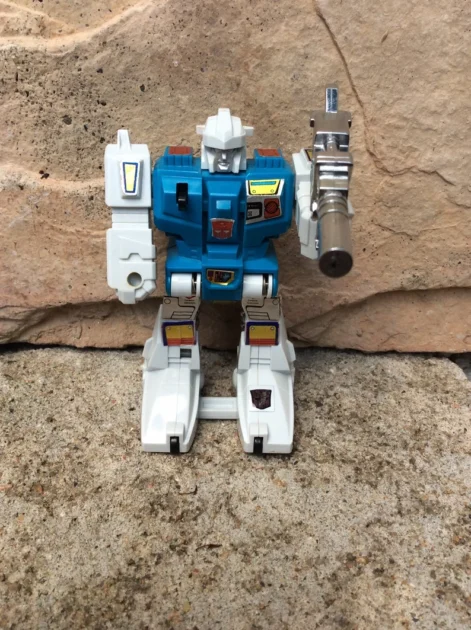
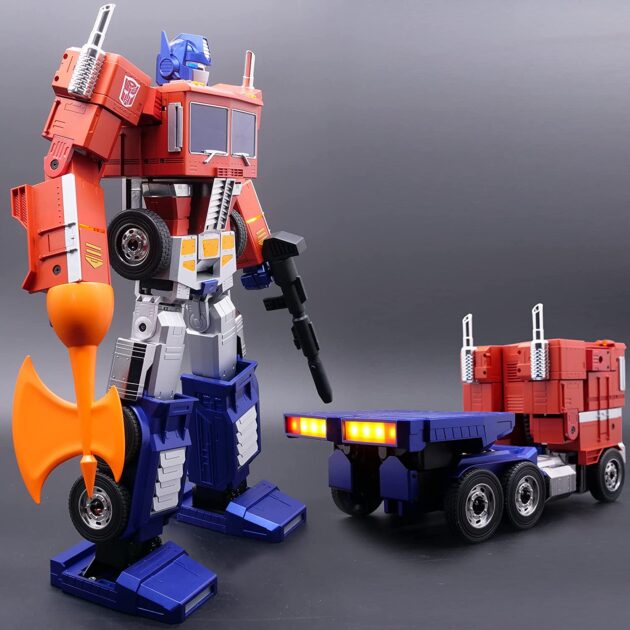
The first generation of Transformers figures was released from 1984 to 1990. There were different types of transformers with unique abilities. For example, Optimus Prime could transform from a robot to a truck. And Megatron could transform from a robot to a gun. The way these transformations worked was revolutionary for its time. You can still buy it for around $1,000 from Walmart, Target, or Amazon.
Features of this 19-inch tall robot include voice activation, a battle axe, a blaster, and a charging cable. it has 2 built-in rechargeable batteries and a travel case. Robosen’s advanced technology brings this classic toy to life with voice-activated actions, mobile app controls, and programmable walking, punching, blasting, and driving. It consists of over 5000 components, 60 microchips, and 27 servo motors, making it a great experience! Yes, still so in 2023.
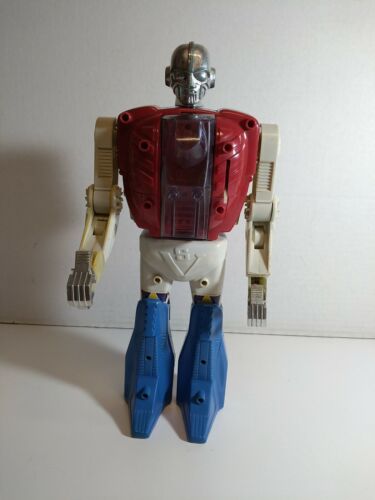
After transformers, GoBots were the second most popular robot toy in the 80s. The best thing about them was that they were cheaper than transformers and just as fun. Minneapolis company Dimension Creative Art Works designed the toys. They made a total of 72 different GoBots, including Leader-1, Cy-Kill, Vamp, Crasher, and Turbo. The GoBot toys were very simple to use – you just pulled a cord to transform them from robots to vehicles. The plastic they were made of wasn’t very durable, but that didn’t matter because they were still a lot of fun to play with. Although they were popular in the 80s, GoBots fell out of favor in the 90s and eventually went off-air.
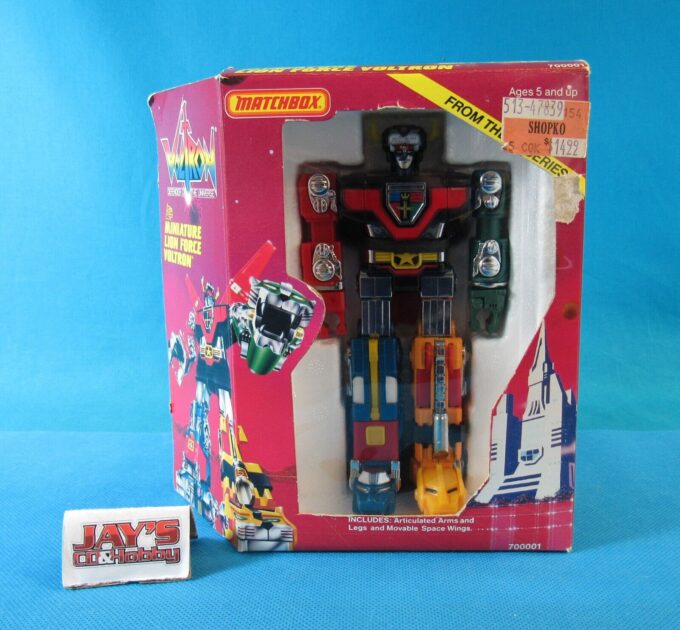
In the 1980s, the “Voltron” robot toy line was hugely popular. A plastic, rubber, and metal die-cast figure, Voltron was made by Matchbox and was part of the “Animated Adventures” series. The Voltron toy was an original, licensed reproduction of the popular TV show character. And the toy line; from Lion Force to Defender of the Universe, was special due to its “spacey” storyline. The unique storyline followed five pilots who traveled to different planets to battle evil forces. The heroes faced a different challenge on each planet. Kids loved the idea of these heroes battling evil while controlling a giant robot and replaying it for real in form of toys.
Teddy Ruxpin was an animatronic teddy bear released in 1985 by Worlds of Wonder. He looked and acted like a literal bear. Like he had a wide range of facial expressions; blinking eyes, and a moving mouth. He also had a cassette tape drive which allowed him to read stories and songs. Teddy Ruxpin was widely popular in the 80s and 90s, and yeah, he also had his own cartoon series. He was also one of the first interactive toys 80s kids got to play with. Tedy Ruxpin was a “classic” kid’s toy that had robo features.
Sindy was a popular 80s British robot doll. Her design so much looked like a teenage girl, and she had long blonde hair, blue eyes, and a range of outfits. The doll had electronic accessories, such as a toy telephone that you could talk into and hear Sindy answer-back. She also had an electronic organ that played music when you pressed the keys. Many people currently in their 40s-50s have fond memories of playing with this toy when they were younger.
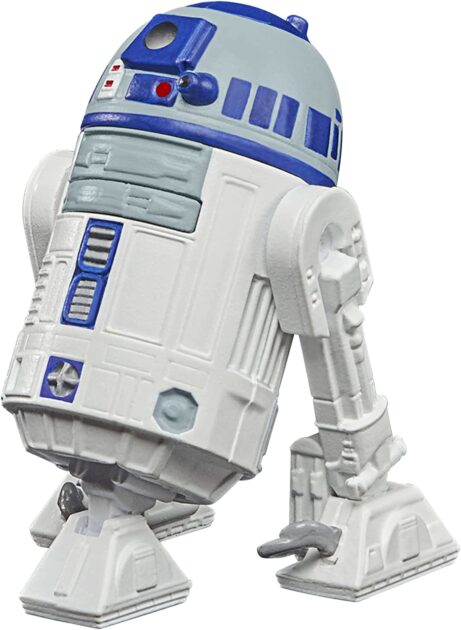
Star Wars Droids were tiny robots Kenner released in the late 1980s as part of the Star Wars toy line-up. They included R2-D2 (Astromech Droid), C-3PO (Protocol Droid), R5-D4 (Astromech Droid), 8D8 (Maintenance Droid), IG-88 (Assassin Droid), 4-LOM (Bounty Hunter Droid), and more! Each droid came with different features such as spinning antennas or moving arms/legs/head; depending on which droid you bought! Kids loved these droids because they could reenact scenes from their favorite movie (Star Wars, of course) while playing with them!
My Buddy & Kid Sister were two 1985 dolls Hasbro released as part of their Giggles collection. The denim overalls are so cute on them, as you see in the picture above. Kids used to know these two dolls as inseparable. Each doll came with several accessories including books, clothes, shoes, hats, sunglasses, etc. 80s kids loved them because they could dress up their dolls however they wanted! Plus there were several other fun accessories available too such as My Buddy’s fishing pole or Kid Sister’s Barbie car!
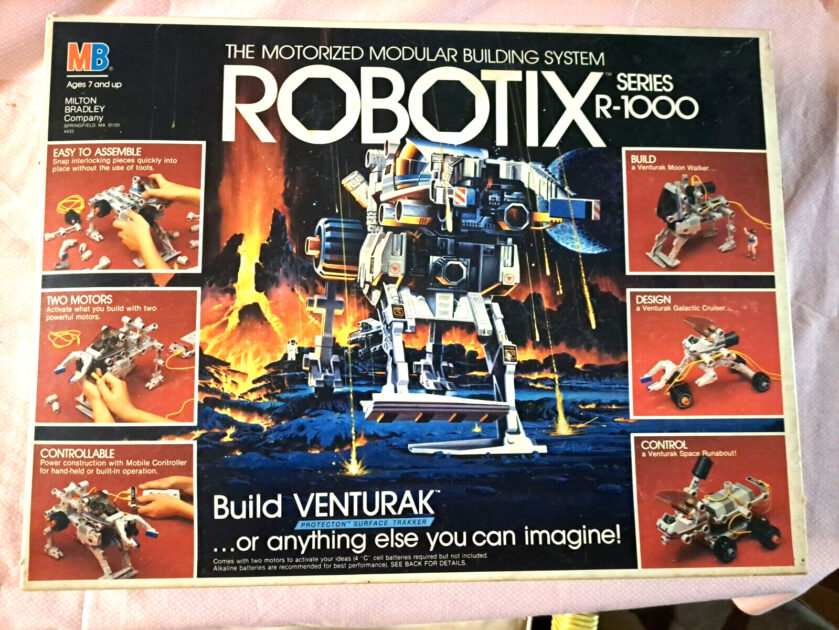
Robotix was hugely popular during the 80s due to its versatility – allowing kids not only to have fun building robots but also to take pride in creating something unique that they themselves could control via remote control. Milton Bradley created this toy line based on the animated series of the same name. The series was about a conflict on Skalorr, between Protectons and Terrakors, with humans caught in the middle. The toys were similar to erector sets, with motors, wheels, and pincers that could be used to create robots. Each set had an end goal, and its own name, and could be mixed and matched. Tyraanix Series R-1100, R-1000, and R-2000 were some of the sets released. Robotix was like Legos on steroids and provided hours of fun for kids and adults alike.
Radio Shack RC Robot
Okay, this one was like nothing else. Unlike anything on planet earth, Radio Shack RC Robot used to be in form of something like a balloon. You had to blow it up and then control the toy with a remote control. Just look at the creativity – it literally was a robot. And due to the form it was in, portability was a big plus. I have to say, it’s my favorite one on the list. This robot toy was a success in the early-mid 80s. However, due to popularity from competitors like Robotix & Big Trak, it eventually faded into obscurity. But still, looking at it now, the RC Robot was one of the most innovative toys of its time.
HeathKit hero 1
The HERO 1 robot was a hi-tech and advanced robot in the 80s. High-level programming languages like ANDROTEXT made it easy to control and program. The robot was featured in a few episodes of the children’s television program Mr. Wizard’s World. In fact, Byte magazine even called it a “product of extraordinary flexibility and function.” Separable from other robots of its time, HERO 1 had a self-contained computer with a Motorola 6808 CPU and 4 kB of RAM. Yes, 4 kB, and it was a lot back in the 80s! Moreover, the robot also had light, sound, and motion detectors as well as a sonar ranging sensor. An optional arm mechanism and speech synthesizer was also included. If you were a teen in the 80s, this robot was definitely more than a toy and something many dreamt of having.
The KITT car from Knight Rider was one of the most iconic toy cars from the 1980s TV show starring David Hasselhoff as Michael Knight, who drove around in a high-tech black Pontiac Firebird Trans Am called KITT (short for “Knight Industries Two Thousand”). The car featured advanced technology like an artificial intelligence system, talking computer voice, self-driving mode, rocket booster jets, and more! Of course, it also had its own line of toys – including miniature versions of KITT. It became very popular among kids during the 80s (and still remains an iconic robot car for the 80s kids). The knight rider was one of the first cars most 80s kids got to play with, apart from the 70s Big Trak.
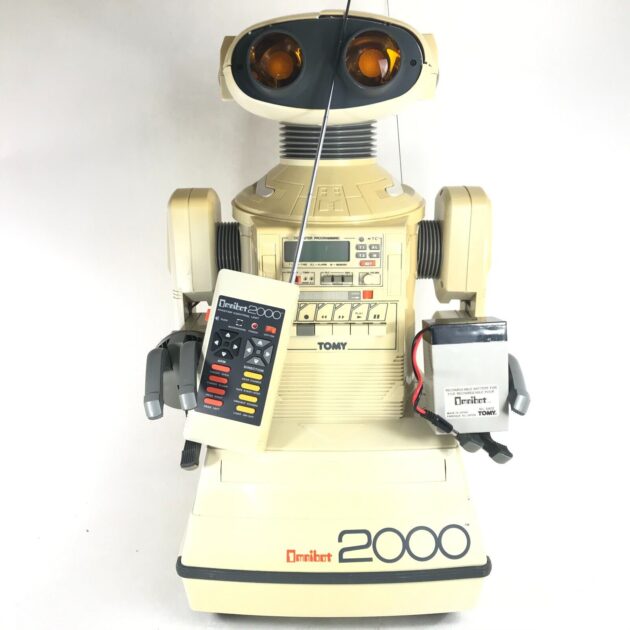
Tomy Corporation’s Omnibot 2000 Robot Toy was released in 1984 and was a huge hit throughout the decade. 1980s kids also called it a toy robot from the future, as they could see “2000” written on the front of it. And it indeed did futuristic tasks for that time! Yes, it featured an AI voice recognition system. That system was what allowed users to speak commands into the toy robot’s microphone for it to perform actions. Actions like turning on lights or carrying out simple tasks like cleaning up after dinner parties. It also had sensors that enabled it to react naturally when touched or spoken to. In fact, it could even deliver pre-recorded messages if desired! It’s not hard to see why this robot quickly became one of the most beloved toys from the 1980s. Today there are many variations of this 80s toy robot available online.
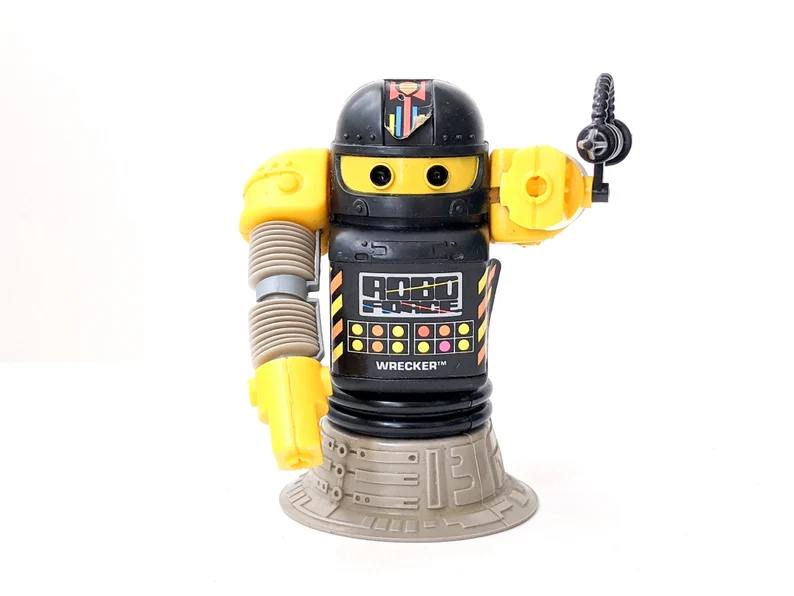
Another classic from Tomy Corporation was their Roboforce Robots line, also released in 1984. This robot toy came in two different sizes (large & small). Users used to battle against each other using various weapons such as lasers & missiles! These robots were unique because they could detect when they had been hit by their opponents’ weapons. So, no one ever won until all four robots had been destroyed. They also featured realistic sound effects making them even more enjoyable & exciting when played with friends! Toyfinity, an independent toy company, revived the robot in 2013.
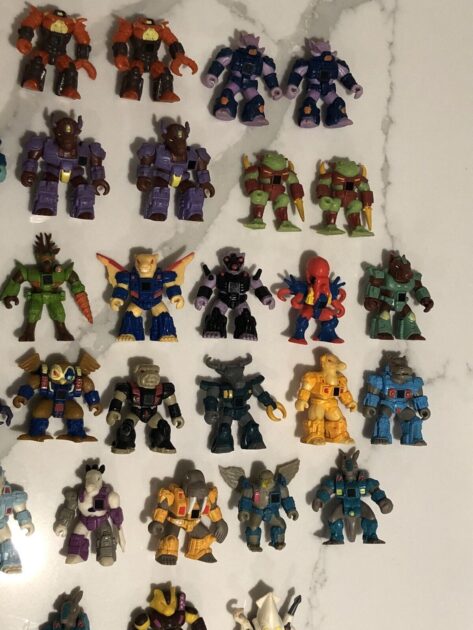
Battle Beasts Action Figures were a popular robot toy line by Japanese company Takara Co, released in 1985. Each figure depicted an anthropomorphic animal armed with various weapons such as swords & guns. This allowed users to customize their teams in every single way they liked. They would light up when placed onto heat-sensitive panels indicating whether it had lost or won against another opponent’s team. For the 80s kids, this robot toy was a great way to pass time with buddies.
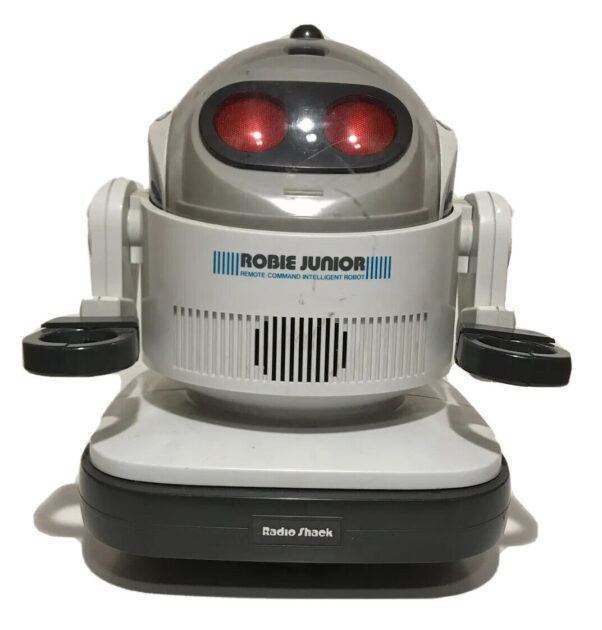
Robie Jr robot toy was a hit during the late 80s thanks to its ease of use and durability. And in fact, its interactive features enabled users to record personalized messages using its built microphone. Not only did this come with complete sound effects but also some facial expressions allowing them to become the user’s very own robotic friend. His eyes light up when moving and the bump guard on the front base allows him to turn and say phrases such as “Oops” and “Excuse Me” if he encounters an obstacle. The controller has manual control and a follow function that makes this 11-inch robot follow it. Robie Jr’s durable plastic design ensured he’d last generations. The perfect gift for those wishing to bring back memories and share them with your kids, grandkids, and theirs.
Bottom Line
This time too, like the previous article about robot toys, my grannie helped me a lot. The robot toys from the 80s were an important part of many children’s childhoods. Although she was in her 20s when the robot toys were at the peak of their popularity, she can still recall them vividly. In the 70s, most robot toys were just robotic figures that performed pre-programmed actions. But in the 80s, as you see, robot toys had the ability to interact with their environment. That’s certainly a big jump. Thanks for reading. And stay tuned for the next article, which will be about robot toys from the 90s.
Toy robots are still a classic staple of any kid’s toy collection. The first robotic toy was created in 1954. However, we can say that the decade of 70s was when robot toys truly began to take shape. During that time, both the number and complexity of robot toys were increasing. The toys had a realistic design and sophisticated movements, making them more entertaining and also more educational. Furthermore, the materials used to create these toys were of higher quality, making them sturdier and longer-lasting. That was with the help of advancements in materials and technology. In the 70s, the electronic components had also become more reliable and affordable. In fact, the first programmable microprocessor, the Intel 4004, was created in 1971. Robot toys surely benefited from this heat of innovation in the 1970s.
Big Trak Robot Toy – 1979
In 1979, Milton Bradley Company released the Big Trak. And the robot toy was real big of a hit with its six-wheeled, two-wheel drive tank, keypad, and “photon beam” headlamp. It was the most advanced toy of its time, allowing users to program a sequence of up to 16 commands. Big Trak was a great teaching tool for young children to understand basic computer programming. With the 24-key keypad, users could make the tank move up to 99 feet at a time. Even big movies featured it, like E.T. The Extra Terrestrial. Big Trak was so popular that over two million units were sold. The toy robot cost $40, which is more or less equivalent to today’s $150.
Shogun Warriors – 1977
Shogun Warriors were popular 70s toy line featuring giant robots based on anime and tokusatsu shows. The main reason for the toy’s success was its spring-loaded weapons. It not only launched missiles but could also transform. For example, Raydeen could become a birdlike spaceship. Furthermore, features of the toy line reappeared in Jim Terry’s Force Five series. People of all ages loved it but due to some safety concerns, the toy line was eventually discontinued in 1980.
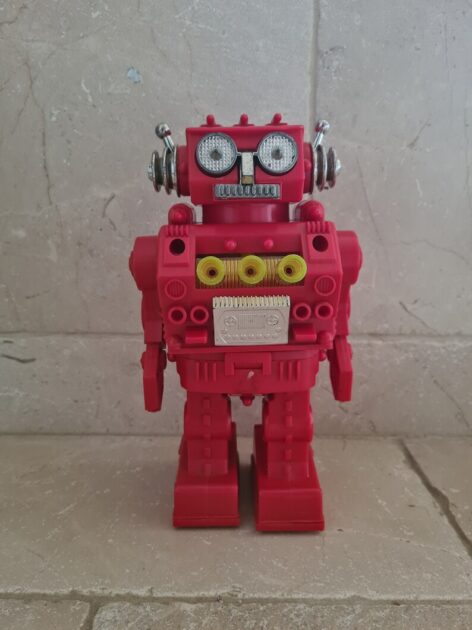
Robot Commando or Baby Thunder whatever you say; was a great robot toy in the 70s. It was not as popular as the previous two, but possessed a lot of entertainment. IMAI (the creators) had crafted this plastic model kit with a friction-powered motor and spring-loaded missile. The best thing about the Baby Thunder was its ability to move forward even after it had been powered off. The toy was also able to shoot its missiles in all directions, which made it a great hit with kids. The missiles were also capable of bouncing off walls, adding to the fun.
Robotron RT-2 Robot Toy
Robotron RT-2, the popular 70s battery-operated robot toy. Standing at 15in tall, it captivated children of the era. Battery-operated mechanism brought it to life. In the 70s, battery-operated robot toys were a sensation.In fact, my grannie had a Robotron RT-2, and it still works today! So long lasting, I have to say.
The Cosmic Fighter Tin Toy Robot was a classic by Japan’s renowned Horikawa Company. Asia, still in 2023, accounts for 50% of all the robots in existence. So, it is only normal to include this sensational Japanese robot toy of the 70s in this list. The 12-inch tall robot toy features a rotatomatic action with its spinning body. This not only entertains, but also reveals a gunner inside with flashing lights and shooting sounds. Its large claw-style hands and well-crafted design make it a unique collectible.
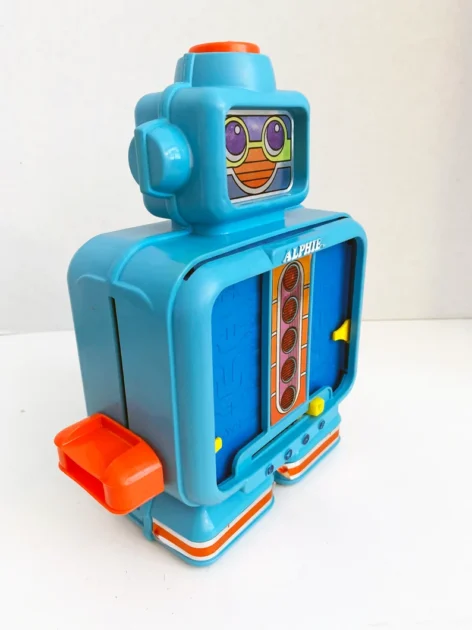
The 1978 robot toy Alphie continued its popularity well throughout the 80s. It featured an input slot for interchangeable cards, and accompanying buttons on the front. This means children could play with it, learning math, spelling, and matching skills. It also played music – yes! At that time, music was more than a bonus; a phenominal way to keep kids engaged.
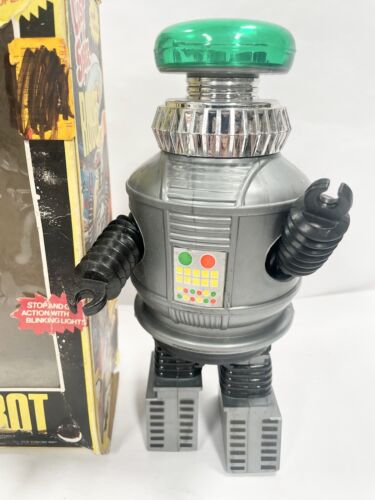
Lost in space robot toys have had a long story; from Remco’s 12″ manually controlled robot in 1966 to Aquapolis’s 6″ Friday in the 1970s. AHI’s Lost in Space robot toy was introduced in 1977. It stood 10″ tall, with bump and go action, a blinking chest light and stop and go function. It featured stop-and-go action, a blinking chest light and three sound effects. Stop-and-go action means it could walk, turning the robot’s head and arms as it moved. The blinking chest light and sound effects gave the robot a realistic and exciting feel. This made the AHI Lost in Space Robot a great addition to any child’s toy collection.
The Micronauts were an innovative product, unique in their time. Their design was complex, featuring interchangeable parts and the ability to build creative, customized figures. Kids could mix and match parts to create unique figures and vehicles. The motorized vehicles and robots could move with the help of a wind-up key. From 1976 to 1980, Micronauts were a huge success, with millions of kids having fun playing with them. The figures also inspired a comic book series and a toy line.
Tomy Wind Up Robots were very popular in the late 70s, and still remain a timeless classic to many. There were different versions of this robot toy; the boxing ones, golf ones, and who can forget Strollin Bowling? Kids used to collect multiple kinds of these, and loved to show off their unique collection.
During the 1970s; star fights, wars, and stuff were all the rage. The Star Fighter Robot was more like a niche robot toy, mostly among action-minded kids. It had a unique design with a sleek body and flashing lights. Its movements and sound effects were so realistic for a 70s robot. The easy-to-use controller allowed kids to navigate the robot in any direction. In 1978, after the release of the Star Wars movie, the robot’s popularity even further skyrocketed.
I had to take help from my grannie to write this article, and it was definitely worth it. Hope you enjoyed learning about the robot toys from the 70s! Of course, we’re reading this article in 2023, and things have changed. Autonomous robot toys, for example, are growing rapidly, and with expected CAGR of 18.80%, their industry could reach $22.9 billion by 2030. Today’s kids are growing up with these amazing autonomous toys, and their future looks brighter. However, 70s kids will always be nostalgic about all these amazing robot toys from the good old days.
3D printing is a surprisingly old technology, existing since the 1980s. That was when Chuck Hull invented the stereolithography apparatus. The technology is not only being more accessible with time, but also advancing quickly. In 2023, you can 3D print a lot of things. From prosthetics to furniture, and space exploration tools to toys. Grandviewresearch’s stats show that the 3D printing industry is growing with a CAGR of 20% till 2030. The best of 3D printing technology in 2023 was like a fantasy a few years ago. Courtesy improving materials (i.e. metals, polymers, ceramics, composites, etc.) and increasing accessibility (i.e. cost, ease of use, and availability of 3D printing services). And it has also become a necessity now, giving a real edge in production and design to many industries. We’re just starting the year 2023, and this article is all about the very best of 3D printing.
A 3D-Printed Space Habitat
https://www.youtube.com/watch?v=C3JBu_kXmsw
3D printed space habitat – yes, you read that right! This ambitious project to create a 23-feet high 3D-printed polymer took two years. Institut auf dem Rosenberg students, aged 6-18, and SAGA Space Architects were behind this amazing prototype. The coolest part? Well, its application of simulating mission control and “systems thinking” in preparation for space exploration. The 3D printing material has a UV stabilizer to make it more durable. In fact, it is also possible to break the habitat and reuse the polymer. In the name of 3D printing, it’s good to see projects like this. Not only is it trying to make a difference in space exploration journeys, but it’s also inspiring future generations. Kudos!
An Ear
I don’t know about you, but my ears got exhilarated when they heard about 3D printed ears! Amazingly, technology now creates realistic, custom-made ears. 3DBio Therapeutics’ 3D printing procedure, which took seven years to develop, is a stunning medical advancement. By integrating proprietary technologies, it uses patient cells to make living tissues for a misshapen ear. In fact, a 20-year-old woman has already had a successful transplant. Here’s the complete process of 3D-printing ears in a nutshell:
Step 1- Harvesting cells from the patient
Step 2- Growing billions of cells
Step 3- 3D printing the ear shape with a collagen-based bio-ink
Step 4- Implanting the ear.
Truly, this 3D printing application is a revolutionary step in the field of tissue engineering.
A Home
A few years ago, we were like “Who on Earth 3-D prints home!”. And now, in 2023, a 100% bio-based, 3D-printed home has came to exist. BioHome3D – a 600-square-foot prototype with 3D-printed walls, floors and roof. Highly insulated and 100% recyclable, BioHome3D can tackle the current housing crisis and labor shortage. Moreover, its advanced manufacturing process reduces construction waste and dependence on constrained supply chains. This innovative 3D-printed item is a great step forward in the affordable housing sector. Kudos to the University of Maine Advanced Structures and Composites Center!
An All-in-one 3D-Printed Robot
Robots parts are difficult to manufacture, especially with the necessary electronic and mechanical systems needed to operate them. For example, assembling and connecting the limbs, electronic and active components, which can be bulky and heavy, is difficult. But a team of UCLA engineers and their colleagues have created a new design strategy. A 3D printing technique that can build robots in one single step. Yes, one single step! The 3D-printed “meta-bot” is comprised of an internal network of sensory, moving and structural elements and can move by itself, propelled by a small battery. It can sense, move, jump, and make decisions. The most interesting thing about 3D-printed robots is that they can be much more lightweight and flexible than conventional robots.
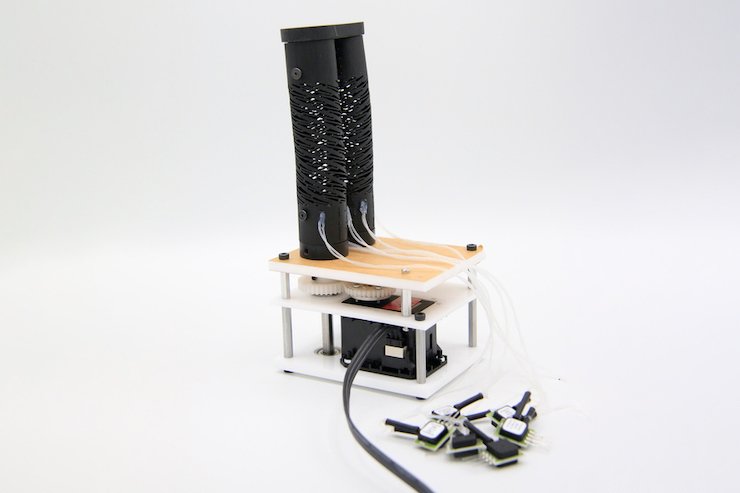
Yes, programmable! A programmable 3d-printed material means a lot. Like, the materials can actually sense how they are moving and interacting with the environment. MIT researchers have developed a method for 3D printing materials with tunable mechanical properties. These materials are in fact created using a single material and a single run on a 3D printer. Digital light processing 3D printing was the method engineers used to create the materials. The most interesting part of 3D-printing programmable material is the fact that engineers can route channels throughout it. So, they can get sensorisation with structure. The team 3D printed an HSA (handed shearing auxetics) soft robot capable of several movements, including bending, twisting and elongating. The robot was ran through a series of movements for more than 18 hours.
MX3D used 4,500 kilograms of stainless steel to create a 3D printed bridge. The bridge is 12 meters long and 6.3 meters wide. If you had a very little doubt about the strength of 3D printing, this bridge will change your mind. It’s neither a toy, nor a prototype. It’s a real big whole bridge that can carry the weight of people. The bridge is located in Amsterdam, Netherlands, and was unveiled in 2021. This bridge makes it look like 3D printing is all about materials – like if you can print anything given a material. But, that’s not the sole factor. A significant portion of 3D printing is design too, something this bridge is spot on in. We need to attribute that to the engineers and designers behind this project.
Bottom Line
You know what, the best thing about 3D printing is that there is a lot relying on it. And even heavier sectors too, from space exploration, to medical advancements. Although a good number of people are now aware of 3D printing, there is still a lot to do. Drastic changes are yet to come. We have already 3D-printed a complete robot, and a programmable material. The next probably is a mixture of both.
Today, I was surfing Amazon and got to buy Angie, a drawing robot. The way Angie draws a picture using its robotic arm was incredible. My drawings are always awful, and so are the ones created by a robot with my command! Sandaisy’s video below should show the better of Angie:
There are more than 12 million robots among us, and drawing is definitely not among their top jobs. But the end goal of robotics is to combine Artificial Intelligence and physical robots. The combination’s weight, let’s say, is heavier than the sum of the two parts. And with the latest trend of using AI to generate art, I considered comparing Angie’s work with AI-generated art.
A Drawing Robot
Drawing robots come with a kinematic structure. It not only allows them to draw with precision but also with a sense of style. For example, Angie can draw using various techniques like pointillism, shading, and outlining. Manufacturers program robots with algorithms to identify and interpret their environment. For a drawing robot, it would be to identify the shapes it needs to draw. Say, a robot can draw a perfect circle or a triangle. All in all, these robots are physical. Being physical means that they can have an impact on the environment.
Here are a few examples of robots that draw:
Angie
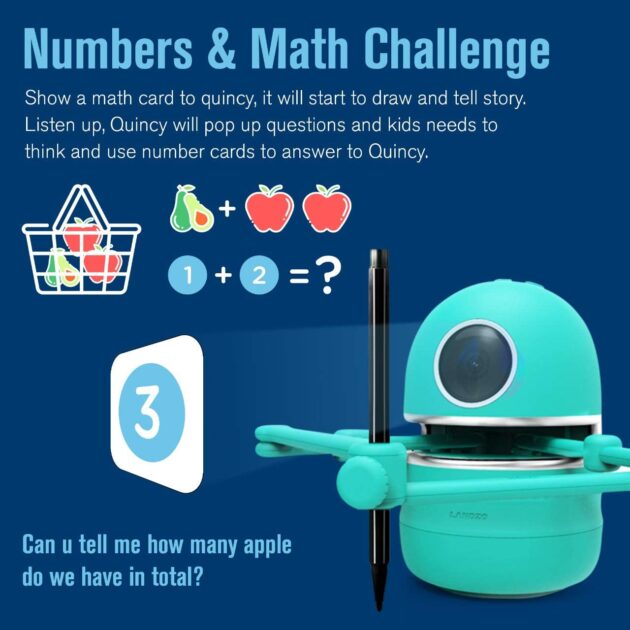
Angie is a great learning buddy for children aged 4 and up. I got easy, step-by-step instructions to solve puzzles and more. With three buttons–Scan, Next, and Repeat–I was able to become an “artist”. The package also comes with two pens, a charger, and over sixty drawing cards. What’s funny is that I didn’t read the description that Angie is for kids (it’s also for testing spelling and math skills). But believe me, despite being 26, I had as much fun as a kid. The drawing robot is a great gift to surprise your child.
4M Doodling Robot
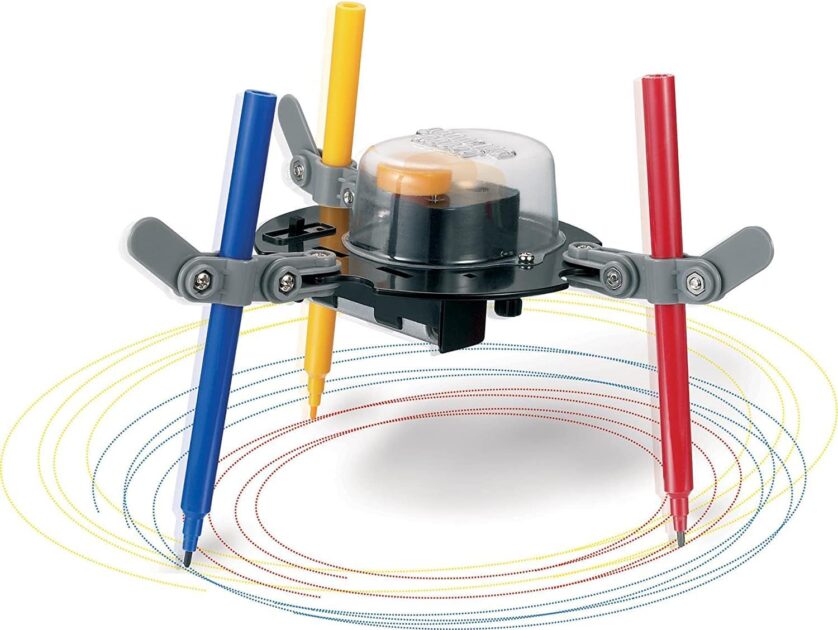
The 4M Doodling Robot is a great drawing tool for any child looking to explore their creativity. With adjustable height and angle, you can create art without any special tools or knowledge required. This educational toy runs on one AA battery (not included) and is suitable for ages 8 and up. The kit includes parts, pens, and instructions to help get the robot up and running. Also, the vibration and spin of the robot’s motor help it doodle pictures, which makes it fun to watch.
iDrawHome A3 Pen Plotter
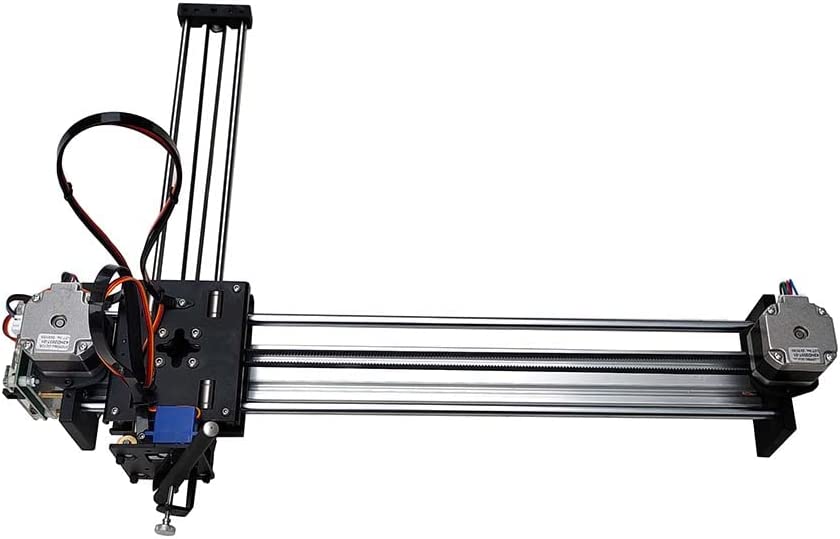
A robot that draws 3D images is something that will take your creativity to the next level. The iDrawHome A3 Pen Plotter offers an amazing experience that requires some hands-on ability. It has an A3 working area, a high-precision 42 stepper motor, and 16 subdivision A4988 drive. This provides a 0.2mm positioning accuracy and 0.2mm XY movement accuracy, making it ideal for intricate drawings. It’s like almost assembled, with a guide to finish the whole assembly. In fact, this drawing robot can print direct input, drawing, or SVG JPG BMP PNG DXF files. It means that you can quickly print almost any graphics or text.
Comparing a Drawing Robot with AI-Generated Art
From the way MyHeritage AI Time Machine generates your ancestors, to DALL E 2 picturing your imagination. And from MidJourney-generated art winning an art competition to GPT-3 disrupting the art of content creation. Just leave alone Google’s Parti, a text-to-video generator Google is scared to release. AI-generated art has turned out to be the biggest trend of the decade. It’s more than just a robot drawing based on your simple commands! Here is how it’s different from a robot that draws:
a. Programming/Intelligence
AI-generated art possesses significantly more complex programming than that of a drawing robot. AI art generators can detect, analyze and interpret patterns. Programmers feed them with a set of data for that. The data is often in form of images and alt text i.e. descriptions. Furthermore, it uses that data to create unplanned art. The limits here are not the availability of data or the number of possibilities, but the practicality. For example, if you automate it, an AI art generator may keep on generating art pieces forever. Only the practicality is limited here. It is possible to create a lot of art pieces, but difficult to decide which one’s the best. It’s clear that AI-generated art relies on algorithms and data sets. Yes, drawing robots, too, have algorithms. But the difference is in the level/intensity of programming. For example, a drawing robot is programmed with coordinates and commands to draw. It will keep drawing until it receives a stop command, like forever!
b. Interaction with the Physical Environment
A drawing robot has the ability to interact with a physical environment. On the other hand, an AI art generator can draw only within the parameters of its code. The AI art generator can not come out of the device; it’s only the output that you may print. And that too, as 2D art on paper, is barely physical. Drawing robots have become advanced, and are already printing 3D things, like the iDrawHome’s A3 robot does to an extent. On top of that, 3D printers, themselves, are considered to be a form of robots (and they draw objects). One way to compare AI-generated art with drawing robots is by comparing sports with gaming. However, this method asks for controversy, due to its subjective nature. Let’s say, playing a game and playing a physical sport share some similarities. They each have rules, and goals, and require a certain degree of skill. Yet, the physical nature of playing a sport gives it an edge. But it’s all about the primary form of something. Physical sports have existed for centuries, while gaming is relatively new, making physical sports superior. However, when it comes to AI and Robotics, things change. Because programming language, which didn’t have any physical forms, has been around for longer than robots. As such, the primary/default form of AI is not physical, but digital.
A Mixture of a Drawing Robot and AI-Generated Art
The combination of the AI art generators’ limitlessness, and the physical nature of robots make an interesting hybrid. As of now, AI is already capable of generating everything. Courtesy of OpenAI, the public got to know that a superhuman AI content generator, the level of GPT-3 can exist. And it doesn’t just stop there. We are all familiar with how human these AI-generated contents are; let it be images, text, or audio. Humanity has already deployed a human-like AI in digital form, and it’s only 2023. Humans are challenging Terminator’s prediction in every possible way, and 2045 now seems to be too far.
Now comes the interesting part, the mixture, which involves two main steps, and then, 3-D printing.
a. Automation
Automating AI-generated content is not an enormously difficult task. In fact, if nothing works, just create a robot that automatically presses buttons and creates art. Yes, that’s not the smartest way to go about it. A much better and smarter approach is by using robots that can read an AI’s output and draw it in real time. One way or the other, automation is not tough, and we can definitely manage it.
b. Deploying the power of AI generators to a physical machine
This step is now the only obstacle that is coming between us and our robot-generated art. We need to figure out how to take the AI’s output and transfer it to a physical machine. This is where the difficult part comes in. We need to figure out how to combine the output of an AI with a robot and make it draw the art autonomously. There are many reasons why it’s tough. For example, the AI’s output might be too complex for a robot to interpret, or the robot might not have the precision needed to draw the art accurately. Furthermore, it might take a long time to transfer the AI’s output to the robot.
c. 3-D printing of the art
Again, this step is not as difficult as the step 2. Once the robot is able to draw the art correctly, it can be 3-D printed. We all know 3-D printing is already advanced, and it is becoming more accessible to everyone.
Bottom Line
Art indeed is lovable, but AI-generated art is here to stay. A robot that draws, such as Angie, offers an interesting comparison; it does create cute drawings. But such robots may lack the diversity and complexity of AI-generated art. The best way around this is to combine the two; an AI algorithm and a flexible physical robot. In this case, combining the creativity of the robot artist with the precision of AI-generated art. Feeding the drawing robot with complex generative models, it can draw something unique, beautiful, and physical in nature.
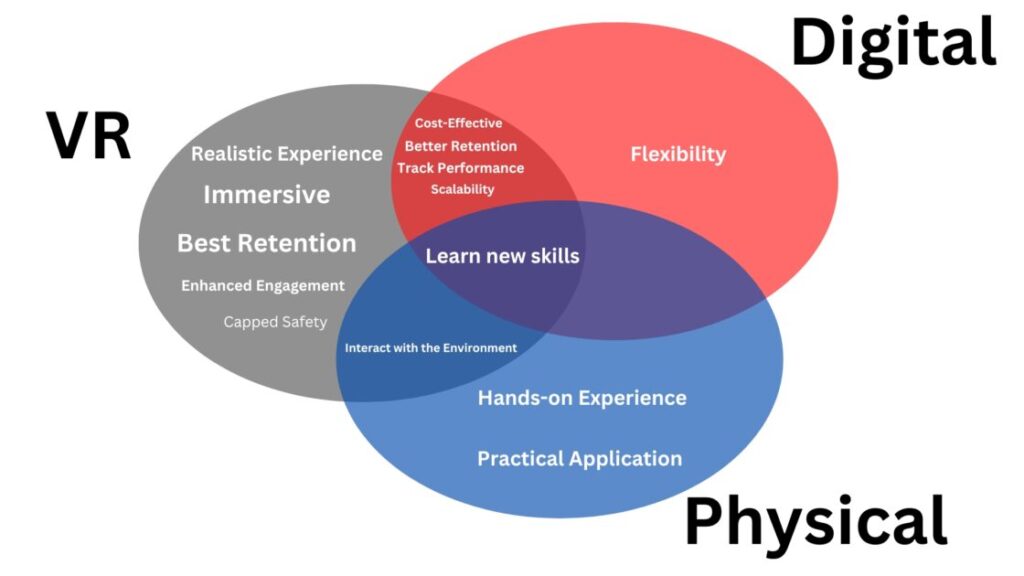
Learning new skills in Virtual Reality disrupts traditional learning. Every sort of learning, from formal education system, to everyday skills. When people (of any age) put on a VR headset, they are likely to learn new skills faster. In fact, users learn up to 4x faster in VR, and retain up to 65% more knowledge than “reading”, and 70% more than “lectures”. Not only that, VR is cost-effective, interactive, and engaging. And on top of that, those who learned new skills through VR are 275% more likely to implement those skills. And I probably don’t need to mention the importance of applying your knowledge!
Here’s a Venn diagram comparing learning new skills in VR, Physical, and digital world:
Learn a New Skill with VR: Easy Steps
1. Choose Skill: Decide which skill to learn. Your goal should be to find something that interests you. If a person finds a subject attractive, they are 35% more likely to learn it. In VR, you can learn almost anything from fixing a car engine to cooking a meal. Yes, I understand that everything is interesting in VR. Just choose the skill that interests your learning gut the most!
2. Find VR App: Look for a VR app to practice the skill. For example, to practice running on a treadmill, you can use a VR fitness app like FitXR. One thing to remember is that the app should be compatible with your VR hardware. Like, if you have a PSVR, make sure you choose a VR app designed for it. Apps for PSVR have a logo icon of it. Smartphone users can always use Google Cardboard or Samsung Gear VR.
3. Practice: Now, put on the headset and start practicing. You can practice at your own pace and repeat the steps until you master the skill. You can also pause and resume the session if you want to take a break.
4. Identify Weaknesses: Identify weaknesses and areas of improvement.
5. Refine: Refine the skill and practice until mastery.
6. Repeat: Repeat the process until the skill is mastered.
7. Monitor Progress: Monitor your progress to see how well you are learning the skill. Some VR apps have in-built analytics that shows your progress. Also, you can use other tracking tools to have a better overview of your performance.
Comparing VR with Free Skill-Learning Options
Any skill, to any extent, unless it is a formal education system, can be learned for free, in theory. But, in practice, learning is not always that easy. Without a structured and engaging environment, it can be difficult to stay motivated and learn effectively. Virtual Reality changes that. The way it makes practicing a skill more engaging, motivating and immersive, makes it a better option than traditional ways:
Vs YouTube
Yes, you can use YouTube to learn new skills, just like most internet users. Youtube indeed is free; however, it is static and passive too. According to a study we conducted, 83% preferredVR over YouTube, as a supplement to learning new skills. Yes, it’s a fact that 86% of viewers do find YouTube videos to be effective for learning. But they just don’t know what they’re missing by not using VR for learning a new skill! Okay, just take a YouTube video that lasts for an hour, and compare it with a VR session of the same duration. Unlike YouTube, VR enables learners to interact with 3D objects and environments. Time simply moves differently in virtual reality. And yeah, we can not include YouTube’s “play in VR” option in what we are calling “VR” here. That’s because YouTube videos are not VR-optimized in the first place.
Vs Web
A Search Engine can be a lot of text, images, and videos. Though it is better than textbooks, it can still be boring and ineffective. For one thing, the internet consists of too much misinformation; so much that 80% of US adults have consumed fake news. Furthermore, the web is often unhelpful to learn and employ new skills. For example, a help article from WikiHow may show you some diagrams of a guitar, but it can’t offer you what it feels like to actually play the guitar. Current VR tech including haptic feedback, touch, and spatial sound, allows learners not only to visualize the process but also to “feel” it. Now, this really means a lot. For example, a learner can practice the skill of playing guitar in VR, and “feel” the strings with a VR controller. This kind of immersive and interactive learning is simply not possible in web-based learning.
Vs Textbooks
Textbooks are boring. Especially for kids aged 8-13, can be dull and lifeless. It’s a norm that kids (17 or under) don’t find textbooks interesting. For instance, as many as 33% of high school students plan to never read books again after they graduate. The numbers are actually concerning. A science textbook explaining kinematics may ask you to visualize the motion of a car in your brain. But VR, instead of just asking you to imagine, actually puts you in the driver’s seat. You experience the same motion, which makes learning new skills more effective and fun. Textbooks are not only uninteresting but also ineffective if we compare them with VR. In fact, a study conducted by BMC Medical Education found that students learning anatomy with VR scored 23% higher than those who used textbooks.
VR vs Traditional Courses to Learn New Skills
There is one school of thought that says that VR replaces the necessity of courses as a whole. In VR, you can learn while playing, and it does mean a lot. For example, virtual reality can help you learn a new language by playing a game or learn a new skill by interacting with a virtual environment. Such skills may include playing cooking games, electronics repairing challenges, and so on.
But for now, it is clear that VR alone is not enough to master a skill or knowledge. Courses are still essential for achieving the desired goal. And VR courses, which are “a thing” by now, are the way to go. Here are comparisons of VR vs online and offline skill-learning courses:
Online
Online courses are convenient but lack interactivity. Like with Skillshare, you can learn a wide range of skills, such as programming, music production, and design. In fact, 73% of students find online courses to be effective for learning – so much so that they would take fully online courses. Now, if online courses come above physical lessons, VR courses definitely come above online courses. In the priority list of people seeking to learn new skills, VR courses are simply at the topmost. Clearly more interactive, easy to access, and engaging; good for a beginner. As earlier mentioned, learning new skills in VR can be 4 times faster than online courses (like skillshare, coursera, etc). And with speed comes “more effectiveness”, when it is to comparing VR with online courses to learn new skills.
Offline
Below are the average hourly costs of learning skills for a beginner. The costs are of hiring a private teacher (something closer to what you would get with VR):
VR courses are a lot cheaper than that because they do not require a physical space or instructor. On average, a VR course is about 2-3 times cheaper than a traditional course overall. Of course, VR courses are not to be taken as a complete replacement when it comes to driving or music lessons, etc. After all, you are living in the “real” world, aren’t you? What VR does provide is a great supplemental tool, helping speed up the process to learn new skills.
Bottom Line
Learning, as we all know, is all about exploration and experimentation. VR’s way of creating virtual environments makes it a great tool for acquiring new skills, not only because it’s fun but also because you get paid for it in form of effectiveness and time. But still, your tendency to replicate the skill you’ve learned in VR into the real world, is the key.
Technology just keeps on changing its form with additional innovations. Historically, we have witnessed that the very present always seems to be the peak of technology. Like in the 90s, we thought that there was nothing more to achieve with technology. However, regardless of that, there was and always is room for more innovation. In the 3rd decade of the 21st century, the world is witnessing an array of emerging technologies. In fact, consumers, businesses, and even governments can not sit back and relax on the current tech. Not only have the tech advancements moved away from traditional industry boundaries, but they have also become more integrated and mutually supportive.
Disruptive vs Emerging technology
Due to the disruptive nature of technology, the pace of change is incredibly fast, and even “spikey” in times. While disruptive technology innovates, emerging technology refines. To be more specific, disruptive technology is revolutionary, emerging technology is often evolutionary. This means that disruptive technology often replaces existing technology while emerging technology often supplements it. Disruption shakes up the status quo, while emergence optimizes it. The best example of disruptive technology is the invention of the automobile. It replaced the horse and buggy, completely changing travel. On the other hand, the emergence of electric cars is a great example of emerging technology. It supplements the existing technology of gasoline cars, creating a more efficient, environmentally-friendly form of transportation.
Emerging Tech 2023
Below are the top emerging technologies/tech products in each sector for 2023. We have selected the most promising and impactful ones:
Top emerging tech in healthcare – da Vinci Xi
The da Vinci Xi Surgical System provides a wide range of complex surgeries like urological procedures. It has an ultrasonic bath that meets the minimum requirements and requires a capital purchase. Along with this, the da Vinci Xi has a doorway and hallway with minimum dimensions, as well as an elevator with a capacity of 2100 lbs. and floor space of 70 inches by 48 inches.
Image Credits: Intuitive
This revolutionary robotic technology is actually bringing complex surgeries to life. After being released in 2021, it quickly became one of the most sought-after robotic surgery systems. Da Vinci medical robots are here since 2000. The latest version, the one we’re talking about, is the most advanced and sophisticated. Improved features like the new patient cart that allows surgeons to move and rotate the robot with the patient and its virtual care options, this system is revolutionizing robotic surgery.
Top emerging tech in education – Interactive Holographic Teaching
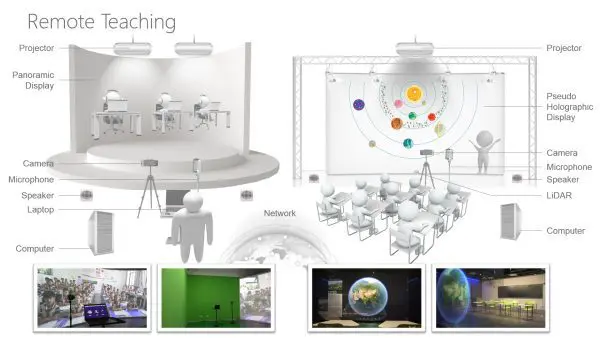
Mixed reality would be indeed the easiest guess if the question was about the future of education. But it’s already here; up and running.
Image Credits: Lenovo
Lenovo’s Interactive Holographic Teaching technology is emerging as the Next Big Thing in education. Being an immersive learning environment, it enables teachers to create a highly interactive teaching experience. This tech provides a mixed reality and holographic approach to traditional classroom teaching and online education.
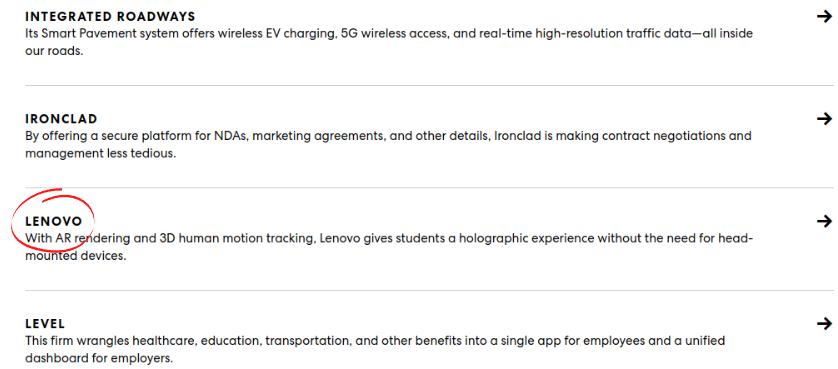
Lenovo Future Classroom offers many benefits. It allows teachers to conduct virtual experiments and observations that could be difficult outside of a state-of-the-art laboratory. The technology is also being used to bring together students from different campuses, cities, and countries. This improves access to quality educational resources, helping to promote educational equity. In fact, Interactive Holographic Teaching was selected by Fast Company as one of the 120 companies that are tackling basic societal problems.
Image Credit: FastCompany. Lenovo’s Interactive Holographic Teaching (in the list of companies that are tackling basic societal problems)
Top emerging tech for business – OpenAI’s DaVinci 003
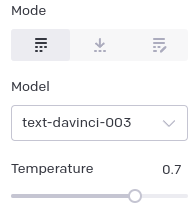
As an emerging tech, OpenAI’s playground is disrupting content marketing, a key for any modern business. OpenAi’s latest GPT-3 model, Davinci 003 is the most powerful generative AI. It enables automated processes, such as data extraction, analytics, and customer service. It also helps with marketing activities, like content creation and email campaigns.
Credits: OpenAI
According to OpenAI, the model has gone through a big improvement from previous models davinci-002 and davinci-001. For example, instead of writing simple sentences, davinci-003 can produce entirely complex arguments and structures. Like, it can give examples, describe problems, and provide solutions. Businesses are already taking advantage of this new technology to generate high-quality content that can be easily customized. It also helps reduce the time needed to create content and manage campaigns.
Top emerging technology in cyber security – Behavioral Analytics
Behavioral Analytics is rapidly emerging in cyber security. It uses advanced analytics to identify abnormal user behavior and detect potential threats. The technology monitors user activity, detects anomalies, and flags suspicious activities for further investigation. Behavioral Analytics also uses anomaly detection to analyze various data points, such as user interactions, login locations, and application usage. It generally looks for patterns in user behavior that deviate from the norm. Some user behaviors can be indicative of malicious activity, such as accessing sensitive data or attempting to gain unauthorized access. Such behaviors may include:
Logging in from unusual locations or devices
Making frequent attempts to access restricted data
Accessing data outside of normal working hours
Unusually long periods of inactivity
Nonsensical data entries (like repeatedly using an email address that doesn’t exist)
Top emerging technology in agriculture – Home hydroponics systems (HHS)
Home hydroponics systems are efficient and sustainable. These systems provide fresh fruits, vegetables, and herbs with expert advice. For example, home hydroponics starter kits come with all the components necessary for setting up a hydroponic system. It means customers can shop with confidence. The hydroponic systems use nutrient-rich water, instead of soil, in order to provide the necessary nutrients for plant growth. Therefore, this technology is revolutionary in agriculture.
AeroGarden Harvest Elite Slim with Gourmet Herb Seed Pod Kit – Hydroponic Indoor Garden, Stainless Steel. Credits: Amazon.com
As a revolutionizing HHS tech, “AeroGarden Harvest Elite Slim” provides home hydroponics and a 6-Pod gourmet herb seed kit with all-natural Miracle-Gro Plant Food for an in-home garden system. Its high-performance LED lights ensure rapid growth and abundant harvests. This further ensures that you have fresh, local, in-season herbs and veggies all year round.
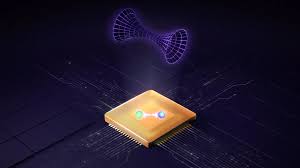
Top emerging tech in computer science – Quantum computer wormhole
After about a century of Albert Einstein and Nathan Rosen’s theoretical work, the quantum computer wormhole is finally here. Being the most powerful emerging technology in computer science, quantum computer wormhole has been successfully created by Maria Spiropulu’s team. Utilizing Google’s quantum computer, Sycamore, the team has beaten competing physicists. This technology is revolutionary in the sense that it is a quantum gravity experiment on a chip. It means that the new tech could enable us to traverse through space-time by passing into an extra dimension.
Credits: Quantamagazine.org
The researchers also believe that the use of qubits could open the door to many more possibilities. For example, it could help us to explore the universe in ways never thought possible before.
Top emerging technology in food processing – Isochoric freezing
Food processing technology is rapidly advancing in the 21st century. It has now offered new possibilities for safe and high-quality products. Isochoric freezing is an emerging technology that offers a number of advantages over traditional freezing methods. It provides more uniform freezing and better preservation of food quality, while also reducing energy consumption and production costs.
Roberto Avena-Bustillos (left) and Cristina Bilbao-Sainz demonstrate the use of isochoric freezing chambers. Photo courtesy of the U.S. Department of Agriculture through ift.org
Additionally, it allows for more precise control over the freezing process, resulting in a more consistent product. As such, it is becoming increasingly popular in the food processing industry.
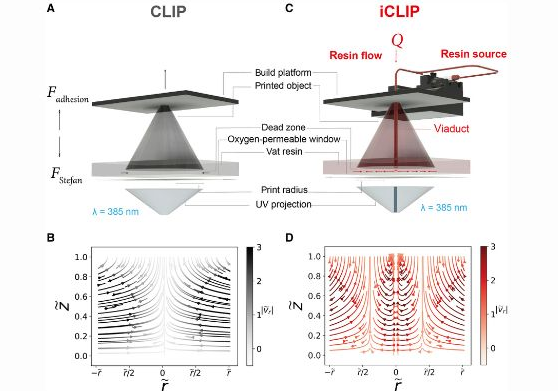
Top emerging technology in 3D Printing – iCLIP 3D Printing
iCLIP 3D Printing is an emerging tech capable of expanding the scope of 3D Printing. Developed by Stanford engineers, this technology uses multiple types of resin. It is 5-10 times faster than current printing methods.
iCLIP seeks to improve on some of the perceived limitations of CLIP while still leveraging its advantages. One of its key advantages is a “dead zone” or layer of oxygen that greatly decreases adhesion forces, leading to greatly increased printing speed.
Conclusion
2023 is now about a day ahead of us. Tech advancements are constantly shifting and evolving, and 2023 promises to bring many new and exciting innovations. Make sure you keep an eye out for the top emerging technologies in each field to stay ahead of the curve.
According to Yahoo, the global big data and analytics market was $41.39 billion in 2022, and is expected to skyrocket to $346.33 Billion by 2030. Augmented Analytics is forthcoming too, and will be one of the fundamental factors driving that growth. It’s true that data analytics methods always change. For now, or at least until the next analytics breakthrough, ultrawide screens offer great advantages for data analytics.
All four phases of data analytics: descriptive, diagnostic, predictive, and prescriptive require one common thing – efficiency. All of them do benefit from an ultrawide monitor. However, especially for descriptive and diagnostic data analytics, the way you interpret the data matters a lot. Unlike predictive analytics, where less manual intervention is needed, descriptive and diagnostic analytics requires analyzing data from multiple angles.
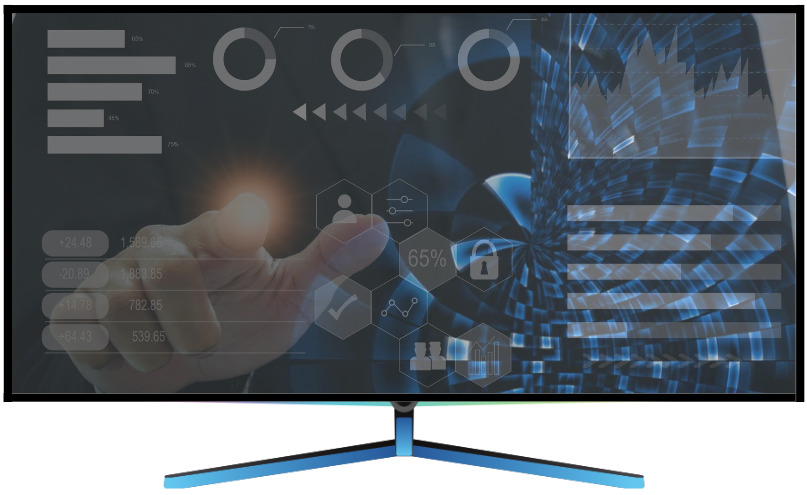
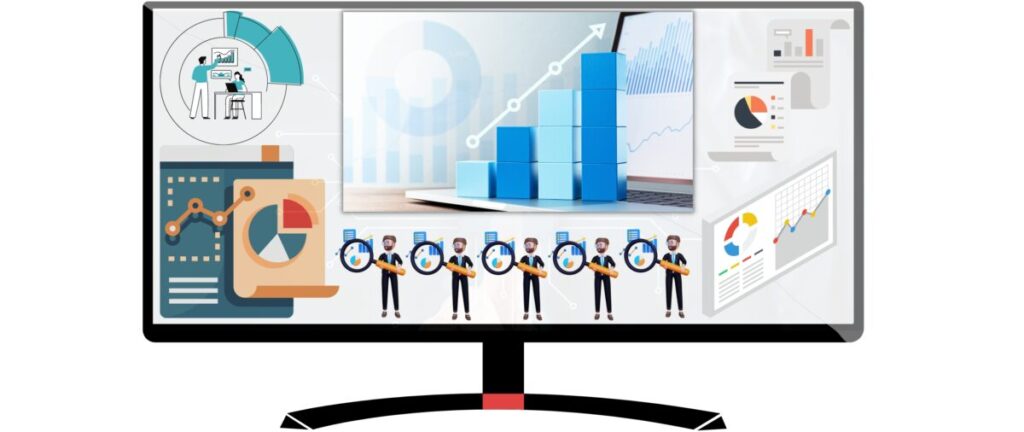
Now, it’s obvious that more screen area is better for data analytics. And for a larger screen, you can only increase a monitor’s width, not its height, as your viewable area. That’s why ultrawide screens are ideal for data analytics. Ultrawide monitors are a much better way to achieve an ultrawide screen, I mean, than this traditional data analytics setup:
Traditional method: A data analyst using 2×16:9 monitors for data analytics
Here are the benefits of an ultrawide screen for data analytics, given the greater viewable screen area it offers:
The Way you interact with the Data
At a glance, it may seem like an ultrawide monitor makes it easier to interact with data, nothing else. However, the way you interact with the data is one of the most important aspects of data analytics. And it is greatly improved too by using an ultrawide screen. Not only is it faster, but it also helps you to see and interact with the data patterns more clearly. Using an ultrawide screen, you require fewer scrolling and switching between tabs. It also allows you to work on multiple tasks or windows simultaneously. You can keep one window open for analyzing data and another window open for creating reports. In addition, an ultrawide monitor can run multiple windows side-by-side, so you can compare data more effectively.
The Way you Visualize the Data
Given the rate at which visual information is processed, the use of quality infographics is 30x more likely to be read than plain text. Ultrawide screens offer a great advantage here, as they support wider resolutions. This not only makes data visualization easier but also allows for the simultaneous display of multiple data points. You can easily view multiple charts and graphs at the same time, and compare them. After all, you’re a human being. Better graphics and visuals do attract your attention more than a bunch of numbers. Due to the 21:9 aspect ratio of an ultrawide monitor, you can visualize data in a way that’s more appealing.
For example, you can use a timeline chart on the left and view the data chart on the right – all on the same screen. And both the screens are as good as a normal monitor and a half each! In fact, you can also use the extra space to add more elements to the visualization. Good visualization leads to a better understanding of the data.
Finding the Insights
In data analytics, there are a lot of insights you may miss if you don’t have enough screen space. For example, if you’re working with a spreadsheet that has five columns, you might find it difficult to view the entire spreadsheet on a normal monitor. Another example is if you’re working with a map. You need to zoom in and out a lot to get a clear view of the data. An ultrawide monitor offers the perfect solution for this.
Technical analysis of the financial market is also a form of data analytics. If you are a trader, spotting insights like hidden candlestick patterns are invaluable. On an ultrawide screen, you can see the entire trading chart. See the illustration below of the same trading chart; one is on a normal monitor, another on an ultrawide monitor:
You can clearly see how much you might be missing with a normal monitor! In the example above, at least 20 candles are hidden in the normal 16:9 monitor compared to a 21:9 ultrawide.
Saves a Lot of Time
Many professionals have stated that data analytics is a stressful career. A fair portion of that is attributed to the time-consuming nature of the job. Using an ultrawide monitor saves data analysts a lot of time and stress. Generally, it takes more time to analyze data and create meaningful insights on a 16:9 monitor. For example, if you want to compare two data sets, you would have to switch between the two windows on a monitor, which can take time. Furthermore, moving your cursor from one window to another can also be tiresome. In fact, if you are working on a large project, it can be time-consuming and tedious. That is especially if the project is about data mining. An ultrawide monitor makes navigation faster and saves time.
Also, one thing to note here is that you are not paying the price of accuracy; with an ultrawide monitor, it’s faster yet more accurate.
The Nature of Data Analytics Software Tools
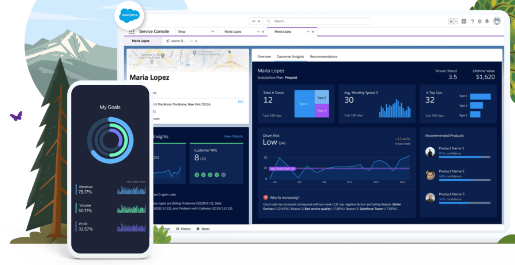
Image credit: Tableau
The nature of current data analytics software tools demands considerable screen space. Working with multiple tabs, windows, and tools becomes inconvenient on regular-sized screens. And for any data analytics professional, all those tasks are often simultaneous. For example, running queries, reviewing results, visualizing data, and creating reports. Especially the data analytics software like Tableau and Power BI, which are used to create interactive reports and dashboards, require vast screen estate. The nature of the current data analytics tools is also about a lot of number crunching. And an ultrawide monitor helps you to view more cells, rows, and columns of the data at one time.
The way an ultrawide screen makes data analytics better, faster, and more accurate provides a great edge. From traders to data miners, and from statisticians to data scientists, all should use an ultrawide monitor for data analytics. In some cases, though, a 21:9 screen may not be enough, like if big data analytics is the job. Even then, rather than using 2×16:9 monitors, there are 32:9 ultrawide monitors available for a cleaner and more efficient setup.
Gaming always asks for more – GPU performance, screen width, CPU cores, RAM, and what not. The difference an ultrawide screen makes in gaming depends firstly on your hardware, and then on your gaming needs. Like, purchasing an ultrawide monitor still won’t fix that laggy gaming experience caused by your poor GPU, right? So, the most important question here is about its worth, which is based on several factors.
Is an Ultrawide Monitor Worth it for Gaming?
The 33% bigger width ultrawide monitor offers is hands-on appealing for gamers. Especially when it comes to competitive and immersive gaming – two of the most popular genres – having a wider field of view can make all the difference. For example:
You can see more surroundings and enemies.
Easier to spot hidden items and clues.
An average ultrawide monitor costs anywhere between $200 to $800. However, depending on your purpose, the price difference can be significant. Below is a table showing the average price ranges of different ultrawide monitors and their suitability for gaming:
Price Range
Refresh Rate
Resolution
Aspect Ratio
Features and Gaming Suitability
$150 to $200
60-75 Hz
1080p
21:9
For normal usage
$200 to $300
75-144 Hz
1080-1440p
21:9
Acceptable for gaming. The option to choose a curved monitor unlocks.
$300 to $450
75-160 Hz
1440p
21:9
Good for gaming, better response rate.
$450 to $800
144-240 Hz
1440p to 4K
21:9 or 32:9
Advanced features like G-Sync, nice colors. Great for gaming.
$800 or more
144-240 Hz
4K
21:9 or 32:9
Larger screen (up to 49”), advanced gaming features, much better color accuracy and image quality. Best for gaming, but pricey.
Yes, the cheapest ultrawide monitors are available for around $150, however, they are not particularly made for gaming. For example, LG’s 29WN600-W costs as low as $180, but has a refresh rate of only 75 Hz. Any current gaming monitor should offer a refresh rate of 144 Hz or higher. In fact, the refresh rate of a monitor matters just as much; if not more, than having an ultrawide screen for gaming. And an average ultrawide gaming monitor with a good refresh rate, decent response time, and image quality will cost around $500. So, here are the factors to help to decide if an ultrawide monitor is worth the investment:
Your PC’s Specs
If you have $700 jumping in your pocket and have to choose between an ultrawide monitor and a decent GPU, go for the GPU right away. For gaming, GPU matters much more than the screen’s aspect ratio. In fact, the CPU could also come before upgrading to an ultrawide monitor on your priority list.
A decision is when you have to choose between upgrading to a better SSD/RAM, and an ultrawide monitor. As such, consider the following before choosing one:
a. Between RAM and Ultrawide Monitor
In most cases, RAM has a limited role in gaming. So, if you have decent RAM, and if high-RAM-demanding games like COD Warzone are not your daily cup of tea, go for the ultrawide monitor. If your game types demand more RAM or the RAM you have is not enough, go for a cheaper RAM upgrade, and still buy an ultrawide monitor. Anyways, if gaming is your sole purpose, just don’t break the bank for RAM!
b. Between SSD and Ultrawide Monitor
A good SSD is hard to not recommend for any gamer. As a gamer, you know the importance of loading times. A high-end 1 TB SSD costs around $100 to $150, which can be decisive on whether or not you have money left over for the ultrawide monitor. Choosing between an SSD and an ultrawide monitor is tough. So, here are some factors to consider:
i. Do you have an HDD? If you are using a Hard Drive in 2023, take a big jump to an SSD. An SSD with not only higher storage, but also tech specs like SATA III, PCI-E NVMe and so.
ii. Is your budget too tight? If it’s too tight, and if you’re not planning to save enough money that buys an ultrawide gaming monitor, go for an SSD.
iii. Do you already have an SSD? If you do, just go for the ultrawide monitor, and skip the upgrade for now.
If you have an HDD right now, the reason I recommended a big jump to a good SSD is that loading times are the worst possible way to waste your gaming time. Like, it’s so unproductive to wait tens of minutes for the OS or the games to load. You deserve better than that.
What Games do you Play?
For some gaming needs, an ultrawide monitor has a more significant impact than others. For example, for flight simulators, the wider field of view is a huge advantage, while the same can’t be said for an FPS.
Games That Benefit from Ultrawide Monitors
Here is a list of some game types that work great with an ultrawide monitor:
Flight simulators
Flight simulators require a wide field of view because the player needs to see both the cockpit and the terrain outside. Furthermore, these games are not limited to a specific track, making an ultrawide monitor ideal.
Battle Royale
Battle royale games are always fast-paced and chaotic. An ultrawide monitor helps you to spot enemies and items quickly. The wider field of view is also helpful for spotting hidden clues. As such games are mostly competitive, the edge you get from an ultrawide monitor can be the difference between winning and losing.
Strategy games
Strategy games like Age of Empires, LOL, and Starcraft benefit most from ultrawide monitors. With an ultrawide monitor, you can easily see the whole map and manage your armies in a better way. The wider field of view also helps you to spot enemy movements and plan your strategies accordingly.
Open world/RPGs
RPGs including The Witcher 3, Tomb Raider, and Assassin’s Creed are also great with an ultrawide monitor as such games ask for more exploration, better with a wider aspect ratio.
Sports games
An ultrawide screen does not give you any big competitive edge in sports games. However, the wider field of view helps to immerse you in the game and make it more enjoyable. For example, an ultrawide screen is more similar to the real shape of an NFL ground (100×53 yards) than a normal monitor. Even though not completely exact in dimensions, a wider screen means you can view more of the pavilions and spectators too.
It’s absolutely worth it to buy an ultrawide monitor for playing sports video games.
Games That do not Ask for an Ultrawide Screen
And here are some types of games that don’t necessarily require an ultrawide monitor:
FPS
First-person shooters are more about accuracy and reaction time. An ultrawide monitor won’t make you a better aimer.
Arcade
Arcade games are all about quick reflexes and do not benefit much from an ultrawide screen.
Puzzle
You don’t need to buy an ultrawide monitor for puzzle games like Monument Valley, etc.
Platformers
Platformers like Mario and Sonic the Hedgehog don’t need an ultrawide monitor either. That’s because such games are all about timing and precision.
Racing Games
In any racing game, the player is usually focused on the track ahead. An ultrawide monitor won’t help you race better. Furthermore, it does not make the racing games more immersive, as it’s all about the track ahead.
Bonus tip: If immersion is your top gaming priority, then go for a curved ultrawide monitor.
Bottom Line
Ultrawide monitors, in a nutshell, are good for gaming; they do not have any disadvantages. But it is worth it for you, especially considering its higher price, is up to you. One way or the other, a balance is necessary, both in your PC’s specs, as well as your budget. Buying an ultrawide for gaming in a 90s PC won’t be a sound decision. Firstly, consider a powerful GPU, then a good CPU; then comes the monitor’srefresh rate, and only after that, consider an ultrawide screen.