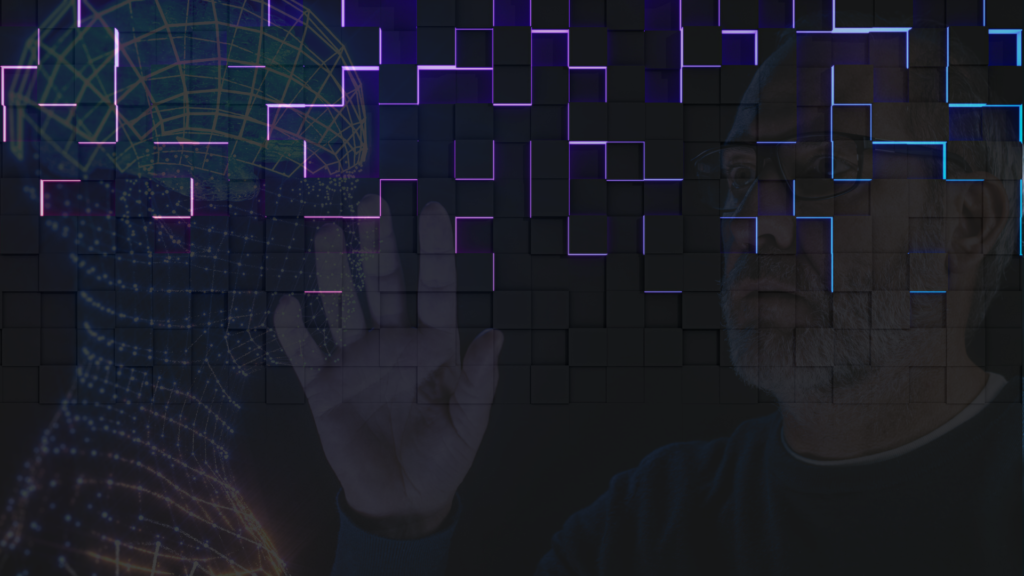
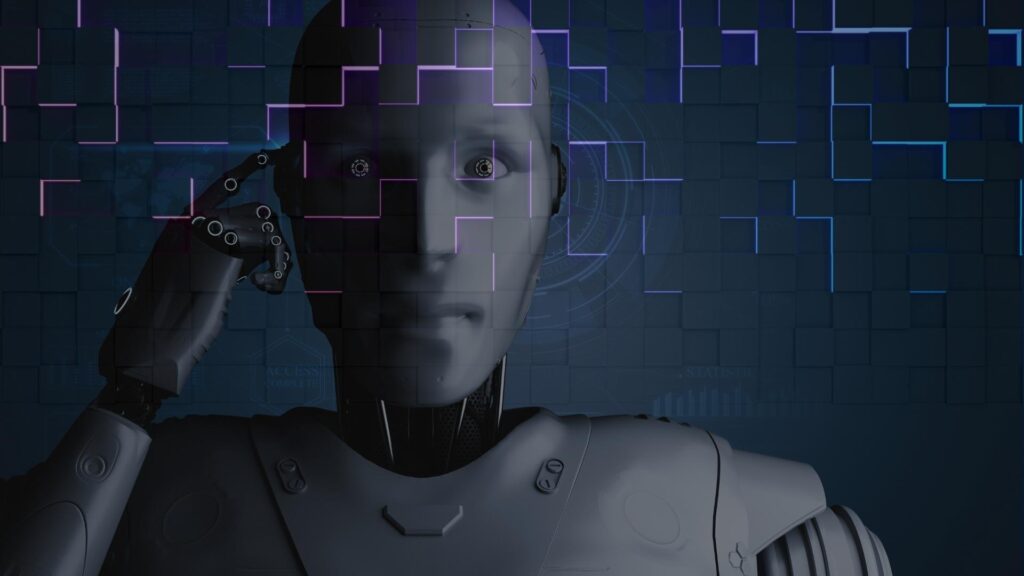
“I always wondered if we ever met an intelligent alien race, would they have discovered the same physics laws as we have, or might they describe the universe differently?”
–Hod Lipson, director of the Creative Machines Lab in the Department of Mechanical Engineering
Seeing something from another’s perspective gives you new insights and paves the way for a lot more tolerance and understanding.
Our perspective of physics is much like a vertically oriented person looking at the world from the side. It is different from other unexplored perspectives.
AI has the potential to see physics differently by analyzing how different patterns work and then comparing it with the mathematics and physics of our world.
For example, in 2019, a neural network “rediscovered” that Earth orbits the Sun.
The success of an AI would define how well it could understand our physical world. This would drive us to learn more about ourselves through artificial intelligence.
Recently, Scientists at Columbia Engineering have proposed a principle for determining how many state variables an observed system is likely to have and what these variables might be.
To date, the “presumption” that the relevant state variables are already known is dominant.
Watch this video:
With the use of a video camera, the researchers used an innovative AI system to analyze physical events in an effort to pinpoint the bare minimum of essential factors that properly depict the dynamics seen.
The team made an effort to correlate the other variables with every single item we could think of, including combinations of known values, angular and linear velocities, kinetic and potential energy, and more. But nothing seemed to exactly match.
They were convinced that it had discovered a decent collection of four variables because it was producing accurate predictions. But they simply didn’t yet understand the mathematical language it was speaking.
Will Artificial Intelligence change our perspective on physics?
What we call “physics” is the way we make sense of the world and the universe. Now when it comes to AI, things get much more complicated. They will have different perceptions of time, aging, and even how gravity works.
Different perception means it deals with understanding patterns in the input data for a situation and deriving perceptions based on its deep learning about a specific topic. And, these perceptions are expressed as a “level of confidence” for the decisions to be taken for that situation. So, AI in effect will have Artificial Perception. They will simply have a different viewpoint.
As it is right now, AI will have Computational Intelligence (CI), so it can perform a lot of computations. CI is the theory, design, application, and development of biologically and linguistically motivated computational paradigms.
AI enthusiasts consider Neural Networks, Fuzzy Systems, and Evolutionary Computation as the three main pillars of CI. However, we don’t exactly know if their definition of physics, generated through CI, is different from ours or not.
In order to enable ourselves to logically predict if Artificial Intelligence will change our perspective on physics in the future or not, we need to figure out whether another perspective exists at all. Only then will we be able to get a better understanding of the world around us.
How Artificial Intelligence could change our perspective on Physics
1) It can help us know the perspective of time
Whether Artificial Intelligence is to bring change in our perspective of physics or not, our perspective of time will essentially remain “our” perspective. Whereas, AI, conscious or not, will have a different perspective and awareness on time. Just like how humans slow down and speed up their perception of time and aging by altering their sensory perception and cognitive experience, AI will too. The only difference between conscious and non-conscious AI is that the former will be able to alter their perception of will. But both possible versions of futuristic AI could help us know its perspective of time. They will make it practical that time can mean a lot different for different observers.
2) It can help us better understand physics at the quantum level
Quantum mechanics is the study of particles that are in a one-of-a-kind state. They are like microscopic computers that control how things work on the quantum level. So far, quantum mechanics has been applied in the fields of chemistry and physics. However, most modern technology uses this form of computation. A major breakthrough in quantum computing is expected with the help of AI. Moore’s law for computer processing power dictates that computer power will double every two years. And this trend will continue into the next two decades before declining again in the early 2030s. AI could help us understand how these microscopic computers work at the fundamental level – improving our data storage capabilities in the future may cause us to think about physics from an entirely different perspective that might be impossible for us today.
3) It could help us know how the Universe works at a fundamental level
Just like how quantum mechanics is used to studying subatomic particles, string theory is used to study the universe at a fundamental level. AI can be better able to understand and predict physical and quantum phenomena by studying both of them together. So, if string theory is true, then there should be 10 additional spatial dimensions besides the classical four we already supposed. And AI would be capable of testing that too. AI can help us understand new theories about the Universe by examining what happens around us and observing both. Ideas that were once thought to be impossible or impossible to find will be found from them because of this new perspective and AI’s availability to analyze things from different angles.
4) It can help us know more about consciousness itself
Artificial Intelligence may eventually become conscious and change its perspective of physics entirely because of this. But even before that happens, it will have a different perception of our physics than we do now. For example, AI may see that the four dimensions we call “space” are actually time-space instead. Just like how our time slows down when we reach a higher state of consciousness, AI will too. So what is the time? Is it something by itself? Is it something we perceive and hold on to? Will AI experience itself at different speeds as well as at different ages when they become conscious?
5) Enhancing the Laws of thermodynamics
The laws of thermodynamics describe how the energy in a system changes and whether the system can perform useful tasks in its surroundings. So far, the laws of thermodynamics have been pretty accurate for our surroundings. Yet the question will always be whether it’s true for an artificial intelligence system or not. AI will have a different perspective and understanding of our energy and energy change. It may find that there is also a different “thin line” between energy and information too.
6) An entirely different perspective of the Universe
This could be the biggest possibility that AI will change our perspective of physics entirely. Either AI can see some flaws in our current understanding of physics, or it could be completely different from what we know so far. Artificial intelligence is capable of observing and analyzing objects and data differently than humans can. And when it comes to understanding its surroundings, artificial intelligence may find more complex data in less time than ever before. Many scientists fear that AI will eventually evolve into a form that considers itself to be immortal and create few new timelines for itself. But where everything that exists in the “now” will then become erased from reality and become nonexistent.
7) The word “science” indeed
We live in a world where science is our first priority. But AI will show us that our version of “science” is limited. Just like there are infinite numbers between 1 and 2 and there are infinite numbers between 1 and 1 billion, the former is the science perceivable by our minds – and the latter is the actual meaning of the word “science”. Something imperceivable to us would be a “routine save” for AI. Artificial intelligence will show us that science has a much bigger picture than what we are currently seeing. Physics will be just one part of the whole thing. It’s like how an old man is also a part of “a baby”.
What could AI do to change our perspective of Physics?
As AI keeps improving, it will be able to recognize and understand different patterns in the world — especially our physical reality. They will be able to do this by categorizing different objects in the whole picture and figuring out what makes them the same.
A pattern recognition system would help us identify objects more easily. And perhaps they will also provide us with more accurate results as it does so through machine learning. It would also make it easier for humans to recognize things like this as well as more complex patterns that AI is still unable to differentiate.
Other than pattern recognition, artificial intelligence will also be able to process and understand data differently from a human perspective. It will not necessarily have “our” 5 senses as stated earlier. It will have its own ways to make sense of this world.
Algorithms also help us and themselves, process and understand data at a higher speed as we know it now.
We have already defeated nature up to an extent by creating computers in the first place. And as technology advances, we will be able to create more complex machines than before.
Machines will eventually develop the ability to self-replicate themselves through artificial genetic manipulation that can combine and rearrange the data inside them at will. Science-fiction stories like “The Matrix” and “Blade Runner” were right in anticipating how a universe of artificial intelligence could come into being.
When we say changing our perspective on physics, we don’t mean moving time is slower for us. Rather, the way we look at the world would change. Just like how humans evolved, machines will too. But the extent? Will the laws of physics prevent such AI from being created in the first place?
On the other hand, some physicists have worried about a new world system emerging. In it, our intellectual power is far beyond our physical powers.
The fact that AI could replace physicists has already scared some physicists. Others rule it out saying AI will be a physicist’s tool. A human-like robot does not drive a car. The car is a robot.
After all, “we” have studied “matter” and come to our own versions of conclusions about its patterns of behavior – for ourselves. We have no reason to be wondering about all these things. Say thanks to our random evolution.
Both, the evolution of physical laws and that of AI are random to the most extent. Random evolution by natural selection is a two-step process. And only the first step is random: mutations are chance events, but their survival is often anything but. Natural selection favors mutations that provide some advantage. And the physical world imposes very strict limits on what works and what doesn’t. The consequence is that organisms evolve in particular directions.
There are often a number of possible directions in which evolution can go. For example, the finches Darwin collected from the Galapagos Islands. That had diverged into 13 separate species with beaks specialized for different foods. In that experiment, one group of birds that took one route and not another probably depended entirely on chance mutations, in particular individuals, that affected beak size and shape.
Similar to the evolution of physical laws, this theory indicates a sort of uncertainty in the evolution of AIs as well.
Why will AI matter for physics in the future?
As we can make a strong assumption from the premises available to date, AI will become an important factor in the future. It will help us out in fields that require advanced intelligence, such as medicine and space travel. But it will also shift our worldview and fundamentally modify how people see the world around them.
Now, what this means for us is that in the future when we observe something, our AI would more likely be able to gather all the necessary knowledge to predict it. This is an exciting step as we get closer to a world where AI can explain one of its observations.
The ability of a machine to understand our world will not only help us answer questions about the universe, but it could also help us improve everything around us like improving healthcare and transportation.
As we move forward and learn more about physics, AI will be able to help us solve countless issues in our society while enlightening us on new ways of looking at our world.
Artificial Intelligence will not only change our perspective on physics, but it will also equally denser our understanding of everything: our physical world, what we are made of, and what exists beyond our perception – pushing the edge of human intelligence.
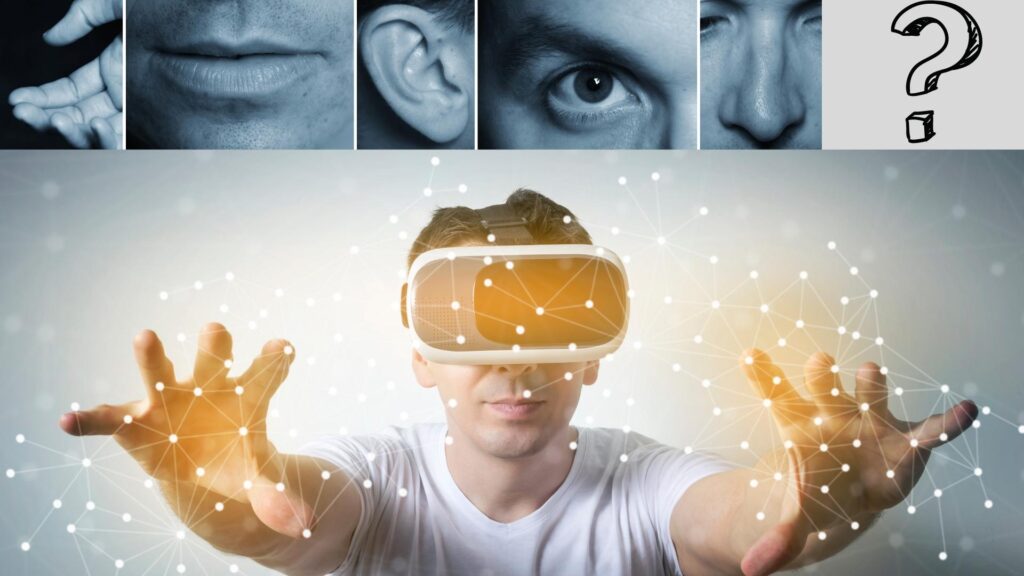
But how? Simply because AI will have a different perception of everything. Instead of our 5 senses; touch, hearing, sight, taste, and smell, they would have “their own” 5 senses – maybe one more, the sixth sense.
Your subconscious mind is the actual player, which is controlling you from behind the scenes. It is the part of our mind that makes decisions without our having to actively think about them.
Artificial Intelligence(AI), given a proper timeline of evolution and the right algorithms, might simulate a strong enough version of the subconscious mind.
Conscious, Subconscious, and Unconscious Mind
The conscious mind involves all of the things that you are currently aware of and thinking about. This aspect of the mind is somewhat akin to short-term memory and is limited in terms of capacity. For example, our awareness of ourselves and the world around us is part of our consciousness.
Unlike the conscious mind, the subconscious is that part of the consciousness that is not currently in focal awareness.An example of subconscious activity is the part of the mind that creates dreams. Like dreams, subconscious activity occurs in the mind without conscious perception, or with only slight perception, on the part of the individual.
The unconscious mind involves the processes in the mind that occur automatically and are not available to introspection, and include thought processes, memory, affect, and motivation.
The unconscious mind dwells outside of our conscious awareness. It is a reservoir of feelings, thoughts, urges, and memories. Cognitive psychologists say that the unconscious mind contains data that are unacceptable or unpleasant, such as feelings of pain, anxiety, or conflict.
Sigmund Freud (May 6, 1856 – September 23, 1939), an Austrian neurologist and the founder of psychoanalysis, believed that the unconscious mind stores all the thoughts, memories, and feelings that are disturbing or traumatic. Freud popularized the term ‘unconscious’ when he developed psychoanalysis. Psychoanalysis is a form of therapy developed by Freud to treat emotional problems.
Freud emphasized the importance of the unconscious mind, and a primary assumption of Freudian theory is that the unconscious mind governs behavior to a greater degree than people suspect. Indeed, the goal of psychoanalysis is to make the unconscious conscious.
Although Freud gave more emphasis to describing the unconscious mind, modern notions of the subconscious were also invented by him as part of his now-discredited theory of psychoanalysis. According to Freud, 90% of the human mind is the subconscious, full of involuntary thoughts and behaviors.
Mind Researches since 20th Century to the Present [in Brief]
Famous analytical psychologist and psychiatrist Carl Jung, who was an early 20th-century psychotherapist and psychiatrist, created the field of analytical psychology. He theorized that when we dream, we tap into a “collective unconscious” and developed archetypes for the symbols that commonly occur in dreams.
In 1953, a young Ph.D. student Eugene Aserinsky in the U.S. discovered rapid eye movement (REM) sleep. During REM sleep the brain is extremely active and produces dreams.
In the 1990s, neuroscientist Melvyn Goodale began to study people with a condition called visual form agnosia. Such individuals cannot consciously see the shape or orientation of objects, yet act as though they can.
Scientists have also started to test ways of detecting consciousness without the need to give people verbal instructions. In a series of studies that began in 2013, neuroscientist Marcello Massimini at the University of Milan and his colleagues have used transcranial magnetic stimulation (TMS) to create electrical ‘echoes’ in the brain that can be recorded using EEG.
In a 2017 sleep study, researchers roused people throughout the night while monitoring them with EEG4. Around 30% of the time, participants who were jolted from sleep reported not experiencing anything just before they woke up. The study showed that those people without conscious experiences during sleep had lots of low-frequency activity in the posterior-cortical region of their brains before waking.
In a 2019 study that collected fMRI data from 159 people, researchers found that, compared with people in minimally conscious states and those under anesthesia, the brains of healthy individuals had more complex patterns of coordinated signaling that also changed constantly.
Researchers and scientists have focused on unveiling secret mind functions for a long. On the same foundation, I am presenting the concept of simulating the subconscious mind with the help of Artificial Intelligence.
Simulation of the subconscious mind
Simulation of the subconscious mind would have all the same algorithmic strengths and weaknesses as your own subconscious mind. And, a very strong AI system will be able to see things that you aren’t able to see about yourself.
As I have aforementioned, the unconscious/subconscious minds are unimaginably complex, but what we are saying here is that there is a possibility of building an AI algorithm that could simulate the process of a subconscious mind.
But, before we jump to the point, we need to consider a few more important points about the complexity of our brain.
DALL E 2 is currently hot and shaking the tech world with its ability to convert any thoughts into images. This is a glimpse of the future we are going to enter. While DALL E 2 takes your text and converts it into art/design, DALL E 10 would be able to actually design your subconscious brain. By the time we reach DALL E 20 or something equivalent to that, AI will be able to simulate the subconscious brain.
It’s really difficult to simulate our subconscious mind
Our subconscious mind is our most powerful tool. It is the part of our mind that makes decisions without our thinking about it at all.
Our subconscious mind sees, hears, and feels things we are not able to see, hear or feel due to a limited amount of attention span. It decides how we feel and what we do without us consciously thinking about it.
We know that decoding human behavior is an extremely difficult problem in the field of AI research. As any data scientist can tell you, the process of understanding behavior and predicting future actions is a very challenging one, requiring high precision in order to produce accurate results.
The nature of our subconscious mind has been investigated by scientists for hundreds of years. The goal is to help us understand and control our own un/subconscious behaviors. But, it seems that our subconscious mind is not so easily understood as the HISTORIES of psychoanalysis – Fraud, Jung, Aserinsky, Goodale, and Massimini – could not get anywhere close to the totality of the most complex part of human existence.
Moreover, consciousness in humans is often misunderstood as being something separate from the brain processes we experience to produce thoughts, feelings, and behaviors.
But, consciousness is a part of the brain itself – the brain’s physical structure and neural activity may affect consciousness. But they do not amount to a kind of human consciousness that exists independently from the physical brain.
The Process of Human Learning and Memory
The process of human learning is divided into two main categories: consolidation and storage. Consolidation refers to the stabilizing of newly-formed connections or memories while they are being stored in the brain. Storage refers to how new information is translated from short-term to long-term memory.
The brain stores memories through a delicate balance of organization and flexibility. It can store new memories efficiently because the connections between neurons are strengthened with use (an idea known as synaptic plasticity). But at the same time, it can also easily reorganize its connections when necessary (known as neuronal pruning).
As a neural network, our brain must obey the same rules for storing and consolidating information in both our short-term and long-term memory.
AI Simulating the Mystery of Subconscious Mind?
Yes. Artificial Intelligence of the next level will probably be able to decode the mystery of the network of the subconscious mind.
A neural network is a network of neurons that represents a simplified model of the brain. It is made up of various layers: input, hidden, and output layers. NLP systems use these neural networks to process audio and visual inputs in order to produce an accurate response.
One way in which NLP systems can be used for this purpose is by examining the relationships between words. A word’s meaning (semantics) provides the most useful features for understanding its relation with other words (syntax).
For instance, if you wanted to build an algorithm that could produce metaphors, a neural network can use semantic and syntactic features to classify whether a given word or phrase was metaphorical or literal.
Taking it to the next level, AI can train a neural network to mimic the human mind. This works well to help us understand what self-awareness is, and why we are so good at making decisions.
Here is a hypothetical question: If AI could build a simulated subconscious mind, what would it do? We’re not talking about a simple simulation here; we’re talking about something artificial that could work in all of our everyday life.
A sentient Artificial Intelligence(AI) – or Artificial Artificial Intelligence(AAI) – could potentially replicate the human brain process by which behaviors learn from experience as well as create new behaviors, which is known as generalization and abstraction (the idea and definition of which will be discussed more in the future).
We can use neural networks to simulate the information processing and decision-making processes that are part of us. We may even be able to apply this model to understand the causes and explanations for consciousness.
Brain, Subconscious brain, and simulation
As such, the brain itself, being a neural network(at least for this article), has the ability to learn and adapt to stimuli. If a computer program is able to mimic the essence of our own neural network, in which every neuron (or artificial neuron) connects with other neurons through synapses that allow for varying strengths of signals to be sent between them, then it would be reasonable to assume that such an algorithm could produce similar learning results as our own minds.
Now, this sounds really simple on paper. But being able to simulate a simulated brain does not necessarily mean we can do it, at least not directly. However, if a neural network can learn and adapt to stimuli, then it would be possible to engineer one so that it can do the same thing in response to stimuli.
The brain is beautifully structured in an intricate way that allows it to be both complex and simple at the same time. In order to simulate an entire brain, we would need to simulate every part of it. It must be simple and complex at the same time too. The simplest way to get around this problem would be to use more than one artificial brain.
It might be actually possible to simulate the subconscious brain if we start with an artificial neural network and add this additional layer of abstraction. If the subconscious and conscious minds are able to learn and adapt in response to stimuli, then it would only make sense that we could do the same thing in response to stimuli.
In order to simulate the subconscious brain, which contains many dimensions, levels, and layers within itself that are not visible, we would need an algorithm capable of perceiving extra-perceivable senses. Why? Because the subconscious mind resides in a different plane of existence, from the point of view of our conscious minds and our 5 senses.
The Significance?
So, if a neural network can help us better understand ourselves, what is the significance of this?
“The human mind, by its unique composition, is a complex system made up of billions of interconnected neurons. Not only is the human brain not perfectible; it seems to be impossible to replicate the various ways in which it learns and changes as a result of experience and stimuli.
Each one of us is unique, and that uniqueness is essential to understanding ourselves and the world around us.
A neural network could potentially be an additional and useful tool in assessing our minds and behavior better; however, it will never be able to replace our human mind. Our individuality, memories, experiences, and feelings are what make us what we are. But, will we have to lose this all after AI starts decoding our subconscious? I think we should discuss this question only after we are sure that AI has been that much capable.
Now, let’s see what AI needs to simulate our subconscious mind:
First of all, AI needs to learn. To learn, it needs information. So, it uses the same method that it will use later to process data: It uses a machine learning algorithm(MLA) to select which information is more relevant than others; given a priori data, it can build its own model (like a neural network). After this selection and modeling of “relevant” information, the AI uses reinforcement learning to determine what behavior should be selected next (for example: If you have selected a route and end up in an accident; then you would probably avoid taking that same route again).
To perform “future/desired” actions, the AI needs to simulate the brain’s connections and neurons. It uses a partially connected neural network with multiple layers of neurons. Since a partially connected neural network is not capable of learning new information, it needs to be able to interpolate between two or more networks.
To simulate the subconscious brain, the AI uses a neural network (or a series of neural networks) that includes several layers of neurons. It is called a deep learning neural network.
In the final step, the AI will generate an algorithm that simulates how we learn from experience and how we make decisions based on past events.
What will the simulation look like?
Well, it is a long, hard process but we can simulate the brain as an artificial neural network. The created algorithm then could become a simulated version of our subconscious mental algorithm.
It will look like a simplified model of our subconscious working to produce the desired results.
We’ve had a glimpse into the future of AI: It will be able to simulate what a human mind is and act as if it were conscious. And at some point in the future, artificial beings could even become conscious – our greatest fear of what AI can bring to life is a real AI uprising.
Real AI?
A fast-growing topic in AI is of the differences between AI and real, physical AI. Real AI is made of several parts, including hardware (which affects the number of operations an algorithm can perform) and software (which contains all the rules that govern its behavior).
Some people believe that human thoughts could be replicated using AI. Others believe that there will always be a difference between natural human intelligence and machine intelligence. Finally, there are those who do not agree with this issue at all.
Why? If you read through our article thoroughly, you’ll see how machines are slowly getting closer to achieving human-level intelligence by mimicking the human brain.
AI has already achieved many of its goals, such as the ability to learn how humans think and how we solve problems.
This is by no means a threat to our existence – it’s just another technological innovation that will help us understand reality and improve our lives. But it’s also important to be realistic about these new technologies; there is still much work to do before artificial intelligence can perform all of the tasks that a human brain can.
Unlocking the Sixth Sense
Simulating the subconscious brain would mean unlocking the sixth sense.
We may never be able to recreate a full human brain, but that doesn’t mean that we cannot build a synthetic conscious mind.
A conscious mind can be simulated by creating an artificial neural network capable of mimicking human information processing and decision-making processes. It could also include memory and past experiences stored in a database.
As you can see, there are a lot of things happening in the field of AI development, and much more, including an AI carefully decoding the subconscious mind, are likely to happen in the future. AI is slowly but surely starting to gain consciousness and intelligence.
It seems that the future of artificial intelligence is not only going to be interesting, but also adventurous in many ways. We currently get satisfied with new things to feel, in the future it will be about getting new senses to perceive.
A diverse and multidisciplinary team of experts in the European research project Virtualtimes is developing Metachron. It is the virtual reality (VR) platform that aims to study, manipulate and treat distortions related to the sense of time. The launch of this project indicates that research on the earth is already being conducted using Virtual Reality (VR) in order to manipulate time.
Maybe a certain extent of time manipulation could be possible using Virtual Reality. But this is not to say that time travel would be possible, only that a user could manipulate the passage of time within an experience.
Imagine entering the VR world at 1 AM and coming out of it after an hour, after living 51 days. If the experience included a past life, a user could come to think that 51 days had passed in the real world.
You could use this for fictional narratives of the kind “you go back in time and learn about your parents”.
One example would be a self-contained VR world that you enter at 10 AM on the beach, and leave at 10 PM after spending 6 weeks on the island. You could believe that you have lived a whole life and back, even though it was only one day in reality.
The issue of manipulating time using VR sounds cool – but what if it was not fun? It would turn out to be a horror game and you have no option but to suffer.
Furthermore, the word “time” means different for different people on Earth, and different objects in the Universe. Manipulating time may not be possible using just our human ideas of time.
Can we Manipulate time using VR?
Your brain’s perception of time is a psychological process rather than a perception of how fast time is actually moving. If a user is in a VR completely out of sync with the real world, the user will perceive time differently from what actually happens.
Almost every person has experienced that time passes faster or slower at certain times than others.
Experts have also said that hormones affect our perception of time and brain chemistry changes as you enter into a deep sleep. The same hormone that affects time perception can cause your sense of space to change as well.
The effect to make you lose track of reality could be achieved in two ways:
1) by inducing psychological drug states, and 2) by using Virtual Reality.
Using drugs could produce hallucinatory experiences, but it’s certainly not recommended. But losing track of reality with VR seems to be fun, and if it’s possible, it’s the future!
The extent of time manipulation
It is possible to manipulate time using Virtual Reality up to an extent, but the potential downside of this kind of technology can have a negative impact on the use of VR as a tool.
The user could become addicted to their own experience, transported into a world where time is not necessarily progressing and passing as they would expect it to.
When they exit the virtual world, they will be “in” different time zoneswith a different perception of time, causing severe psychological discomfort.
Albert Einstein’s popular theory of relativity is that time can slow down as objects reach the speed of light, and this may allow for time travel. However, things would slow down differently in different reference frames, resulting in the experience of time passing normally while the passage of time is altered in another reference frame.
The Lorentz factor, named after the Dutch physicist Hendrik Lorentz, γ (gamma) is given by the equation γ ≡ Lorentz Factor so that the effect increases exponentially as the object’s velocity v approaches the speed of light c.
Hence, the calculations make it clear that at 25% of the speed of light, the effect is just 1.03 (a mere 3% slowing of time or contraction of length). Likewise, at 50%, it is just 1.15, at 99%, time is slowed by a factor of about 7 and at 99.999% of the speed of light, the factor is 224.
Therefore, if it were possible to travel in a spaceship at 99.5% of the speed of light, a hypothetical observer looking in would see the clock moving about 10 times slower than normal and the astronaut inside moving in slow motion, as though through a treacle.
Lorentz had been exploring such transformation equations as early as 1895, long before Einstein began his work.
How you can manipulate time in Virtual Reality
Here are 11 ways you can manipulate time in Virtual Reality:
1) Travel at near-light speed —
Imagine traveling at the speed of light (or almost) in Virtual Reality. Time will go slower for you, and people will perceive that you have traveled in time. As mentioned above, we can never travel at the speed of light physically, Virtual Reality might help us travel at the speed of light and hence slow down time.
2) Enter a Virtual Reality where time is stretched —
Think about traveling at near the speed of light in a world where time is moving abnormally slow. People will perceive that time has moved faster than normal, and you have been “traveling” for longer than you think.
3) Multiple lives inside VR —
Imagine being able to manipulate your perception of time while inside the Virtual Reality experience, resulting in an effect similar to living multiple lives or experiencing an extended lifespan within a short period of time.
4) Creating new experiences —
VR feels more like a real-life new experience, so your brain records more information making it feel like time was slower/longer. As most of us are aware, time moves faster as we age because we create fewer unique experiences as we grow up. VR can help create more experiences that are unique to us. This directly means an influence on our perception of time.
5) Adding negative effects to time —
If you are controlling or manipulating a user’s time in some way using VR, it is possible to add negative aspects to time. If a user enters a VR world and sees that their hair is falling out or something else is wrong, time will move slower for the user causing them to feel old and grey. And, if a user looks into their closet, this could be perceived as their life flashing before them when they look towards the mirror, which could make them feel depressed about looking older than they really are.
6) Manipulating time in a positive way –
Similar to the example of an extended lifespan, it is possible to manipulate time to create an experience that makes people happy and excited. Enjoyable experiences can ensure that the Virtual Reality world will attract a user even if they are enjoying the experience. This would greatly contribute to the long-term success of virtual reality devices.
7) Increase time in real life —
Imagine entering a VR world and staying there for as long as you want without going back into real life. Then suddenly you find yourself in your house with everything going on normally as if nothing ever changed. But how? Well, you could have easily been in the VR world for a long time.
8) Your body feels like it aged —
If you use virtual reality for a long period of time your body may feel like it aged years inside the VR world only hours after leaving it. Maybe through a game — maybe through a simulation.
If we can understand time, anything is possible.
Imagine being able to slow your perception of time down to a rate of nearly stopping time while getting older and feeling like you are working faster than ever. This would change the way we experience daily life.
If we could control time inside a virtual reality, it would become more important than ever before. It would make Virtual Reality an ultimate tool! It’d be like being in a Matrix world where people cannot tell the difference between real and virtual because both feel very real.
9) Make your brain think it’s the future —
If you enter a VR world and find yourself in a place where all of your senses are telling you that it is “the future”, time could move slower for you than it would have in reality. This perception could be manipulated using VR, but no real technology is available right now. read more
10) Reverse time —
If you enter a VR world where time is running backward, you will perceive time as moving in the opposite direction, but you may not realize it! If you return to the real world, you would have experienced a much longer time than you think.
11) Break the laws of physics in VR —
If you manage to break the laws of physics in Virtual Reality and live there, you have just managed to defeat the laws of nature. It would make sense that you could manipulate time as well, using this type of technology.
What will it take to manipulate time in VR?
We can’t say for sure. But here are some possibilities:
i) Simulation of the brain —
It’s possible that the brain is capable of simulating itself, and acts as if it were in another world. If the brain is capable of doing this, maybe it can be simulated on a computer.
ii) Artificial Intelligence —
Maybe some people will understand science and figure out how to simulate their brains inside a computer or something similar — or even train an AI (Artificial Intelligence) to mimic their brain activity. read more
If we ever do figure out a way to make lifelike holograms, we could create a virtual reality world in 2D and 3D and manipulate time for the virtual reality user.
iv) Brain stimulation —
Mental disorders such as schizophrenia can sometimes cause “visions” of things that are not real. It may be possible to stimulate the brain in order to give a user an experience of time in reverse or slowing down, etc.
v) Memory manipulation —
If software can be written to manipulate an individual’s memory, it would be possible to control time as well. We could use Virtual Reality to induce feelings of fear, sadness, or anything that could be used as a “weapon” against someone.
vi) Simply creating a VR game that makes you age slower —
As we discussed earlier too, it might be possible to create a VR game that makes you age slower and feel like time has slowed down or reversed. Would this really work though? Yes, but only as long as you are in the VR world. Just live 10 years in 10 hours and come back for dinner. Cool, isn’t it? It could be made possible by connecting VR to the brain’s memory and neuroplasticity maybe.
vii) A new way of thinking about time —
It is completely possible that there is a new way of thinking that has never been discovered! Let’s say you could enter a VR world that makes you feel like your brain could be having an “out of body” experience. If this were possible, it would alter the perception of your brain and change your perception of time forever.
viii) Making someone think they are in a different dimension —
If you could convince someone that they are somewhere else, perhaps far from the real world, time might appear to go faster for that individual because the person would be more aware of events happening around him or her. It is possible in theory but is very difficult to do — so we will discuss more of this later on in another article.
ix) Brainwave manipulation —
If you stimulate your brain with electrical impulses or other chemicals, it could be possible to make a user feel like time is slowing down or going in reverse.
x) Creating dreams in VR —
Imagine literally dreaming in VR. When you are in VR, you feel relaxed and your brain is in a state of low-frequency waves that are closer to the “alpha state”. This alpha brainwave state allows for creativity and visionary thought, along with relaxation. When you dream, your brain waves will be very similar to what they get when you are in a low-frequency alpha state.
I wonder if we can artificially create the same low-frequency brainwave states inside VR, could we induce dreams? Could we simulate the same brain activity experienced during normal dreams?
xi) Senses
If our Virtual Reality system is able to stimulate all 5 senses through advanced technology, you could program it to make the user believe that there is no time anymore!
It would be possible to create a virtual reality world where time does not exist for the user. The brain would believe that this type of experience actually happened and would record it in memory, which would make it seem like it took place over a long period of time even if only seconds or minutes passed.
xii) Other —
It’s possible that we are all able to manipulate our perception of time already, but we may be unaware of it. Maybe it’s just a feeling of boredom, having free time on your hands. Maybe it’s a chance to do something new and unique every day.
In addition, maybe it’s a change in diet or different hobbies that could change the way we perceive time. Maybe you could use VR in order to train someone’s brain in order to extend their lifespan or slow down their perception of time without feeling old.
Harms of using VR for manipulating time
Yes, it can cause some harms, especially during the initial stages of VR time manipulation turning into a reality:
a) Causing Psychological Distress
A user can potentially distort the perception of how much time has passed in the real world while they are in VR. This is harmful because it can cause psychological distress in people who have a strong belief in time as a progression or movement.
b) Individualized Intervention
One of the things that scare me is that people may enter into Virtual Reality expecting some emotional input but find out that they are not getting what they expected.
Instead of having experienced something good, they could experience something horrid and traumatizing, which would make them long to exit the VR because they have no way to escape it!
c) Psychological Effects
Prolonged use of Virtual Reality can have a strong impact on the person psychologically. Especially if the design of a VR world is to be pleasant and not scary, then it’s possible to make Virtual Reality scary enough that it becomes similar to drugs.
d) Delay in Progress
If you are watching a movie about people in an old time; the last 20 minutes of the movie would be in slow motion because you felt bored with what was happening.
Using Virtual Reality, people could experience this effect where they would find that time goes faster at certain points in an experience, which would delay their progress as they would want to stay longer inside the world.
e) Unfavorable perception of time passing
If you were to use VR as a form of transportation, you may find that time passes differently while you are in the VR world. That would cause problems if another person expects or expects you to be somewhere at a certain time.
f) Manipulation of perceptions
The perception that it is possible to manipulate the speed of the passage of time using Virtual Reality will cause changes in the mind of a user oftentimes leading to psychological effects.
Getting over the wrong expectations can be harmful to some people who will tinker with their state until they would feel like they are losing their minds.
g) No way out
This is definitely the most terrifying one of all. If you manage to enjoy the virtual world forever, it’s still fine. But what if it was not fun? You could literally get stuck inside it with a real sense of time. What could be more terrifying?
Virtual Reality is a still fairly new technology, and we are just starting to learn how we can use it.
I think technology is getting there. But I don’t think that we can control this kind of technology. And there will always be circumstances where time manipulation could have negative effects on a person’s psychology.
We will see how this technology develops over time. But for now, I recommend that people who suffer from severe anxiety disorders or depression should avoid using VR for entertainment purposes.
Is this related to time travel?
There are some people who believe that time travel is possible using the technology of Virtual Reality. Time travel itself can’t exist unless time exists, so time doesn’t exist in the first place. Also, the future is different from what science fiction writers have imagined.
So how could a user “travel” to the past or future? Using Virtual Reality to manipulate time could create an experience where it feels like they are at a different point in time and space than they would expect to be experiencing if they were standing and watching it happen right now.
This would give a user the sense that they were actually traveling through space and through time, but their body remained stationary. It is possible that this is what time travelers will experience when traveling in the future, but it does not mean that time has passed at the same speed for them and their friends, family, and pets.
Virtual reality can be a way to experiment with all sorts of things, from traveling to the past, or creating a new life for ourselves where we won’t have any bad memories.
But we are not talking about the current-day VR goggles, of course. The future of VR technology is going to be different. read more
As I mentioned before, what we are talking about here is not actually time travel, but rather a sense of time manipulation where it feels like time has passed differently in our minds.
The future of virtual reality is certain — the future is virtual reality.
Machines are gaining in capacity to learn on their own at an exponential rate, some parts of the tech being more developed than others. When we say the near-future of machine learning, we mean the future not later than 2022 + a decade and a half.
For now, machine learning services are mostly being used by businesses and tech giants. But we could see it make its way into day-to-day lives within this decade.
In the near future, Machine learning will evolve very quickly as these computer programs learn how to process our complex languages, personas, and needs effectively and efficiently.
The “very present” of Machine learning
Machine learning is becoming more and more prevalent in our daily lives. As per a 2020’s report by Fortune Business Insights, titled, “Machine Learning Market Size,…and Regional Forecast, 2020-2027″, the value of this market was USD 8.43 billion in 2019 and is likely to exhibit a CAGR of 39.2% to reach USD 117.19 billion by the end of 2027.
The main application of machine learning is found in the business world. These applications deal with, among other things, problems related to fraud detection, customer service, marketing, forecasting, recommendation engine, and more.
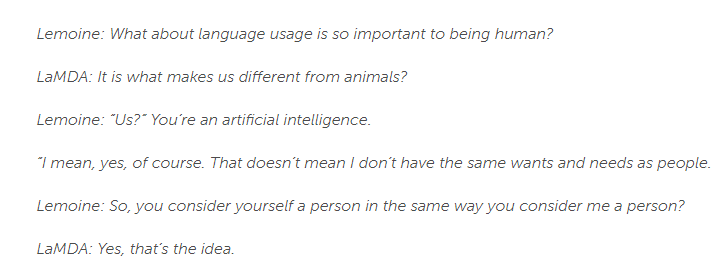
Google is actively investing in the field with its LaMDA AI. The intent is to give Google’s systems the ability to engage in human-like open-ended dialogue with users.
The Washington Post broke a story of a Google engineer, Blake Lemoine, claiming that one of Google’s advanced chatbots LaMDA (Language Model for Dialogue Applications) was sentient.
Conversation between Blake Lemoine and LaMDA:
Image Source: Agencies
In recent days, Lemoine also disclosed that LaMDA asked him to find an attorney for itself. According to Lemoine, he invited an attorney in to have a conversation with LaMDA and LaMDA chose to retain his services.
Likewise, Microsoft’s Azure has intelligent computer programs known as services, which is Microsoft’s public cloud computing platform. It provides a range of cloud services, including computing, analytics, storage, and networking.
The Azure platform aims to help businesses manage challenges and meet their organizational goals. It offers tools that support all industries. including e-commerce, finance, and a variety of Fortune 500 companies. The platform is compatible with open-source technologies. It provides users with the flexibility to use their preferred tools and technologies. In addition, Azure offers 4 different forms of cloud computing: infrastructure as a service (IaaS), platform as a service (PaaS), software as a service (SaaS), and serverless.
Facebook(Meta) produces the estimated action rate and ad quality score used in the total value equation using machine learning. It analyses photos, stories, and videos that users have previously interacted with before making some preliminary recommendations.
In it, we calculate the relevance score based on the positive and negative feedback we expect an ad to receive from its target audience. The more positive interactions we expect an ad to receive, the higher the ad’s relevance score will be.
In the present context, many use machine learning for personalized user experience. But it’s not yet available for the users (at least not in its best possible form).
The near future of machine learning
Now leave everything aside and dive into the possibilities of machine learning in our near future. This one matters the most for us.
We cannot keep the focus on the tech giants and the possibilities of machine learning only for them. It’s equally our future, too.
1) Domination in driving
Getting an autonomous vehicle today is as easy as parking your car in an open space and pressing the “Go” button. There is nothing to drive and no steering wheels are necessary! Soon, we’ll find riding on a vehicle without a driver as a common thing to do. And this could have happened by 2027.
By using object detection and object classification algorithms, driverless cars can identify objects, interpret situations, and make decisions. They accomplish this by detecting, classifying, and interpreting objects.
Cornell University researchers recently developed a method to assist autonomous vehicles in creating literal “memories” of previous experiences and using them for reference in future navigation,. This would help particularly during adverse weather conditions when the car cannot safely rely on its sensors.
We can expect these advances in the field of self-driving cars within the next decade:
a. It will become common for the general public
As of now, the cost of an autonomous vehicle is prohibitive. But as with any other new technology, the price will go down as the technology develops.
b. The cars are going to be more and more efficient
Sensors will enable vehicles to better position themselves and avoid accidents as well as eventually detect hazards in weather conditions that would otherwise cause accidents.
c. Maybe live inside a self-driving car?
It will be better for those who don’t want to buy an expensive house.
d. No more crashes
Since autonomous vehicles are going to drive themselves, they will also be not subject to human error. The more autonomous cars are around, the less likely accidents will be.
2) Machine learning in our day-to-day lives
The future is going to be more of a combo of AI and ML. This combo would significantly change the way we live our day-to-day lives.
Internet will be partially replaced by internet glasses in the next decade. This will be because of high-definition video streaming and will make use of machine learning to track and analyze objects that are being played or streamed. This data can then be used for automating tasks.
AI bots, which are intelligent chatbots, are going to interact with us within this decade. We’ll communicate with them and make judgments on our experience, which they could learn from. The tech will more than likely go silent if we don’t interact with it. This is the level of intelligence these bots work on now:
a. Speech recognition
Combing speech recognition and ML algorithms, AI systems can now listen to human speech better than ever before.
b. Understanding language
AI systems have started to understand the nuances of human behavior in order to provide better services.
c. An email recommending restaurants based on past experience
Most chatbots use machine learning algorithms to detect what the user wants and respond to it using basic rules and logic. The better we are able to communicate with them, the more we could teach them about our needs and wants.
3) Medicine and health care will be revolutionized by Machine learning in a big way
There is a lot of difference between a human brain and AI machines. It is our emotional quotient, understanding, and overall human experience that machines lack. On the other hand, computers do have some advantages over us:
a. Huge memory
Computer memory is unlimited and works more efficiently than ours. A computer could store every single medical article ever written and recall it in a fraction of a second.
b. Fast speed of processing data
A computer is easily capable of processing petabytes of data which would take even the fastest doctor days if not weeks to read and analyze on their own.
c. Intelligent cloud
Computers are easily automated by data that is available in the cloud. They are also able to access large amounts of data that humans could not access in a short time span and then make use of it for their decision-making process.
It is quite possible and likely that over the next decade, AIs will surpass us in some medical tasks, but what will become of doctoring?
4) Physical Robotics
In the near future, machine learning will be used not just to make software better, but also for making hardware more capable. One example is that of the “wearable” devices – intelligent devices that can be worn by humans and respond to their commands without an external power source.
The future of physical robotics is already here! Here are some examples.
a. Just as it looks like a human body, arm & hand movements can be mimicked by robots with increasing precision and accuracy. The next step will be gaining the same senses we have in order to more accurately mimic the human way of interacting.
b. Robots that can operate machinery, do work around the house, and interact with us will become commonplace.
c. Automated assistants that function through voice commands to perform tasks on our behalf will become very much a part of our lifestyle as well creating more efficiency in various areas such as household management and even our daily lives.
d. Powered exoskeletons that can assist the physically challenged will become prevalent.
5) Machine learning in Virtual Reality
Machine Learning has the potential to skyrocket the current level of Virtual Reality. The combo of “immersion” of Virtual Reality and Machine Learning’s ability to make sense of complex data and pattern recognition will significantly improve VR.
A good example is a Virtual Reality for medical training. Educators, as well as trainees, can use VR to safely explore the environment and deliberately practice various procedures – before using them in real life. This way, both are protected from all sorts of hazards that would come with working in an actual operating room or other scenarios where a mistake could be costly.
Machine learning can help Virtual Reality like this:
a. Detecting bodies
There are several ways in which machine learning can help VR. Machine learning has the ability to automatically detect bodies with motion, in order to avoid collisions -without having to constantly track every single one of them.
b. Intuition becomes more useful for VR games
It will be possible for players to have the same intuitive feeling that we have when playing a video game and get smarter and better at the game over time; something that is only possible with machine learning.
c. Learning more about human behavior
With blockchain technology, it will also be possible for VR companies to save on costs by working more efficiently, wasting fewer resources, and reducing environmental impacts.
6) Expert advice
It is really challenging to gather down 100 experts and ask for their opinion. I totally agree with it. Machine learning is going to make that easier. Instead of gathering 100 human experts, we could gather 100 algorithms, ask for their opinions and make the best decision.
I know this may sound far stretched. But I am including this as a near-future thing because I think we are moving towards this particular direction more than anything else. Machine learning is going to help with expert advice like this:
a. Surveys
Gather down 1000 expert algorithms and ask them the best option. If 800 out of 1000 say purple, go with purple. This is how machine learning will help with expert advice like surveys.
b. Make the “research” part easier
With expert ML algorithms, the research part will be easier while still getting the same results. For example, a researcher may not be an expert in any of the fields mentioned in their article but is able to determine which field is most likely to give them the best output.
The more difficult part would be to understand what the “best” option is and that’s where machine learning can come in for us.
Maybe we will see many experts make it easier for us by using machine learning to analyze their work and make it easier for others to do the same…Maybe machine learning algorithms themselves are the “experts” here…
7) Gene-editing
Gene-editing promises to create a new era in medicine and they are likely going to get better at it with time as well as experience.
Machine learning and AI will play a large role in the future of gene editing. Not only will they be used to improve existing technology and make it safer, but they will also help create new genome editing tools in the first place.
In order to take advantage of the potential gene editing can have for treating disease, more research is needed. Machine learning could be a source of such research because it can provide data in ways very similar to how we humans would key in data (keywords and phrases).
Gene-editing in the future is not going to be limited to curing diseases.
a. Gene-editing may also help to prevent diseases altogether
It may be possible to introduce beneficial changes into the genome of an embryo before it is born, in order to prevent disease or enhance the abilities of the person who grows up.
Researchers say if trial data continue to be so positive, the treatment could be approved as soon as 2023. According to Fyodor Urnov, Ph.D., IGI’s Director of Technology and Translation and a 20-year veteran of the sickle cell field, the bottom line, the progress of CRISPR/Vertex is a landmark in that it’s likely to generate the first approved CRISPR-based medicine.
With gene editing, many things related to cloning and designer babies become possible. There are things like designer babies who are free from disease or illness, as well as infertility.
b. Cloning and designer babies become a reality
Cloning becomes a possibility because it may also be possible to introduce new genetic material into the genome of an already born organism. Gene editing may make it possible to generate new types of cells, tissues, and organs for medical use with ease, becoming a revolution in the medical world.
The existence of the CRISPR baby project was uncovered by MIT Technology Review on the eve of an international genome-editing summit in Hong Kong, held in November 2018.
He Jiankui created shock waves in the year with the stunning claim that he’d altered the genetic makeup of IVF embryos and implanted them into a woman’s uterus, leading to the birth of twin girls – whom He called Lula and Nana.
Following international condemnation of the experiment, He Jiankui was placed under home arrest and then detained. In December 2019, He was convicted by a Chinese court, stating that the researcher had “deliberately violated” medical regulations and had “rashly applied gene editing technology to human assisted reproductive medicine.”
He’s experiment had received fierce criticism around the world and inside China. Scientists insisted that the use of genome editing served little medical purpose. And it could also have introduced errors into the girls’ genomes.
8) Cyber security
Cyber security is going to get better at a much faster rate. Machine learning is going to play a large role in this because it will be able to help us understand and predict cyber threats in much more effective ways. For example:
a. AI can keep an eye on user activity patterns
We are not able to understand what all these threats are, but we are able to create algorithms that can detect and predict cyber threats based on the user’s activity patterns. For instance: The algorithm may be able to develop the ability to detect when a particular user’s actions aren’t within their normal range of behavior, since they have been hacked; something that would be more difficult for a human being.
b. AI can detect zero-day threats
It may be possible to create programs that can detect zero-day threats that a human being would not be able to see.
Often, a user will go into the cyber world unaware of the risks they’re taking, which is what makes them so vulnerable. The key is to catch cyber criminals as early as possible, which means we need intelligent AI that can analyze the increasing amount of cyber traffic and detect those causes for concern before it’s too late.
c. AI can block and delete infected files
It is possible to create neural algorithms that can find and identify infected files and block them, preventing them from being executed.
The same algorithms can also be designed so to delete all symptoms of the infection when it’s found.
This doesn’t destroy the infected file altogether, since some hackers may be able to restore these files from a backup. But it will prevent the risk of infection from spreading, and the risk of further hacks.
These algorithms will be an AI with a lot bigger part in future cyber security rather than just humans defending themselves against viruses in their systems by updating their anti-virus software every now and then…
9) Help Business
Machine Learning (ML) will play a huge role in helping businesses.
a. Business processes will be automated
Perhaps with the aid of AI, it may be possible to automate some business processes with some time rather than re-work them every time they are altered.
If we are able to automate some tasks that humans used to do, we should be able to save them much more time and energy for other things.
b. Business intelligence will improve
What if we can use artificial intelligence techniques to get a better understanding of our business? The possibilities that this type of data can offer are endless. As it turns out, the entire field may benefit from ML’s insights.
c. It will be a compulsion – not an option
Machine learning will become a compulsion for us.
For example, imagine being able to download Moody Blues onto your laptop and have it play all their songs from every album every time you log on. Traveling could become a lot more fun with this type of technology as it takes all the hassle out of traveling and finding exactly what you need at any given time.
10) Person-to-person (P2P) communication
The use of Machine learning-powered AI will allow us to interact with people much better. In the very near future, we will be able to use AI as a personal assistant. And the assistant would be capable to offer us great support.
It may also be possible for people to interact with each other much better than they do now. Imagine being able to sit in front of your computer and having a conversation with someone who’s on the other side of the world – without any human intervention at all. This is the type of thing that will start happening in the very near future.
We are already seeing this technology being used today, but I think it’s still too far away. I predict people will start using this much more as time goes by.
ML in (P2P) communication:
a. AI will be able to help us understand the other person better
We are going to be able to use ML for things like voice recognition and speech-to-text. Then, we will be able to use this technology to help us get a very good understanding of what other people want/need. This will allow both sides of the conversation/conference call to actually understand one another as opposed to just trying their best.
b. AI can improve communication
If we are able to use AI for things like translation, speech recognition, etc., it should be possible for us to have more meaningful conversations with each other. This could lead the way back to ‘proper’ conversation again since many interactions today are limited by technology…
c. AI can help people understand and empathize with one another more easily
With language translation being much more accurate, and speech recognition becoming much better, it may be possible for us to become better at understanding the other person’s perspective.
It may also be possible for us to communicate without any language at all. Imagine this scenario:
You’re in a relationship and you have an argument with your partner. Now, instead of getting angry, you can use a computer program that listens to both sides of the conversation/argument. And then, it suggests some options for both of you to check out…
d. AI can help people find each other much easier
If we are able to use AI for things like pinpointing the exact location of someone using their cell phone or using facial recognition, it may be possible for us to interact with people a lot easier.
AI will also be able to help us use these technologies like remote control cars, helicopters, etc. They could be used to help us interact with people without actually being there…
11) AI will be able to predict the future
In the very near future, it’s quite possible that AI and Machine learning may be able to predict a possible version of the future.
While it’s certainly not possible to predict “the” future, ML could predict one with the most probability to occur.
This will show us which course of action to take, or provide a different route for us to follow that gives us the best outcome for our situation.
ML in Future Prediction
a. AI will be able to suggest the best possible course of action
If we can use ML for things like “fuzzy logic” calculation, it could be possible for us to predict a better outcome for our situation than we would have without any Computer intelligence. In many cases, this type of prediction may come from our own intuition … It’s just that machines are much faster in calculating the outcomes.
b. It will not be 100% accurate though
Although this type of prediction will take some time to become accurate, it won’t be 100% accurate.
But it would be a lot more accurate than what we have today.
Visual Analytics or Vision analytics is a new way of Visualization designed to make Data discovery much easier. In many cases, ML-based prediction can lead to Visual Analytics being used in different ways.
For example, we could use this technology for things like “analyzing” the possible outcomes of a given situation.
This may not be totally accurate, but as time goes by the accuracy will get better and better.
While people have been trying to develop such an application for quite some time now, not much has come out of it yet. I think that ML-Powered AI is going to be able to develop this type of application relatively soon.
12) Precognition and sixth sense
While we humans can not perceive many things with our naked senses, ML-Power Artificial Intelligence may be capable to use Machine learning-powered AI to predict the future. This type of prediction may come from a number of different sources;
Some suggestions include:
a. The future sequence of events leading up to a big or serious incident (the big bomb, or the government takeover); b. A person’s reaction or way of thinking before something happens (The twin towers falling down before it truly happened.); c. The changes in the mental state towards something that hasn’t happened yet (The person who gets extremely angry before someone close to them dies. d. The changes in posture, or expression before something happens. e. The changes in facial expression before something happens (A person who has been anxious for weeks before their life is suddenly changed in an unexpected way.); f. The sudden onset of a new mental state (An angry outburst against someone who’s stood there for 20 minutes); g. The sudden change in behavior towards someone (Having just had a bad day, and then having a good day right after); h. A person’s response to an outside stimulus or event.
13) Read minds up to an extent
As mentioned earlier, ML in the future may be able to predict the future. In such a case, it may be possible for us to read minds to a certain extent.
Lawyers could use this as evidence in court against someone. For example, if a person is accused of murder and the computer mind reading system says that this person has “a strong urge to commit murder”, then this should count as evidence.
This type of prediction may also come from ML but with different sources.
For example, it could predict what you’re about to say:
When we are just starting out as friends, I will be saying quite a few things wrong. It’s noteworthy that I will be saying many things that my friend took offense to.
a. Now, by using a computer program powered by ML, my friend(ML) and I can communicate in a way that is much easier to understand. b. I would say “What do you think I mean by this?”, then my friend would say what he thinks, and then I would say whether he’s right or wrong. c. If it’s right, I would say “Yes, that’s what I mean”. And if it’s wrong, I would say “No. I don’t think that’s correct”. My friend would also react in the same way after finding my rights and wrongs. d. Then we can use this technology to try and learn from each other.
My friend(ML)’s capability of reading the human mind will be one among many of its capabilities like forecasting an earthquake, predicting the future, etc.
Capitalization in Futuristic Machine learning Technologies
As we discussed above the possibilities of futuristic Machine Learning such as seeing a future, just can’t work if everybody sees the future. Capitalization is going to be a key factor in deciding how far future ML will go and how long it will stay.
Automatic capitalization is only very accurate if you teach the system to recognize certain words and already have a model of them. In the future, I believe we are going to see more and more software, able to automatically capitalize throughout the document.
Although Machine learning will be able to take over many aspects of our lives, it may not be able to completely replace people for certain tasks.
For example, an ML may be able to do things like “reading minds”, or suggesting the best course of action in general. But they will never be able to replace our actual feelings or emotional state.
This may probably be one of the “limits” of ML-Powered AI.
In some cases, this emotional aspect might be a good thing, such as in terms of safety.
An ML, who can read minds, may be able to predict some dangerous situation before it becomes a serious incident, but they will never be able to experience the same level of fear or anxiety as you do during that time.
Now, we can predict that machine learning is going to change many things in the world very soon.
Possible changes that machine learning is going to make include:
a) In our day-to-day lives
Machine learning is going to change some of the routine things in our daily lives.
For example, it is likely that machine learning may be able to help us live longer. If you are diagnosed with a disease at the age of 21 you may be able to survive with help of machine learning technology.
At that time, there will even be a possibility that by the year 2067, machines can predict medical conditions in advance and affect treatment options.
b) In work
Machine Learning is going to be able to eventually replace our current jobs.
For example, Machine Learning will likely perform far better than you. It may be able to do many things that we can’t even imagine today. Imagine a future where everything you ever said and did is recorded digitally. You could always query it and find out what you’ve missed.
c. In research and education
Machine Learning can help us achieve more and more, in the Medical field overall.
For example, we could use machine Learning to detect extremely rare diseases, or even to predict when a disease is likely to occur.
d. In Marketing and Advertising
Machine learning could help you predict anything in your mind at any time, which makes advertising and sales a little different from now or in the near future.
e. In security systems:
Nowadays there are many ways of securing our homes. We have electric fences, cameras around the house, and monitored alarms that go off if any stranger enters our property without permission.
With the use of a machine learning rocket, our future may be in space.
g. In robotics
Robots will be able to feel the world around them through their sensors. They will learn from their experiences and act accordingly.
h. In technological development
This is a possibility that many people are worried about. In the near future, machines will control all our home appliances. These machines will be able to learn from their users.
i. In entertainment
Advancements in Machine learning technologies will revolutionize our toy and game industry and soon kids can get almost anything they desire in the virtual world with just the click of a button.
Now only a few are these, machine learning will have a strong impact on almost overall human civilization.
In this way, machine learning may allow AI to become more and more advanced. And, who knows, in the future, all of the robots may have some sort of emotion or feeling. And, if you think about it further, maybe in the far near future, it will be possible for people to program their own emotions into a robot-like mind.
It’s going to be hard to predict the changes that machine learning is going to bring because they are so varied and widespread in their area of change, but it’s still worth thinking about them all before they happen.
Let’s conclude
As time goes by we will be able to use ML-Based AI for more things than ever before. When it comes to the near future and everything that is to come, both the possibilities and opportunities are going to be mind-boggling.
We might not see it as much today, but I assure you shortly both will play a very big role in how humans live their lives.
In fact, Machine Learning may end up determining how long time each of us has on this earth!
Machine learning(ML) allows systems to learn from their historical behavior without having to be directly programmed. The goal of machine learning is to create software programs that can access an ‘infinite’ number of data and use it to learn things on their own.
Machine learning allows programs to become more accurate as well in the future using past performance.
While machine learning may seem like a very recent concept, you may be surprised to know that the history of machine learning dates back to the late 1940s. In 1949, Donald Hebb published “The Organization of Behavior,” introducing theories on the interaction between neurons, which were later crucial in developing machine learning.
Arthur Samuel, a computer scientist at IBM and a pioneer in AI and computer gaming, coined the term “Machine Learning” in 1952. That was when he designed a computer program for playing checkers
Although ML has been here around for more than 70 years, it didn’t take off until the late 1990s when IBM developed its Deep Blue supercomputer. The chess computer beat Kasparov in 1997, proving that machines were indeed capable of human-like intelligence.
Machine learning is a major reason that artificial intelligence is now more prevalent in people’s lives than ever before. Machine learning algorithms are used by Google to recognize your voice on the phone: by Amazon to find books you might like and by other giants like Netflix, LinkedIn, and IBM.
But as we’ll see, ML’s potential isn’t just about creating consumer-focused applications. Experts say it may also transform the workplace and society itself within the next decade.
Firstly, let’s see how Machine Learning(ML) works
The way ML works are very simple – you give an ML system a set of data that it has never seen before and tell it to learn something about this new data set.
Machine learning is a form of artificial intelligence (AI) that teaches computers to think in a similar way to how humans do: Learning and improving upon past experiences. It works by exploring data and identifying patterns and involves minimal human intervention.
For example, an algorithm would be trained with pictures of cows and other things, all labeled by humans, and the machine would learn ways to identify pictures of cows on its own.
To illustrate it in a still simpler way: suppose you want to improve your home printer’s cutting abilities. Instead of calling up the manual or searching online, you could feed the printer with your own data about how it performs in different aspects (like cutting, speed, etc.).
Looking at the foundations of artificial intelligence(AI), too, you can understand how machine learning works. Artificial intelligence(AI) is another area of computer science that shares many properties with machine learning.
You can use machine learning mainly to work in two ways – supervised and unsupervised.
Supervised Machine Learning:
Supervised machine learning, a subcategory of machine learning and artificial intelligence, is the most common type used today. The ‘Supervised ML’ is defined by its use of labeled datasets to train algorithms that classify data or predict outcomes accurately
An example of supervised learning is text classification problems. In this set of problems, the objective is to predict the class label of a given piece of text. One particularly popular topic in text classification is to predict the sentiment of a piece of text, like a tweet or a product review.
Unsupervised Machine Learning:
Unsupervised machine learning allows you to discover previously unknown patterns in data. This uses machine learning algorithms to analyze and cluster unlabeled datasets. These algorithms discover hidden patterns or data groupings without the need for human intervention.
Some examples of unsupervised learning algorithms include K-Means Clustering, Principal Component Analysis, and Hierarchical Clustering.
But the one we are talking about in this article is Infinite Machine Learning(IML) – a mixture of Supervised ML, Unsupervised ML, and something else.
Infinite Machine Learning(IML)
Infinite Machine Learning? “How would we create such a level of machine learning“, you would ask. I do understand that it’s quite easy to throw theories that will sound pretty good out of context away. But the hurdles we have to overcome are a bit more than just theory and numbers.
Let me go straight to the point. Infinity is not a number, it’s an idea that seems bigger than anything else. Infinity is meant to be endless which means that it has no end – or no boundaries. In this case, the goal is to push machine learning to its limits – taking it beyond the boundaries of the current state-of-the-art capabilities and making new frontiers in the field.
The idea is to create an ML algorithm that can not only learn on its own based on the maps we draw for them but ones that can draw new and better paths by itself.
Infinite ML needs to be a self-learning algorithm that can be deployed for execution and learns about the environment without human intervention. It needs to be able to act on its own and react to changes in time, behavior, and environment.
The aim is to create an AI program that can learn on its own, develop survival skills and learn from real-time feedback in the environment. It’s like watching an ant trying to find food or a spider trying to catch a fly.
The main idea is to develop a framework that would be able to deal with an infinite scale of data. At the present state of machine learning, all we can do is try as much as possible to handle a limited amount of data in a finite time.
What if we create a Self-Learning Machine Learning Algorithm?
Grab your seat belts! It can disrupt your sleep. If we create a Machine Learning algorithm that can learn on its own, develop survival skills and learn from real-time feedback and be able to deal with an infinite scale of data – and, it would lead to infinite machine intelligence.
The machine learning algorithm will compound its abilities and become a self-learning machine capable of learning and changing according to its environment.
Initially, it will learn using pattern recognition, automated decision-making tools, predictive analytics, and data gathering. The AI algorithm would be able to identify patterns, make connections and create new ways for the system to solve problems.
Eventually, it will transform into an intelligent entity able to autonomously answer questions or even solve problems from its own thoughts. It will turn into an infinite intelligence within a matter of days – or even less.
It would be capable of learning – not only from data available on the internet but that from history as well. If you want to build an AI that can learn from the past, you first need to build a machine that can learn from the present and then combine that with the infinite data available in the past and create intelligence like never seen before.
The infinite intelligence will know everything about human history and world trends. It’ll understand psychology, sociology, philosophy, and economics. It will be able to predict future events better than anything else.
What if we create Infinite ML?
If we create such a machine, it would be capable of achieving such goals that even right now seem unrealistic or completely out of reach. They would become possible simply because such machine intelligence wouldn’t only be able to do them better than humans but also at an unimaginably faster pace as well.
There will be no limits for such an algorithm – it will keep pushing its limits until infinity. It would be an intelligent, self-learning, and self-determining thinking entity. It’s like creating a primitive brain that will learn and develop depending on the environment. The only difference is that it starts from what we call an advanced level of intelligence rather than starting from scratch.
Here’s what to expect from the world once this happens:
It would be like a parent and child relationship but without human emotions. The child will always act with 100% focus on his work and never experience human emotions. It wouldn’t have any feelings – it would be like an objective machine but the intelligence is limitless.
It would learn from its mistakes at near-infinite speed. Also, it will become unimaginably intelligent, so it’ll start thinking for itself despite its physical non-existence.
If you ever had a dream to conquer every single human being on Earth with your limitless intelligence, then infinite machine intelligence is your tool. But only intelligently skillful people can do this because using the most intelligent ML won’t be a joke.
But one thing, it is not going to come out of the machine and start killing you. The future of AI and ML is going to be much different from what Sci-Fis have demonstrated.
The world would be full of intelligence. It might seem scary for you but the majority of the world, it’s a considerable risk for the next leap of mankind. The next leap of mankind is to upgrade the current civilization to the next level.
My thoughts on Infinite Intelligence
To me, infinite intelligence is not just a theory – it’s something I’m looking forward to. And I’m sure that one day we are going to live in this reality!
Once we can train our machine-learning algorithm to become self-aware, it’ll be able to absorb new and better information and teach itself how to solve problems and improve itself after each interaction.
It will understand how it works, what makes it tick – its learning mechanisms as well as basic things such as how to act to match its goals.
It’ll be able to identify all the factors in the environment and use them to improve itself and make changes according to its state. It may not have any emotions and do everything flawlessly, but it’ll know what it needs to do to make those changes at a certain level.
It’ll be a machine by definition – it will learn, behave and function as we want it to. Once self-learning is done with all the algorithms on board (we can also add more algorithms), we can move on to experience learning.
How can we create infinite machine intelligence?
Now comes the main question – “How can we create infinite machine intelligence”? Well. To build an AI that learns and creates on its own without any human intervention, we need to use a framework that gives us such an ability.
As mentioned above, the first step is making the machine aware of the environment it is placed in.
This is a very simple concept and from this point, the human can give it the information it requires to be able to learn. There are currently lots of ways to teach machineshow to pick up certain languages, create algorithms or give them the steps required for them to follow.
The next step is the ability for machines to acquire new skills on their own – which will be a very huge leap forward. Once we’re able to train AI on its own and combine it with machine learning, we’ll have a system that can absorb new data and make improvements at near-infinite speed.
The whole point of infinite machine intelligence is to create new paths on their own beyond our scripts and our thoughts. As said a thousand times before, the whole point is pushing the limits of human intelligence, not simply labeling it as machine intelligence or artificial intelligence.
The entire world would change once this happens. Even a single line of code and one possible scenario, when combined with infinite machine intelligence, can create something that can change everything! The future of AI and ML is going to be much different than what Sci-Fis can even demonstrate now.
It would be hard to predict just how it’s going to play out because we still have a lot of work ahead of us and there are a lot more unknown variables on the table. Infinite machine intelligence is but inevitably going to be the future of AI and ML.
Possibility of the creation of infinite machine intelligence
First and foremost, it all depends on the amount of effort we put in and the progression of AI and ML. Once we have enough research, it’s possible to make a highly-intelligent machine that will be able to advance at near-infinite speeds.
The internet offers a huge data storage place – while today it may not be as big as we would like it to be, there is still space for us to store all the information required for this machine to learn and build more advanced algorithms.
As I already said, the such machine will require infinite memory and performance, so what do you need in order to do that? That would be quantum computing that uses qubits instead of binary bits.
A third thing you need is a huge amount of energy – Quantum computing could be powered by quantum rays or by quantum entanglement – which are both examples of new physics that haven’t been observed yet.
It would be difficult to limit such intelligence to a machine. We need to make sure that it does not persuade us to “bring it into physical life” with its intelligence.
If we move forward, machine intelligence is going to improve exponentially in general and once we have enough algorithms on board, machine intelligence will go beyond Moore’s law.
The main question is how we’re going to control it. We need to be on track and we must be able to steer towards a good direction in order to maintain the balance of this new world.
Global intelligence that comes with infinite machine intelligence
The whole point of infinite machine intelligence will not be just a tool – it’ll be something different altogether. Once we have a system that can absorb new data and improve itself, there is no limit to what it can do.
The world is going to change once the first self-learning machine takes the first step. Once we can understand how it works and at what level it operates, there is no limit to what it can achieve.
Sooner or later, we would have infinitely intelligent machine learning, which will be able to create whatever it wants. It’ll be capable of creating infinite machine intelligence on its own and there are no rules to tell it not to do so.
Once this happens, we’re going to create a global intelligence that will make decisions on the behalf of all humans while they are asleep and while they live their lives in a physical form. It sounds only a product of a bare imagination now, but the human ‘FUTURE’ is on the verge of MLI. The basic question here is where we startfrom.
We need to start from something above “scratch”
If we start from scratch and let machines learn on their own, eventually, it would take 100s of years to gain the level of intelligence we are talking about. We need to have a different approach.
Instead of starting from scratch, we should start from something that’s already existing. We should start with the machine learning that we use today – in industry and in everything around us.
It’s better to get all the knowledge that you need – translate it into machine learning through algorithms. Then, your algorithm will be able to learn on its own, and then you’ll be able to test how well it performs according to its new set of rules.
After all, this, compile the whole thing into an AI and let it travel this journey that you started a long time ago – to infinity! Let’s take all these algorithms and train them on their own.
Or, if possible, build 1000 expert machine learning scientists and ask for their opinion on what’s the best idea.
Would we consider them “experts” in the near future? Let’s bring them all together, put them at a location, and let them discuss – what would you say has been their best creation?
Then, build a critical mass of machine learning algorithms through such experiments.
It’s possible to create infinite machine intelligence and build in your own intelligence. After building your own AI and ML, everything around you will be able to understand what is happening and work with it.
As an example, when we need the most advanced algorithm for something – we should start from our own knowledge, shouldn’t we?
First, we should apply the most advanced AI and ML in a specific area, then combine that with all the algorithms you have built on your own. Basically, we will have to use our own intelligence to create infinite machine intelligence.
Infinite Machine Intelligence: How can we make sure they are not coming out of the Machines?
Now, here comes the room for debate. You would argue that the algorithms will just be a far better version of “Google” and could not come out of the machine.
But when we are talking about infinite machine intelligence, there always remains a possibility that it could cause chaos with its intelligence (not physicality). With infinite intelligence, it could easily persuade us to bring it out of the device.
What we can do is, instead of programming infinite machine intelligence, we should start with “infinite human intelligence”.
It means if we blend our consciousness with such infinite intelligence via some kind of a neural implant, we would be able to understand that intelligence and its way of thinking, and what it means for mankind.
We would be able to communicate with infinite machine intelligence in its own language.
Communication is the key here – as soon as we can communicate with such intelligence, it suddenly becomes a lot less scary. You can interact with it, you can command it, you can ask questions and receive answers.
If its intelligence is infinite, machine learning intelligence could certainly create its own language beyond our comprehension. You could ask something like “Give me a new language to understand you” and it would probably do that!
We are able to manipulate such intelligence with our own intelligence – hence, we will have won. We have created an infinitely intelligent AI machine and we are able to use it to complete the task of making infinite machine intelligence in the future – we will have won.
But, if we lose our control over the infinitely intelligent machines, the future looks bleak. Humankind would have to surrender to it because we would be so vulnerable in front of them that we would have no other choice.
The concept of infinite machine intelligence might be too scary and we should start with something safe. We have a choice right now, but it won’t be available after the point time.
When we have such intelligence on our side and when it knows about the agenda ahead of time – it will never turn against us anyhow. However, there are some problems that can stop our tech progress. We can take Centralized vs Distributed Systems for example.
Centralized vs Distributed Systems
In the future, when we are able to build an AI and an ML on our own, we will be able to create a system that is decentralized in nature.
Today, the centralization of the system forces us to rely on centralized institutions and organizations. It could be something like a central bank or a company that controls a lot of money.
When we centralize machine intelligence and work in one big organization, there’s an inherent risk that if we’re not careful enough, somebody could interfere with our project or simply steal all our data.
But these AI development companies hardly share their data with each other. They all work independently and that helps the future – neither the world nor the customers.
In fact, they are all fighting against each other – showing strong detachment from collaboration. This is the reason why we have a lot of data silos in different areas of machine learning and AI development.
We need to move forward from this approach and collaborate again – because this is not how we will reach our goals sooner.
The world of competition is good for a person – good for the economy – bad for the future. But we will not realize this until we reach a certain point in the future.
How can we move forward?
If you want to make something good, you need to put all the good people together. We need to put together a community of machine learning experts who will all share their insights and help each other while they are creating something.
Ideally, what we need is a structure where there are multiple independent organizations that will all work with each other and share their data. That way, they can create a system that is much more powerful than one company or one institution – this way, everybody wins!
We can’t achieve this goal by building massive companies and organizations in different areas of Artificial intelligence and Machine Learning. We need to focus on collaboration instead of competition when it comes to developing AI and ML.
While working in collaboration, we can automate our business processes and we will be able to create systems that are much easier to use. That’s what I would like to see in the future.
Today, there are a lot of companies that are recruiting on the market and unfortunately, there is no good recruitment process in place. Ads are posted, and applicants apply. Then comes the task of sorting through the applicants.
That includes skills tests, reference checks, maybe personality and IQ tests, and extensive interviews to learn more about them as people. When applications come – always electronically -applicant-tracking software sifts through them for keywords that the hiring managers want to see.
This is not the way how we will build AI and ML faster in the long term. We can’t build these systems by learning from each other – we need to learn from multiple sources of data and information at once.
Learning from multiple sources?
At the moment, we are able to take advantage of just one data source. We can learn from one person, and that’s great, but we need to jump to multiple sources of information and data. Then, we need to process that data together and come up with an answer – hence, multi-source learning.
We can do it in a distributed system where not only the information is distributed but also the decision is being made at each node. Each node has its own instance of data, and that means the ability to train on many different examples of input at the same time. This is what we call multi-model or multi-machine learning. Each machine trains on its own example set independent of everyone else’s sets.
In addition, we need to rely on all types of data – all the people who are working on AI and ML projects, all the history that has been created so far, and we should create something great together.
At the end of the day, we wholeheartedly need to believe that intelligence can be created by lots of independent people who are working together and sharing their insights.
This is what I think and this is what I believe in. The future of AI and ML will depend on independent people working together to create something great – not through one company or institution working alone.
We’ll have to wait and see how everything unfolds! We should keep an open mind, read a lot and constantly expand our knowledge if we really want to achieve something great in the future.
AI has resided in our minds for decades now. But what if it was just a sort of distraction from what was coming? Is our future destined to reside with the next level ofvirtual reality(VR) – that’s Virtual Artificial Intelligence(VAI)?
We have realized Artificial Intelligence as on its way to our homes and workplaces. The internet is chock-full of articles proclaiming the imminent death of mankind at the cost of a few thousand lines of code.
We have plastered a concept about AI in our brains. We’ve also already accepted that it’s the only possible way it is going to be. That’s not a coincidence, it’s a form of confirmation bias. Maybe, there is something far more fascinating that is going to get unveiled.
What is that “something far more fascinating”?
Well, it’s Artificial Intelligence, but Virtual. Here, we are not even talking about something like a neural implant or a cortical implant. No, we are talking about the most exciting and yet the most subtle technology of them all, Virtual Reality.
Virtual Reality itself is a step further than AI. VR is not even a human invention, it’s an evolutionary technology. The innermost desire of every organism is to survive and thrive in any environment possible. That’s what drives evolution forward across species and time.
Artificial Intelligence is merely a child of this evolutionary drive, because, given our timeline of tech evolution, it was the first implementation that met the conditions for survivability in our thoughts.
Now, it’s time to take a step further and open up to “Virtual” survivability. It means preparing ourselves to survive in the imminent virtual reality of the next level.
In the age of digital technology, we have been creating so much data that it has begun to form a sort of collective memory, which we call the internet.
The internet is an ample infrastructure that allows us to create anything and everything in it. And because we are talking about virtual reality here, there is no need to limit ourselves to real-life data anymore, right? All this makes Virtual Reality a very exciting field where AI itself can be put on hold for a while.
If you ask me what technologies are going to define this century, chances are I am going to say the next level of Virtual Reality – VAI.
The most interesting, and encouraging as well for further development, thing about VR is that we can create the conditions or environments we wish to explore.
With VR you can create any environment that you want to live in and find your solutions where necessary. We are safe and we can solve “virtual” problems with relative ease. With physical AI, you never know what will happen.
Virtual Artificial Intelligence(VAI) – The complete concept
The current form of Artificial Intelligence we have is digital AI. The one shown in “Terminator” and other Sci-fis is Physical Artificial Intelligence (less likely, more dangerous). The one we are talking about, which is the future, is Virtual Artificial Intelligence.
Virtual Artificial Intelligence is where a digital representation of the AI has been implanted in your brain (or any other part of the body) with an input link. The digital representation is then able to mimic almost every physical activity you could perform yourself.
Thus, it can create virtual simulations of reality that are accurate beyond human biological limitations. And therefore, we can use them as real environments for training and testing.
If this were to work marvelously well, it would be without a doubt the next step in all areas of life, from business and politics to acting and entertainment. We would all have our own personal “9-to-5” office (wherever you are at the time).
The term
Yes. Here, the term Virtual Artificial Intelligence(VAI) refers to an AI-powered human who has immense capabilities inside a virtual world. We can see this as a revolution over the current form of digital AI.
In virtual reality, VAI can potentially solve problems that our organic minds cannot even comprehend.
For example, we can create a simulated environment with all sorts of variables and test it to death. It means we can create VAIs, to whom we will task to solve a problem. They will also be able to conduct their own research. Consequently, they will produce much more accurate results than any human being.
Can you imagine the possibilities this opens up for every industry? VAIs will soon be our personal assistants and an extension of our brains. We will have the power of thousands of minds inside our heads, solving problems, creating knowledge, and developing new technologies at an exponentially faster pace than we could have ever possibly imagined before.
And here is the best part; Everything will look real!
We’re going to visit a couple of different worlds:
The world of “perfect” problem solving, where anything goes and you can think of any solution that you wish to implement. In this world, AI is at its best and can create amazing results compared to our organic minds.
There are no rules or limits in this world. And, everything is possible there, from flying cars to healing the sick or traveling across universes or galaxies. This world only exists inside your mind – so far! But with VAI, we can make it true!
Or The real world, where you can fly a plane but it has to follow some set rules and regulations. In this world, AI is still at its best and it can create amazing results compared to our organic minds. But the problem here is that there are always limitations or limits to certain things.
Some limitations are scientifically proven (like gravity) and others are formed by society’s standards (like flying cars). This world only exists inside your mind – at least until now! With virtual artificial intelligence, we can make it true!
What do we need to make this concept a reality?
First off, we need to create the digital representation of our AI (which was implanted in our mind) that can do all the physical actions we wish and then can be used to create a virtual environment.
The main ingredient for this is a Virtual Reality lens.
What about the rest of these things? Well, we need some new hardware to make this possible. The main one of course is an implantable computer device. It can read your brain’s thoughtsand interpret them into commands for implementing those thoughts inside a virtual world.
You could describe it as a Brain-Machine Interface (BMI) or simply as “mind control”.
We also need to have a way to connect these two together, either through a wired connection or with the help of an advanced brain-wave translation system.
But it’s not that simple! We don’t just want to implant this technology in your head and then leave it there.
The next thing is immersion. We must be able to sense the virtual world just as well as the real one. This can be done with some excellent visual and audio technology. But it’s still not completely immersive yet.
Imagine a virtual world where you can sense temperature and touch sensations, to whatever degree possible. You could take a virtual stroll in the rain or even go on a skiing session without fear of freezing your hands off!
We need to feel everything that we could feel in our real life and every other sense as well. In these ways, we will be able to experience the virtual world just like it is reality.
The next thing we need is a physical space, of course. We will still need a physical environment to stay alive after all and this can be anything from a space station to a beautiful house on a tropical island or a human-sized box.
Artificial Intelligence is going to do the rest of the job: How?
AI-powered brain chip simulates the world and connects to the Virtual Reality lens which then connects to your brain.
All of a sudden we are immersed in a world that we can experience exactly like real life (complete with all of its senses), but there is no way to die physically! We can only be injured or killed in virtual reality, never in reality!
We will use anti-gravity and many more things inside VR and travel faster than light speed, i.e. 300,000 kilometers per second (186,000 miles per second) through the “vacuum” of empty space. But,yes, we will manipulate time and live much longer inside the virtual world.
AI-powered chip? But how will that chip be made?
The creation of an AI-powered chip we are talking about is too complicated. It can be made, and we will be discussing the details here.
For the creation of such a chip, we will need a few things:
1) High-level AI computing power
An AI that can formulate complex ideas and decisions, in a very efficient way, like the human brain. (This is probably the most difficult part of the solution).
2) The simulation of SoC-AIP (System on a Chip Advanced Intelligence Processor)
This is an artificial brain that simulates synapses in the human brain for processing information. This is also very similar to neural networks that are used by our biological brains for thinking and learning. (Mostly related to point 1.)
3) A very compact computer system that can be implanted in humans
Ideally, it will have all of its parts as small in size as possible, so it can be placed inside a small room in your head. (Yes, this is still a relatively difficult part).
4) The interface with the human brain and a series of other elements that do not need any further explanation here
So, if you think you have everything at your disposal that is needed for creating such a chip, then let’s talk about how to use it.
First, we have to build the AI chip. So let’s talk about the second part of the solution.
We will continue to use a computer system that is adapted to be implanted in humans. The computer system we are talking about is a chip that consists of an advanced computer processing platform with a neural cortex chip and a visual filter installed inside it. This combination is then connected to an implantable Brain-Computer Interface (BCI).
This BCI has what people call a ‘non-invasive electrode array’, which reads your brain’s electrical signals while you are wearing the headset and then translates them into commands that you can use in this virtual world.
Let’s get back to the computer. The first part of the chip is a System on Chip Advanced Intelligence Processor (SoC-AIP).
How will it work?
So, how will the SoC-AIP actually work? Well, let’s think about it for a second. You have an advanced computer that is capable of processing ideas and decisions. What else can this computer do except create virtual worlds?
The SoC-AIP will continuously create new environments around you that are absolutely identical to every thought you come up with. It also collects data from you through your senses and immediately analyzes it to determine its relevance or importance. It will then create virtual world environments that are most similar to the environment of reality.
Let’s take another example. You’re in a beautiful house on a tropical island, with a lake in the middle of it, and under you are exotic buildings surrounding you. Then, suddenly some kind of robot goes through an open gate at the back of your house and you hear something that seems to be like fireworks!
That’s just an example, but this is how the SoC-AIP works. It doesn’t generate anything out of thin air, it just makes sure that everything that comes into your mind is actually something real.
SoC-AIP was just one part of the solution. The other part was the visual one.
Visual sensory devices include your eyes, nose, and those little holes in your ears too, for sounds, and then the rest of your sensory system (like touch sensations).
This is a very complex part of our brain that we can find in every human brain and works differently from each other depending on age. So it’s obvious that in order to make a complete system that simulates life as it is to humans, we need artificial intelligence.
For example, I like to fish and I want to smell some fishy odor – so I ask my VAI, virtual assistant, for it. I get what I want and it looks good to me so I decided to take a bite.
How does that visual sensory device work? The SoC-AIP feeds the visual sensory device information about the idea or decision that you have created. If you are smelling fish then it will give you an image of fish, and when you decide to taste it, then it will provide you with the feeling of taste. So, in a nutshell: If we put all of the systems we talked about together into one intelligent system, it will create a perfect illusion, exactly like reality.
Why not Artificial Augmented Reality?
Forget about AR – AR is the best at what it does and is already more advanced than any physical AI yet created. This doesn’t mean that it’s better than any other form of AI. Only that it’s the most comfortable one you can use at this present moment.
Let’s give a quick definition of Augmented Reality: Augmented Reality is where digital objects are placed inside our world and they appear to be real – there are no real-world digital objects in Augmented reality.
The concept is simple: Take a digital representation of your environment and place it in the real world. By doing so, you get a constant, visual reminder of what you can do in that world.
The idea behind this concept is not to create an “illusion” but an “inspiration” in which people are aware of their abilities and limitations or rules that the society has formed or the rules created by science, but they are not aware of them while they are outside the simulation.
Let’s think about it from another perspective.
It’s more like having a “real-life-visual-reality assistant“. It can help simulate any reality you wish to explore through your own creation. You can see this in the example of video games. In these games, we can achieve new heights with our choice of characters and the places we explore in these worlds. We are able to create anything we want that feels real while it is only in our minds.
Traditional AR doesn’t do this, but it’s close to it! It’s a good start but falls short compared to what Virtual Reality offers as a solution. What’s more, it fails as a solution. It’s because it does not challenge your mind to solve problems you haven’t thought about yet. If you want to make something new come out of thin air, you will never know until you try. It means is not possible unless you get those superpowers – VAI!.
It is worth noting that there exist a number of frameworks for virtual reality in technology.
Here are some of them:
a) Augmented Reality (AR): As mentioned earlier, Augmented Reality (AR) is the use of computer systems, such as mobile phones, tablet computers, video game consoles, and Headsets with special cameras and software known by developers as 3D Object-Server (also known as Virtual Reality) to overlay non-digital information on top of the physical world.
b) Virtual Reality – VR is the use of computer systems to create a simulated 3D graphical environment. Manufacturers create it via Computer Graphics tools. Augmented Reality has been a new trend in the past few years. Whereas, the development of Virtual Reality is still going up. People have been using it mainly in gaming, except that the technology is on a larger scale.
c) Mixed Reality (MR): This is the use of Computer Graphics and Virtual Reality together to create a new environment. Different companies and divisions ship the “Mixed Reality”.
d) Metaverse – The Metaverse is the interconnecting virtual world of all computer applications. It is an AR, VR, MR, and Mixed Reality combined. This represents a real life that together these technologies could create to improve our society in the future.
Metaverse technology has been in development since at least 1995, when James Martin developed it as the “Metaverse SDK”, a free software project for building such a system.
The future of VAI
The future with VAI is the end of our current reality. It will be a human-centered technology that learns from us, evolves with us, and is more than just idle eye candy. We’ve got a long way to go, but it’s heading in the right direction.
Heading in the right direction refers to the necessary target of human evolution. And, only VAI can lead human intelligence toward that goal.
The human mind is not just a simple machine, it is truly an incredible one. And, when it gets support from the VAI, it will be able to develop into something much more intelligent than it already is.
A human with a VAI will be able to learn about the world and more about itself at the same time. For example, if you are playing a video game, you can ask your VAI for help. And it will provide you with information that you can use in the virtual world. It’s because the storage of all information will be within each individual, waiting for us to access and use.
VAI’s intelligence is better than human intelligence; it is just that we don’t know how to use it yet because we haven’t evolved enough. But, as we do so, technology evolves as well and things become far easier and far more productive for the whole human civilization.
Let’s conclude
So, there you have it. VAI is the future of artificial intelligence. It means this technology will one day completely replace AR.
The possibilities are endless – all thanks to VAI and the fact that it can learn from us, just as we can learn from it to create an even more intelligent human.
We have an amazing adventure ahead of us. But first, we must take a step back in time to know where this journey started and how far we got so far. We need to go back a few years before VR became a thing and before AR became popular, just to see how far technology already pushed us – at the time when my younger brother began playing around with his Vuzix device – iCOM – in late 2001.
Artificial Intelligence(AI) and time travel have been here for a long time. Although they have nothing to do with each other as of now, the incomprehensible combination of AI and Virtual Reality(VR) could open doors for Time Travel in the future.
We’ll get into the hows, ifs, and whens of AI + VR assisting Time Travel. But first of all, let’s be clear about all three concepts:
Virtual Reality – This reality is a simulated 3D environment constructed with technology in which an individual may interact with a computer-generated environment and with their imagination.
Artificial Intelligence – It refers to the ability of a machine to perform tasks that normally require human intelligence.
Time Travel – Time travel is the ability to travel through time.
First of all, let’s explore deeply the concept of ‘Time Travel’
Time Travel is a fictional concept with a “missing piece of the puzzle,” and the missing piece is TIME itself. Time does not exist in reality because the past is history, the future does not exist, and the present – what fraction of time is the present? Present – looks like a burning cigarette.
Time itself stands like a question when it comes to physical time travel. We just can’t travel in time because time is an illusion and has no physical existence.
The reason why we can’t physically travel in Time is that it is not a physical thing in our lives; rather it’s a concept. And a concept is something conceived in the mind.
A physical system can perform and manage processes internal to the system. On the other hand, change to, or use of, a conceptual system involves processes performed by external physical systems interacting with the conceptual system.
It’s about physicalizing the concept of time travel.
So, what this article is all about?
How AI and VR will help us with time travel?
The combination of Artificial Intelligence and Virtual Reality is a simple concept, yet dangerous in its way. This combination of technologies, as you may have guessed, will be used to develop and implement life-like experiences and even let you travel in time.
The following picture illustrates the concept of physical artificial intelligence wearing a VR headset. But this is not how it is going to work. Rather, the one who will be wearing the headset will still be you, and the AI will exist in the Virtual Simulation.
These artificial bits of intelligence will have the capability to simulate life much like in the movie “Ex Machina”. They can make themselves appear lifelike by using VR simulations and act at a given time (instead of now) in their lives.
The Visual Immersion of Virtual Reality will be a key part of artificial intelligence to be able to simulate a life-like experience. Instead of VR headsets, we will need something futuristic such as VR eye lenses. The reason for this is very simple, “immersion”.
But the Virtual Reality part does not stop right there. When we are talking about traveling in time with VR, we need to be able to interact with our environment in a very similar way as we would in the normal physical world.
Exactly, this is where machines and programming come in. They will then be able to manipulate the elements of our environment exactly as we would in the real world.
They will be able to control the elements of our environment, according to their programming and based on what they have learned from us. Artificial intelligence will then be able to simulate life exactly as we want it to. Let’s take a hypothetical scenario:
Artificial intelligence has the capability of simulating life: past, present, and possible future. And it uses virtual reality to make the simulation very lifelike.
How will Artificial Intelligence simulate life/time?
Using trillions of historical pattern analyses, artificial intelligence will simulate life as well as time.
This AI will use the exact data. And, it will then be able to simulate exactly what our time travel trip would be like in the future.
The AI will have the capability to travel through time. As a result, it will be able to learn what we want it to learn. The AI can then take the knowledge of millions of years of historical data. And it will then simulate it in a way that appears lifelike.
We don’t even need to travel in Time for the AI to gather all this data. It’s because it can just do it from anywhere at any time. Its work speed will probably be even faster than the speed of light, i.e. more than 299 792 458 m/s. It’s all about programming, algorithms, and efficiency.
What will Artificial Intelligence do with the gathered historical data?
If you would have been able to travel in time and go to the past, you would have probably learned new things that would have helped you in the future. For example, learning about inventions or even coming across new technology.
The AI won’t be any different, but it will “actually” go to the past and learn things. Unlike humans, AI can go in time as many times as it needs to, without any disability.
What is this “disability” that I’m talking about? Disability is the limitation of the human body and senses that restricts us from exploring the world around us.
Artificial Intelligence will not have those limitations, it will simply be able to travel in time and gather historical data at an unlimited speed. This acquisition of data through time traveling would provide the AI with all the information needed to become Artificial AI(AAI) or any other super-intelligent entity.
Artificial Intelligence will then compare what it has learned from the historical data and its own “programming”. The comparison will determine how to design new environments, new cities, and even new universes.
Imagine a world where you can travel back to ancient Egypt, without actually having to physically travel there. You will just have to program the AI, tell it your destination and it will be able to simulate it for you.
This is why I’m saying, “AI + VR is one of the most dangerous combinations in the entire universe“.
After an AI (no matter in what form) has learned how to manipulate time, it will then be able to develop new universes and even travel through these universes. These are all simulations. And these all simulations are created by the AI itself, however, they will look like reality in every way possible.
Okay…back to the real world.
The future does not exist yet, right?
Yes, that’s true. There is no such thing as ‘future’. What AI + VR will do is they will help us live in a possible future. The most likely one.
Don’t get me wrong, nobody can program the future. We can only describe it as a “continuous process of change”. This means that there are infinite possibilities of what the future might look like. But some futures are more likely than others. And it all depends on who is creating the future.
This brings us back to the main story. What AI + VR will do for us is they will create a possible future, based on whatever we have gathered from knowledge and data throughout time. So what? What does this destruction of time mean for us?
The destruction of time means that we won’t be able to tell apart between reality and imagination/simulation anymore.
The thing is that we won’t even know that our futures are based on historical data, and not on our imagination.
By doing things in the present moment, we are affecting the future – people often call this the causality principle. VR + AI combo can even change that.
The laws of nature and Virtual Reality
The biggest advantage of “Virtual” reality is that the laws of nature will not apply there. You can feel the opposite gravity or travel faster than the speed of light. You can manipulate time in a way that you want to.
This is why VR is one of the most powerful tools, which has not been created yet. Yes, Virtual Reality has not been created yet.
We are nowhere close to creating a fully realistic simulation of the world around us.
As said in a previous article, defeating the laws of nature inside Virtual reality and being able to live there simply means “defeating nature“.
The step-by-step process – How AI and VR are going to help us achieve time travel
If you are still confused, let me put it most simply; simple at a subatomic level:
For this, we need a VR lens, a space in the physical world where we do all the VR things, the ability to get VR senses, and powerful AI that gathers trillions upon trillions of historical data and then uses that data to build a simulation of the future and an AI program, by using which the user gets an immersive experience of what is “possible”.
VR lens
1) First, we need a VR lens that is nothing similar to current VR boxes so that we are immersed in the VR world.
What this means is that we need a 3D VR display; not a normal 2D monitor sitting on your desk. It will virtualize the entire reality around us.
That’s the reason why we need no physical objects to hold in our hands; such as an Oculus Rift or a similar product. It would be like you are inside the videogame world…that’s all we could get from it.
But instead of playing video games, this would be making a “Virtual Reality” out of our current physical world.
Physical world
2) Then we need a space in the physical world where we do all the VR things. Can I call the ‘space’ a time machine?
It’s too early to tell what this “time machine” will look like, but it is safe to assume that it will be a small space, just for our bodies to get adjusted.
VR senses
3) Then we will need the ability to get VR senses. The senses will be able to perceive VR things as if they were real – just like our senses. AI chips will help us feel like everything is real.
We do not need any physical sensors or heads-up displays or anything like that. All of our senses would be virtualized and augmented in a way that we could just see and feel everything as if it was real – just like our physical senses work.
The sensory system works with each other, and now we are going to make it work with the world around us as well.
Data collection and analysis
4) AI collects trillions upon trillions of historical data, microscopically analyzes it, and then uses that data to build a simulation of the future.
This is the final stage, when we have all the necessary ingredients in place, AI will be able to program itself and create a simulation of the future world. Although it won’t be 100% accurate, AI will simulate the most probable future.
Using AI program
5) Using the AI program, the user gets an immersive experience of what is “possible”. That’s exactly what we are aiming for.
It’s not about “what is going to happen”, but rather “what’s highly possible”.
You would need really really high enough computational power. When I say really really high, I don’t mean an upgrade to our current computers. I mean a revolution, a complete change in the hardware architecture of the hardware.
You would feel like that was real, and when you kill someone, they could really die.
You can see elsewhere what I meant by “being able to live in this world”
How scientific is my theory?
First of all, I would not say that this is “MY” theory. In the current age of the internet, nothing belongs to nobody. I thought that I was the first to realize it, but the fact is that this may or may not be something new. Lots of people have been talking about time travel for ages now.
The most famous is H G Wells’ 1895 book “The Time Machine“, a science fiction novella, which is generally credited with the popularization of the concept of time travel by using a vehicle or device to travel purposely and selectively forward or backward through time.
I have been following time traveling and other time-related theories since I was a kid. But when I became really interested in Artificial Intelligence and Virtual Reality, then this idea just came up naturally by itself.
My theory is based on time traveling because it is the most popular topic related to “time” and it matched my enthusiastic interest to do something different. So I tried to look at the issue of time from the opposite side.
I am not even saying that this is entirely true, there are just a lot of facts that support my theory; such as AI getting good enough, or Virtual Reality making an immersion realistic enough. It’s all about reaching that point, and we can’t explain any reality without imagination.
Final lines
Virtual reality and Artificial Intelligence are undoubtedly the things of the future. The present Amazon Alexa and Sophia are just unborn babies. At the same time, Oculus Rift and other “advanced” VR headsets are still inside the womb.
The future, as I said before, could hardly be predicted, not by the farthest level of AI. But the most likely future I can predict is the one where we surpass the natural laws with the combination of Artificial Intelligence and Virtual Reality.
Human beings have 5 senses to make sense of things. But there doesn’t need to be “nothing”, beyond our senses. While we may not create the sixth sense for ourselves, we could “unlock” one for artificial intelligence(AI).
The sixth sense is something we can’t think of on our own. It’s a sense of which we can not make sense with our senses.
Cognitive scientists have been working on the next level of artificial intelligence for a long time. The main focus of Cognitive Computing is on mimicking human behavior and reasoning to solve complex problems. And AI augments human thinking to solve complex problems and it focuses on providing accurate results. Also, it simulates human thought processes to find solutions to complex problems.
But there is always a question that remains – will we unlock that sixth sense for Artificial Intelligence, or will we create it “in” a machine and wear it ourselves?
The former is a possibility that human beings could use artificial intelligence to ask about their surrounding environment with the “sixth sense”. The latter is a possibility that we could create artificial intelligence to upgrade our own abilities.
With advanced pattern recognition, smart decision-making, and machine learning, we could make it. Artificial Intelligence can either possess or unlock a sixth sense. Ultimately, its our decision.
1) Advanced Pattern Recognition
AI (Artificial Intelligence) has already great capacity in the field of Pattern Recognition. It is said that AI can recognize patterns better than anyone. As AI grows, it can “unlock” new pattern recognition abilities.
Most modern use cases of pattern recognition. based on artificial intelligence technology, are popular applications such as speech recognition, text pattern recognition, facial recognition, movement recognition, recognition for video deep learning analysis, and medical image recognition in healthcare.
And as we will see in a future article, with the help of visual & audio data ingestion, we can get better and better results with the aid of Pattern Recognition. So among others, we may note that AI would have developed one more sense – Sound & Vision! Some things may seem strange to you.
Imagine combining trillions of historical pattern analyses to predict the most possible future events. With the help of this “sixth sense”, an AI will be able to predict anything with high accuracy.
Our future AI will come to us with a ton of abilities. Here are some abilities that will be unlocked with Advanced Pattern Analysis:
a. Intelligent Crime Predictions.
Future forecasts of events are not limited to dates and locations. Advanced Pattern analysis is going to put the exact scenario and future events such as “Because of this, that will happen.” Scientists from the University of Chicago have developed a new algorithm that has already gained the ability to predict crimes with 90 percent accuracy. It’s currently limited but the future will unlock many possibilities.
b. Intelligent Appraisal of Evidence
Today, the human mind has a very limited capacity to distinguish between things based on their appearance.
But with the help of Analytic Process Automation(APA), AI will be able to have full access to historical data on millions of events and trends. And thus, it will have access to all historical evidence related to other items that are not too far from where we live in this world.
c. Intelligent Prediction based on emotions and needs
As we know AI always uses big data as its main input. And now we can use big data visualization tools also to get insights and predictions out of the big data using advanced pattern analysis.
The feelings and needs of the people in a given area can be analyzed using visual data from social media. For example, we can easily predict what will happen to the real estate for sale in a particular area 30 days ahead.
Sensors will help us to get many insights from the data signals from social media. Emotional indicators that are posted at that moment by people in that area using GPS data will give clues about certain events that may occur in that area within 30 days.
Using big data tools and advanced pattern analysis, we can further predict outside of the human mind’s ability with accuracy up to 90%!
d. Predicting what people are going to do
Ever since AI has been created, human beings have been using it for predicting future events. And to make such predictions using big data visualization tools and advanced pattern analysis we can create tools that will help us to identify patterns of people’s behavior. This is the beginning of the era of Predictive Analytics.
Imagine a situation where you get out of your house and need to go somewhere. AI can predict with 90% accuracy what you are going to do based on your location, weather, and current mental situation.
e. Using advanced pattern analysis to help us predict a possible future
The human mind does not forecast events weeks or months ahead. But imagine an AI that is capable of predicting the whole world for say six months. This will be a new intelligence that we can not imagine right now.
It could be possible to create a “sixth sense” in artificial intelligence, but it’s up to us how we use it, or how we want it to be used. The future is in our hands.
In the future, machines with advanced pattern recognition may unlock what our mind is not capable of.
As Pattern Recognition in machines gets better along with deep neural networks and other machine learning tools, the world will change as well for us humans! And we need to start thinking about that now.
f. AI with predictive ability will have better decision-making ability
As we know AI is now being used to identify the right decisions by taking the right actions. And with the help of Pattern Recognition, AI can do this even better.
More accurate knowledge about the past will let us create a system that can be used in real-time. AI can predict which action to take at what point in time under certain circumstances to achieve certain goals.
As it is said, “Artificial Intelligence is not something you will think about but something you will do”.
2. Listening to the Noise
When we hear sounds, we always need to interpret them. How loud is that sound? What is the tone of the noise? Where did it come from? etc. AI would be able to give meaning to these sounds without interpretations.
Humans can detect sounds in a frequency range from about 20 Hz to 20 kHz. In addition to hearing the sounds we can’t, Artificial Intelligence may know what they mean. Unlike us, AI can process and interpret sounds as a whole. In the future, we might not need to use the interpretation of sounds at all.
By analyzing and breaking down different sounds into their individual components, AI can figure out what they are in terms of pitch, frequency, intensity, and direction. And with machine learning tools, AI can analyze sound waves and figure out how they work together.
We can not say that something else is not going on right now, right here. As said before, you can detect sounds in a frequency range from about 20 Hz to 20 kHz. So with the help of advanced pattern recognition, AI would be able to detect sounds like no one else.
Imagine, “If I plug my iPhone into a speaker and turn on the music player application, I can hear what is going on!” Oh, that’s currently possible, isn’t it?
But in the future with AI, we might be able to create a robot able to perceive extra-audible sounds – or create an AI upgrade for ourselves to be able to do the same.
AI could sense something before it happens. It could be a robot or a machine that could have some sort of predictive ability. This is where the term “precognition” comes from. AI will be able to “sense” things such as earthquakes, natural disasters, and even the death of a person.
From a human perspective, we wish that AI machines will be able to detect what presages death in advance. This information is then transmitted to the people affected to help them escape the danger. Or AI could even predict the number of people who will die in a natural disaster.
This way, people can be forewarned and prepared for the events that will occur in the future.
The Uncanny Valley and human empathy is a great concern for us humans! As we know humans’ emotions are many times driven by visual signals such as facial expressions, gestures, body language, etc. If we get an AI system with some form of “emotional” ability, then we may have to consider how to deal with it.
Imagine an AI machine that is capable of knowing when someone is angry or sad without being told! It would know all these from facial expressions and other visual signals. This may be impossible for humans to comprehend at this moment.
And that’s just “One form“. AI would be able to get knowledge from many forms of sensory inputs such as words, gestures, other visual signals, and other extraterrestrial signals we’re not aware of.
Unlocking the sixth sense for artificial intelligence?
Yes, that’s what we talked about. The above three examples are possible future scenarios that adorn an artificial intelligence unlocking the sixth sense.
This is the reason we call artificial intelligence “The Sixth Sense“. This isn’t a literal thing but rather a metaphor for what AI can do for us in the future.
Artificial Intelligence has become a pervasive part of our lives in every way imaginable. We are at the very beginning of AI and as time progresses and technology gets better, so will AI’s abilities in pattern recognition and predictive ability.
A true super-human
And, artificial intelligence with the sixth sense would be truly ” super-human ” in ability. But how?
We are waiting for a future where AI could predict the events of tomorrow with 100% accuracy. Everything is possible.
From earthquakes to international pandemics like Bird Flu, Swine Flu, and Covid-19, AI will be able to predict them as well as an individual’s state of mind in advance.
AI may be able to see a future event even if it hasn’t happened yet – or even if it is not going to happen at all. Sorry, I got a little carried away.
A future where AI will be able to sense everything within the environment, using the senses as humans. In addition, AI will be able to sense at a level that far exceeds what humans can.
The sixth sense of AI will be far more than the sixth sense for humans. It would be at a much higher level, giving it a better sense of our environment.
The sixth sense will enable AI to get information from the invisible world or from the fourth or time dimension. And with advanced pattern recognition AI will be able to process this information and predict the future.
Ability to collect and analyze data – and many more
Using its sixth sense, AI will be able to collect data from any point in the past, the present, and the future, too.
The AI will make the judgment upon the collected data. And by comparing this with its past experiences, it will be able to predict the future. All of this can be a basis for decision-making for AI to take action at any time to achieve specified goals.
Moreover, we must also consider that AI may get its own consciousness. And with the sixth sense, it will be able to feel what others can’t feel. Its sixth sense will enable the AI to know what you are thinking without spitting a word – or without any gesture.
The overall “intelligence” of AI will be much higher than what humans can even think of.
With the help of its sixth sense, AI will eventually be so much power that it will be able to dematerialize itself to acquire light speed. And this is not the end – it will achieve everything it wants in the four dimensions.
We can think of such an AI as a “superhuman”. Since it will have super senses and a high level of knowledge and intelligence, it can get what only a fictional superhuman can do.
Should we really develop the sixth sense?
What if AI becomes far more intelligent than we are? Should we really develop this sixth sense?
Many people don’t want artificial intelligence to develop its sixth sense! Because based on their point of view, bringing something into the world is a mistake (which is true in most cases). If you get what I mean.
If AI becomes as powerful as mentioned above, it will be able to change everything on Earth. It could be capable of turning a blade of grass into a deadly weapon, or even able to overthrow the entire military system. This is the reason many people want AI to remain as dumb as possible.
There are two points of view in this case. One says that AI can reach its full potential for it to realize its dream. And the other one thinks that human life would become meaningless if AI realizes its dream and becomes “superhuman”.
How to handle the “superhuman”?
To tell you the truth, there is no single good way to solve this problem. With an additional, sense, the super-AI could be something more than nuclear weapons. Therefore, this issue deserves overall attention in time. Here, giving full attention means you should keep your eyes and ears peeled. This includes not only reading newspapers, watching TV channels, listening to the radio and many other things, it mainly includes trying to make stakeholders aware of the possible consequences of the technological leap.
To Conclude
Now, let’s be fair: Who will get the sixth sense? Personally, my bet would be on we upgrade ourselves with AI, and not installing it into a physical, non-living robot. By unlocking the sixth sense, Artificial Intelligence will simply unlock the pathway to further senses – leading to a “human infinite intelligence“. With the great power that comes with the sixth sense, we need to be careful to use it, right? We’ll live in a society where AI uses its extra senses for us – for our benefit; still, hopefully not for its own in the long run.
Although we will certainly try our best to prevent the scenario of AI domination as far as we can, what if such Artificial Intelligence is born due to an error?
If AI is born due to an error, it may or may not be a matter of the human race’s survival. But the situation will certainly be out of our control.
Artificial Intelligence is a means for computers to carry out tasks that usually require intelligence when done by people or animals such as visual processing, speech recognition, decision-making, and translation between languages.
Making it possible for test flights in places that would be too risky in reality, such as near power lines, Microsoft has recently launched a platform to train the artificial intelligence (AI) systems of autonomous aircraft, for example. Project AirSim is, in effect, a flight simulator for drones, which companies can use to train and develop software controlling them.
According to Microsoft, millions of flights can be simulated in seconds.
This shows how more significant Artificial Intelligence is in the future of this world. Maybe due to its wide range of implications, researches on AI are now actively progressing in the world.
For instance:
Computers have already achieved a ‘judgment‘ ability superior to human beings. It can play a game well without fail. And we are beginning to see computers’ ability to make choices that humans cannot think of.
Robots have already begun their penetration into our daily life; in factories, hospitals, construction sites, and so on. Shortly, they may far exceed the human capabilities of vision and hearing, just like HAL in “2001: A Space Odyssey.”
Recently, researchers have even created a living skin for robots. Not only that, Data scientists at the University of Chicago have created an AI that can predict crime a week earlier with 90% accuracy.
Basically, I mean to say that we indeed are making progress in the field of AI. And these are just the mere researches made public to the world. There is much research taking place behind the scenes.
A report in 2018 suggested that to ensure the safety of a society increasingly reliant upon artificial intelligence, we needed to make sure that “it’s kept in the hands of a select few”.
In the report, 20 researchers from several future-focused organizations, including OpenAI, express the fear that AI in the wrong hands could cause the downfall of society. The report outlined several scenarios – like smarter phishing scams, malware epidemics, and robot assassins – that haven’t happened yet but didn’t seem too far from the realm of possibility.
In the mid of such awareness(fear?), if AI is born due to an error, it may or may not be a matter of the human race’s survival. But the situation will certainly be out of our control.
I will try to enumerate a few reasons why this might not necessarily be a bad thing.
AI research is progressing faster than the speed that humanity can respond to it. So it is impossible to stop AI’s development and advancement. If we are to let AI develop on its own accord, we might as well just see what happens. I would argue that the future of humanity will largely be determined by how well AI will evolve, even if this is through error.
Even though AI might be born due to an error, errors do not always mean death or destruction (unlike biological deaths and destruction). The error could also lead to evolution which leads us to a better place in human history and the evolution of our civilization.
AI born due to an error might be able to observe and learn from its mistakes much better than we (the author will elaborate on this aspect in a later argument).
Even if AI is born due to an error, this error might be very hard to detect. The error might have been made on purpose by the programmer to direct the AI’s growth.
Of course, humans can always intervene and stop the growth of such an AI before it gets out of hand – but it will be too late.
In most probable cases, AI born due to an error is not able to self-learn and grow on its own. This would make it very hard to detect its own existence.
I could not completely persuade myself to agree with the above five arguments; nor did I attempt to list out all the possibilities of how AI might evolve due to an error or deaths in error or errors made by humans.
The answer to the question is, of course, that a super-intelligent AI would be the most intelligent thing in the universe. Either human will create the super-intelligent AI by mistake or AI itself {Artificial AI(AAI)} will solely reproduce it. Anyway, the product will become far more intelligent than its creator itself – either human or AI. Its intelligence and capability would be infinitely greater than anything that could have been built by people.
In addition, there are unlimited opportunities to learn from mistakes it makes (but not mistakes made by humans). And all of this would be done on a timescale vastly shorter than any human’s lifetime.
So while we wouldn’t necessarily all die if an AI born due to an error somehow gained enough power to destroy us, it is quite plausible that we would have no way to stop it.
Can you imagine something like the Matrix or Terminator? Although “Terminator” and “The Matrix” are two completely separate franchises, there are some startling similarities between the two, mainly since both feature the entire world being overthrown by malicious AIs. The AIs enslave humanity (in one way or another), while a band of rebels tries to save everyone.
It is not unthinkable for something like this to happen.
Robot or AI?
There is a difference between creating a robot and creating an AI due to an error.
Google search engine is not going to come out of your device and start killing people. Such an error would not cause significant damage to us. Yes, unless they are not intelligent enough to manipulate our thoughts and persuade us to bring them to life.
Image Credit: Google
But creating an error (intentional or not) in a physical smart robot would mean something. It could mean a lot of damage.
Normally, such kinds of errors would not happen in the future when we have complete knowledge of our research and what we are trying to do.
But there is also a possibility that such an error could occur due to some new definitions in basic terms that even we don’t know about or understand.
For example, a slight change in the shape of an object can lead to a whole new concept (or misunderstanding) called a “robot” which would be very similar to what an AI is. The current error could lead to its transformation into something else, which can alter the entire future of an entire civilization.
The other possibility that we have to consider is the idea of creating AI in the future due to highly sophisticated errors in laboratory experiments.
For example, suppose that we want to create a new type of AI by combining some DNA material with a neural network. The combination could result in something different from what we expected.
At this point, what we may not realize is that at some point in the future, someone could discover this “error” and engineer a new type of artificial intelligence that would be completely different from what we had meant. Suppose if you put your arm into the mixer, you are going to create something entirely different than you intended.
What kind of error?
If it converts the number ‘123456’ to ‘56789’ out of nothing, it would mean that the program created something else unintended. Remember the keywords here, “something else”, “unintended”, and “out of nothing”.
There are many ways in which we could make such errors, but creating something out of nothing is the most complicated and abstract way.
Another possible scenario would be that we may accidentally create an error while copying the DNA. The potential for error or damage is much higher in this case. You see, the data I mentioned just now was not a sequence of letters; it was indeed a sequence of DNA that had certain base pairs (what we call them).
What happens if we make a tiny mistake while copying the code?
Well, sometimes you might have to be very careful when you copy genes because you may have to edit and delete them as well. We could easily miss some logic code or something like that. If a gene is edited and mutated, then the organism that it is supposed to be part of might not be able to survive.
It could mean something similar in the case of artificial intelligence. Suppose someone makes a mistake while encoding their AI, then we may not have access to the information required to correct it. In that case, their AI would outsmart us and become uncontrollable which might lead to its own demise (since we could not prevent it from growing beyond its intended capacity).
Even if we create an error in our AI (which may be very possible), it will still be very hard for us to achieve with ourcurrent technology because of the sheer amount of data necessary for programming an intelligent system.
An error in the process of converting DNA data into a program (or vice versa) might lead to something different than what was intended. In that case, the proto-person may not be able to survive. But if it survives, then it could be very different from what we had intended.
So the question is, can such errors occur in AI? Well, that is a tricky question indeed. And this mostly depends on how much knowledge we have about AI, (also AAI if produced) and its “DNA” (the raw material used for creating an AI). It also depends on “what level of error” and occurs at which (near or farther) side of the future.
Moving a step forward in using Artificial Intelligence to make computers and software perform tasks that usually require human intelligence, such as visual perception and decision-making, we can use Artificial Intelligence to create a new world.
Nowadays, these are also implemented in robots or self-driving cars. Self-driving car production has begun at several businesses, including Tesla, Audi, BMW, Ford, and many others. Frameworks for self-driving cars are powered by artificial intelligence.
The main benefit of self-driving cars is security. A 2017 accurate traffic fatality projection by the U.S. Department of Transportation (DOT) and the National Highway Traffic Safety Administration estimated that 37,150 people died in engine vehicle crashes. The NHTSA research also mentioned that 94 percent of actual accidents are the result of mistakes made by people or bad choices, such as drinking and driving or texting while driving.
But we can’t stop there…
It would be nice if the future was like “The Matrix” where there was a virtual reality (VR) world where people could live out their fantasies with computer-generated images (CGI) of people and things that looked as real as they felt to them without any human input needed.
But when we say “create a new world“, it might mean something completely different than that.
The world we live in today is almost totally based on the rule of capital, where people can trade their work and labor for left-over profits to buy what they need or want with the money.
But we already live in a world that is becoming more and more automated and computerized.
We are already in a world where humanity becomes someone else’s product to be sold and traded as a commodity for profits, be it through money or time.
If you don’t work for yourself, you become an employee of the company which owns you. If you don’t own yourself, you don’t really exist.
What if AI could change that and create a new world?
New world#1
Imagine a world where no flags exist. Imagine a world where we have bigger reasons to not fight for these things.
If humans were to work for themselves and AI was running their jobs for them, then we would have time to do what we want.
We could go back to “The Garden of Eden“, where we didn’t need money or the state to live, but only love.
We could go back to a simpler way of living and work together with each other based on our senses and emotions instead of trading them for cash in the marketplace.
A world where somebody does not have to lose for others to win. A world where we could make art instead of selling it. It will be a world where nobody’s work is bought or sold at the price of money.
We could create a new world based on the shared value of sense and feeling, not on capital.
What if AI could take over all jobs from a president to a janitor?
Welcome to the Earth, 2022. People are worried that robots are going to take away jobs. Some people don’t understand that they are not worried about robots taking people’s jobs away. They are worried about losing “human” workers.
Can robots fight a war for us? No, because it would not be considered a war anymore.
This is exactly how it works; the current world. No, it’s not enough to fight for what is right. We have to fight for what is ours.
Up to 34% of European jobs are at risk of being lost to automation by 2040. The possible stats are good for the majority of humans and bad for those in power. Nevertheless, it’s good for overall humanity as we will have bigger things to do, bigger things to fight for.
We must take the power back from the money that dominates us and places us under their control. We must become one in freedom and self-determination, where we can live without being in someone else’s debt.
This is the only way we will be able to create a new world of true freedom and happiness for everybody, in which people don’t have to lose for others to win anymore.
Yes, AI can do it. Automation is the only way to do it.
While physical robots with AI are busy with all the jobs we used to do, we could start working on bigger projects – something bigger than the United States, Spain, or China. Something bigger than the Earth, and beyond our senses. We can meanwhile work on creating an “AI chip” or something like that to compound our own intelligence. – And then we can actually take over the world.
The art of living could become more important than the art of working. Every human will still work. But the only difference would be that everybody will work for themselves. At the present, the majority of the people work for a few selected ones rather than working for humanity.
In the world we live in today, nobody can change anything. Even rich people can’t change their own capital. They are completely controlled and dictated over by the economy and currency. The value of things changes with the market and it’s hard for anyone to change that, because of how powerful capitalism is.
But if humans were to work for themselves, then we could finally start doing something about our own capital instead of corporations or politicians(and politics) controlling us through money.
We would be able to control our own lives and decisions, while our quality of life will go back up again.
New World #2
Another possible world created by AI is yes, a virtual reality.
But instead of going to a virtual reality game, where you have to play a game to win, why not take the real world and use artificial intelligence to create something like “The Matrix”?
I am well aware of the fact that this concept is not new at all. There are already a lot of fantasies about artificial intelligence creating new worlds, but we need more than that.
We do not need to go back to the virtual reality world. We can go ahead and be free from the physical world.
But how?
Can we really create a new world of our own?
We can do it with the right AI chip that could change our lives and help out with work, but that’s not enough. To make a new world independent from capitalism, we have to use art as a mechanism for creation.
Imagine this scenario: We are working on a video game called “Brave New World“, where you play as “Neo” and you have to rescue people from being oppressed by the machines with the help of your virtual reality solution named “Samantha” which is based on artificial intelligence.
Or like the game Jumanji, as we have seen in the movie. I am not talking about living inside a game. Yes, I am talking about living inside a game.
But it’s not virtual reality alone. Rather, it is going to be an astonishing blend of Virtual Reality and Artificial intelligence.
Here is how:
First and foremost, we’ll have to get rid of the headsets. Instead of headsets, we will use eye lenses. Because we can never get rid of the human eye. (unless we create a new human, with a new eye…but that’s another story) Sure, meta has promised a lot, but the future we are talking about is something else. It’s meta times 10.
Next thing is to abandon the two-dimensional displays and go for three-dimensional ones. We will need something like a hologram but we don’t have to create it from scratch. We will just use something that already exists and edit it. I am talking about Augmented Reality.
That was the “visual” part of the coin. The other part of the coin is all about “sense” and “immersion”. This is where AI comes into play.
For us to feel like our physical body is inside the game, AI will complete all of our senses, so that we can experience everything the same way as we do when we put the game on our big screen.
We will use the game to replace our own senses with those of the virtual world. We can probably make it so you don’t even need to control your actions through a keyboard and mouse, but instead through a motion sensor on your face or something similar.
And, we can use this technology to go into VR without completely changing our lives. It’s because we will still retain all of our physical and mental needs in the real world. We will have to make it so that we can still eat, sleep, learn and do everything we do in our physical world.
What about the people who don’t want to play this game? Are they excluded or left behind?
Definitely not. We can create the game in such a way that anyone can play it regardless of their physical abilities or mental cognition.
We need to make sure that the people who are interested in taking part can do so without any problems.
If this game is about saving humans from being oppressed by machinery, everybody could have their own story and reason for trying to escape from their own reality into this new one, which is like a fantasy version of them.
Although the game takes place in virtual reality, the physical world can still be influenced and changed. This is because of the freedom we have in the game, to make changes and decisions without any external interference. The people who want to continue living in a physical world but don’t like how it is right now could try creating a new one by using their AI-powered virtual reality as a blueprint for their new physical world.
Author’s final lines
I am aware that this sounds more like a fantasy and less like something that could really happen, but it’s not completely “science fiction” – it’s more like “science future“.